

Review: Canon EOS 6D Mark II
Friday 29 September 2017, 20:20 by Johannes Klapwijk | 12,806 views | 5 commentsThis article was translated from Dutch with the help of AI. Read the original.
Canon launched a promising new camera this month. The successor to the 6D, the (relatively) affordable entry-level model for the full-frame world.
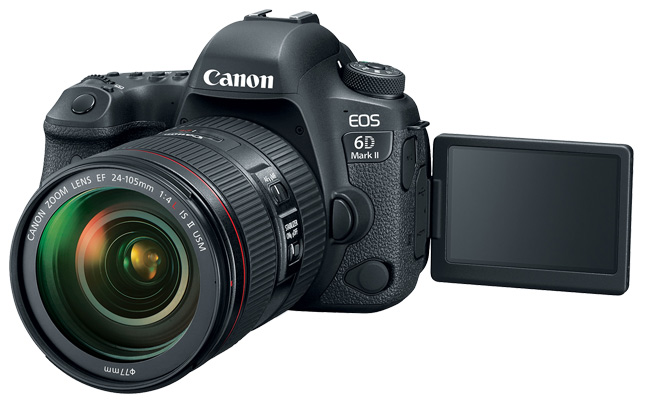
The camera sits between the better 1.6 crop cameras (such as the 80D) and the more expensive full-frame models (the 5D and 1DX series) in terms of price and specifications.
I'll start straight away with the reason this camera caught my attention: it is Canon's first full-frame DSLR with a tilting screen...
And that is extremely interesting to me, so it's time to put this new body through its paces.
So yes, I am biased, because I've been waiting for years for a full-frame camera with a tilting screen, and this year that need became even greater after buying the Laowa 15mm wide-angle macro lens.
I obviously prefer to use that wide-angle lens on a full-frame body, but I often use this lens from ground level for a bug's-eye perspective.
Of course, you can use an angle finder, but with a tilting screen you have an angle finder and live view in one, allowing you to zoom in very accurately (and therefore focus) on any part of the image. Ideal!
Background to the review
I currently use the Canon 70D (1.6 crop) for my macro work and the Canon 5D Mark II for landscapes and the Laowa wide-angle macro.
The 70D is my designated body for macro work because of its tilting screen. This prevents quite a few neck complaints and wet or dirty clothes when you want to work close to the ground.
I also shoot portraits with the 70D because of the 5D Mark II's slow AF. I now only really use the 5D Mark II when I want to make the most of my wider lenses: for landscapes with the 24-70 and the wide-angle macro.
If it performs well in the test, the Canon 6D Mark II would therefore be the ideal replacement for both bodies. Everything in one.
The following comparisons are less relevant to me
- A body such as the 5D Mark IV or 1DX Mark II is outside my budget, so I will not be able to make comparisons with these bodies. I consider well over 2,100 euros more than enough for a body that, however good it is, will always become outdated quickly because of the rapid developments in the camera world. In addition, these more expensive bodies do not have a tilting screen, and that is absolutely a relevant factor in my considerations.
- Comparison with other brands is also less relevant to me, given the set of lenses I already have.
- Video: in practice, I rarely or never film with my DSLR, so the absence of a 4K video mode is not a problem for me.
- Dynamic range: I usually expose to the right myself or work with HDR if necessary. Dynamic range (which the 6D Mark II seems to receive a lot of criticism for) is therefore not such an important aspect to me, although of course it is always nice to have plenty of dynamic range.
- I am afraid I cannot provide extensive charts from a lab situation. For an extensive comparison of the specifications, I would have a look at DP Review.
The main things I am focusing on in this review
- New features
- Autofocus
- Noise performance
For this review, I am therefore mainly comparing the 70D (1.6 crop) with the 6D Mark II (full-frame) to see whether this upgrade justifies the purchase price for me. It would be better to make this comparison with the 80D, but I simply do not have one in the cupboard.
I was mainly curious about the difference in noise performance, image quality and bokeh. Since I am not suddenly going to exchange my Sigma 150 macro for a 240mm macro lens (which does not even exist), I also found a comparison of the bokeh interesting when shooting from closer up with a full-frame camera or from further away with a crop camera.
Full-frame does produce more attractive blur, but longer focal lengths (and therefore crop as well) have more or less the same effect, so I was curious to see what the same lens would do from a different distance.
Background blur:


I tried to photograph the same composition and area with the same lens. The 6D Mark II seems just subtly softer in the blur (look especially at the faded flower head of the butterfly bush), but the difference is not that great, if you ask me.
If you switched from a 100mm macro lens used on a crop camera to a 150mm lens for your full-frame camera, you would see significant differences in the background. So when I think about my portraits, I regularly use the 24-70mm on my crop camera.
I would probably use the 70-200mm more often on full-frame, to work from a comfortable distance. You would certainly see a difference in the bokeh and background there.
Conclusion: the gain from full-frame in terms of blur will be small for my macro work, while the gain in my portrait work with a 70-200mm, where I will zoom in more, is a definite improvement.
The fact that the working distance for macro will be shorter with full-frame can be an advantage in tight corners, but a disadvantage when approaching insects.
Specifications
But there are more differences than just depth of field and working distance. Here are the interesting specifications for the bodies relevant to me:
| Specification | 70D | 6D Mark II |
|---|---|---|
| Launch price | € 1.099,- | € 2.129,- |
| Sensor | Digic 5+ | Digic 7 |
| Megapixels | 20.2 | 26.2 |
| WiFi | Yes | Yes |
| GPS | No | Yes |
| Tilting screen | Yes | Yes |
| Auto focus | Dual pixel CMOS AF | Dual pixel CMOS AF |
| Focus points | 19 focus points in a horizontal diamond pattern | 45 (fairly central) focus points |
| ISO range | 100 - 12,800 | 50 (L) - 102,400 (H2) |
| Burst mode | 6.7 fps | 6.2 fps |
The camera in your hands
The first thing you notice when holding the camera is that it is quite light for a full-frame body. At 765 grams, it is almost 100 grams lighter than my 5D.
I do not personally consider this a huge advantage, but I think many people will appreciate it. The camera also feels great in the hand and is well designed in my opinion.
Details that stood out to me included a dedicated AF-ON button (which does not work that way by default, you have to enable it in the menu). The zoom button is in a different place from what I am used to, and that shows you how using your camera wears in.
I keep pressing the wrong button on automatic pilot, so it will take some getting used to.
After browsing through the menu, you find some more interesting built-in features that are missing from the 70D. I found the option to take a series of photos with the timer interesting, as well as the option to select a first image in the camera for a double exposure.
They will not become my most-used functions, but if they are there, it is certainly nice to be able to use them.
Autofocus
You can read about the technology in a camera for as long as you like, but in the end it is at least as useful to put it through its paces in the field.
The first thing I noticed about the autofocus is that the focus points are all positioned fairly centrally.
All the focus points are cross-type, and 27 can focus down to f/8, so the autofocus sensitivity is good. But I also consider freedom in the composition very important, and being able to focus only fairly centrally is a drawback for me.
The 70D has a horizontal diamond pattern, with the outermost focus points spread out quite well. The 6D Mark II has considerably more focus points, but they are all grouped together in the centre.
With a relatively central composition, you can focus very finely and accurately, but for more unusual compositions you are forced to recompose if you want to use autofocus.
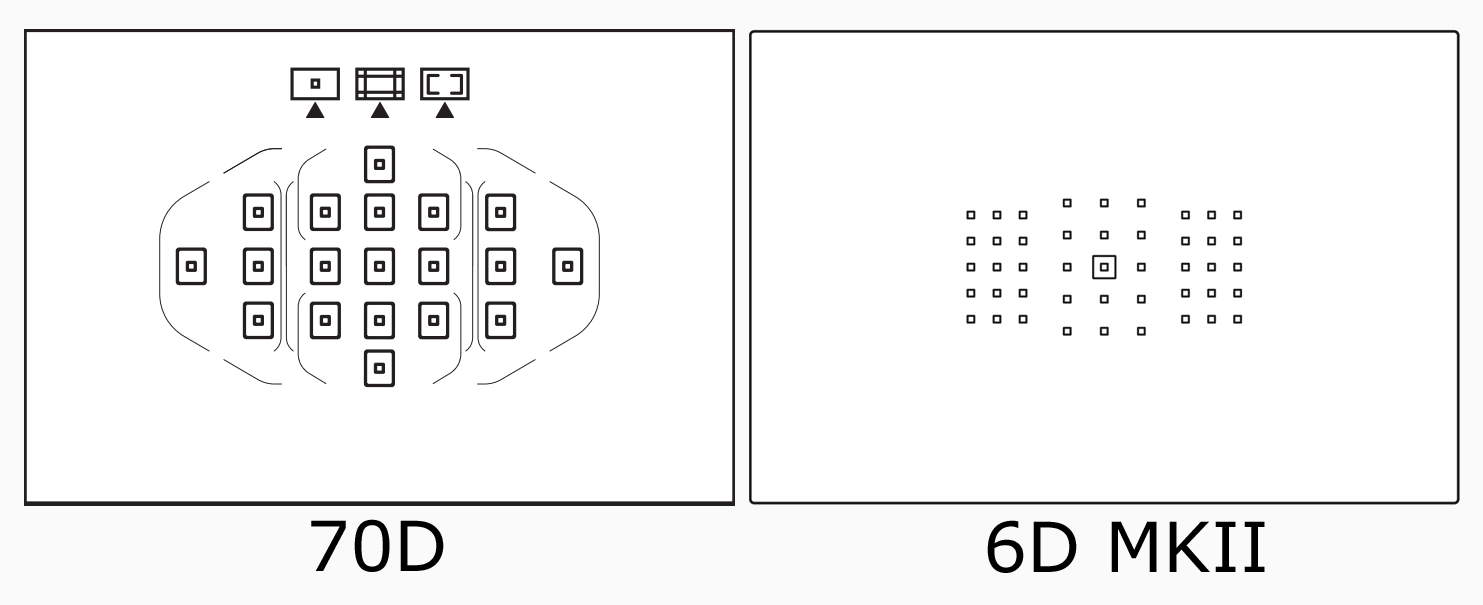
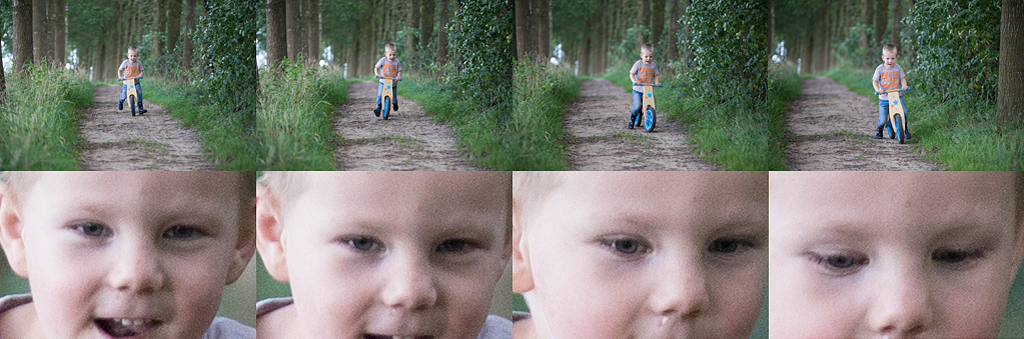
So the spread leaves something to be desired in my opinion, but I have no complaints about the rest. In AI Servo, after getting used to the camera, I was able to take a burst of 13 photos of my son on his balance bike.
He came racing towards me at, I guess, about 15 kilometres per hour, and I photographed him from fairly close up with a 70-200mm f/2.8. Every shot was more or less in focus. I certainly would not have tried that with my 5D Mark II, which would not even have managed to take photos in a similar situation.
ISO performance
One of the main reasons why I find a full-frame body interesting is, of course, the improved noise performance compared with a crop sensor.
I am quite critical when it comes to noise, so in practice I shoot at ISO 100 as much as possible. The presence of ISO 50 (L) is already a welcome addition to me, although it should not really be necessary.
I usually find the maximum ISO range uninteresting, because I give up somewhere halfway through the permitted ISO range because of the noise and poor image quality. If I want noise, I will use my phone.
The seemingly bizarre upper limit of 102,400 on the 6D Mark II will therefore not really be usable, but the noise performance is good enough that I could soon use an extra 2 to 3 stops in practice.
Noise performance will probably account for most of the improvement over my current camera.
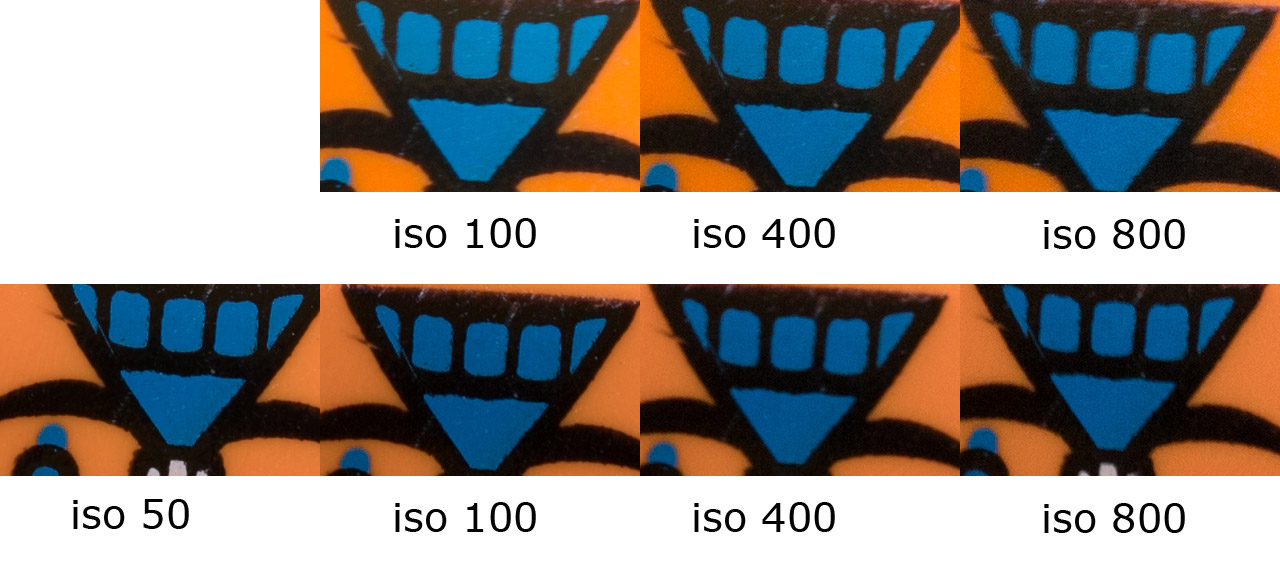
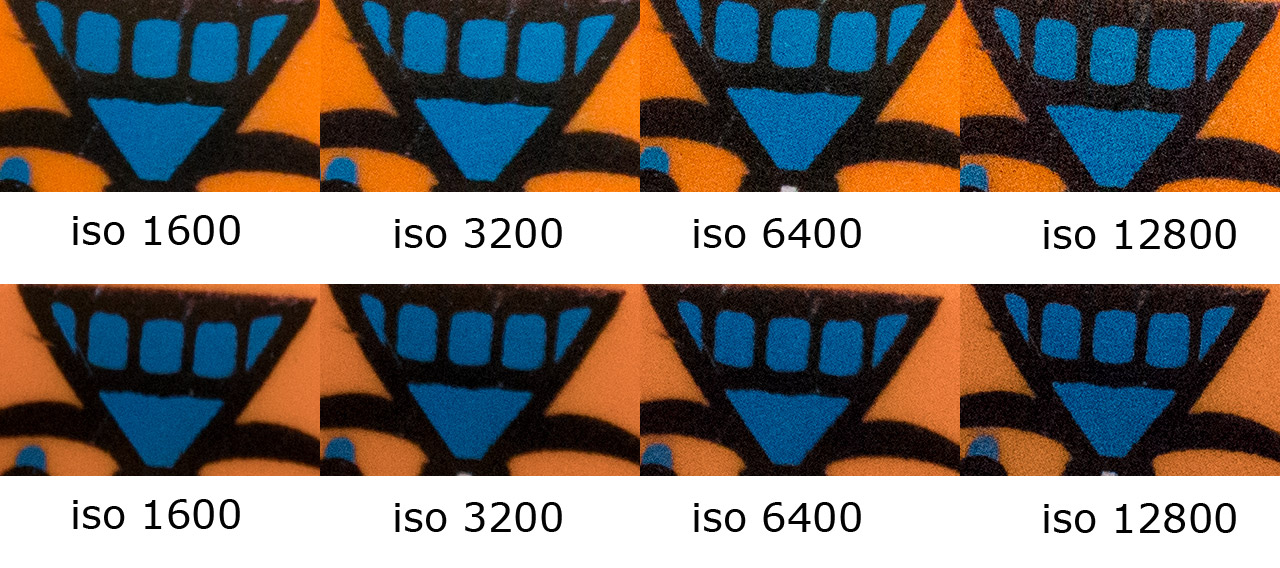
Up to ISO 800, the cameras seem fairly evenly matched, but at higher ISO values you can see that the 6D performs better in terms of noise, especially in the darker areas.
To make the comparison completely fair (the 6D Mark II produces 5 extra megapixels, so if you resize the results from both cameras to web size, you get proportionally finer and less visible noise), I reduced the ISO 6400 result to the same size and placed the results next to each other.
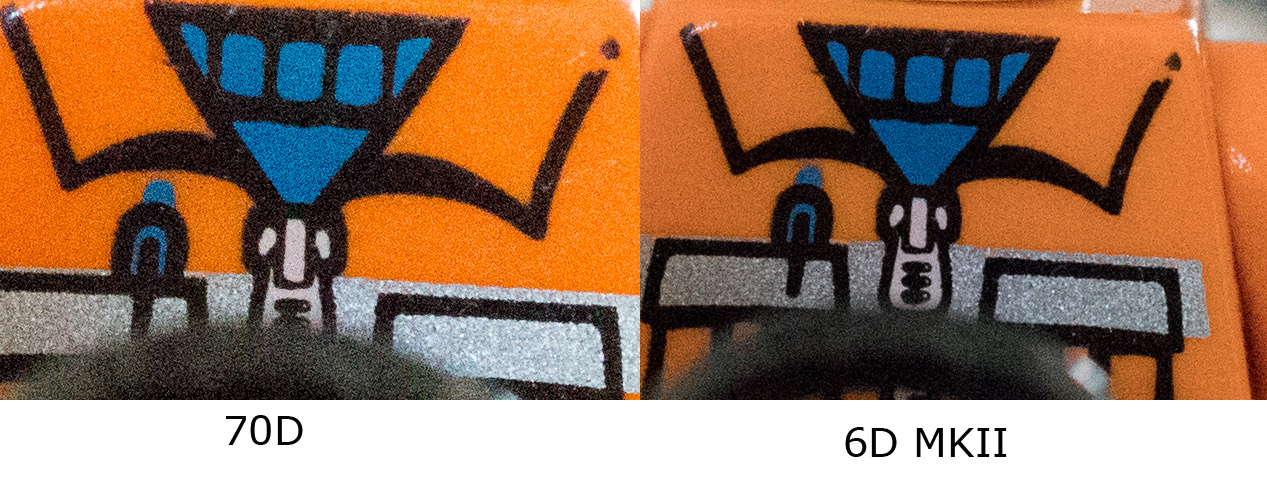
The darker areas are clearly more even on the 6D Mark II, and the contrasts between dark and light in the noise are considerably lower. Does the body completely blow me away with its noise performance?
Well, looking at the results, I think I would still very much like to stay below ISO 1600. There are clear differences, but I do not find them earth-shattering. In my opinion, it is still important to use higher ISOs as little as possible.
For macro work, where every detail is crucial, I will probably be happier with the option of ISO 50 than with the higher ISO settings. At ISO 50, the camera seems to produce images that are just a little fresher and brighter than at the higher ISOs.
Teething problems?
During my review, I did run into one thing that can hopefully be put down to teething problems. I often overexpose heavily when shooting, and I always use live view for macro photography.
So I find it very useful to get a feel for the exposure and the final result.
With my 70D, I am used to live view showing very accurately what the final result will look like. With 3 stops of overexposure in live view, however, I get large blown-out white areas, while the actual final result appeared almost a stop darker and therefore had no blown-out white.
Now I know that you should look at the histogram to check for blown highlights, but I do not only want to see whether something is blown out. I also want to get a feel for the effect of overexposure on the final result, because sometimes you simply want a lighter effect, such as beautiful pastel tones, and sometimes you do not.
So I hope they can bring these two closer together with a firmware update. Otherwise, I will have to take photos and check them afterwards more often instead of judging the result in live view mode.
Conclusion
Of course, everyone will have to decide whether and why this body is an interesting purchase for them. In my situation, I reach the following conclusion:
Pros
- All-round body: suitable for landscapes, portraits and macro work
- Good image quality and noise performance
- Flexibility thanks to the tilting screen
Cons
- Spread of the AF points
For me, the 6D Mark II is a very good all-round body. I do not feel that I am making huge gains in image quality and noise performance compared with the 70D, but the full-frame sensor is a big plus for my wide-angle lenses.
In fact, all the specifications are simply good, and the body is especially versatile. The combination of full-frame, a good autofocus system and, above all, the tilting screen is a pleasing one.
The bonus features that come with it, such as selecting a base image for multiple exposure and printing a set of photos after using the timer, are nice extras.
Whether this combination of factors outweighs the cost of the camera is something everyone will have to decide for themselves.
About the author
Johannes Klapwijk heeft zich al een jaren intensief toegelegd op natuurfotografie. In het voorjaar en de zomer ligt de nadruk op macrofotografie. Maar ook grotere onderwerpen binnen de natuurfotografie boeien: van vogels tot landschappen.
Johannes verzorgt ook workshops in natuurfotografie.
You might also like
-
 Review: Canon EOS R5
by Nando Harmsen
-
 Preview: Canon EOS 200D and EOS 6D Mark II
by Michelle Peeters
-
 Review of the fantastic Canon EOS R6 Mark II
by Nando Harmsen
-
 Canon EOS 200D and EOS 6D Mark II announced
by Michelle Peeters
-
 Review of the Canon EOS M50 mark II
by Nando Harmsen
-
 Review: Canon EOS R3
by Nando Harmsen
5 comments
-
 Wijns Patric wrote on Saturday 30 September 2017 at 16:33 | reply
Nice review. But I would rather see a comparison with the 6D. When I look at the review in Photoplus, a Canon magazine after all, I see the following compared to the 6D;
Translated from Dutch.
- RAW to noise ratio:
- The 6D performs better at low ISO than the 6D Mark II. This up to about ISO 600
- Dynamic Range:
- THE 6D performs better across the entire range
- AF Focus points:
- Impressive that there are 45, but they are placed too centrally
My conclusion:
- Canon has not listened enough to the 6D users.
I therefore wonder whether the 6D Mark II will be successful. I don't immediately see a pro buying a 6D Mark II as a backup. And will current 6D users consider it an update. I have my doubts as a 6D user. It's a shame that the 5D Mark IV costs so much or I would have already decided. -

 Johannes Klapwijk
wrote on Sunday 1 October 2017 at 09:29
| reply
I agree that a comparison with the 6D or the 5D MKIV would also be very interesting.
Translated from Dutch.
For me, the question was mainly how the upgrade from crop to full-frame would turn out. People who already have the 6D will have other questions. A comparison with the more expensive 5D MKIV would also be interesting, it all depends on budget, current situation and what kind of photography you practice.
Thanks for your addition, good info! -
 Donald Willemsen
wrote on Tuesday 3 October 2017 at 11:03
| reply
Phew, finally a review from someone who has no commercial interest in a camera brand. Magazines often have a commercial interest in a positive review, because that brings in advertising assignments, and therefore income. I do understand the logic of the magazines behind it, but whether the reviews are honest as a result, you can question. Okay, you can trust laboratory tests because they work with objective standards/equipment. The influence of a human tester can therefore be driven by a commercial interest. In the review above, that doesn't seem to be the case to me. The review is written from the photographer's perspective of how he wants to use the camera in practice and whether it meets his expectations in doing so. Therefore I can only say that I am happy with a review like the one above. Together with a laboratory test, this review gives an open view of the camera's performance.
Translated from Dutch. -
Johannes Klapwijk
wrote on Tuesday 3 October 2017 at 11:10
| reply
Thanks for your positive response Donald! Nice to hear that my approach is appreciated!
Translated from Dutch. -
 Tom Kok wrote on Tuesday 3 October 2017 at 17:29 | reply
Johannes Klapwijk, I've had the 6D2 for a few weeks and have come to the same conclusion regarding occasionally blown-out skies etc. especially when shooting against the light or something, as for noise, no problem at low ISO, visible at high ISO including some loss of detail! Big plus is the tilting screen and size/weight! I might have bought a 5D-4, but the fixed screen held me back..
Translated from Dutch.
Have your say
Please note: Articles older than a week can only be commented on by signed-in visitors.Would you still like to comment? sign in or create a free account.
Become a better photographer every week
A practical photography tip in your inbox every week.
38,764 photography enthusiasts already receive the tips! More about the weekly mail. Or keep up to date via  Facebook.

Elja Trum
Photofacts; everything to do with photography!
Would you like to take better photos and keep up with what is happening in photography? Photofacts publishes articles that teach you something about photography — from a product announcement to a practical shooting tip or a look at a website. Photofacts covers photography every day and is a hobby project of Elja Trum's that got out of hand. The articles are written by a team of volunteer authors. If you would enjoy writing one or more articles for Photofacts, do get in touch.More about PhotofactsPhotofacts is made possible in part by
