

Canon EOS 200D and EOS 6D Mark II announced
Thursday 29 June 2017, 10:50 by Michelle Peeters | 5,982 views | 11 commentsThis article was translated from Dutch with the help of AI. Read the original.
Canon announced two new Canon cameras this morning: the EOS 200D and the EOS 6D Mark II. The EOS 200D is an extremely light, compact DSLR. The Canon EOS 6D Mark II is the successor to the EOS 6D, with some very nice improvements and additions.
Canon EOS 200D
The EOS 200D is the world's lightest Canon DSLR. It is designed for enthusiastic smartphone photographers looking for their first DSLR camera. It is stylish, lightweight, very compact and offers a user-friendly upgrade.
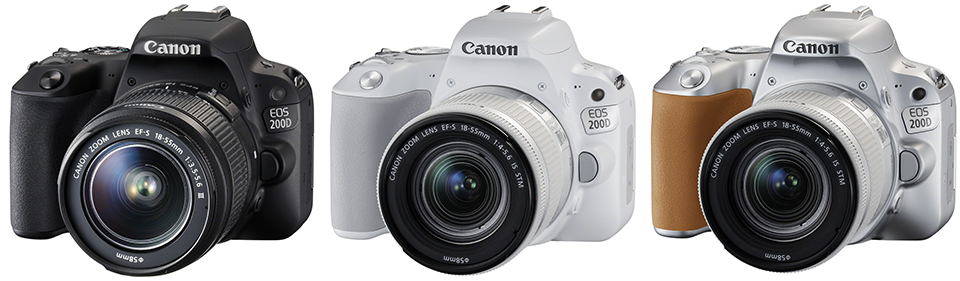
The camera has the same features as the Canon models in the highest camera segment, so it consistently produces very good image quality. It features Canon's renowned Dual Pixel CMOS Auto Focus system, allowing you to focus very quickly and accurately.
Canon EOS 200D specifications
- 24.2 megapixel APS-C CMOS sensor
- DIGIC 7 image processor
- Dual pixel CMOS autofocus
- 5 photos per second
- Sensitivity: 100-25600 ISO
- 3-inch TFT LCD screen
- Tilting touchscreen and a viewfinder
- 1080p full HD video at 24, 25 or 30 fps
- Intuitive interface and GUI
- Selfie mode
- Skin smoothing and background blur for Instagram
- Available in black, white and vintage look (silver and bronze)
- Weight: 453 grams
- Wi-Fi, NFC and Bluetooth
- Extra: Protecting Cloth PC-E1 (protective padded cloth)
Canon EOS 6D Mark II
As the successor to the Canon EOS 6D, the EOS 6D Mark II is a versatile full-frame DSLR camera for a wide range of applications, suitable for everything from travel to portrait photography. The EOS 6D Mark II was developed based on feedback from users.
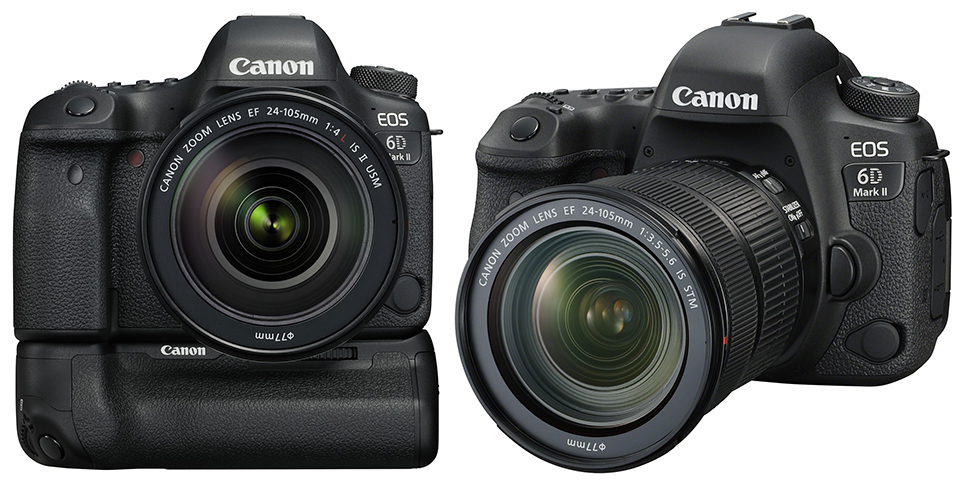
The new 26.2-megapixel CMOS sensor offers higher performance than its predecessor, as well as very good image quality. The greater dynamic range gives you more exposure freedom and more options when photographing in bright lighting conditions.
The 45-point AF system is adjustable and allows you to track the subject much more accurately. The DIGIC 7 image processor offers considerable processing power, while the speed of 6.5 frames per second opens up a range of new possibilities.
Canon EOS 6D Mark II specifications
- 26 megapixel full-frame sensor
- DIGIC 7 image processor
- 6.5 photos per second
- Dual pixel autofocus
- Sensitivity 40,000, expandable to 102,400 ISO
- 45-point autofocus
- 100% viewfinder coverage
- Rotating and tilting touchscreen
- 1080p full HD video, no 4K (but 4K time-lapse videos)
- Image stabilisation during video
- Weight: 765 grams
- GPS, Wi-Fi, Bluetooth
Price and availability
Both new cameras will be available in shops at the end of July. The EOS 200D will cost 609 euros 99, while the 6D Mark II costs 2,129 euros.
About the author
Michelle Peeters is fotografe en oprichter van DeuxBleus Fotografie. Michelle herkent het bijzondere in het gewone en het gewone in het bijzondere. Ze heeft zich nooit willen specialiseren en is daardoor van alle markten thuis.
You might also like
-
 Preview: Canon EOS 200D and EOS 6D Mark II
by Michelle Peeters
-
 Canon 6D Mark II on its way
by Elja Trum
-
 Canon introduces the EOS R8 Mark II
by Nando Harmsen
-
 Review of the fantastic Canon EOS R6 Mark II
by Nando Harmsen
-
 Sony A9 Mark II announced
by Aäron Nasarany
-
 Review: Canon EOS 6D Mark II
by Johannes Klapwijk
11 comments
-

 patrick180 wrote on Thursday 29 June 2017 at 11:09
| reply
Nice camera, the new 6D. It's just a real shame that the price has gone up quite a bit compared to its little brother.
Translated from Dutch.
the 6D was an entry-level camera in the Full Frame area for the ordinary consumer but with this price one is unfortunately going a bit off the mark for the ordinary consumer.
But the Mark ii seems 100x improved to me in that respect. so then the price will probably be reasonable I think. -
 Paul Oosterlaak wrote on Thursday 29 June 2017 at 19:40
| reply
The price of the 6D was originally also something like €2100, so it hasn't gone up.
Translated from Dutch. -
 Lanny wrote on Monday 3 July 2017 at 22:24 | reply
I currently photograph with a Canon 70D. At the time, I decided against the 6D Full Frame, because it only has 1 cross-type AF point in the centre. With concert photography, so moving musicians and little light, a problem. Would like a Full Frame, so that I can turn up the ISO. I was hoping that the price of the Canon 5D III would drop in price to approx. E 2300 (preferably even lower). Unfortunately, that is still not the case. An alternative is then the Canon 6D mark II. I still have my doubts because of the negative criticism I read on the internet. (No 4K, centred cross-type AF points, etc and still a price of E2130 compared with its competitors.) The advantage, however, is its light weight and its tilting screen.
Translated from Dutch. -
 Michelle Peeters wrote on Tuesday 4 July 2017 at 10:55
| reply
@Lanny: I understood that the Canon EOS 6D Mark II does have Cross-type AF for all 45 focus points!
Translated from Dutch. -
 Jos wrote on Tuesday 4 July 2017 at 12:45 | reply
Lanny: what is actually the problem with 1 cross-type AF point in the middle? The sensitivity of this one point is enormous. Furthermore, the sensor of the 6D (1st version) is comparable to that of the 5D: very light-sensitive and you can work with high ISO.
Translated from Dutch.
Do you want to focus with multiple points, in other words let the camera determine the focus point? Then there is a good chance that the camera will choose the wrong point. I think 1 AF point is sufficient for the vast majority of situations. -
Michelle Peeters wrote on Tuesday 4 July 2017 at 14:33
| reply
The Canon EOS 6d Mark II has 45-point cross-type AF points: 45-point f/5.6 (cross-type AF), 27-point f/8 (9 cross-type), central point is f/2.8 and f/5.6 (dual cross-type)
Translated from Dutch. -
 Eduard wrote on Tuesday 4 July 2017 at 15:04 | reply
Indeed a nice camera, but I also find the price far too high.
Translated from Dutch. -
Paul Oosterlaak wrote on Tuesday 4 July 2017 at 19:10
| reply
@Jos: I've been working with a 5D2 for over 7.5 years now, so I know better than anyone how to work with focus/recompose. But I also work with other cameras from time to time (usually 5D3 and 5D4). For sports, 1 focus point is really too limited, since it's very difficult to track a fast-moving subject properly. Yes, you also get photos that turned out perfectly, but the keeper rate is very low. Besides, the central composition is also rather boring, and changing your framing afterwards every time by cropping isn't ideal either. It can all be done, been there, done that, but optimal is a whole different story.
Translated from Dutch.
Then portrait photography. Stationary subject, so focus/recompose is usable, but if, like me, you work with a shallow depth of field, the slightest movement by yourself or the model while you're recomposing is disastrous for sharpness. With the 5D3/5D4 I can nicely keep the eye/face (depending on the framing) at 1/3 (both horizontally and vertically), place a cross-type focus point exactly there and use AI Servo to track the focus and take my shots. The keeper rate is then much higher again. -
Lanny wrote on Tuesday 4 July 2017 at 22:48 | reply
@ Jos: I completely agree with Paul. I make a lot of use of the cros-type AF points outside the center (of my 70D). Eyes / facial expressions need to be sharp. Moreover, you want a beautiful composition with the instrument that is being played.
Translated from Dutch. -
 Marly wrote on Tuesday 25 July 2017 at 11:33
| reply
Hello Paul and Lanny,
Translated from Dutch.
I now also have a 70D and, just like Lanny, would like to switch to a FullFrame (preferably 5DIII). Only considering the costs, I wonder whether it would also be worth waiting until a good full-frame mirrorless camera comes onto the market? I was told (at cameraNU) that the mirror is no longer needed with current technology and that therefore DSLRs will eventually (within 4 years) disappear.
What do you think, will it really happen that fast? A mirrorless camera is much smaller and lighter than a full-frame DSLR.
I’m curious whether you have already considered this option?
Regards, Marly -
Paul Oosterlaak wrote on Wednesday 26 July 2017 at 00:18
| reply
Hi Marly,
Translated from Dutch.
DSLRs will continue to decline a bit more, although Canon still has one trick up its sleeve: putting an electronic viewfinder in a DSLR (so that you can switch between EVF and OVF).
A mirrorless camera really isn't that much lighter when you put equivalent lenses on it. Okay, there are exceptions, but just for fun, take a look at how much the Sony FE 24-70 f/2.8 and 70-200 f/2.8 weigh (and at their size). They aren't lighter or smaller than Canon's. The body can be somewhat smaller and lighter, but having a good grip is no unnecessary luxury. And what about all those extra batteries you have to take with you if you do a lot of photography. A DSLR battery easily lasts 3x as long as a mirrorless camera's.
I don't want to make this into an anti-mirrorless-camera story, because they do have their advantages, but also their disadvantages. And some advantages are very limited in practice.
If you want a good full-frame mirrorless camera now: what's wrong with the A7R2 for you? I can name things, but maybe you should first indicate what your requirements and wishes are and why you don't want to go for an A7R2 now.
Have your say
Please note: Articles older than a week can only be commented on by signed-in visitors.Would you still like to comment? sign in or create a free account.
Become a better photographer every week
A practical photography tip in your inbox every week.
38,764 photography enthusiasts already receive the tips! More about the weekly mail. Or keep up to date via  Facebook.

Elja Trum
Photofacts; everything to do with photography!
Would you like to take better photos and keep up with what is happening in photography? Photofacts publishes articles that teach you something about photography — from a product announcement to a practical shooting tip or a look at a website. Photofacts covers photography every day and is a hobby project of Elja Trum's that got out of hand. The articles are written by a team of volunteer authors. If you would enjoy writing one or more articles for Photofacts, do get in touch.More about PhotofactsPhotofacts is made possible in part by
