

Sports photography and the Canon 100-400mm f/4.5-5.6 II in practice
Friday 27 January 2017, 23:23 by Huub Keulers | 14,630 views | 25 commentsThis article was translated from Dutch with the help of AI. Read the original.
Let me start with the most important thing: I have not regretted this fairly expensive purchase for a single moment, at around 2,000 euros. But, as with many things in life, quality comes at a price.
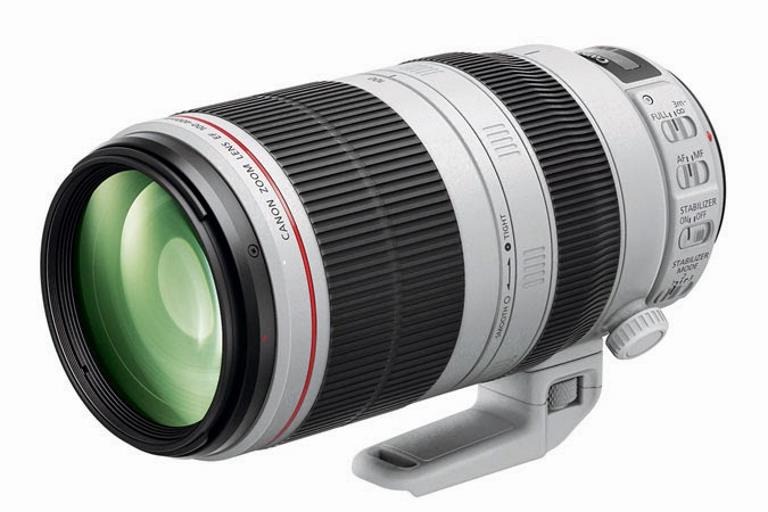
This article is not a full review, by the way, but an account of how I experienced this lens in practice. To make things a little more interesting, I have included various photos taken with this Canon 100-400mm lens during the Asics Dutch Athletics Championships in Amsterdam and the Dutch Athletics Championships for teams in Sittard.
For me, these sporting events are ideal opportunities to test equipment as well as network and socialise with fellow photographers, athletes, organisers and enthusiasts.
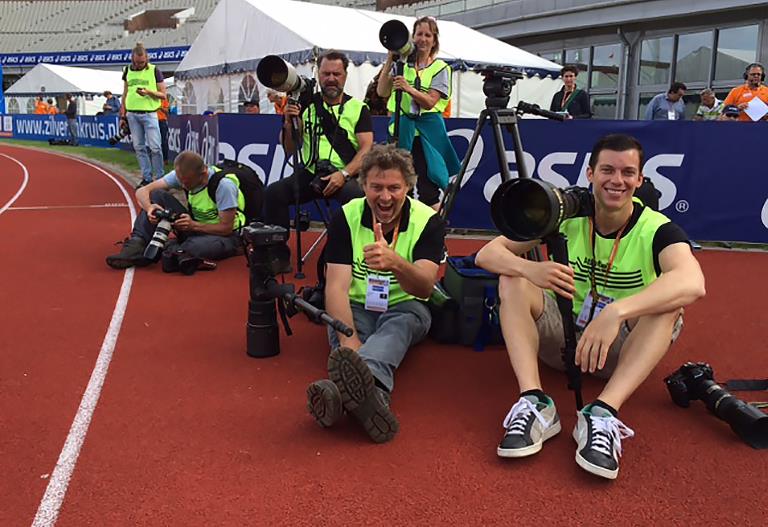
A few years ago, I became 'addicted' to sports photography, and athletics in particular. I am fairly sporty myself, but I have never practised athletics. I was more of a football type.
Why athletics in particular? Mainly for three reasons. It is a very accessible sport. In other words, you can easily photograph athletes from close by. The atmosphere between athletes and supporters is unique, in the sense that most athletes are happy for each other's successes and I have never encountered an athletics hooligan.
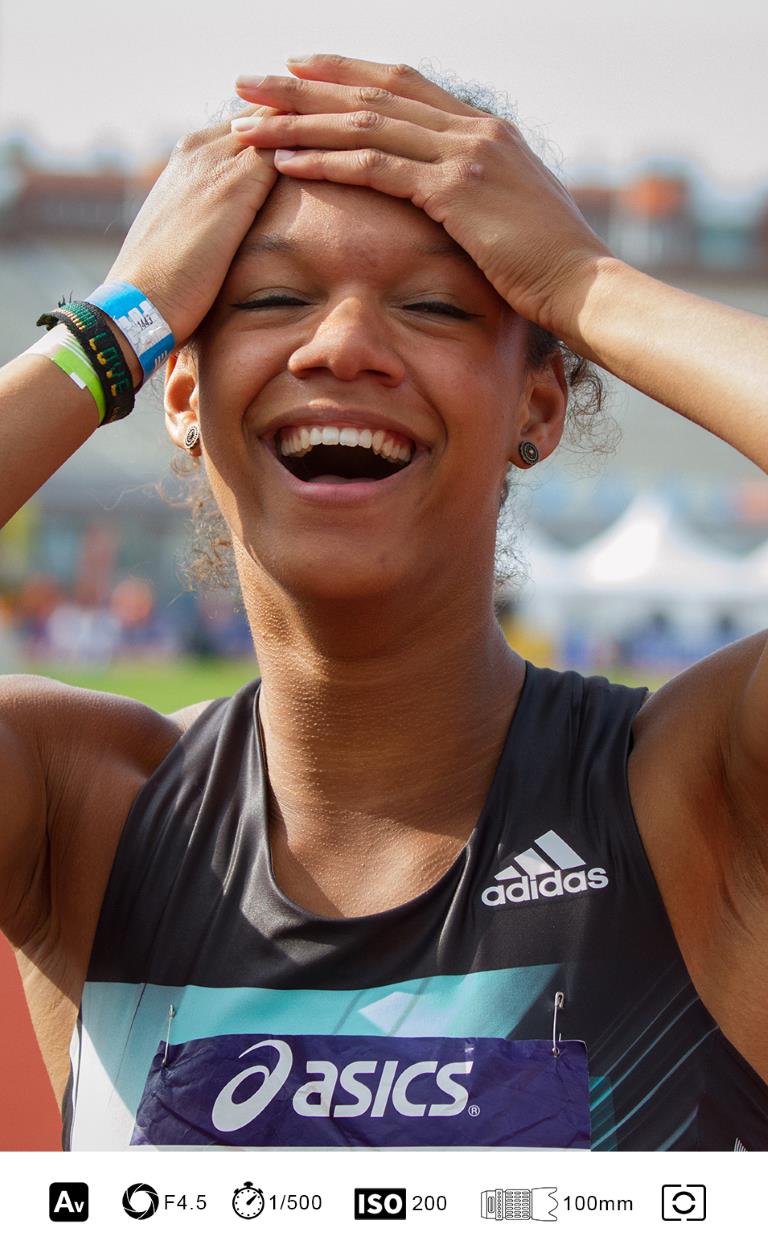
There is also always something happening that you can turn into a great photo story. Think of an athlete's emotional release after a great performance, or the disappointment after a failed race or attempt. With the Canon 100-400mm, you have a lens that can handle almost any situation.
Tip: Send an email to the organisers of a sporting event and explain honestly that you enjoy photographing sport but do not do it professionally.
Saturdays and Sundays are usually the busiest days during events, but if athletes are also competing on Thursdays and Fridays, for example during qualifying rounds, you have a better chance of getting permission, even if you do not have a press card.
Especially if you meet the organisers halfway by making some of your photos available. I started that way too, and over time became a member of the Dutch Association of Journalists, which makes obtaining press accreditation much easier.
Long reach
The main reason for buying the 100-400mm was that I regularly found I did not have enough telephoto reach, especially when photographing athletics. Since a fast 300 or 400mm prime lens was not financially an option for me, I ended up with the new version of the Canon 100-400mm.
I had already read several good reviews of it, so I got this lens about a year ago.
Compared with Canon's 70-200mm f/2.8, the Canon 100-400mm is slightly larger in diameter but, surprisingly, a little shorter. However, with the large lens hood attached, it is ultimately much more imposing than the 70-200mm.
In terms of weight, both lenses feel equally heavy, but technically the 100-400mm is slightly heavier. For photographers used to the 70-200mm, this new 100-400mm will therefore present no problems in terms of handling. This lens feels very comfortable in your hands.
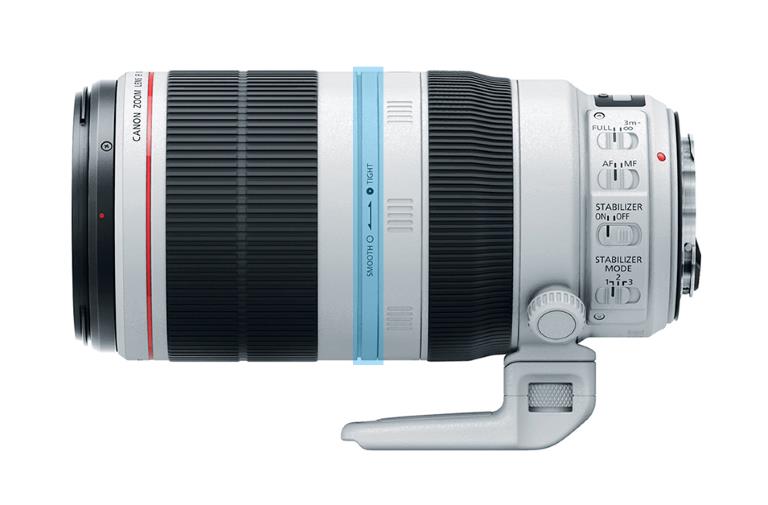
One of the things I also appreciate about this lens is that you can adjust the 'resistance' of the zoom ring. One photographer may prefer to zoom smoothly, while another may prefer a little more resistance when zooming. You can adjust this quite easily with a ring marked 'smooth' and 'tight'.
Normally, lenses and cameras have more trouble focusing automatically on subjects moving quickly towards you than on subjects moving across or diagonally towards your lens. The Canon 100-400mm, however, has absolutely no difficulty with this.
This was particularly noticeable when photographing the 100 and 200-metre sprints during the Dutch Athletics Championships in Amsterdam and the Dutch Athletics Championships for teams in Sittard. Even when refocusing on athletes at full sprint, this lens locks onto the athlete very well, meaning you get almost no blurry, out-of-focus photos.
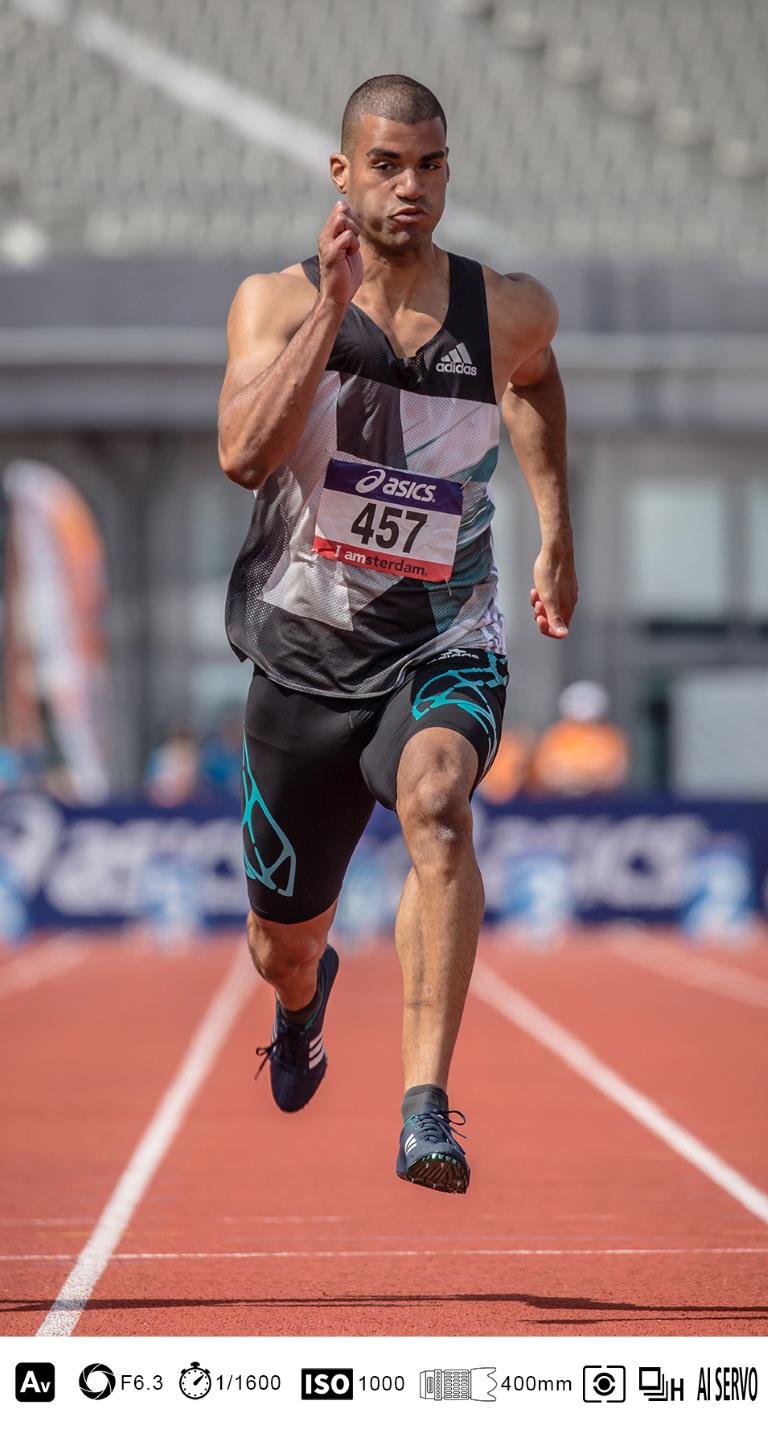
Tip: Before photographing at a sporting event, look for inspiration and consider what kind of photos you would like to take. There are plenty of examples online, such as on Flickr, 500px and Zoom.nl. Inspirational photos that serve as examples do not have to become copies, but they will encourage you to take better photos and give you ideas.
You can lock the zoom at any focal length using the lock function, which I personally find very useful. This lens also has nine rounded aperture blades, which produce attractive bokeh.
This lens has very effective image stabilisation, rated at 4 stops. However, you do not need this feature, although unfortunately you do pay for it. With fast sports, your shutter speeds are normally between 1/500 and 1/2000 of a second, so there is little chance of blurry photos caused by your own movement.
At shutter speeds slower than 1/500 sec, this option is very desirable, for example when taking a portrait of an athlete before or after their action.
It is a lovely feeling to sometimes have only two lenses with you during my sports shoots: this 100-400mm and the 24-70mm. I mainly use the latter for close-ups when athletes have crossed the finish line, or to photograph the high jump from close by.
Keep an eye on the action
One of the things I have taught myself over time is not to look at every photo on the camera display.
Why is that? It means you do not pay attention to the action happening around you. At the beginning, I missed quite a few great and interesting photos this way. You are also less likely to get injured, as athletes and sports equipment can come towards you very quickly without you noticing.
I have already seen several photographers get injured, or almost injured, in this way. For example, they were standing at the finish of a running race and noticed the approaching athlete too late. Or a broken pole was catapulted in their direction.
Tip: Only look at the photos you have taken on your camera when it suits you and it is safe to do so.
Various disciplines, such as high jump, pole vault, hurdles, discus and shot put, are quite easy to photograph. These are so-called zone sports.
You can use the so-called pre-focus method for these. This means focusing in advance on roughly the point where the action is at its best, or where the athlete reaches their highest point.
For hurdles, for example, this is the place where the athlete jumps over a hurdle you have chosen in advance. For the high jump, it is the middle of the bar. Press the shutter when the athlete's face is above the hurdle or bar.
This is a matter of practice and timing, but it is a proven and successful method, especially in combination with an aperture of, for example, f/5.6, which gives you a reasonable depth of field. If you also photograph several frames per second, you will have the greatest chance of capturing the ultimate moment.
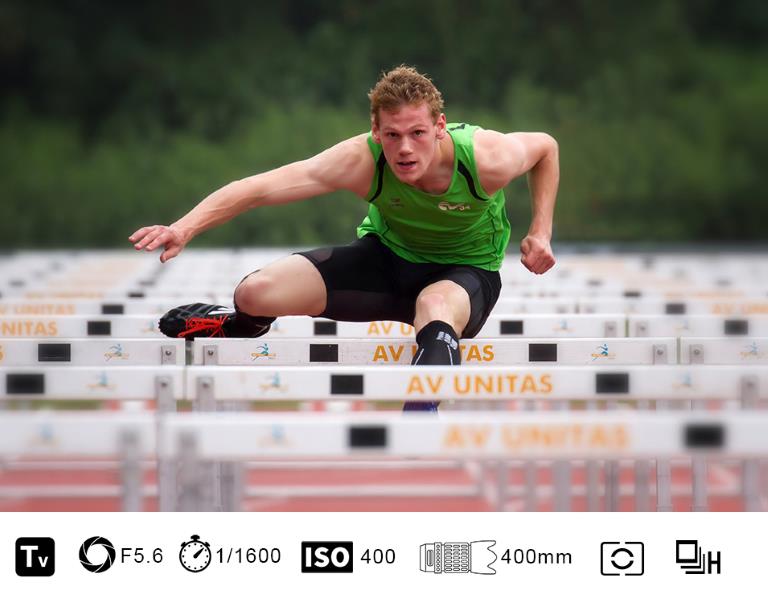
Tip: First observe a few athletes for a while as they perform their discipline. Only then start photographing. Every athlete will have their peak moment at a different time and in a different place. This helps you prepare, because just like an athlete, a photographer also needs to warm up first.
With other disciplines, such as the 100 or 200-metre sprint, you will have to rely on the autofocus speed of your camera and lens combination. Equipment quality is particularly important with athletes running straight towards you.
If you also use the Back Button Focus technique in combination with several frames per second, the chance of missing shots is small. It is no coincidence that professional sports photographers have cameras with a reliable and efficient autofocus system.
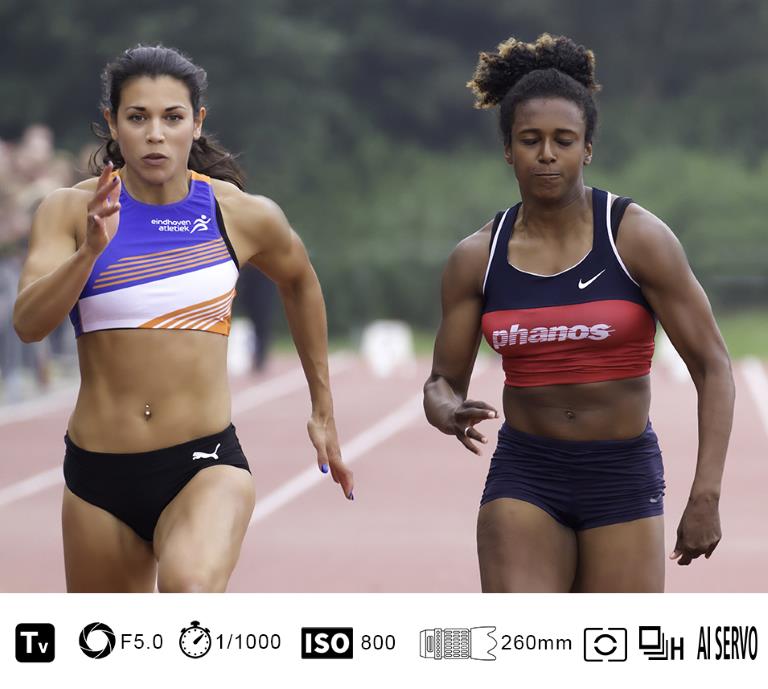
Tip: Activate the autofocus mode on your camera that follows the athlete's movement. This is also called Autofocus Tracking. Canon calls it AI-Servo and Nikon calls it AF-C.
Besides action photos, it is also fun to spend some time concentrating on details and supporters. This way, you create a good and complete story of a day photographing sport. It also helps you practise looking for and seeing the fun moments that make a photo interesting and exciting.
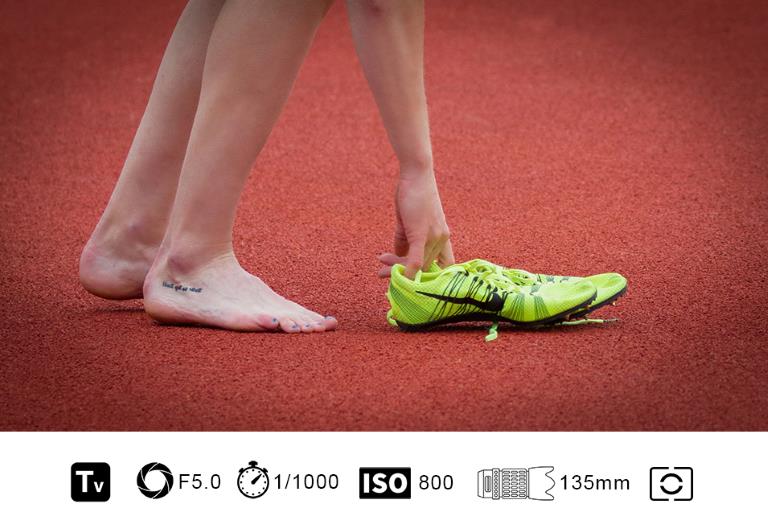
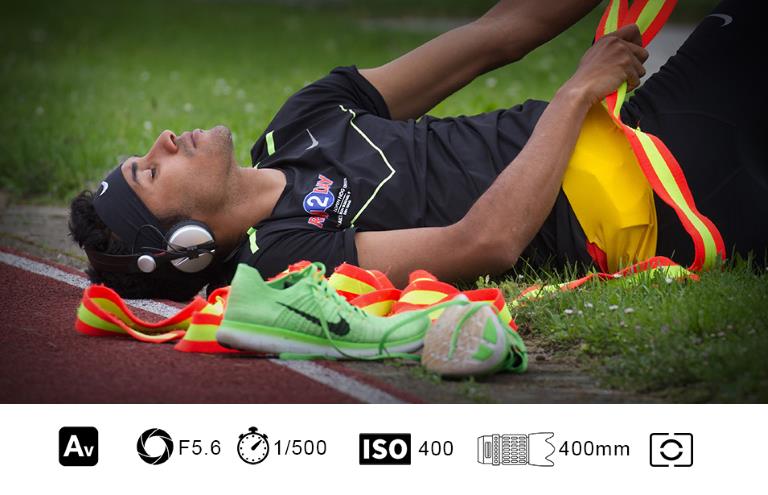
Tip: Photograph sports action for part of the day, and details and what happens around the event for another part. This gives you a break while still allowing you to come home with a variety of photos.
Indoor sports photography?
Is this lens also suitable for indoor sports photography? The answer depends on which camera you use and how much light there is in the sports hall.
In combination with the Canon 1Dx camera used here, it certainly is. Why? With this lens and an aperture set to, for example, f/4.5, you often need an ISO value above 4000 for indoor sports to achieve short shutter speeds of around 1/100 of a second.
With a full-frame sensor camera, this is no problem in terms of noise. With a camera with a crop sensor, such as the Canon 7D, you will quickly start to see colour noise.
Tip: For 34 euros per year, you can become an individual member of the Dutch Amateur Photographers Association. As a member, you receive a pass that gives you slightly easier access to events. This is not a guarantee of accreditation, as you always depend on whether the organisers grant it to you.
The only slight downside of this lens, as far as I am concerned, is that the tripod collar can become loose fairly quickly. Unfortunately, this was the case with my version.
Remedy: Tighten the four small screws on the underside of the collar again. Unfortunately, these screws are not very easy to reach.
Conclusion
To sum up, my conclusion about this lens:
• Flexible thanks to its wide zoom range
• Beautiful sharpness and detail from 100 to 400mm
• Reliable and fast autofocus
• Holds the focus point well while zooming in and out
• Very effective image stabilisation system
• Lens hood with a handy opening for attaching and removing a filter
• Not too heavy and not too large, so easy and comfortable to use
• Much more affordable than a 300 or 400mm f/2.8
Finally, I would like to wish everyone lots of inspiration and success, but above all plenty of enjoyment when taking sports photos, whether it is your son playing football, your daughter doing athletics or your grandchild racing.
About the author
Huub Keulers is een enthousiasmerende veelzijdige freelance fotograaf woonachtig in Elsloo (Li). Hij is gespecialiseerd in sport-, bedrijfs-, straat-, honden en portretfotografie. Daarnaast is Huub auteur van diverse educatieve fotografieboeken en verzorgt hij allerlei fotoworkshops, masterclasses en lezingen.
You might also like
-
 Sports photography tip: Think like an athlete
by Nico Delmeire
-
 Review: Book Sport Photography
by Michelle Peeters
-
 Review: Canon RF100-400mm f/5.6-8 IS USM
by Nando Harmsen
-
 Sports photography tip: Creating an abstract sports photo
by Nico Delmeire
-
 3 Tips for Successful Sports Photography (and get my book free)
by Nico Delmeire
25 comments
-
 Koen Smeets wrote on Sunday 29 January 2017 at 10:28 | reply
Huub, great article. Well done. Lots of useful tips, I also continue to find sports very interesting and enjoy doing it myself. Although unfortunately I may not yet have the suitable equipment for it myself. In any case, I can move forward with all the information in this article, and for the future I know what a worthwhile purchase would be for this branch of sport. Hope there will be many more articles from you and that you will certainly also get some more responses. Indeed, it surprises me that an article like this hasn't received anything yet. Who knows what is still to come. Keep it up Huub. I and many others will certainly continue to follow you, I think.
Translated from Dutch. -
 Huub Keulers wrote on Sunday 29 January 2017 at 10:53 | reply
Thank you Koen. That's nice to read and a great encouragement. I really appreciate it.
Translated from Dutch. -
 Cor van Dorst wrote on Sunday 29 January 2017 at 11:17 | reply
Huub, great article supplemented with the necessary useful tips.
Translated from Dutch.
you write honestly and from your own experience, that is also what people want to read. I would say keep it up and more and more people will read your articles. -
 Loe Bergers wrote on Sunday 29 January 2017 at 13:18 | reply
A great article Huub, although the review of the lens is somewhat less interesting to me as a Nikon photographer. On the other hand, your tips for sports photography are very valuable. Especially the tip not to immediately look at the photo you took on the display is a good one. I used to make this mistake too, with the result that I missed situations that were much more interesting. The article reads pleasantly and I hope there will be more to come.
Translated from Dutch. -
 Francis van der Burgt wrote on Sunday 29 January 2017 at 15:50 | reply
Is it a review of a lens? Or a review of the lens in combination with sports photography?
Translated from Dutch.
You immediately start with the conclusion that it is an expensive lens, but that for you it is worth every penny.
That is an immediate show-stopper for me because I don't have that kind of money to spare for a lens right now.....
But why do I keep reading anyway?
Because (in your well-known way) you get the reader enthusiastic about this branch of photography. In an enthusiastic way, you give a whole lot of tips&tricks that are also perfectly useful without this lens.
And the result will quite often be that people get inspired by your story and get to work. I can say from my own experience that I then quickly discover that it might actually be better to set those euros aside for that lens that can deliver just that "little" bit extra... -
Huub Keulers wrote on Sunday 29 January 2017 at 16:14 | reply
Nice to see that people read the article to the end despite my conclusion at the beginning about the lens, but also because athletics photography in particular is being 'embraced' in this way. Absolutely true that this lens is still quite expensive but certainly worth setting money aside for a possible purchase. Thank you!
Translated from Dutch. -
 Peter Lefèvre wrote on Sunday 29 January 2017 at 16:19 | reply
Another interesting article with good explanations. Explained just as well as in the "Sports Photography Handbook". Highly recommended for the aspiring sports photographer.
Translated from Dutch.
I myself only photograph running events in terms of sports, without Canon equipment.(Nikon or Fuji). I will take the tips along in the camera bag. -
 Ruud Keijmis wrote on Sunday 29 January 2017 at 18:52 | reply
Hi Huub, an interesting and pleasant-to-read article. Especially the indoor part is recognisable to me : as you know I take photos at six-day cycling races : the moving subjects and changing lighting conditions require a creative photographer and the right equipment. Using flash is not always an option or sometimes simply doesn't look good. The 100-400mm of course has a great range, the widest aperture is 4.5?
Translated from Dutch.
With this I would like to photograph a six-day race sometime.
With pre-focusing you indeed get a more dynamic photo, which therefore contains movement The back button focus I actually only knew by name, I have now practised with it a bit, and especially for sports this seems very useful. -
Huub Keulers wrote on Sunday 29 January 2017 at 19:40 | reply
Largest aperture opening is indeed 4.5 at 100mm on a full-frame, Ruud. You can certainly borrow my lens during the six-day event.
Translated from Dutch. -
 Roy Coumans wrote on Sunday 29 January 2017 at 21:04 | reply
Huub, a great article packed with tips. Supplemented with powerful photos. Tip: besides Autofocus Tracking, you could also mention 3D Focus Tracking and when it would be best to use it. It can offer a solution in some situations, but in other cases you might advise against it completely.
Translated from Dutch. -
 Gerrrit Dam wrote on Sunday 29 January 2017 at 22:14 | reply
What can you expect with such a title above an article. Often the title doesn't cover the content. Here the content even goes further than what the title promises. In short, my compliments Huub! Your casual and personal writing style is a breath of fresh air and makes the whole story very pleasant to read ... right to the end. Purchasing such a lens will still have to wait for a while, but even without an "L" the tips will certainly come in handy at some point. I found it very pleasant to see the settings below each photo. Enlightening!
Translated from Dutch. -
Huub Keulers wrote on Sunday 29 January 2017 at 22:23 | reply
Nice to read, Gerrit and Roy. Nice addition from you, Roy, regarding the 3D Focus Tracking. Thanks everyone for the responses so far.
Translated from Dutch. -
 Bob Richelle wrote on Tuesday 31 January 2017 at 14:30 | reply
Nice reviews, but can I also compare the results with the EF 70-200 with 2x Extender? The fact that this combination is quite a bit longer than the EF100-400 is a disadvantage, but the advantage of this is that I already own it.
Translated from Dutch. -
 Laurus wrote on Tuesday 31 January 2017 at 14:35 | reply
I miss the information about the camera body that was used. Not entirely unimportant for the quality of the photo!
Translated from Dutch. -
Huub Keulers wrote on Tuesday 31 January 2017 at 15:43 | reply
Dear Laurus, the camera body is indeed important, especially in sports photography, you have a point there. The reason I didn't mention it, however, is that otherwise the focus might shift more towards the camera instead of the lens or the subject itself, namely sports photography. The camera body used for this article was the Canon 7D, I now use the Canon 1Dx and my wife now has the 7D
Translated from Dutch.
Thank you for your additional question. -
Huub Keulers wrote on Tuesday 31 January 2017 at 15:49 | reply
Dear Bob, first of all thanks for your response. You can reasonably compare these results with a 70-200mm F2.8 lens, also regarding the settings shown with the photos. The other aspect I had in mind in this article is namely separate from the equipment used and has more to do with sports photography in general, hence the tips included. With this article I also want to motivate and inspire people
Translated from Dutch.
-

-
 Bram Veldhoen wrote on Tuesday 31 January 2017 at 22:52 | reply
I had just decided to buy the Sigma 150-600 Contemporary for my 6D... now you're making me doubt it again! Do you have any experience with this?
Translated from Dutch. -
 Roland v d bossche wrote on Wednesday 1 February 2017 at 10:17 | reply
Cool to read. but an expensive lens for enthusiasts .This lens will also prove itself in nature photography.
Translated from Dutch. -
Huub Keulers wrote on Wednesday 1 February 2017 at 13:26 | reply
Dear Evert, thank you for your response. Evert, do you mean the Canon 28-300mm lens? You can also take good sports photos outdoors with a less light-sensitive lens, as long as you make use of your camera's capabilities and the available focus methods. Have fun with the best hobby there is
Translated from Dutch. -
Huub Keulers wrote on Wednesday 1 February 2017 at 13:33 | reply
Dear Bram, unfortunately I have no experience with the Tamron 150-600mm contemporary, so comparing them is difficult for me. When I look at the reviews of this lens, you won't make a wrong choice with it. I know that you certainly won't regret getting the Canon 100-400mm. The question, however, is whether the 1,000 euro price difference is worth it to you. For that, though, you do get a faster lens with very good image quality and autofocus. In this case, I would let your budget be the deciding factor.
Translated from Dutch. -
Huub Keulers wrote on Wednesday 1 February 2017 at 13:34 | reply
Bram I of course mean the Sigma 150-600mm, typo. Apologies.
Translated from Dutch. -
Bram Veldhoen wrote on Wednesday 1 February 2017 at 19:26 | reply
Thank you Huub. If budget were no problem, the choice wouldn't be so difficult :-p ...
Translated from Dutch. -
 Monique Otjes wrote on Wednesday 1 February 2017 at 21:26 | reply
Huub, what a great article. I regularly photograph athletics competitions at our local athletics club as a hobby and will definitely try out your tips.
Translated from Dutch. -
Huub Keulers wrote on Thursday 2 February 2017 at 12:18 | reply
Nice to read your positive response, Monique. Have fun with your athletics photography.
Translated from Dutch.
Kind regards, Huub
Have your say
Please note: Articles older than a week can only be commented on by signed-in visitors.Would you still like to comment? sign in or create a free account.
Become a better photographer every week
A practical photography tip in your inbox every week.
38,764 photography enthusiasts already receive the tips! More about the weekly mail. Or keep up to date via  Facebook.

Elja Trum
Photofacts; everything to do with photography!
Would you like to take better photos and keep up with what is happening in photography? Photofacts publishes articles that teach you something about photography — from a product announcement to a practical shooting tip or a look at a website. Photofacts covers photography every day and is a hobby project of Elja Trum's that got out of hand. The articles are written by a team of volunteer authors. If you would enjoy writing one or more articles for Photofacts, do get in touch.More about PhotofactsPhotofacts is made possible in part by
