

Review: Tamron 28-75mm f/2.8 Di III RXD for Sony
Friday 27 July 2018, 14:41 by Casper de Graaf | 7,252 views | 2 commentsThis article was translated from Dutch with the help of AI. Read the original.
Tamron recently launched the 28-75mm f/2.8 Di III RXD especially for the Sony E-mount range. A fast standard zoom that sits between the cheaper kit lens and Sony's much more expensive 24-70 G-Master. How does this lens perform?
Sony has been making progress for some time now with its powerful mirrorless cameras. Previously, the range of lenses for these full-frame cameras was somewhat limited. There was no huge selection and what was available cost quite a lot of money. There was also an imbalance in favour of primes.
The G-Master range changed that, with the Sony FE 24-70mm GM among others. A superb lens. Large, solid and strong, with excellent optical qualities. The price reflected that, at 2,249 euros.
For those who could not or did not want to spend that much, there was not much choice beyond the somewhat underwhelming Sony FE 28-70mm f/3.5-5.6 kit lens and the Sony FE Vario-Tessar 24-70 f/4.0.
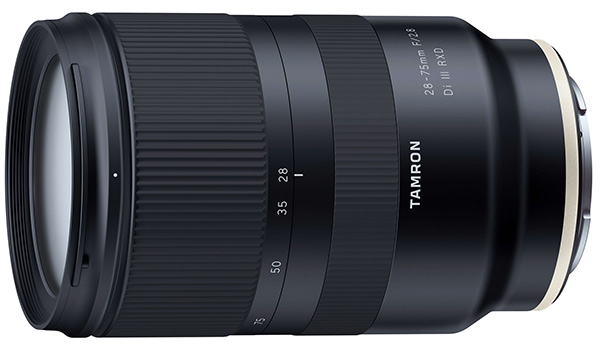
Tamron has been actively working on the Sony E-mount range for some time, and recently Tamron also joined in, starting with the 28-75mm f/2.8 Di III RXD. A standard zoom with a large fixed aperture. We like to see that.
The lens is so popular that shortages are already increasing. I recently received my copy.
For the tech-minded, DI in the lens designation stands for Digitally Integrated Design. This means that ghosting, flare and chromatic aberration are reduced.
RXD stands for Rapid eXtra-silent stepping Drive autofocus. And III indicates the version, because earlier versions of this lens have appeared for mounts other than the Sony E-mount.
Build and quality
The lens is a compact and lightweight zoom, especially compared with the 24-70mm G-Master. It is somewhat larger and heavier than the standard kit lens, while the build is not necessarily better. There is a lot of plastic, without the lens feeling cheap.
It is not particularly weather-resistant, but it is dust- and splash-proof. That is also a plus point.
The reversed zoom and focus rings are a disadvantage. The zoom ring is at the front, by the lens hood, and the focus ring is at the back. Normally this is the other way around, which takes some getting used to if you change lenses a lot. In practice, however, it has caused me few problems.
The lens is otherwise fairly basic, without a manual AF/MF switch. It comes with a lens hood and lens cap. The lens is 118mm long and weighs approximately 550 grams, a lot lighter than Sony's heavy 24-70mm G-Master.


Zoom range and bokeh
What immediately stands out is the start of the range, 28mm. Tamron has taken 4mm away from the wide angle and 'added' 5mm to the telephoto end. It makes no difference to me. In practice, I have rarely found this a problem. If possible, you can simply take a few steps backwards.
This standard zoom is ideal for many occasions. At 75mm, you still have an interesting range for portraits, while the 28mm wide angle is useful for landscapes or astrophotography.
You can easily take it on holiday, partly because of its limited size and weight, but also because of its ideal range. Tamron has also given the lens a minimum focusing distance of 19 centimetres at the 28mm wide angle and 39 centimetres at the 75mm end.
This allows you to take nice close-ups that verge on macro. Especially when you play around with interesting crops afterwards, this can produce some fun images.
The bokeh is somewhat untidy without becoming too busy. Soft enough for me, although there are better options on the market. But all in all, it is good and much better than the kit lens. It comes close to the manual Minolta MD 50mm f/1.4 that I still use regularly.
Sharpness
The sharpness of this lens is excellent. Even wide open at f/2.8, the lens is sharp, right up to an aperture of f/14. And this throughout the entire zoom range. If you stop down further, sharpness decreases, but that is not surprising.
The examples with 100% crops also show this, with sharpness reaching right into the corners. An exceptional performance.

Focusing
The autofocus works well and quickly, without hunting or making much noise. The RXD motor makes the autofocus quiet. This is also useful for video, although I did not test this lens for that.
Distortion and vignetting
There are also some disadvantages alongside the plus points. The lens suffers from distortion at 28mm and 75mm. This can be straightened using lens profiles in Lightroom, which solves the problem. It is clearly visible that some bulging occurs, along with vignetting.
Whether you find this distracting is a personal matter. I do not mind a vignette myself, it adds another dimension. Although I would rather add it in software than have to remove it in software. But as far as I am concerned, it is certainly not a disaster.
Conclusion
An excellent and very sharp lens with very few disadvantages, which you can still debate. They are just not always logical, such as the position of the zoom and focus rings. Thanks to Lightroom, distortion and vignetting can be effectively reduced if desired.
The build is not extremely sturdy, but it is strong enough and therefore also light. Sony's mirrorless cameras are themselves also considerably lighter and smaller than large DSLRs. A similarly light lens is a good match for them.
Its sharpness and favourable price are its main strengths. The short minimum focusing distance is also a nice plus point.
Personally, I welcome Tamron's decision to invest in Sony E-mount in this way. I hope for more lenses and for Sigma to take the same step in this range. The choice for Sony E-mount photographers is quickly increasing in this way.
About the author
Casper is een enthousiast fotograaf en vormgever, die naast zijn werk in de communicatie en marketing graag de wereld om hem heen portretteert en visualiseert. Hij fotografeert al zijn hele leven met Sony en maakte in 2016 de overstap naar de systeemcamera. Casper is ook te volgen op Instagram!
You might also like
-
 Sigma and Tamron launch RF lenses
by Nando Harmsen
-
 Tamron introduces its first lens for Fujifilm X-mount
by Nando Harmsen
-
 Tamron introduces an all-in-one zoom lens
by Nando Harmsen
-
 Review: Sony Xperia 1 IV smartphone for photography
by Nando Harmsen
-
 Review: Sony FE 2.8/16-35 GM II lens
by Nando Harmsen

2 comments
-
 Cor cCeenmers wrote on Tuesday 31 July 2018 at 23:23 | reply
How much does the Tamron lens cost?
Translated from Dutch. -

 patrickvanelk wrote on Wednesday 1 August 2018 at 09:59
| reply
Between € 800 and € 850: https://tweakers.net/pricewatch/1154901/tamron-28-75mm-f-28-di-iii-rxd.html
Translated from Dutch.
Very, very nice lens on my A7 III. Indeed had to get used to the bokeh a lot at first, especially in lots of sunlight it stands out. That is also the only downside (minor) of this lens imo!
Have your say
Please note: Articles older than a week can only be commented on by signed-in visitors.Would you still like to comment? sign in or create a free account.
Become a better photographer every week
A practical photography tip in your inbox every week.
38,900 photography enthusiasts already receive the tips! More about the weekly mail. Or keep up to date via  Facebook.

Elja Trum
Photofacts; everything to do with photography!
Would you like to take better photos and keep up with what is happening in photography? Photofacts publishes articles that teach you something about photography — from a product announcement to a practical shooting tip or a look at a website. Photofacts covers photography every day and is a hobby project of Elja Trum's that got out of hand. The articles are written by a team of volunteer authors. If you would enjoy writing one or more articles for Photofacts, do get in touch.More about PhotofactsPhotofacts is made possible in part by
