

6 reasons to buy a tilt-shift lens
Monday 28 January 2019, 14:07 by Michelle Peeters | 9,316 views | 15 commentsThis article was translated from Dutch with the help of AI. Read the original.
They are the perfect tools for architectural and landscape photography, but they are not exactly cheap. Why are these lenses still worth every penny? This article gives you six reasons to invest.
A tilt-shift lens offers perspective correction through the shift mechanism, as well as depth of field optimisation, miniature effects and selective focus with the tilt mechanism. It takes some practice, but once you get the hang of it, you can create distinctive images.
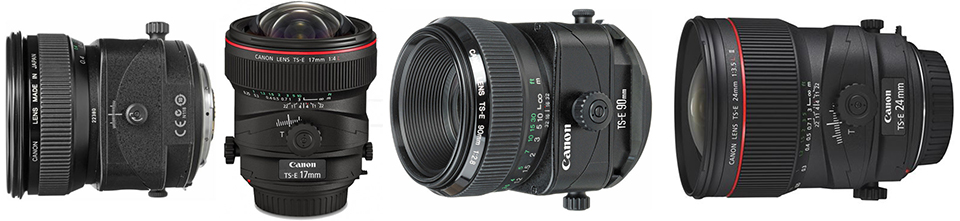
Canon offers TS-E tilt-shift lenses with different focal lengths, namely 17 and 24mm (suitable for architecture, interiors and landscapes), 50mm (versatile) and 90 and 135mm (food, product and portrait photography).
1. Image quality
The distinctive quality of a tilt-shift lens is mainly found in its image quality. The lens has a large glass surface, which is needed to shift the lens relative to the sensor.
This gives you unparalleled sharpness, detail rendition and microcontrast. In the neutral position, they are also free from vignetting, chromatic aberration and edge softness.
2. Focusing very precisely
You have to focus manually, as autofocus does not work because of the complicated construction. But the long focus throw and smooth damping of the focus ring are perfectly suited to this, allowing you to focus with enormous precision. This also allows you to create truly distinctive images.
3. Saving time
A tilt-shift lens saves you a lot of valuable time because you no longer have to make corrections afterwards.
4. Straight lines
A tilt-shift lens is the ideal tool for architectural photography. Straight lines are the norm. You want to photograph buildings without the perspective distortion that creates the illusion that they are falling backwards. This annoying problem is a thing of the past thanks to the shift mechanism of the lens.
5. Moving the horizon
With the shift mechanism, you can move the horizon in landscape photos without having to move the camera position on the tripod.
6. Enormous depth of field
With a tilt-shift lens, you can achieve a huge depth of field with a relatively large aperture, such as f/5.6. With the tilt mechanism, you can tilt the plane of focus, creating a virtually remarkable depth of field.
Conclusion
For me, these are enough reasons to consider investing in a tilt-shift lens. As I have been getting more and more assignments to photograph buildings and houses lately, a 17mm lens seems like a good purchase. Correcting distortion in post-processing is a huge hassle, so it will quickly pay for itself in terms of the time it saves.
Want to learn more about architectural photography?
In the latest course on Photofacts Academy, we take you into the world of architectural photography. Discover architectural buildings in Arnhem and look over the shoulder of architectural photographer Jan Paul Mioulet as he works.
About the author
Michelle Peeters is fotografe en oprichter van DeuxBleus Fotografie. Michelle herkent het bijzondere in het gewone en het gewone in het bijzondere. Ze heeft zich nooit willen specialiseren en is daardoor van alle markten thuis.
You might also like
-
 The shift of a tilt-shift lens explained
by Nando Harmsen
-
Tilt-shift effect in landscape photography
by Nando Harmsen
-
The tilt of a tilt-shift lens explained
by Nando Harmsen
-
 7 tips for architectural photography
by Michelle Peeters
-
 A tilt-shift adapter for the Canon RF mount
by Nando Harmsen
-
 Tilt-shift lens for extreme depth of field
by Nando Harmsen
15 comments
-

 Donald Willemsen
wrote on Tuesday 29 January 2019 at 14:19
| reply
One reason not to buy a TS lens: The high price.
Translated from Dutch. -
 Michelle Peeters wrote on Tuesday 29 January 2019 at 15:10
| reply
@Donald: but that can pay for itself!
Translated from Dutch. -
Donald Willemsen
wrote on Tuesday 29 January 2019 at 15:45
| reply
@Michelle, not for me. First of all: I won't have that much time to earn it back, because I'm not that young anymore either. Secondly: I'm just a hobbyist with a meager pension. Thirdly: Photoshop works wonders.
Translated from Dutch. -
Michelle Peeters wrote on Tuesday 29 January 2019 at 15:47
| reply
That is indeed a good consideration, Donald!
Translated from Dutch. -
 dutchgal wrote on Tuesday 29 January 2019 at 19:36
| reply
Michelle, I completely agree with you. You can correct a lot in Photoshop. However, you also always have to take into account that you sometimes have to crop a lot from your photo and possibly clone parts back in. It is always a bit of quality loss in your photo. You don't have that with tilt and shift lenses.
Translated from Dutch.
You can also buy them second-hand quite easily, and Canon's new lenses are also pretty pricey. -
 guest wrote on Tuesday 29 January 2019 at 19:58 | reply
Another reason to go for it:
Translated from Dutch.
You can also use such a lens excellently for creating panoramas. Because you don't move the camera sensor, you get seamless joins.
If you put a 1.4 converter behind it, you get a second focal length without any loss of quality and without too large an investment, because this really doesn't necessarily have to be from Canon. -
Michelle Peeters wrote on Tuesday 29 January 2019 at 20:17
| reply
@gast: thanks, nice tips!
Translated from Dutch.
@dutchgal: I’m going to look for a second-hand one! But through a camera shop.. -
 PvRFotografie
wrote on Wednesday 30 January 2019 at 08:35
| reply
You can look at Samyang, they have a 24mm TS for ± € 899.00. Or a Lensbaby Edge optic, this works with the Lensbaby Composer system. The Edge has a sharpness gradient like a TS lens. The other optics have a round "sweetspot"so less suitable. A complete Composer set with Edge is about € 399.00. Here an example made with an Edge https://goo.gl/yWv5U6
Translated from Dutch. -
 Kamink
wrote on Wednesday 30 January 2019 at 09:58
| reply
Here speaks an old-school photographer: at photography school, learning to work with the view camera taught me that working with planes of focus and perspective control are invaluable. The tilt/shift lenses of today can only come close to that to a small extent, but if you know how the Scheimpflug principle works, you can still achieve stunning results.
Translated from Dutch. -
Michelle Peeters wrote on Wednesday 30 January 2019 at 10:41
| reply
@PVRfotografie: thanks for the tips!
Translated from Dutch.
@Kamink: interesting, that Scheimpflug principle! Can you tell us a bit more about it? Or shall I look into it and write an article about it? -
Donald Willemsen
wrote on Wednesday 30 January 2019 at 10:43
| reply
@PvRfotografie, I’m familiar with that Samyang, and it’s still problematic budget-wise. I know the Lensbaby brand, but I have no experience with it. I don’t know whether the quality of Samyang’s glass is good.
Translated from Dutch.
Someone else wrote that Photoshop has the major disadvantage that you lose a lot after correction. That’s true. If you know that, you can take it into account very well when taking photos by framing loosely. At least that’s how I work. With perspective corrections and scaling, you can get a long way. -
Michelle Peeters wrote on Wednesday 30 January 2019 at 11:12
| reply
@Donald: I think you can always see that Photoshop post-processing, I can never get it completely perfect. Besides, it's a lot of work!
Translated from Dutch. -
Donald Willemsen
wrote on Wednesday 30 January 2019 at 11:38
| reply
@Michelle, it is indeed a lot of work. You can easily spend an hour on it. I think it is worth it. I dare to doubt that you can see it when you do it perfectly. Then you have to know the original photo if you want to demonstrate that the perspective has been corrected. But before you can do something like that perfectly, a lot of time and practice really have to pass.
Translated from Dutch. -
Michelle Peeters wrote on Wednesday 30 January 2019 at 11:52
| reply
@Donald: you really need to know what you're doing, it's not easy and before you know it you overdo things and it's not right again. That's why I'm quite curious about that Scheimpflug principle. I already found working with a technical camera almost impossible, you see...
Translated from Dutch. -
 bert van herk wrote on Wednesday 30 January 2019 at 16:18 | reply
the tamron 18-200 has the same specs, if I take a photo with that and later look at the exiff data, it says there that the photo was taken with this intended tilt-shift lens.
Translated from Dutch.
why buy an expensive tilt-shift, if it can also be done with the tamron 18-200
Have your say
Please note: Articles older than a week can only be commented on by signed-in visitors.Would you still like to comment? sign in or create a free account.
Become a better photographer every week
A practical photography tip in your inbox every week.
38,938 photography enthusiasts already receive the tips! More about the weekly mail. Or keep up to date via  Facebook.

Elja Trum
Photofacts; everything to do with photography!
Would you like to take better photos and keep up with what is happening in photography? Photofacts publishes articles that teach you something about photography — from a product announcement to a practical shooting tip or a look at a website. Photofacts covers photography every day and is a hobby project of Elja Trum's that got out of hand. The articles are written by a team of volunteer authors. If you would enjoy writing one or more articles for Photofacts, do get in touch.More about PhotofactsPhotofacts is made possible in part by
