

17 Bird Photography Tips from Wilfried Solarz
Wednesday 12 December 2018, 14:55 by Michelle Peeters | 28,720 views | 19 commentsThis article was translated from Dutch with the help of AI. Read the original.
Birds are among the most popular, but also the most difficult subjects to photograph. Almost anyone can take a nice photo of a house sparrow or a tame hawk. But how do you take a truly special photo? Wilfried Solarz's photos stand out in every respect. What is his secret?
Wilfried Solarz
I am a self-taught amateur photographer. I have only attended a few workshops. I gained most of my knowledge through trial and error.
I always ask experts lots of questions and learn a lot from them. In the analogue era, experimenting was more difficult because every attempt immediately cost a roll of film.
I have a great passion for nature photography, especially birds. Fortunately, there is still plenty of nature to be found in Friesland, where I live, and with a good dose of patience and attention you can get a long way.
I would like to give you some tips to increase your success rate when photographing birds.
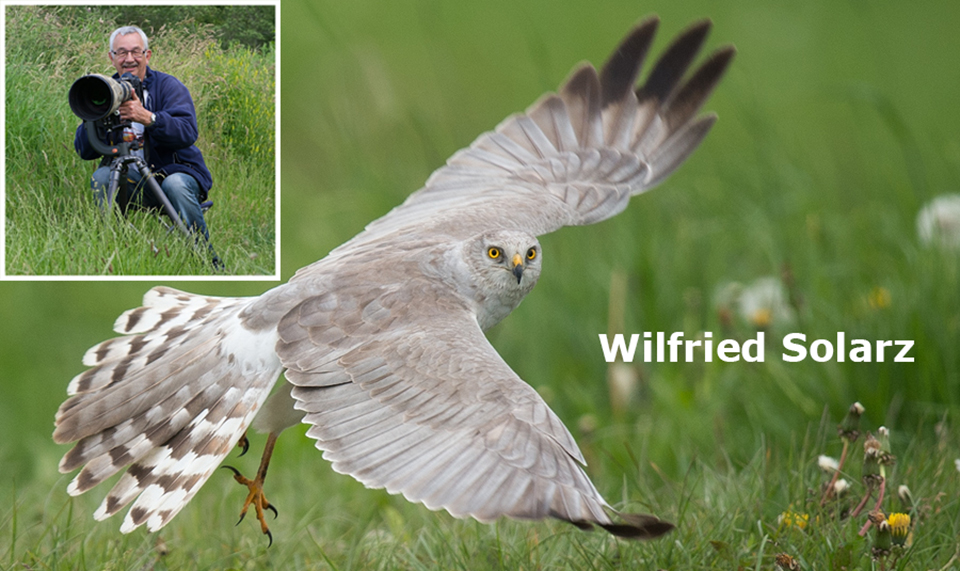
Through social media, such as a birdwatching group on Facebook, and various sightings websites, you can often find out where birds have been reported. I don't need to photograph as many species as possible, but if it is a species I really like, I am happy to drive some distance for it.
I can usually be found in the Lauwersmeer area, and I don't think I will ever get tired of it.
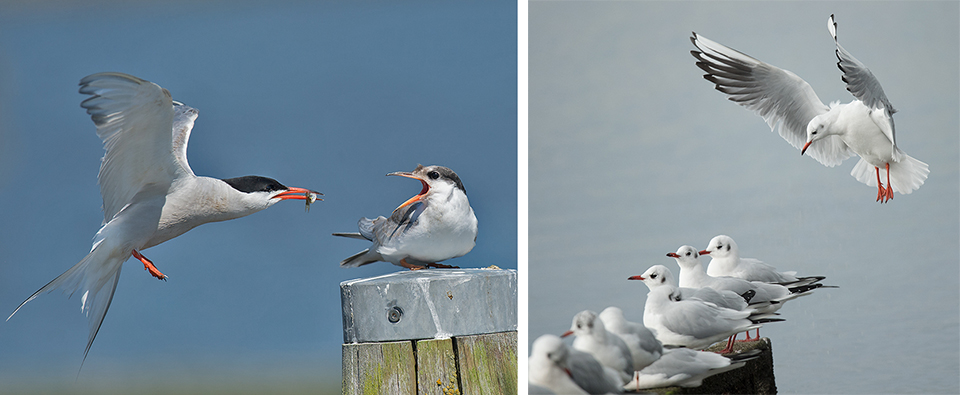
I also enjoy macro, studio and documentary photography, but my preference remains bird photography.
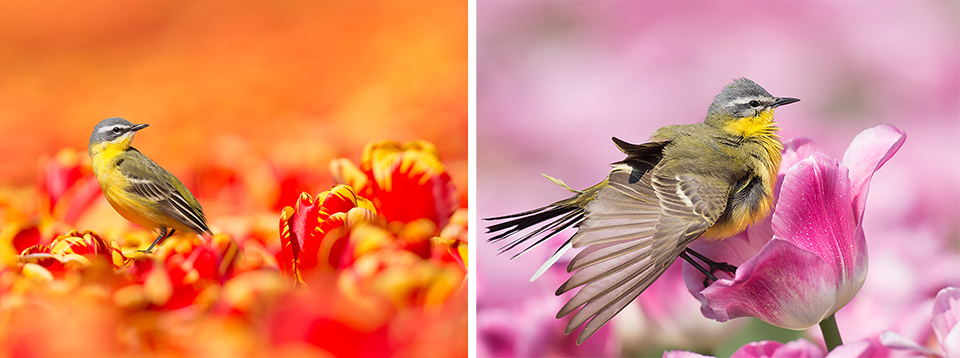
1. Spot metering for good exposure
For bird photography, and especially for birds in flight, I prefer to use spot metering because it increases the chance of a good exposure and there is often too little time to get the exposure completely right.
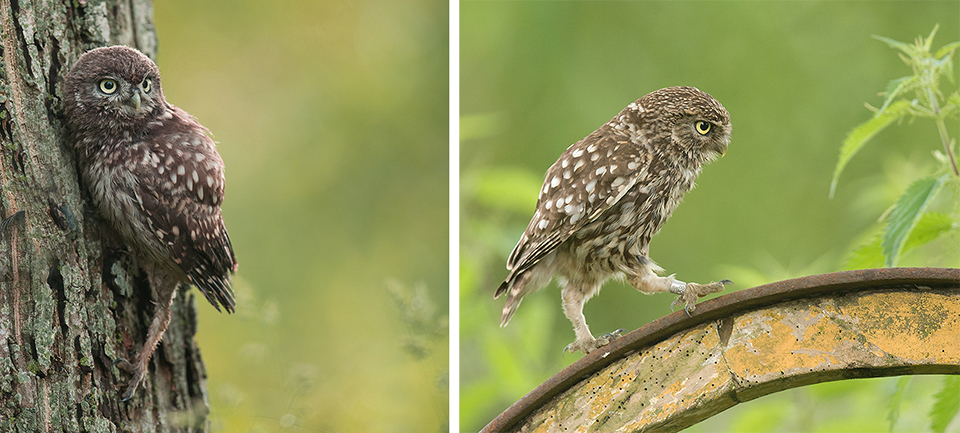
2. Exposure compensation and average metering
For example, compensate for backlighting by adding exposure. Adding exposure means more light in the photo, while reducing exposure shortens the shutter speed and therefore gives you less light in the photo.
Do bear in mind that if you use spot metering and aim at the white part of, for example, a magpie, the black part of the photo will become underexposed when using aperture priority. In such a case, I prefer to use average metering.
3. Golden hour
I think the best time for birdwatching is in the morning at first light or in the evening at the last light. These are called the golden hours for good reason.
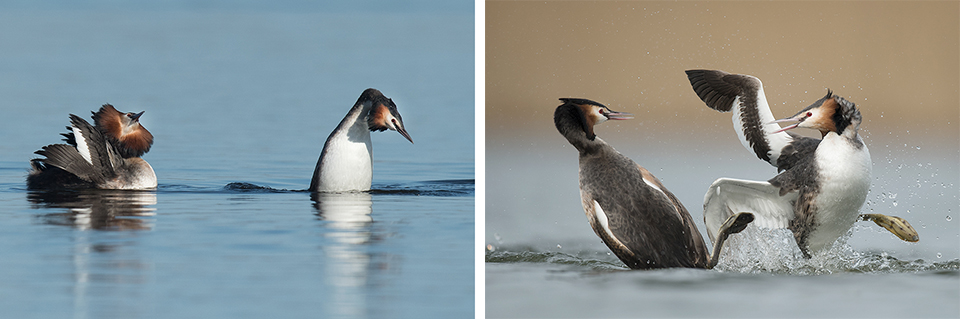
4. Great crebes
At this time of year, great crebes are busy with their courtship displays. This is a whole ritual, and if you have seen it more often, you recognise the behaviour. For example, if they dive under at the same time and come back up with water plants, they will collide with each other and then give each other little kisses. I think they are judging each other and expressing their love this way.
If they have a territory as a pair, they will chase away every intruder. This involves a lot of violence and it is wonderful to watch. To capture this, you need to find a good spot and wait.
5. Low position in the water
To get a low viewpoint, you can also sit in the water wearing waders and using a garden chair. You are less flexible then, but it does produce nice pictures, I think. Do bear in mind that with these temperatures and cheap waders, there is a real chance of getting very cold.
6. Even in bad weather
When cameras still struggled to handle ISO 400 properly, it was quite difficult to get anything worthwhile in bad weather, if you wanted to capture action. These days it doesn't matter as much, although I prefer diffuse sunshine and plenty of action.
7. Lenses
For documentary work, I prefer the 24/70 mm lens, for macro photos the 105 mm, and for bird photography the 300 or 600 mm. I do think that prices for longer lenses have risen sharply in recent years.
On the other hand, you can enjoy them for a long time. My 300 mm lens is more than 20 years old and still works brilliantly.
8. Return to your basic settings
One final tip: return your camera to its basic settings after taking a photo. You often need to act quickly, and you don't want to be caught out because your camera is still set up for a different situation.
9. Kingfishers
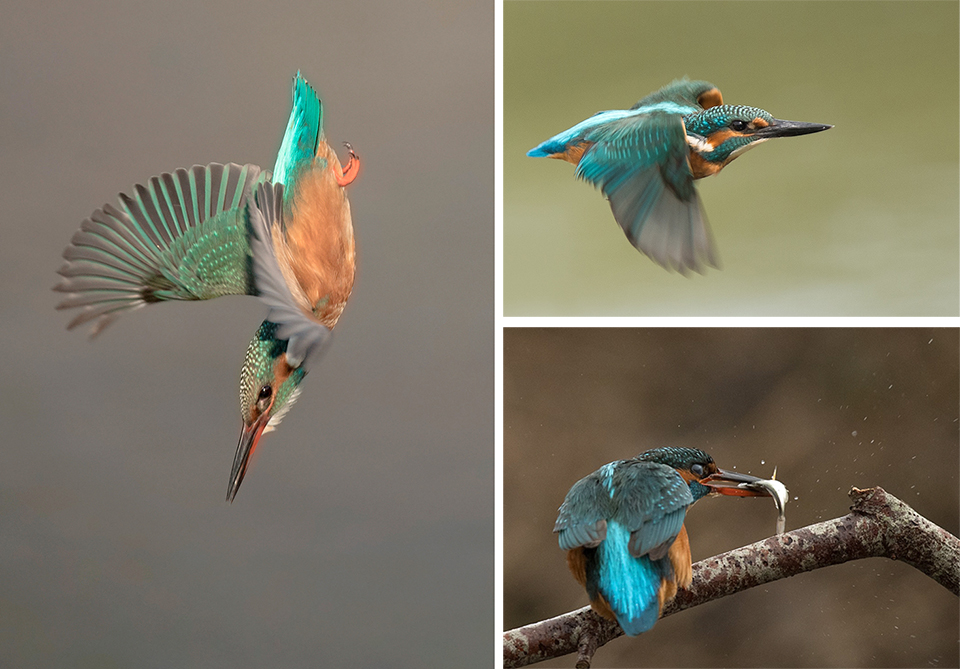
The kingfisher flying vertically downwards was captured as follows. First, I found a spot where I knew the kingfisher regularly went fishing. Often from exactly the same place.
10. Focusing manually
You can manually focus on the spot where you know the kingfisher dives. Use a very fast shutter speed, at least 1/2500th of a second, and then wait for the moment.
And yes, this goes wrong more often than it goes right, so it takes quite a few hours or days. But I enjoy doing it.
11. Shutter priority and auto ISO
You can also choose shutter priority on your camera and have the ISO value adjusted automatically.
In bad weather, the ISO values may rise so high that they produce too much noise. Then you have to choose between accepting that or resigning yourself to not getting a flight photo that day.
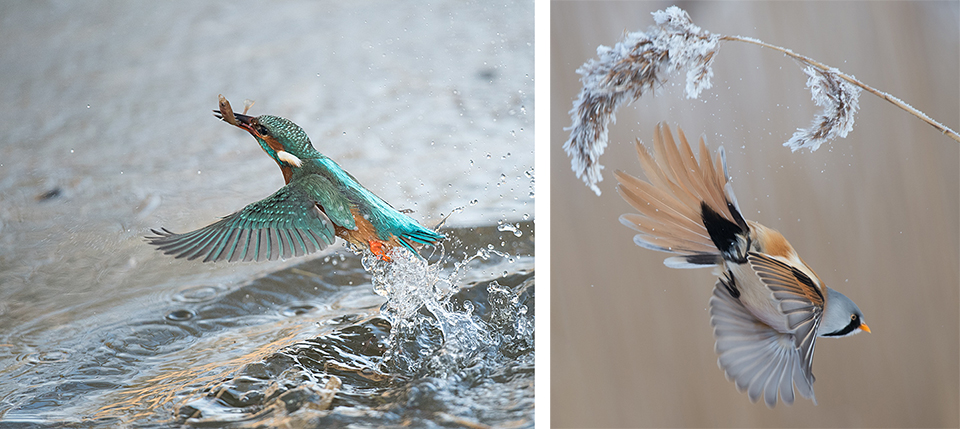
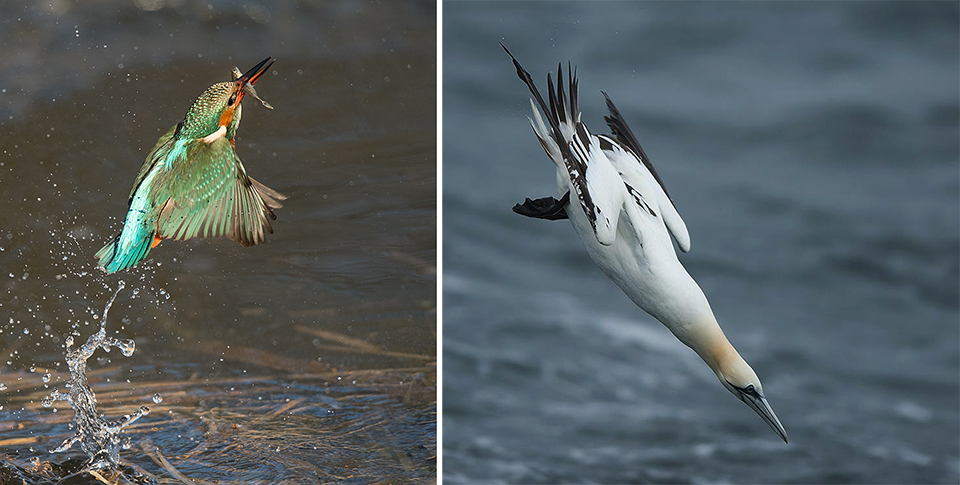
For the kingfisher photo where the bird takes off from the water, I use the same settings. The only difference is that I try to focus quickly myself on the spot where the bird dives into the water. This is a matter of reacting very quickly and accepting that it also goes wrong more often than it goes right here.
12. Gannet
The gannet photo was taken from a boat, from which fish waste was thrown into the water. Lots of birds always come to this, and it is not difficult to photograph them with a 300mm lens.
However, you have to shoot handheld, because a tripod on a noisy boat is not going to work. A fast shutter speed is advisable, and here too you can see from the birds' behaviour when they are about to dive.
13. Short-eared owls and slow shutter speeds
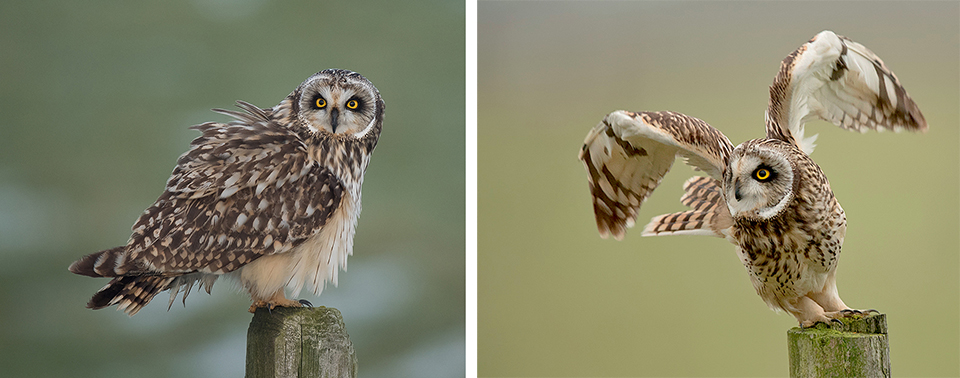
With short-eared owls, it is also a matter of putting in many hours or being very lucky. Short-eared owls often only start flying late to look for food, and in the twilight you can hardly use a fast shutter speed.
A short-eared owl on a post is then the most you can hope for, but it is also a joy to photograph. Those beautiful large eyes make the picture. Sometimes they fly earlier too, for which I have no good explanation, and then it is a pleasure.
14. 'Feeding photos' with young animals
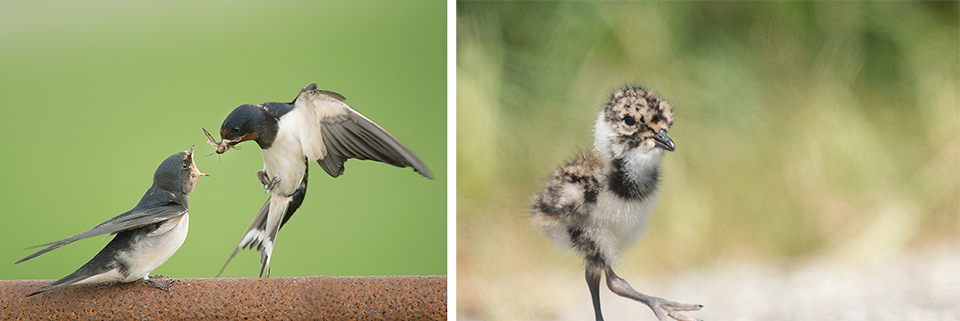
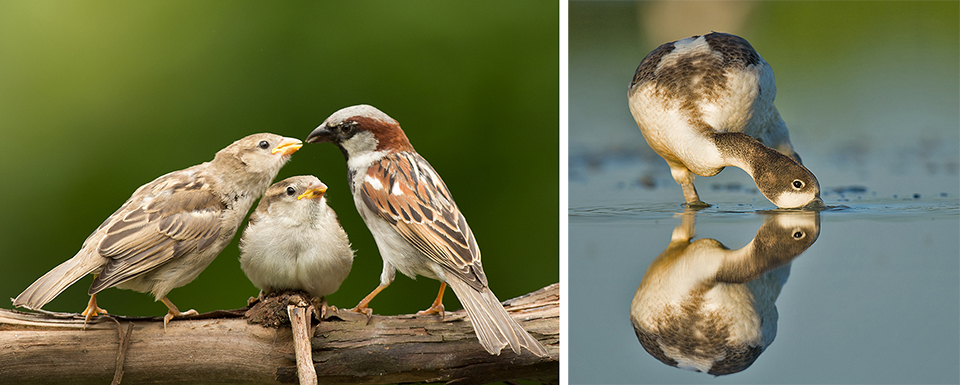
For feeding photos, I anticipate the behaviour of the young birds. When the parents are nearby with food, they become very vocal. That is the moment to press the shutter, and here too a fast shutter speed is advisable.
With barn swallows, it is often a little more difficult. Not because of their behaviour, but because several birds are often sitting next to each other on a wire. The parents do try to feed every youngster, but the most dominant youngster simply gets a turn more often.
15. Tripod, beanbag or car window
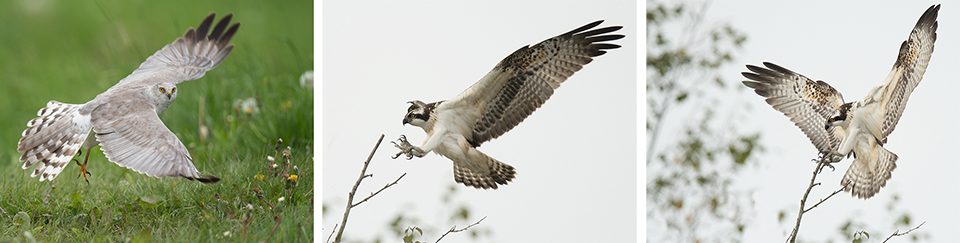
The osprey was photographed from a bird hide, where I usually use a beanbag or tripod. The kingfisher was photographed from the car, but these can also be photographed from various hides.
Incidentally, I photograph mostly from the car. The advantage is that you can use the car window as a tripod. There are even special tripods for sale that you can clamp onto the car window.
16. Remote control
I sometimes use a remote control when I expect to have to wait for a long time but still need to remain alert.
17. Other animal species too
As mentioned earlier, birds are my preference. But when fighting hares unexpectedly appear, I naturally don't let that opportunity pass. Tree frogs are often fun photographic subjects too.
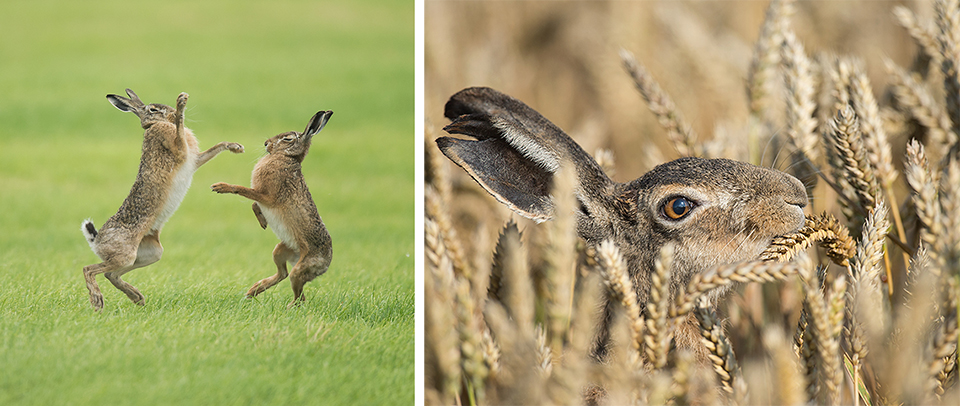
When I drive through the polder and see hares in a field with good light, I park the car straight away. Then it is a matter of waiting. Hares eat, sleep and mess about with each other. You also need a bit of luck to get the right moment.
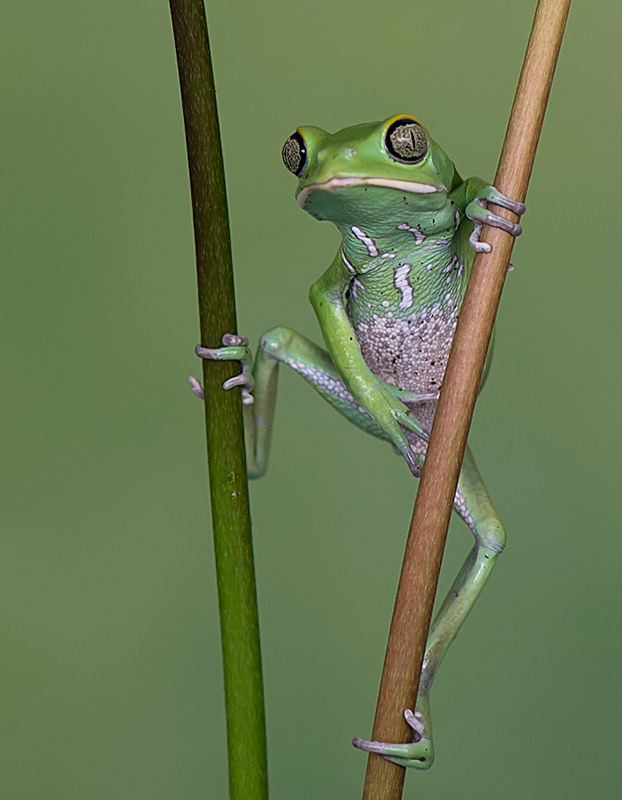
Want to learn?
Would you like to learn more about bird photography and really get stuck into it yourself? Then take a look at the course by bird photographers Daan Schoonhoven and Arno ten Hoeve at Photofacts Academy.
About the author
Michelle Peeters is fotografe en oprichter van DeuxBleus Fotografie. Michelle herkent het bijzondere in het gewone en het gewone in het bijzondere. Ze heeft zich nooit willen specialiseren en is daardoor van alle markten thuis.
You might also like
-
 More Bird Photography Tips
by Wilfried Solarz
-
 3 short bird stories
by Wilfried Solarz
-
 Bird photography? Don't forget the common species.
by Nando Harmsen
-
 My settings for action photography
by Nando Harmsen
-
 Photographing birds? Practise first.
by Nando Harmsen
-
 Crash course in bird photography
by Michelle Peeters
19 comments
-
 Pieter Dooms wrote on Sunday 9 April 2017 at 22:04 | reply
Interessant is het minste wat je hierover kan zeggen. Ik fotografeer liever al wandelend (en ten volle beseffend dat dit enorm beperkend is). Maar je herkent passie en die is hier volop aanwezig.
This comment was written in another language and has not been translated yet. -
 ewit wrote on Sunday 9 April 2017 at 23:02 | reply
Ik ken Wilfried al enige jaren en voornamelijk middels een Forum met Koi. Maar ook daar was zijn werk een lust voor het oog. Vooral zijn macro fotografie vond ik een genot om te volgen. Kleine beestjes loepscherp vastgelegd. Nu volg ik he op FB vogelvrienden. Ook daar maken zijn foto's indruk.
This comment was written in another language and has not been translated yet. -
 Tjerk Epema wrote on Monday 10 April 2017 at 17:28 | reply
Hoewel ik niet een echte vogelaar ben, volg ik Wilfied al jaren op Facebook. Zijn foto's trekken door scherpte en compositie alle aandacht. Een hele goede fotograaf die geweldig mooie foto's schiet. Kauwgom voor het oog . . .
This comment was written in another language and has not been translated yet. -
 Jeanet Groenewoud wrote on Monday 10 April 2017 at 19:01 | reply
Prachtige opnames ! echt een lust voor het oog. Dank voor de tips !
This comment was written in another language and has not been translated yet. -
 hans fidom wrote on Tuesday 11 April 2017 at 10:56 | reply
ik ken wilfried van Footo.nl....wat daar voorbij komt aan werk van hem/wilfried is fabuleux te noemen...ik heb je/wilfried tips uiteraard opgeslagen...nog even iets over het materiaal/lenzen.....kwaliteit van de foto gaat zeker gepaard met de kwaliteit van de lens, ik heb het uiteraard niet over de fotograaf zelf....ik hoop nog vaak van je werk te mogen genieten wilfried!....
This comment was written in another language and has not been translated yet. -
 Maus Sturmer wrote on Tuesday 11 April 2017 at 12:19 | reply
Geweldige foto's, wat zou ik graag een paar dagen meelopen met deze man
This comment was written in another language and has not been translated yet. -
 peter van den hoff wrote on Tuesday 11 April 2017 at 15:50 | reply
zeer leer zaam deze tips daar heb ik wat aan ik ben een begineling
This comment was written in another language and has not been translated yet. -
 Evert wrote on Tuesday 11 April 2017 at 16:38 | reply
Wow ook al net zo'n mooi verhaal als van de sportfotografie.
This comment was written in another language and has not been translated yet.
Ik voel me wel een amateurtje maar heb wel de drijfveer o ook deze uitdaging aan te gaan. Geweldig om te doen en een top verhaal. Dank u! -
 guest wrote on Tuesday 11 April 2017 at 16:50 | reply
leuk!
This comment was written in another language and has not been translated yet. -
 marleen wrote on Tuesday 11 April 2017 at 21:07 | reply
👍 mooie foto's en duidelijke omschrijving.
This comment was written in another language and has not been translated yet.
Dank om dit te delen. Voor beginnelingen vind ik dit echt 'super'. -
 Jaap wrote on Tuesday 11 April 2017 at 22:12 | reply
Prachtige fotografie en een heldere uitleg, bedankt voor het delen.
This comment was written in another language and has not been translated yet. -
 Lia wrote on Tuesday 11 April 2017 at 23:45 | reply
Geweldige fotograaf en een vriendelijk innemend mens.
This comment was written in another language and has not been translated yet. -
 Chris Jansen wrote on Wednesday 12 April 2017 at 17:49 | reply
In 1 woord: fantastisch!
This comment was written in another language and has not been translated yet. -
 R.W.de Vries wrote on Thursday 13 April 2017 at 15:41 | reply
This will be useful to you as a beginning "bird photographer".
Translated from Dutch.
Fortunately, superzoom lenses are getting better and more affordable.
Soon I'll have to get a 150-600 after all... -

 Michelle Peeters wrote on Thursday 13 April 2017 at 15:43
| reply
That is a nice 'Joop van Tellingen' lens
Translated from Dutch.
Something like that is also still on my wish list. You do need a very sturdy tripod for it! -
 Mabotje wrote on Thursday 13 April 2017 at 21:07
| reply
Great photos and a wonderful article. It makes you want to get started with it.
Translated from Dutch. -
 jannes wrote on Saturday 15 April 2017 at 08:23 | reply
great pictures Wilfried and the description with them is very educational regards jannes (jansfotografie)
Translated from Dutch. -
 Breker256 wrote on Thursday 4 January 2018 at 21:58
| reply
The passion really shines through. Just started myself and immediately running into a lot of problems. This is probably due to the bad weather and the lens that isn't very fast.
Translated from Dutch.
I do have one question. What exactly is meant by pluses and how do I set that? I use the canon eos d80 and tamron 70-300 f4-5.6 -
Have your say
Please note: Articles older than a week can only be commented on by signed-in visitors.Would you still like to comment? sign in or create a free account.
Become a better photographer every week
A practical photography tip in your inbox every week.
38,774 photography enthusiasts already receive the tips! More about the weekly mail. Or keep up to date via  Facebook.

Elja Trum
Photofacts; everything to do with photography!
Would you like to take better photos and keep up with what is happening in photography? Photofacts publishes articles that teach you something about photography — from a product announcement to a practical shooting tip or a look at a website. Photofacts covers photography every day and is a hobby project of Elja Trum's that got out of hand. The articles are written by a team of volunteer authors. If you would enjoy writing one or more articles for Photofacts, do get in touch.More about PhotofactsPhotofacts is made possible in part by
