

Getting started with high-speed photography
Monday 1 August 2016, 22:44 by Ellen Reus | 19,938 views | 17 commentsThis article was translated from Dutch with the help of AI. Read the original.
I work with high-speed photography and regularly get questions about how it all works. So it was time to write a blog with some explanations.
What exactly is high-speed photography?
High-speed photography is photographing fast-moving subjects. So, strictly speaking, that covers a lot. You might think of certain sports, such as motor racing, but other forms of photography also fall under the heading of high-speed photography, such as splash photography.
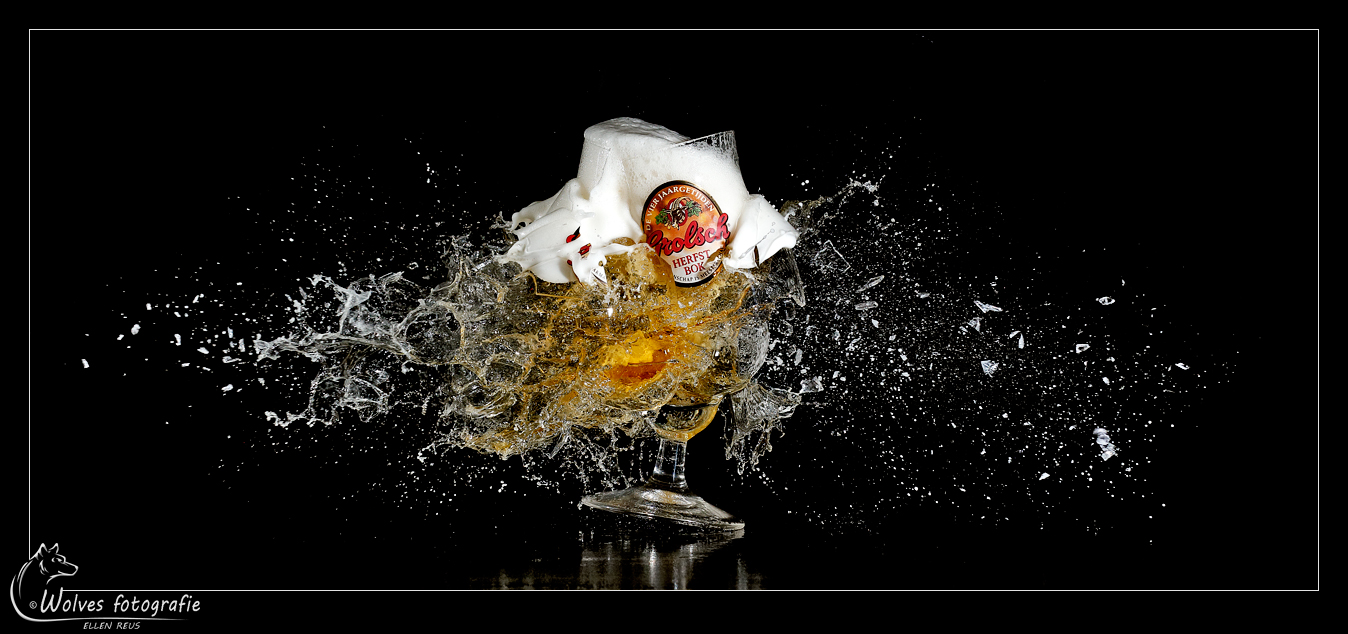
When I talk about high-speed photography, however, I mean an even more extreme form of high-speed photography: shooting objects with an air rifle and taking photographs of them.
Which objects can you shoot?
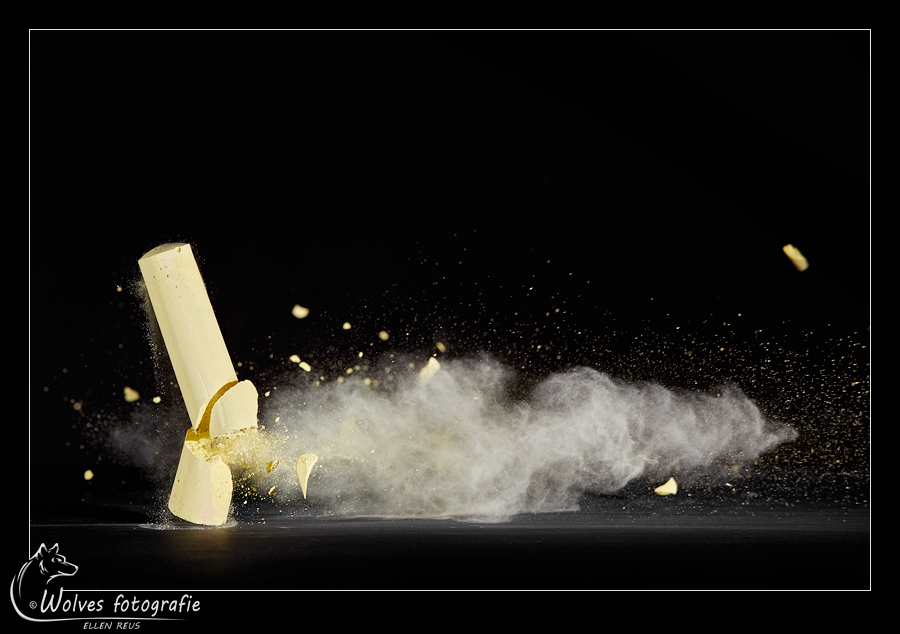
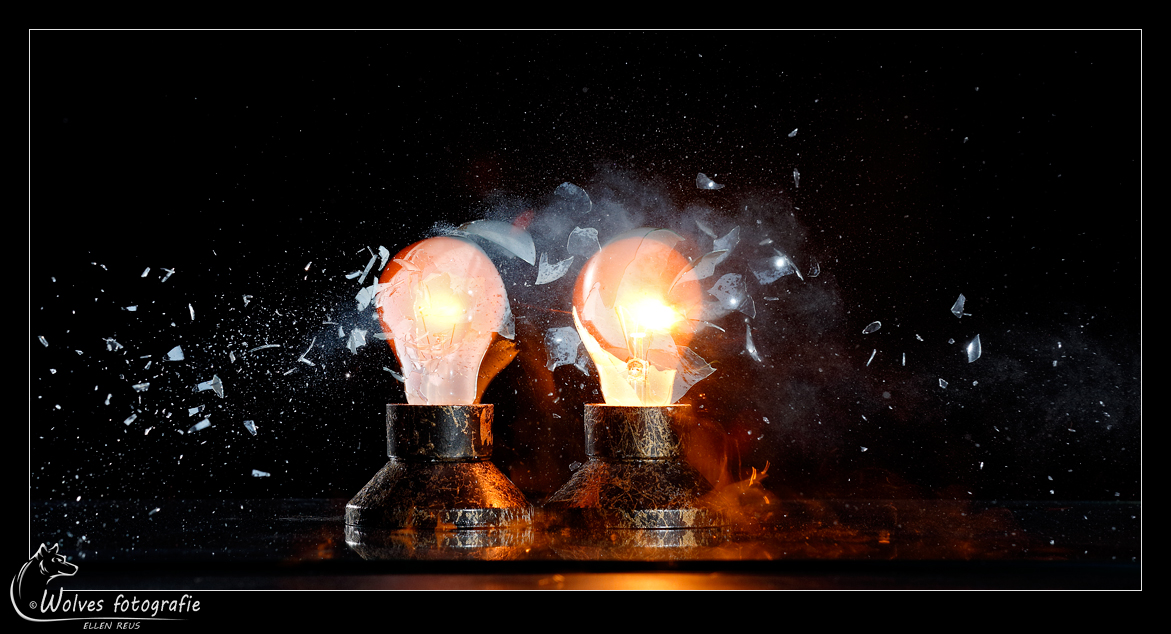
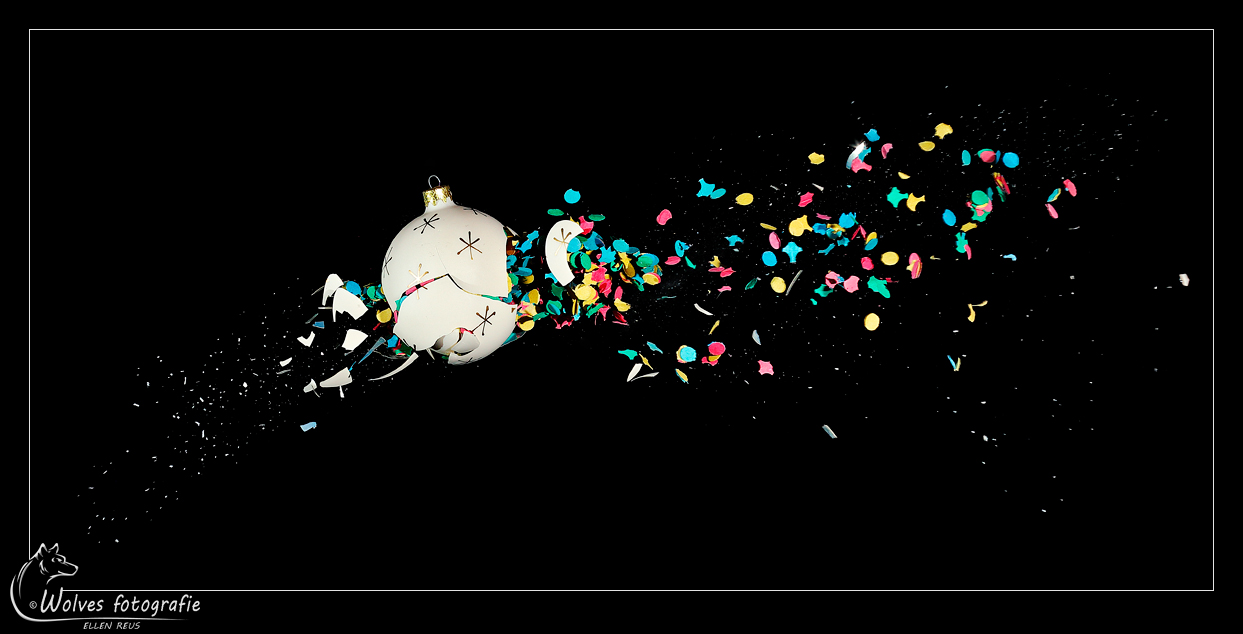
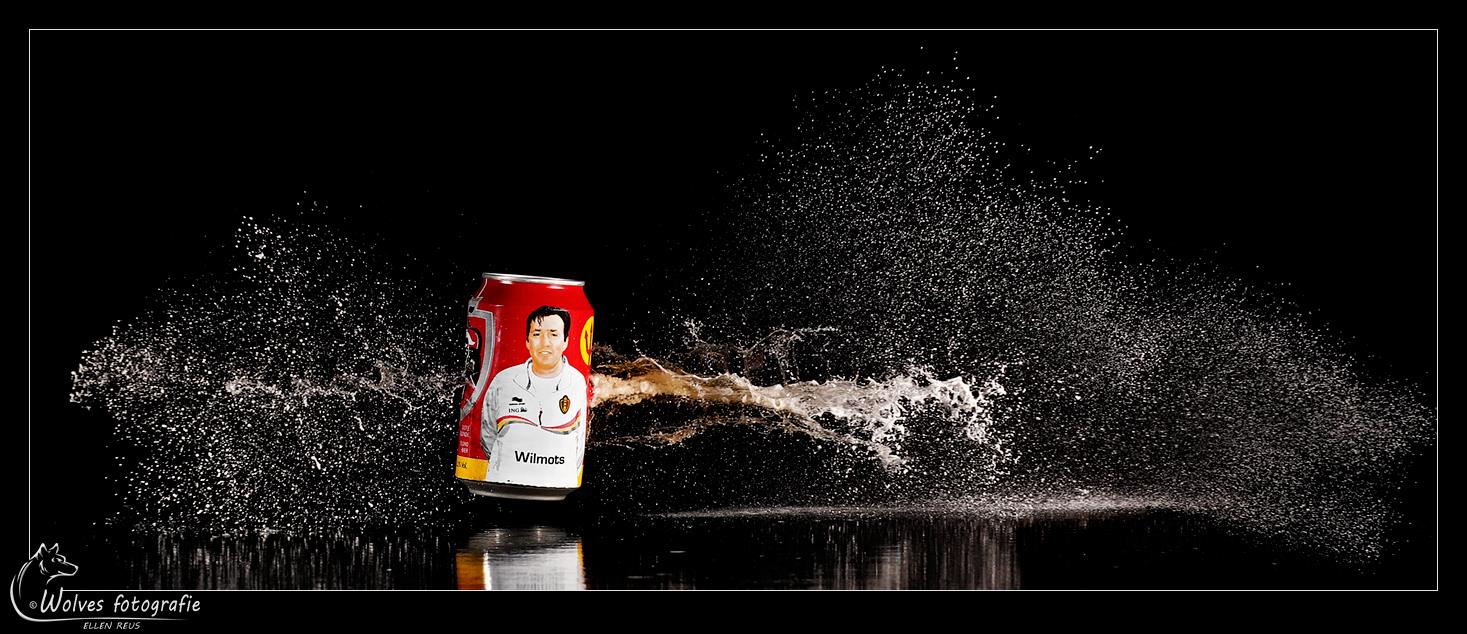
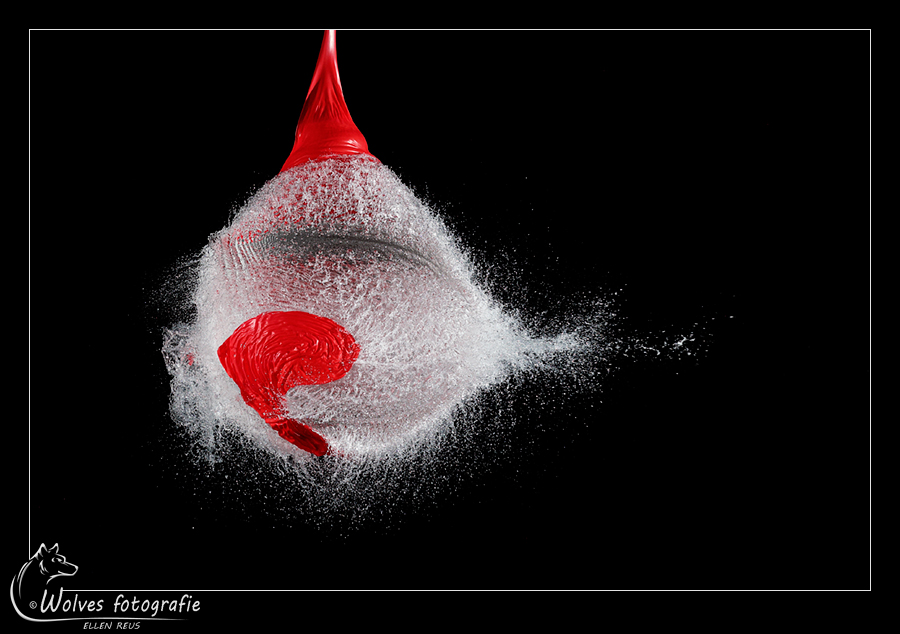
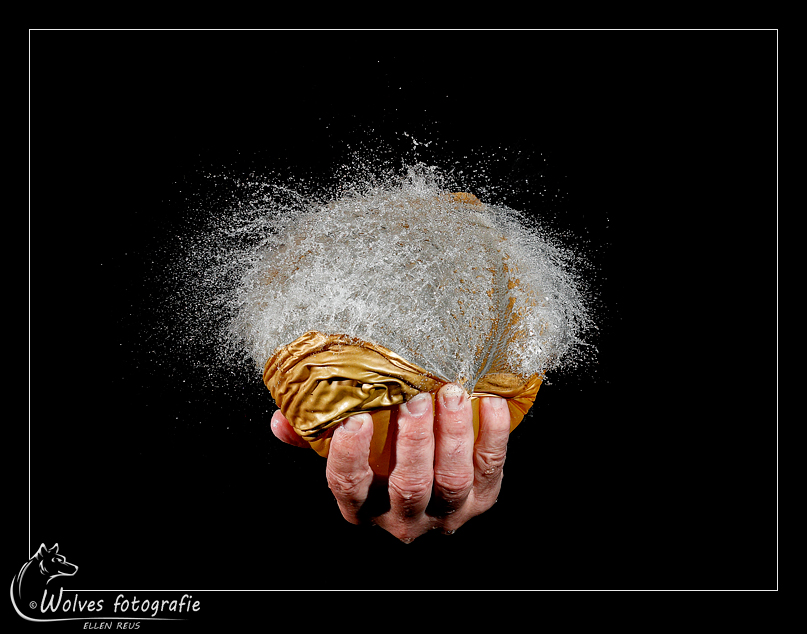
In principle, you can shoot anything that isn't too hard. However, not everything produces a spectacular photograph. Things that work well include Christmas baubles, (water) balloons, pieces of pavement chalk, glasses, (light) bulbs and drinks cans.
Always pay close attention to the hardness of your object, because if it is too hard to shoot, such as thicker glass or bottles, trying it anyway can create a very dangerous situation!
Bullets can ricochet, and a ricocheting bullet can fly in any direction, including towards the camera, the person behind the camera or back towards the shooter.
Thick glass may also just about break when hit. The energy of the bullet is then transferred to the thick shards of glass, which subsequently become dangerous projectiles that you do not want hitting you!
Which camera do you need for high-speed photography?
This is a question my course participants ask me regularly. Most people expect that you need at least a high-end DSLR. But no, that is not necessary at all.
You can also take high-speed photographs with a relatively simple compact camera. The only requirement is that you can set the shutter speed, aperture and ISO value yourself. Other than that, there are no requirements for the camera.
Which lens should you choose?
Apart from with a compact camera, where the camera and lens are one unit, you of course also have a choice of which lens (lens!) you are going to use. It is always a good question exactly which focal length you need.
Let me start by saying that this naturally depends on the distance to your subject and the size of the objects you are going to shoot. Preferably, it should be a lens with some telephoto reach, because you do not want to have to sit too close for safety reasons.
For a crop-sensor camera, for example, a lens with a focal length between 50 mm and 150 mm is ideal, while for a full-frame camera it is between 75 mm and 225 mm. I always use my 70-200 mm lens myself…
What other equipment do you need for high-speed photography?
Besides the camera and lens, you definitely need a tripod. This is especially necessary for focusing.
There is too much time between focusing and taking the photograph to keep the camera still at the same distance when shooting handheld. So without a tripod, the focus would not always be in the right place (or should this be 'never be'?).
You also need a special high-speed trigger, two speedlights, a microphone and, of course, the air rifle and the objects you are going to shoot.
How does it work?
First, you need to understand that something you shoot with an air rifle moves so fast that it cannot be frozen using the camera's shutter speed.
The only thing you can use to freeze your subject is light, flash light to be precise. The flash from the speedlight is much faster than your camera's shutter speed.
You use two speedlights to light your subject properly and make sure they fire at exactly the right moment, so that you get a nice action shot.
You could try to time this yourself, but at best that would be a very difficult task and at worst an impossible one. That is why you use the trigger and the microphone.
You connect both the microphone and the speedlights to the trigger. The microphone registers the sound of the shot, and the trigger then fires the speedlights after a pre-set delay.
There is only one problem left: your camera also has to take the photograph at exactly the moment the speedlights fire. That is also impossible to time yourself. However, this is very easy to solve. You simply use a very long shutter speed.
Of course, in a normal situation this would give you a very overexposed photograph. That is why you have to take the photographs in the dark. In the dark, the shutter can remain open indefinitely, because without light there is no photograph. When the flash fires, there is light for a very short moment, and that gives you a photograph.
Is it dangerous?
Yes, this form of high-speed photography can definitely be called dangerous! After all, you are handling an air rifle, and that is a weapon. You are also simply shooting bullets...
The products you shoot can also pose a danger. For example, when you shoot glasses, the shards fly around.
However, when you do this under the supervision of someone who knows exactly what they are doing, it becomes much less dangerous. For example, I make everyone wear safety goggles.
I know very well how to shoot and, above all, how to handle an air rifle safely.
My experience also means that I have a good idea of which products can be shot safely and which cannot.
I make sure everyone keeps a safe distance, so the risk of accidents or damaged equipment is kept to a minimum.
Fortunately, I can also say that nobody has ever been seriously injured during my high-speed photography workshop (during my own practice sessions, when I did not yet have the experience I have today, I was hit by a ricocheting bullet once, and yes, it does hurt for a moment). Fortunately, all the equipment has always remained undamaged.
Would you like to try this yourself?
Of course, it is fun to take this kind of photograph yourself! You can get started with what I have described here, but it is wise to attend a workshop first. You can then make use of the instructor's experience and equipment.
That will also save you a lot of money, because high-speed photography is certainly not a cheap hobby when you add everything together. But the main reason is that you can be sure you are working as safely as possible, with as little risk as possible of damaging your equipment or yourself!
An added benefit is that you will not be left with the mess yourself, because believe me, this creates a lot of rubbish! The tricky thing is that you have liquid and shards mixed together, which makes clearing it up more difficult.
I also run workshops on this myself.
If you are interested, take a look at this page.
About the author
Ellen is professioneel fotograaf en gespecialiseerd in dierfotografie. Ellen verzorgt met grote passie diverse workshops fotografie in de vorm van workshops, cursussen, privé-lessen en fotoreizen. Uiteraard houdt zij zich ook nog met veel plezier bezig met fotograferen.
You might also like
-
 DJI Air 3 announced
by Elja Trum
-
 How reading fewer blogs and watching fewer YouTube videos improved my photography
by Frédéric Paulussen
-
 Review: Tether Tools Air Direct for wireless tethered photography
by Nando Harmsen
-
 Review: Case Air Wireless Tethering
by Michelle Peeters
-
 How do you create a good photography website?
by Marit Hilarius

17 comments
-

 heylo217 wrote on Tuesday 2 August 2016 at 10:55
| reply
I also always put a cardboard box with a sturdy plank behind my subject to catch the pellets.
Translated from Dutch. -
 Robert wrote on Tuesday 2 August 2016 at 13:10
| reply
Seems like fun to do. Maybe I'll do a workshop sometime.
Translated from Dutch. -
 guest wrote on Tuesday 2 August 2016 at 13:39 | reply
There are, in my opinion, more beautiful activities for high-speed photography. Shooting at objects with a rifle doesn't seem like a good idea to me.
Translated from Dutch. -
heylo217 wrote on Tuesday 2 August 2016 at 14:13
| reply
@ guest: what activities could those be then?
Translated from Dutch. -
 Van Roosendael Paul wrote on Tuesday 2 August 2016 at 14:44 | reply
I have to say that this is fantastic, simply amazing.
Translated from Dutch.
This deserves more than a big compliment. Really beautiful shots! -
guest wrote on Tuesday 2 August 2016 at 16:13 | reply
hello which setting is used for that
Translated from Dutch. -
 Chantal wrote on Tuesday 2 August 2016 at 16:58 | reply
From Belgium quite a long way, unfortunately I would certainly love to participate sometime, seems like a great idea to me.
Translated from Dutch. -
 Jan van Duijn wrote on Tuesday 2 August 2016 at 18:42 | reply
Clear story Ellen, I have seen several beautiful results from your students and from you, impressive branch of photography !!
Translated from Dutch.
greetings
Jan van Duijn -
 Wolves fotografie
wrote on Tuesday 2 August 2016 at 18:46
| reply
@heylo217: Yes I indeed also have cardboard behind it as a bullet trap, with a piece of carpet with a jute backing over it.
Translated from Dutch.
@Robert: It would be nice if you came to participate sometime, Robert. It is certainly very fun to do. At least I think so myself.
@gast: When you don't know how to handle a rifle, then it is also not a good idea to immediately try this yourself, I agree with you on that. However, when you know exactly what you are doing, it is a lot of fun to do.
From me the same question that heylo217 already asked you: "What activities did you have in mind then?"
@Van Roosendael Paul: Thank you!
@gast: that varies a bit from time to time, but as a starting point I usually use ISO 640, F9.0 and the shutter speed on Bulb.
@Chantal: Yes, from Belgium it is indeed quite a long drive. Nevertheless, I have already had the pleasure of welcoming several students from Belgium during my workshops. Maybe you can go together with someone sometime. Carpooling makes the journey more enjoyable in any case.
@Jan van Duijn: Thank you Jan! -
heylo217 wrote on Tuesday 2 August 2016 at 19:03
| reply
@Wolves fotografie: haven't seen you on BD anymore.
Translated from Dutch. -
Wolves fotografie
wrote on Tuesday 2 August 2016 at 20:27
| reply
@heylo217: no, that's right, I haven't been there for quite some time. I think I'm a bit forum-tired.
Translated from Dutch. -
 andrew wrote on Tuesday 2 August 2016 at 20:29 | reply
Hello, shooting in the dark ??
Translated from Dutch. -
guest wrote on Wednesday 3 August 2016 at 11:46 | reply
What microphone and high-speed trigger do you specifically use for this then (brand and model for example?)
Translated from Dutch. -
heylo217 wrote on Wednesday 3 August 2016 at 14:34
| reply
I use the Hähnel Captur Timer Module Pro incl. IR Kit to my great satisfaction.
Translated from Dutch. -
guest wrote on Wednesday 3 August 2016 at 16:34 | reply
Nice tips.
Translated from Dutch. -
Wolves fotografie
wrote on Wednesday 3 August 2016 at 16:58
| reply
@andrew: yes, that's right, it really does add an extra challenge and makes it even more important that you know what you're doing.
Translated from Dutch.
@guest: I don't know the brand of the microphone, if it even has a brand (I have it in my photo studio, hence why I can't check right now), but that doesn't really matter either. The trigger I use is the Stopshot by Cognisys.
@guest: thanks! -
 alain hautman wrote on Tuesday 20 October 2020 at 14:03
| reply
Hi Ellen , it's been a while and yes it's quite a drive from Belgium but I have friends living in the Netherlands where I can stay overnight and that saves quite a bit . I came away with some very beautiful photos and it was quite an experience and a pleasure to take part in this , thanks again ! and who knows, see you again sometime !
Translated from Dutch.
Have your say
Please note: Articles older than a week can only be commented on by signed-in visitors.Would you still like to comment? sign in or create a free account.
Become a better photographer every week
A practical photography tip in your inbox every week.
38,729 photography enthusiasts already receive the tips! More about the weekly mail. Or keep up to date via  Facebook.

Elja Trum
Photofacts; everything to do with photography!
Would you like to take better photos and keep up with what is happening in photography? Photofacts publishes articles that teach you something about photography — from a product announcement to a practical shooting tip or a look at a website. Photofacts covers photography every day and is a hobby project of Elja Trum's that got out of hand. The articles are written by a team of volunteer authors. If you would enjoy writing one or more articles for Photofacts, do get in touch.More about Photofacts Photos
Photofacts is made possible in part by
