

Make your own well-timed action sports photo
Wednesday 15 November 2017, 14:14 by Huub Keulers | 6,897 views | 11 commentsThis article was translated from Dutch with the help of AI. Read the original.
What could be more beautiful and interesting to look at than a photo taken at exactly the right moment? Whether it is a sports, street or even a portrait photo, timing can make or break your photo.
Even with a portrait photo, it is important to press the shutter at the right moment. The model's beautiful, intense look shows that there is interaction between the photographer and the model. And who doesn't know the photos by French street photographer Henri Cartier-Bresson, who was known for capturing the ultimate moment.
Where timing certainly makes the difference between a snapshot and a successful photo is in action or sports photography. Whether it is an international sporting event or your niece raising her fist in the air in celebration after winning a race for the local swimming club.
Everything revolves around the right moment. For convenience, let's call this the perfect moment rather than the perfect picture, as the latter does not exist in my opinion.
Timing
To capture this perfect moment, a number of things are important. For a start, you need a camera that is fast enough. By fast enough, I mean a camera and lens combination that can autofocus quickly and shoot at least 6 frames per second.
All the other aspects that play a role are related to the photographer, and are certainly no less important. Preparation is a very important factor here. In this article, you will also find some tips for perfect timing in action photography.
- Make sure you are ready to take your photos in good time and don't have to set up your camera at the very last moment. For example, take a few test photos beforehand and check that the exposure is correct. Correct it if necessary;
- Know what to expect and position yourself where you expect the action to happen or where you can see the faces of the person or people involved;
- Stay alert and react in good time. Look through your camera's viewfinder early and follow the action with your camera's focus point. Don't let yourself be distracted by people or situations around you. Always keep an eye on your own safety and that of others, as this always comes first.
Always look at your surroundings with the eye you are not using to look through your viewfinder. Let's say you do this out of the corner of your eye; - Being prepared also means keeping your index finger relaxed on the shutter button. Try to stay relaxed so that, when the moment arrives, you can press the button quickly but calmly. Many people press the shutter button too hard and abruptly, creating a high risk of motion blur. It would be a shame to press the shutter at the right moment only to find that your photo is blurred.
Telling a story
The perfectly timed photo is also all about telling a story. What matters is that you remember the ultimate moment when you look at the photo later. That is exactly what such a photo does for you: it brings out the emotion that the viewer or the athlete also felt at that moment.
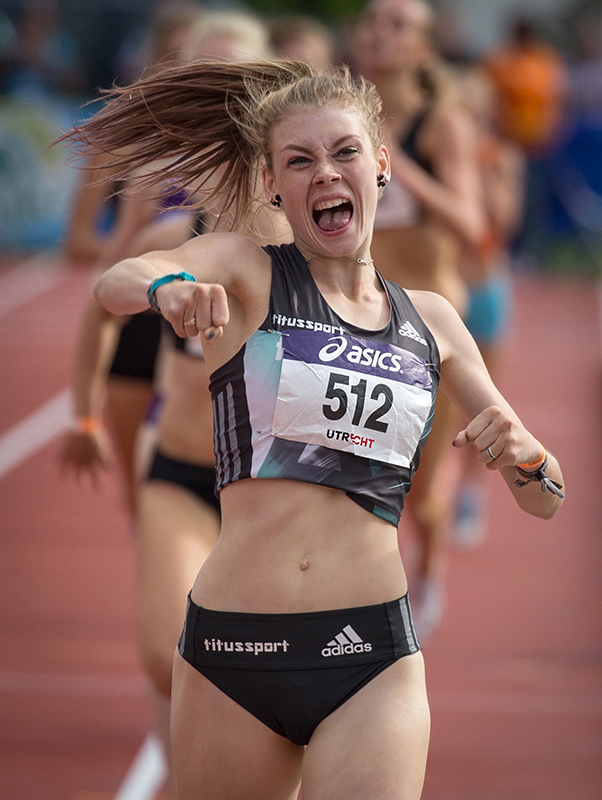
Now that you know the above, I can take you to Saturday 15 July 2017, and the Dutch Athletics Championships in Utrecht. This is Danaïd Prinsen, the new Dutch champion in the 800 metres.
One important aspect to realise beforehand: everyone could have taken this photo. Even at an event like this, it is possible to capture this moment from behind the railing along the athletics track, in the right place.
Preparation
As far as preparation was concerned, I knew beforehand that Danaïd had a good chance of winning the 800-metre final. So I was focused on her from the start. I also knew that Danaïd was someone who might react with joy and emotion, so I already had a photo like the one shown here in my head.
I positioned myself about ten metres behind the finish line. For the record, two metres behind me was the railing behind which other photographers and spectators stood with their cameras. So they actually had the same angle and position for taking this photo.
So what makes the difference? Certainly not where you stand as a photographer, and not the camera either. I saw almost nothing but SLR cameras with telephoto lenses that should have been able to handle this situation.
The difference was made by my preparation, alertness, timing and correct camera settings. Things related to you as a photographer.
When it was already clear 100 metres before the finish that Danaïd was going to win, I pointed my camera at her and continued to follow her with continuous autofocus. I started taking photos ten metres before she crossed the finish line.
I had already seen her arm going up in celebration. However, I did not stop taking photos when she crossed the finish line. Many photographers did. There was still a beautiful release of emotion to come, and it came just as expected. With her fist thrust forward and clenched, all the emotion came out. I had my photo for her family too! ☺
Inspiration
Hopefully, this photo will also inspire you to take a well-timed action or sports photo. Have fun and good luck.
A small detail: this photo was chosen by the organisers and fans as the best sports photo of the Asics Dutch Athletics Championships. Not so much because of the action, but because of the perfect timing.
Camera settings
Shutter priority, 2/3 stops overexposed (because of the bright sunlight), 1/2000 second, F4.5, ISO 500, focal length 200mm, AI Servo (continuous autofocus), central focus point active (the most accurate AF point), burst mode (multiple frames per second), metering method: Centre-weighted.
About the author
Huub Keulers is een enthousiasmerende veelzijdige freelance fotograaf woonachtig in Elsloo (Li). Hij is gespecialiseerd in sport-, bedrijfs-, straat-, honden en portretfotografie. Daarnaast is Huub auteur van diverse educatieve fotografieboeken en verzorgt hij allerlei fotoworkshops, masterclasses en lezingen.
You might also like
-
 Sports photography: Know what your camera can do
by Nico Delmeire
-
 3 Tips for Successful Sports Photography (and get my book free)
by Nico Delmeire
-
 Sports photography tip: Think like an athlete
by Nico Delmeire
-
 The basic settings for action photography
by Nando Harmsen
-
 5 power tips for more exciting sports photos
by Huub Keulers
-
 Tip for sports photography in the evening
by Michelle Peeters
11 comments
-
 Mac wrote on Wednesday 15 November 2017 at 17:22 | reply
It is indeed a very nice photo.
Translated from Dutch.
Only this is of course 1 of the "easy" sports to photograph. The runners always go in a "straight" line. So another method would be to pre-focus where you want to take the photo, and then turn off the AF. I also do this myself with certain sports, the action is always in the same place anyway (e.g. certain gymnastics events), then I also don't have to worry about the Focus suddenly being gone if someone walks through the frame.
If I do use AF, then mainly back-button focus. If I then release the shutter button for a moment, I still keep my focus.
I am actually more interested in what your technique would be with very fast-moving sports. So where there are very fast movements, which are also often unexpected. Like Breakdance, for example. -
 Peter wrote on Wednesday 15 November 2017 at 21:10 | reply
Very nice good explanation of this photo. The emotion splashes off it.
Translated from Dutch.
Great Huub. -

 Huub Keulers
wrote on Wednesday 15 November 2017 at 22:17
| reply
From a camera-technical point of view, it is indeed not all that difficult to take this photo, Mac, you are right about that. I also mention that in this article. The essence of the story is actually more about the non-technical side, namely capturing the right moment, in this case the athlete's release. I know that many beginning photographers do not always have an eye for that, hence. The blog on my website also highlights the more technical aspects of sports photography.
Translated from Dutch. -
Huub Keulers
wrote on Wednesday 15 November 2017 at 22:18
| reply
Thank you Peter. That was the intention too
Translated from Dutch.
-
Sjaak wrote on Thursday 16 November 2017 at 17:41 | reply
The right moment, then. As I already indicated in another article: much more important than all that so-called basic knowledge such as Bokeh, Flash synchronization, Long exposure, manual mode etc.
Translated from Dutch.
Just go out and take photos with "the right moment" in the back of your mind and you'll get there. -
Mac wrote on Monday 20 November 2017 at 08:15 | reply
@sjaak
Translated from Dutch.
I think you're being rather too simplistic here.
You can photograph during the right moment, but if all those other things aren't right, your photo isn't good either. Right moment or not.
Without the right "bokeh", this wouldn't have been a good photo. If the other runners had been too much in focus, you would have been too distracted from the beautiful expression on her face.
And As Huub already wrote, everyone could have taken this photo, but it does stand out. Because he had already taken the outcome into account (and had therefore already set his settings, with the basic knowledge of everything) -
Sjaak wrote on Monday 20 November 2017 at 11:11 | reply
@Mac: how many cameras make the background sharp in this situation on automatic? Just a bit of sensor size combined with the shutter speed already gives you a blurred background. In automatic mode, that is. And otherwise you just set it to a sports mode or something. So you don't need any knowledge of the (overrated) phenomenon Bokeh for that.
Translated from Dutch.
A bit of a sweeping statement? I see a lot of photos, from people with and without all that technical knowledge. Now you can guess which photos are the most interesting. Knowledge is too often used to disguise a lack of creativity. -
Mac wrote on Monday 20 November 2017 at 12:39 | reply
@sjaak
Translated from Dutch.
I think you're getting some things mixed up. Shutter speed doesn't cause a blurry background. The aperture does that. Shutter speed determines whether or not you get motion blur. -
Huub Keulers
wrote on Monday 20 November 2017 at 13:13
| reply
Dear people, I have been asked by Photofacts to respond to submitted opinions and normally I always do that, but do you think it is okay if I do not respond substantively here to a comment regarding technique vs. creativity. I would like to do this with those involved via another medium, such as email, if desired. (huubkeulers@ziggo.nl / www.huubkeulers.nl). Kind regards, Huub Keulers
Translated from Dutch. -
Sjaak wrote on Monday 20 November 2017 at 13:32 | reply
Mac: I’m not mixing anything up. Shutter speed is the deciding factor here to freeze the motion. Short time = large aperture = shallow depth of field.
Translated from Dutch.
Just because I don’t consider basic knowledge all that important for creative beginners doesn’t mean I don’t have that knowledge myself
-
Mac wrote on Tuesday 21 November 2017 at 07:39 | reply
And yet I still think that you are oversimplifying things. Because a faster shutter speed indeed means a larger aperture. How much larger also depends on how much light there is. The author had overexposed, which meant you had an even larger aperture. If that had not happened, there would have been more depth of field, and because of that the photo might not have been as powerful as it is now. So that basic knowledge is certainly important. (because which shutter speed do you choose, is the subject moving towards you, or past you. etc. all important for the settings. Which a beginner also has to think about, albeit not so deeply) Otherwise it is shooting and hoping for the best. Because even the sports mode will try to achieve as fast a shutter speed as possible, with the most ideal aperture. Which therefore is not a large aperture in most cases.
Translated from Dutch.
Have your say
Please note: Articles older than a week can only be commented on by signed-in visitors.Would you still like to comment? sign in or create a free account.
Become a better photographer every week
A practical photography tip in your inbox every week.
38,837 photography enthusiasts already receive the tips! More about the weekly mail. Or keep up to date via  Facebook.

Elja Trum
Photofacts; everything to do with photography!
Would you like to take better photos and keep up with what is happening in photography? Photofacts publishes articles that teach you something about photography — from a product announcement to a practical shooting tip or a look at a website. Photofacts covers photography every day and is a hobby project of Elja Trum's that got out of hand. The articles are written by a team of volunteer authors. If you would enjoy writing one or more articles for Photofacts, do get in touch.More about PhotofactsPhotofacts is made possible in part by
