

When do you use flash and when do you use LED light?
Monday 19 December 2022, 20:10 by Liesbeth van Asselt | 7,148 views | 7 commentsThis article was translated from Dutch with the help of AI. Read the original.
I have been a big fan of flash as a light source for years. To light subjects beautifully, freeze movement and/or go completely wild with it creatively.
But developments are not standing still. LED lamps are getting better and their light output is increasing. This applies to the torches I use for light painting, but also to LED lamps that you can use for portrait photography and other shoots.
So in January I took the plunge and ordered the Forza 60B from Nanlite. Including a projector with handles and gobos.
Why this LED lamp from Nanlite? Because I had seen at a colleague's that the colour accuracy of these lamps is really good. White is truly white. And it stays that way throughout the shoot.
And the light output of this small lamp, it is no bigger than my Godox AD200 speedlight, exceeded all my expectations.
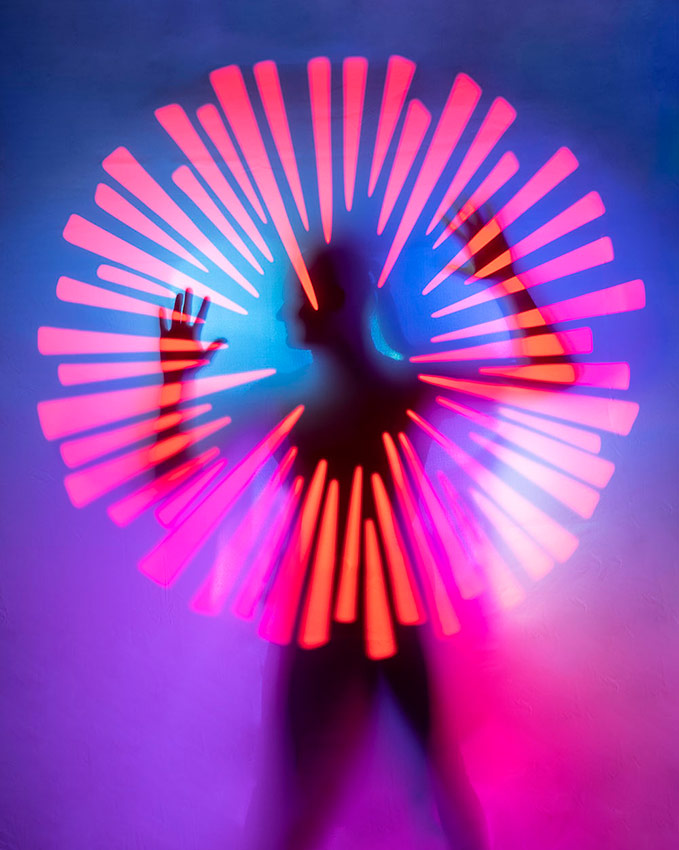
I also wanted an LED lamp for my creative outbursts that could be supplied with a gobo projector, so I could create photos like the one below. And you can do that with this LED lamp.
The figures
For the techies among you: if an LED lamp has a CRI (Colour Rendering Index) and TLCI (the same as CRI, but specially tested for camera sensors) of 90 or higher, you can assume that the colour rendering is neutral.
The higher the CRI and TLCI values, the less colour cast there is. This Forza 60B has a CRI/TLCI of 96/98.
And while I use 1,000-lumen torches for light painting, this Forza 60B delivers almost 14,000 lumens with the reflector. Although the specifications describe this in lux..... With a Fresnel lens in front to bundle the light, it is even more, almost 24,000 lumens.
What is the difference between lumens and lux?
Lumens are the amount of light emitted by a light source. Lux takes the surface over which the light is spread into account.
A 1,000-lumen light source that has to illuminate 1 square metre illuminates that square metre with 1,000 lux. The same 1,000 lumens, spread over 10 square metres, so at a greater distance from that surface, illuminate that area with just 100 lux.
Back to practice
Between January and May, I mainly used the continuous light from the Forza in the studio and in the dark, for example at urban locations. Often combined with LED tubes, Nanlite Pavotubes, which produce coloured light without you having to fiddle around with colour filters, which is much easier!
During our May holiday, I was commissioned by the owner to photograph the holiday home where we were staying.
The aim: to place informative and representative photos of the house on rental website Micazu. A good opportunity to try out the Forza LED lamp in rooms where daylight comes in!
I was pleasantly surprised by how easy an LED lamp is to use. You immediately see where distracting shadows fall behind, for example, lamps. Or where your LED lamp is reflected in windows or, for example, the television screen.
That is something you only see afterwards with speedlights. Being able to put the light in the right place straight away to prevent shadows and/or reflections saves a lot of time.
When using flash units, you take a number of test photos to determine how much light those flash units need to produce. You do not need to do that with LED lamps, of course, what you see is what you get.
the same applies to the colour temperature of the light. You can make the light warmer or cooler in no time. You can of course also do that in post-processing, but if you can do it on the spot, that saves more time in front of your screen.
All sunshine and roses?
So is there only positive news when it comes to LED lamps versus flash units? The answer is no, certainly not.
The Forza 60B and the Forza 150, which I have since also bought, are compact and produce a lot of light. But if you want to overpower the sunlight on a summer's day, you need heavier LED lamps, literally.
That also means heavier support equipment. I do not find that practical, so I choose a compact flash for shoots in the sun. Flash units still win when it comes to delivering a lot of light with compact equipment.
Another disadvantage of LED lamps is that it is not pleasant for models to look into the bright light. So if you want the light to come from your camera position, it is more convenient to use a flash.
And of course, it is more difficult to freeze the movement of a subject with LED lamps. With a flash, it is simple: in combination with a long shutter speed, you can choose a short flash duration to get dancers, cyclists and so on sharply in the photo, for example.
In my studio, course participants even set the shutter speed to bulb and use the flash pulse I provide to capture water droplets from a bursting balloon sharply in the photo. The shutter speed eventually turned out to be 8 seconds.
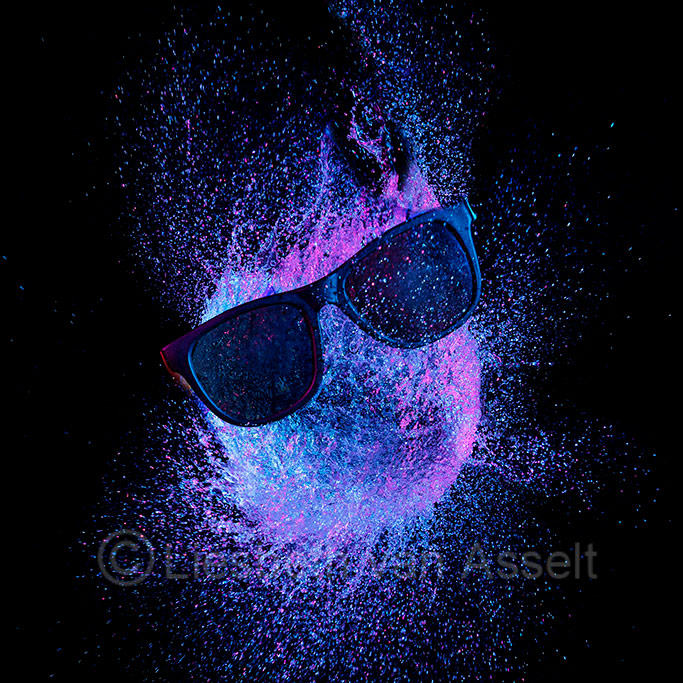
With continuous light, you do not have this option. You have to rely on a short shutter speed, perhaps combined with a wider aperture and a higher ISO.
And then there is this... A flash duration of, for example, 1/40,000 of a second. Just try matching that with your shutter speed!
In short: for me, it is not a matter of flash OR LED light, but flash AND LED light. Outdoors in the sun and for freezing movement, I will continue to use a flash. Indoors, or outdoors in the evening, I will be more likely to reach for the LED lamp.
About the author
Liesbeth fotografeert met haar bedrijf stapfoto.nl voor websites van bedrijven. Daarnaast verzorgt ze al sinds 2004 (vooral creatieve) workshops zoals lightpainting, flitsen in de natuur, fine art, frozen flowers, paintsplash, infrarood, icm en multi exposure. Daarnaast is er een Stapfoto vakgroep voor de meer gevorderde fotografen.
You might also like
-
 Review: SmallRig RM 40C mini LED video light
by Nando Harmsen
-
 LED versus flash: which is better?
by Elja Trum
-
 Elinchrom announces LED 100 C continuous light
by Elja Trum
-
 Creating high-key portraits with LED lighting
by Elja Trum
-
 Review: The Zhiyun Molus X100 COB continuous light
by Nando Harmsen
-
 Review: Sirui Bi-Colour LED CS100B lighting
by Anno Huidekoper
7 comments
-
 Paul wrote on Tuesday 20 December 2022 at 19:10 | reply
Piece is well written, with the pros and cons indeed neatly mentioned. Your photos don't really appeal to me, I wouldn't call them photos anymore either, but light paintings. Not my style, I prefer realistic, but the equipment you describe is clearly also good for that. In any case better than the 500 Watt photocresenta lamps I used in the past, you didn't need heating anymore!
Translated from Dutch. -

 Liesbeth van Asselt
wrote on Tuesday 20 December 2022 at 20:01
| reply
Liesbeth van Asselt
wrote on Tuesday 20 December 2022 at 20:01
| reply
Ha, ha, yes those lamps indeed got scorching hot! Maybe not even such a crazy thing during an energy crisis
Translated from Dutch. . And yes, luckily tastes differ, that prevents cookie-cutter sameness.....
 -
 Jos wrote on Wednesday 21 December 2022 at 06:31 | reply
Adjusting the color temperature in post-processing is only useful if there is just one light source.
Translated from Dutch.
If daylight is shining inside, it is useful to be able to adjust the color of the artificial light to match it, which cannot be done just like that in post. Or at least not without (potentially complicated) masks.
The advantage of a flash is that its color usually comes very close to that of daylight, but that also means that a color filter must be used if that is not the case. With an LED lamp, that filter is increasingly larger and thus more expensive, while they can (usually) be adjusted between daylight and artificial light and no filter is needed for that in the first place.
This does not alter the fact that we have been filtering all kinds of lamps for years, but the LEDs are a lot cooler and that means that we do not necessarily need special filters for effects. -
 Ytos
wrote on Saturday 24 December 2022 at 10:09
| reply
Ytos
wrote on Saturday 24 December 2022 at 10:09
| reply
Nice article, Liesbeth. Last week I was allowed to photograph the end-of-year party and the Christmas market at our school, and of course I used a flash because of mobility. The downside of an auditorium with large windows is indeed the reflection of the flash light in some situations, but I usually know how to avoid that.
Translated from Dutch.
But anyway, what I'm more interested in is the choice of lamp you've made. I don't know exactly what you photograph and whether it's merely a replacement for your speedlight, but may I ask why you didn't go for a somewhat larger, but flatter LED panel? After all, your relative light source in relation to your subject would then be somewhat larger, which generally benefits the softness of the light. I did see that you can place reflectors, and I assume other light modifiers as well, on your lamp, but at the same time, in terms of its design, it's almost a small studio flash. I think you'd be just as mobile with an LED panel. Or am I overlooking something?
I'm asking because for my work I'm looking into such a panel, for when I want to take the photos for the website.
Thanks in advance for your answer. -
Liesbeth van Asselt
wrote on Saturday 24 December 2022 at 15:48
| reply
Hello Yljas, good question! I do indeed also have (older) LED panels. The problem is that I am much less flexible with those. For example, if I want to highlight a model for my light painting, that light needs to be small/focused/concentrated to ensure that it does not end up on the painting. That does not work with a panel. Despite the barndoors, I cannot turn that panel into a nicely focused light source. At most, an elongated one, but then the clothing is also lit completely. You do not always want that.
Translated from Dutch.
With this LED lamp (with a Bowens mount), I can create a large light source by putting an umbrella or collapsible softbox in front of it (Nanlite has collapsible softboxes in various sizes, but because of the Bowens mount you can also just use the old softboxes from your flashes). Or place a translucent screen, like the ones included with the 5-in-1 reflectors, on a small stand in front of the lamp. Or by pointing the lamp at a white ceiling or wall.
Another practical example: last week I photographed in the metal industry with the LED lamps. Then I want to put the employee properly in the spotlight (literally and figuratively). In that tough industry, I want somewhat harder light. That is difficult with an LED panel. Of course, I can place the panel farther away to achieve that, but then I have too little light left.... The week before, I photographed for an accounting firm where it was rather dark inside and where soft light was needed for the portraits. That works fine with an LED panel, but also with the LED lamp with a softbox, or as I did in this case, by shining the LED lamp towards a white wall.
In short: with the LED lamp I can go in all directions, while with the panel I miss a number of possibilities for shaping the light to my liking. -
Ytos
wrote on Saturday 24 December 2022 at 17:22
| reply
Thanks for your extensive answer, Liesbeth. I understand what you mean. For the situation in which I have to work, a panel would then suffice. At most, I need to add some light in a room, where I sometimes have to work against the light. Incidentally, I understood that light shapers or at least softboxes can also be placed on those Nanlite panels, if necessary.
Translated from Dutch. -
Liesbeth van Asselt
wrote on Saturday 24 December 2022 at 18:45
| reply
Yes, that's indeed possible, but no snoot
Translated from Dutch.. So I won't be able to get focused light with it....
Have your say
Please note: Articles older than a week can only be commented on by signed-in visitors.Would you still like to comment? sign in or create a free account.
Become a better photographer every week
A practical photography tip in your inbox every week.
39,077 photography enthusiasts already receive the tips! More about the weekly mail. Or keep up to date via  Facebook.

Elja Trum
Photofacts; everything to do with photography!
Would you like to take better photos and keep up with what is happening in photography? Photofacts publishes articles that teach you something about photography — from a product announcement to a practical shooting tip or a look at a website. Photofacts covers photography every day and is a hobby project of Elja Trum's that got out of hand. The articles are written by a team of volunteer authors. If you would enjoy writing one or more articles for Photofacts, do get in touch.More about PhotofactsPhotofacts is made possible in part by
