

Which lenses would you choose if you could only have two?
Tuesday 8 September 2020, 16:32 by Nando Harmsen | 6,005 views | 0 commentsThis article was translated from Dutch with the help of AI. Read the original.
When you buy a camera, it usually comes with a standard lens. This is often a zoom lens with a range that runs from wide-angle to telephoto, to put it in general terms.
It is often a lens that lets you practise most types of photography very well, from landscapes to portraits, and from holiday photography to semi-macro.
There comes a point when you run into limitations. These are the moments when your lens does not let you take the photo you would like to take.
If this only happens occasionally, it is not such a problem. There are always ways to use a bit of ingenuity or a few tricks to get a little more out of your focal length.
If you run into those limitations very often, however, it may be time to look for a more suitable lens. Perhaps your focal length is not long enough, or perhaps it is not short enough. Maybe the magnification is not sufficient, or you want a very shallow depth of field.
As you can see, your choice of lens depends entirely on what you photograph. Someone who enjoys photographing animals has no use for a wide-angle lens.
A photographer who enjoys photographing architecture and interiors does not need a macro lens. A macro photographer has little use for a lens with an aperture of f/1,4.
You do not always need to have lots of lenses. In fact, you can often manage perfectly well with just two lenses. Which ones they are depends on the type of photography you do.
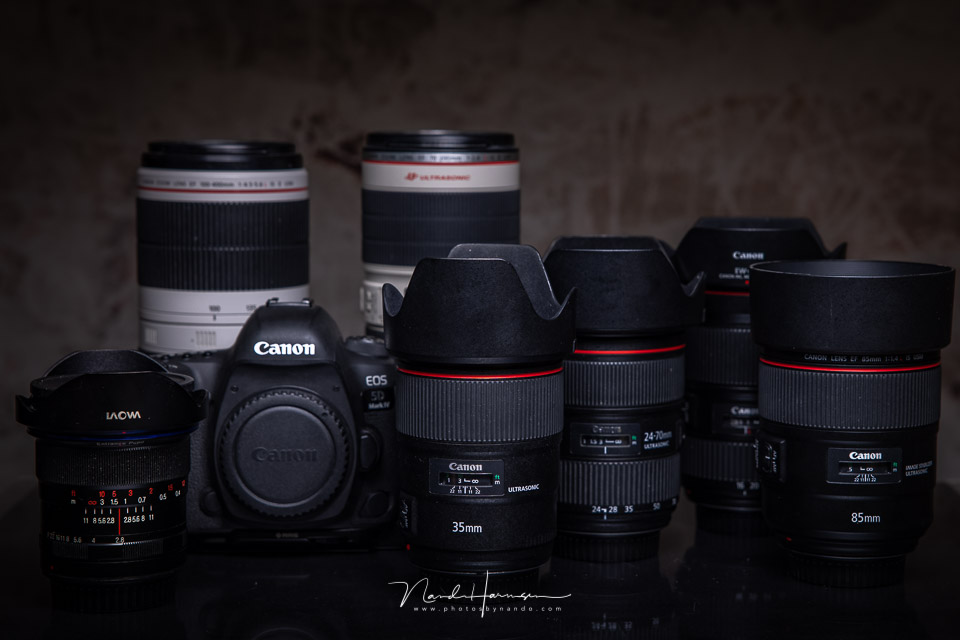
Suppose you could only have two lenses, which two would be the best choice? Of course, I can only speak from my own personal preference, but perhaps my choice can help or inspire you.
I will list the lenses shown in the photo and the ones I use. There are of course comparable or similar lenses available for your brand. If you use a camera with a crop sensor, you do need to correct the focal length using your crop factor.
Landscape photography
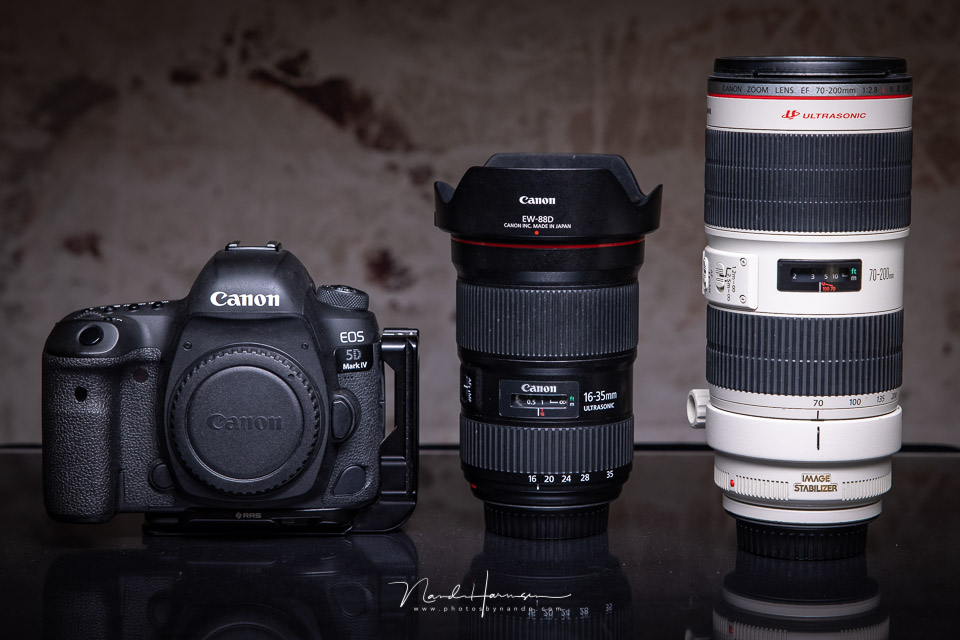
- Canon EF 16-35mm f/2,8L III
- Canon EF 70-200mm f/2,8L II
For landscapes, you can use a wide-angle lens for expansive landscapes with a beautiful object in the foreground, or a telephoto lens for more intimate landscapes. You do not need an aperture of f/2,8 for this type of photography, so lenses with f/4 or f/5,6 are very suitable.
Alternatively, you could choose a 24-70mm lens, or a 100-400mm lens. These can also be used perfectly for landscapes.
Portrait and wedding photography
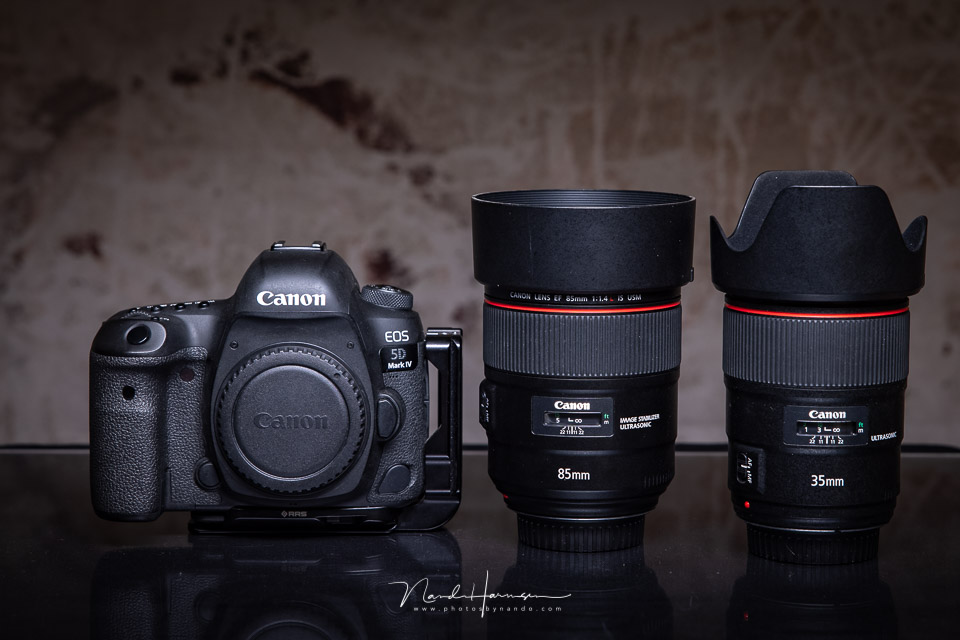
- Canon EF 35mm f/1,4L II
- Canon EF 85mm f/1,4L
I am a big fan of prime lenses, especially for my portraits and wedding photography. These are the two lenses I can photograph almost everything with. In particular, the wide aperture of f/1,4 gives me the opportunity to use a fantastic shallow depth of field when I feel it is needed. It also allows me to work well in dark wedding venues.
You could easily replace the 85mm with a 135mm lens, and the 35mm with a 24mm. If you prefer a zoom lens, a 24-70mm and a 70-200mm are a good choice.
Interior and architectural photography
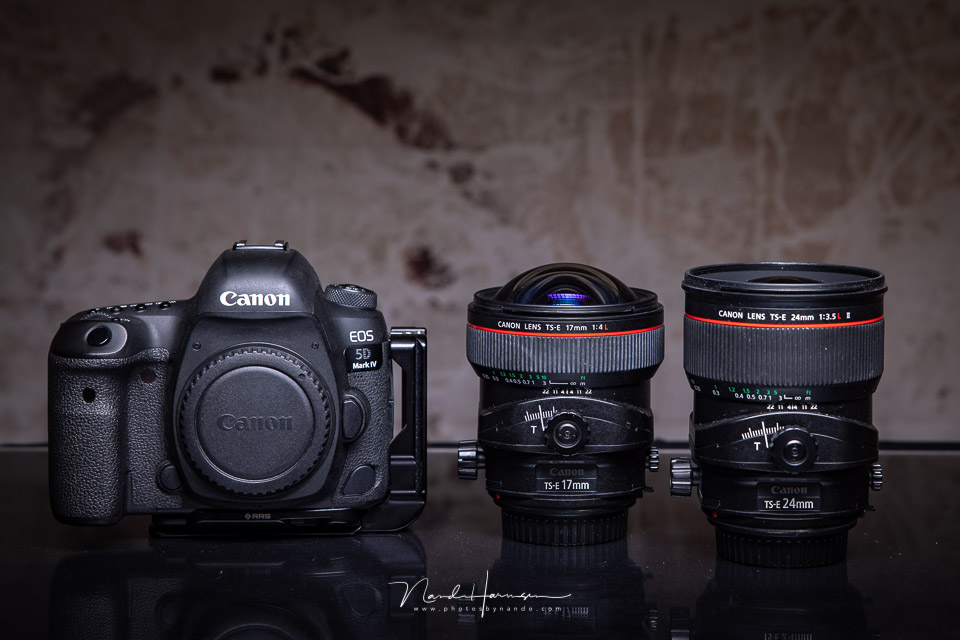
- Canon TS-E 17mm f/4L
- Canon TS-E 24mm f/3,5L II
For my real estate photography, I prefer tilt-shift lenses. They allow me to prevent converging lines, you know, the "fallen-over" buildings you get when you point the camera upwards with a wide-angle lens.
Another advantage of tilt-shift is the ability to get a wider angle of view very easily using the shift function. It can also prevent you from seeing yourself in a mirror.
Alternatively, you could of course choose a 16-35mm zoom lens, or something similar. This can mean that you have to correct the converging lines in post-processing.
Stars and Milky Way photography
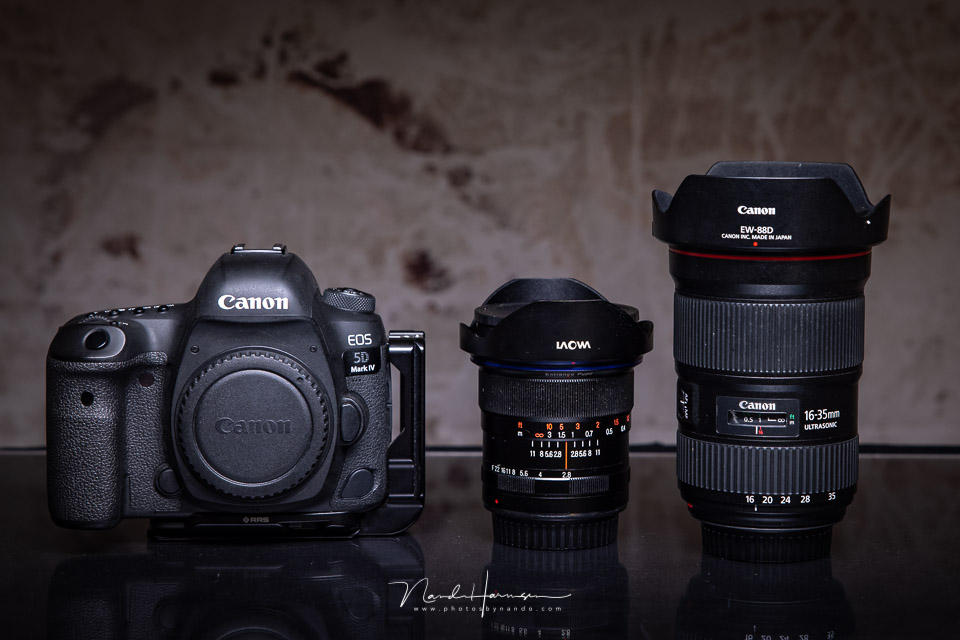
- Canon EF 16-35mm f/2,8L III
- Laowa 12mm f/2,8 zero-D
For star photography, you often need two things: a wide-angle lens and a fast aperture. An aperture of f/2,8 is certainly recommended. Combine this with a 16mm focal length, or even wider, and you can capture an expansive starry sky or a large part of the Milky Way.
Alternatively, you can choose a fast prime lens. A 24mm f/1,4 would be a good choice. If you often want to photograph the Milky Way, a 35mm focal length with f/1,4 is also a good choice. Especially if you want to photograph the core of the Milky Way in fine detail.
Sports and action photography
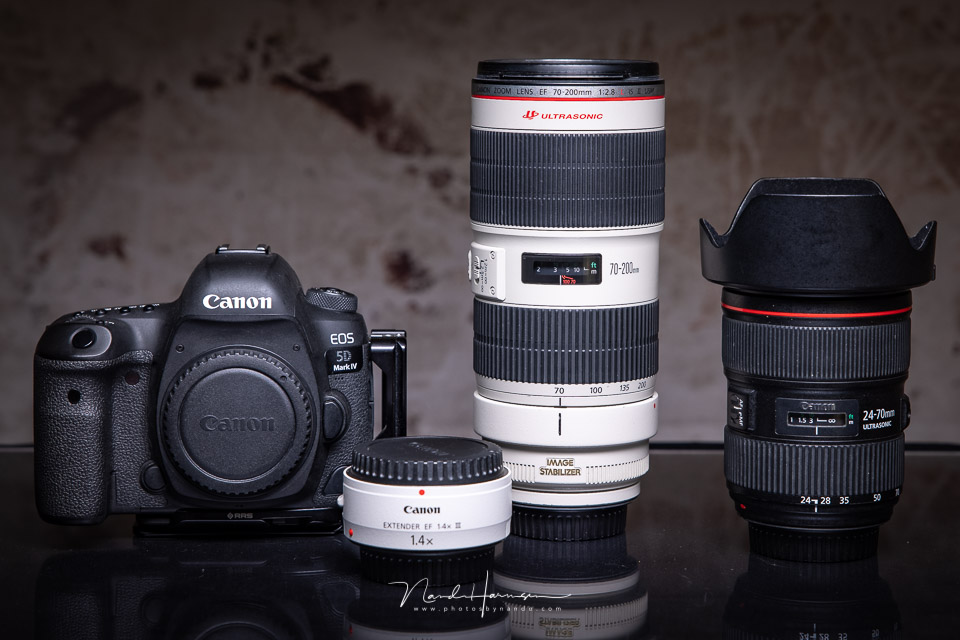
- Canon EF 24-70mm f/2,8L II
- Canon EF 70-200mm f/2,8L II
It is difficult to make a good choice here, as the choice also depends on which type of action or sport you enjoy photographing.
If you want to start with this type of photography, however, this is the choice I would recommend. In general, you can photograph all types of action and sport well with these two lenses.
Depending on the type of action or sport you enjoy photographing, you will probably run into a limitation fairly quickly. You could then choose a 100-400mm lens, or a prime lens with a wide aperture. Think of a 300mm f/2,8.
Animal photography
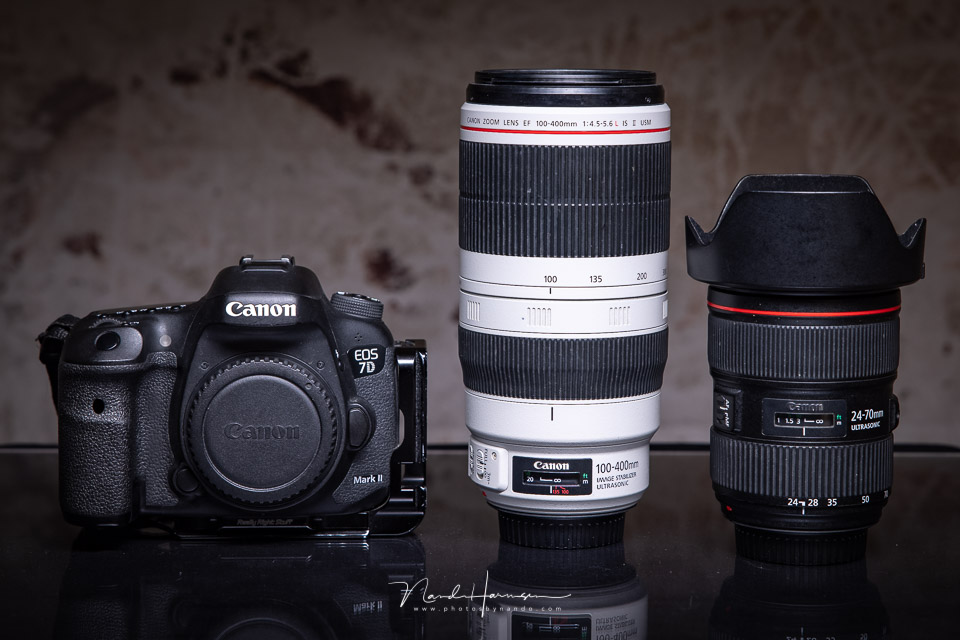
- Canon EF 24-70mm f/2,8L II
- Canon EF 100-400mm f/4,5-5,6L II
A long focal length is often a good choice in this situation. Do not make it too long, though, as before you know it you will have to deal with a loss of light, or rising warm air that makes your image hazy.
A shorter focal length is certainly worth considering too, of course for animals that you can approach more easily.
Alternatively, you can find other zoom lenses, such as a 150-600mm. If you want to specialise further, you will soon end up with prime lenses, such as a 500mm or 600mm lens.
They are often large and heavy, but above all very expensive. A 1.4x teleconverter can be a perfect and affordable addition.
Macro photography
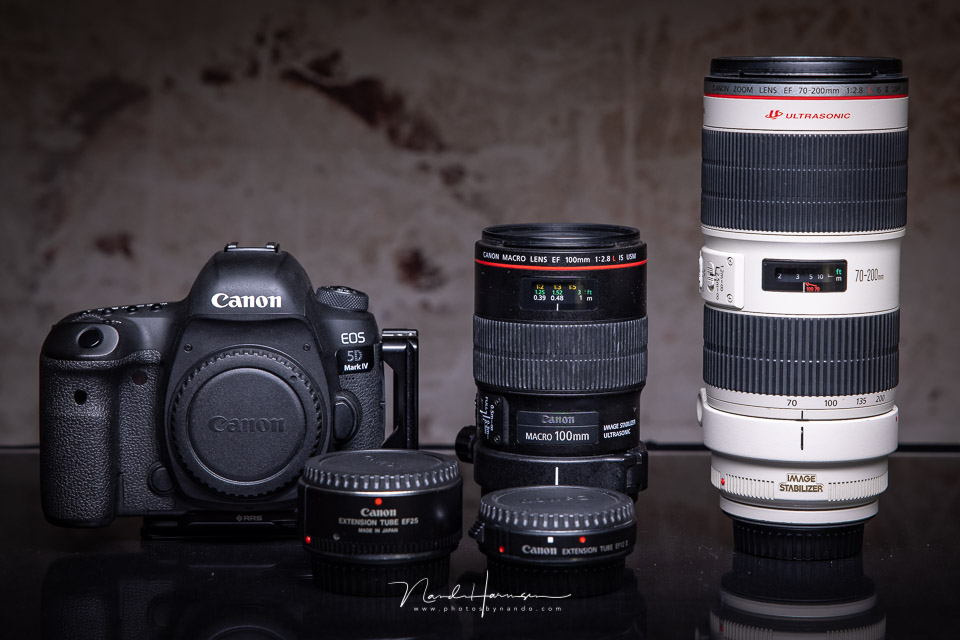
- Canon EF 100mm f/2,8L macro
- Canon EF 70-200mm f/2,8L II
For macro photography, you naturally want to get as close as possible. A macro lens gives you this option. With a slightly longer focal length, you can keep a little distance, although this is of course relative. A 100mm macro is an excellent choice.
You should certainly also consider a telephoto zoom lens such as the 70-200mm. You can zoom in perfectly on your small subject with it. It is not really macro, but semi-macro. If you expand your kit with a set of extension tubes, you can turn your 70-200mm into a very good lens for butterflies and mushrooms.
Alternatively, you can choose a macro lens with a longer focal length, or a 300mm telephoto lens combined with extension tubes.
Something for everyone
This is of course the choice I would make if I could only use two lenses. That choice may be completely different for you, and also very personal.
Share your ideal set of lenses for your photography in the comments below this post, and tell us why. This is useful for everyone.
About the author
Nando Harmsen has been photographing for more than 40 years. He specialises in wedding photography and landscape photography. Nando also gives talks, workshops, masterclasses and photo trips, and regularly reviews new and interesting equipment.
You might also like
-
 The difference between a wide-angle photo and a telephoto panorama
by Nando Harmsen
-
 Review of the Canon RF 600 and RF 800 Telephoto Lenses
by Nando Harmsen
-
 A vertical panorama for a wider angle
by Nando Harmsen
-
 Photographing a forest with a telephoto lens
by Nando Harmsen
-
 Landscape photography with a telephoto lens
by Erik Nevels
-
 Landscape photography with a telephoto lens
by Erik Nevels
0 comments
Be the first to share what you think!
Have your say
Please note: Articles older than a week can only be commented on by signed-in visitors.Would you still like to comment? sign in or create a free account.
Become a better photographer every week
A practical photography tip in your inbox every week.
39,078 photography enthusiasts already receive the tips! More about the weekly mail. Or keep up to date via  Facebook.

Elja Trum
Photofacts; everything to do with photography!
Would you like to take better photos and keep up with what is happening in photography? Photofacts publishes articles that teach you something about photography — from a product announcement to a practical shooting tip or a look at a website. Photofacts covers photography every day and is a hobby project of Elja Trum's that got out of hand. The articles are written by a team of volunteer authors. If you would enjoy writing one or more articles for Photofacts, do get in touch.More about PhotofactsPhotofacts is made possible in part by
