

Landscape photography with a telephoto lens
Saturday 23 April 2022, 14:28 by Erik Nevels | 4,448 views | 7 commentsThis article was translated from Dutch with the help of AI. Read the original.
Landscapes are often photographed with a wide-angle lens. That makes sense, as you get a lot of what you see into the photo.
But is that always what you want? Perhaps you want the sun to appear large in the frame, or you want to zoom in on an interesting subject in the landscape. In those cases, you need a standard or even a zoom lens.
What do I take with me?
When I head out to take landscape photos, I usually take all my zoom lenses with me, covering a total range from 17mm wide-angle to 600mm telephoto. That means a whole rucksack full of gear, even though I know there is a good chance I will only use one or two lenses.
Still, I put up with the extra weight because I especially do not want to regret leaving anything at home. The bag with filters no longer fits in the rucksack, but it comes along attached to the side. Of course, I cannot leave the tripod behind either.
Zooming in on the beautiful oak
One of my favourite trees to photograph is within cycling distance of my home. I visit this oak regularly throughout the year, and I still manage to take very different photos each time.
Naturally, the light and weather conditions are always different, which creates variation in the photos. But the choice of lens also creates variation.
Over the past two years, I have photographed the oak in the photo below at every possible focal length. This photo was taken at 225mm on a full-frame camera.
.jpg "20210222 Linnerhei tree untitled shot 7303539(2)")
I still remember the moment clearly. I had already taken a whole series of photos and had almost packed up my gear.
When I saw the initially bright red sun slowly disappear behind the mass of grey clouds, I quickly picked up my camera again and put it back on the tripod. Just in time, I found the right viewpoint and zoomed in.
Keeping distracting elements out of the frame
Using a telephoto lens for a landscape photo not only makes it possible to zoom in on what I like, it also lets me keep distracting elements out of the frame.
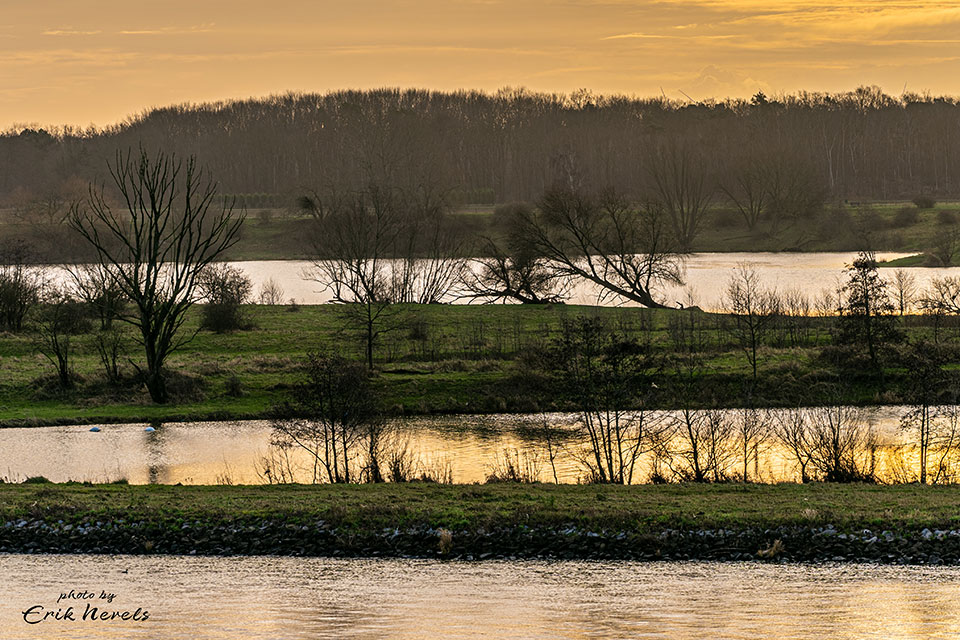
For the next photo, looking out over the Maas and the Maasplassen, I did not want any buildings or 'traffic signs' on the banks in the frame. Zooming in to 153mm did the trick.
It also produced exactly what I did want in the frame, a repetition of horizontal light and dark bands with some striking trees contrasting with the background.
Keeping the sky out of the frame
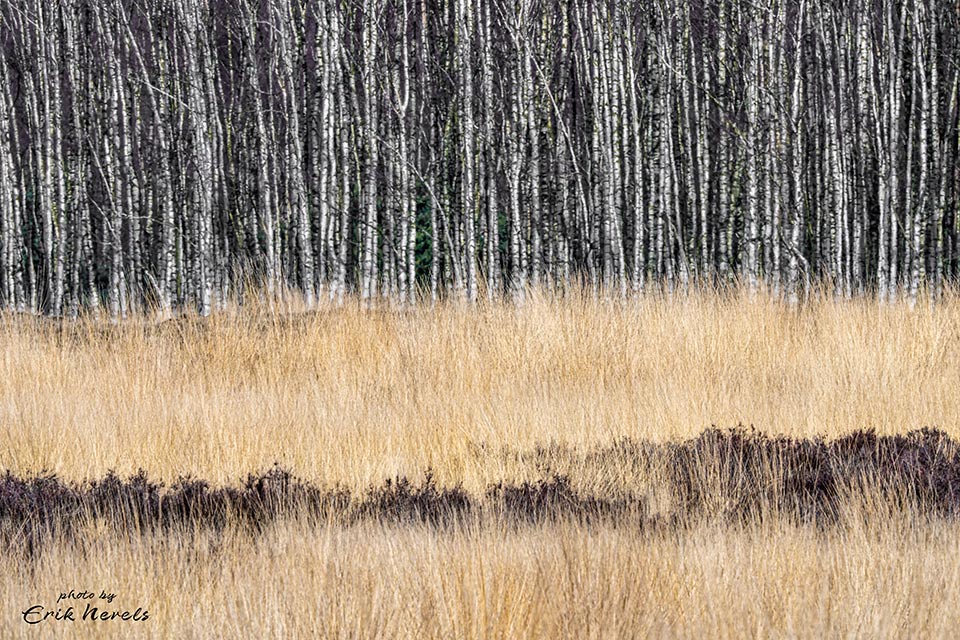
By using even more millimetres of focal length, I effectively compress the landscape further. The depth disappears, especially when you keep the sky out of the frame.
This often creates a surreal effect, as you can see in the following photo, taken at 600mm.
Here I deliberately kept the sky out of the frame to emphasise the idea of a stack of layers without depth. However, because you recognise what you are looking at, you still get the impression of a landscape.
Back to my favourite landscape.
Perhaps you recognise it, the tree on the right of the photo. It is the same tree as in the first photo, but taken a few months later and from a completely different angle.
I often return to my favourite places. The same goes for the final photo.
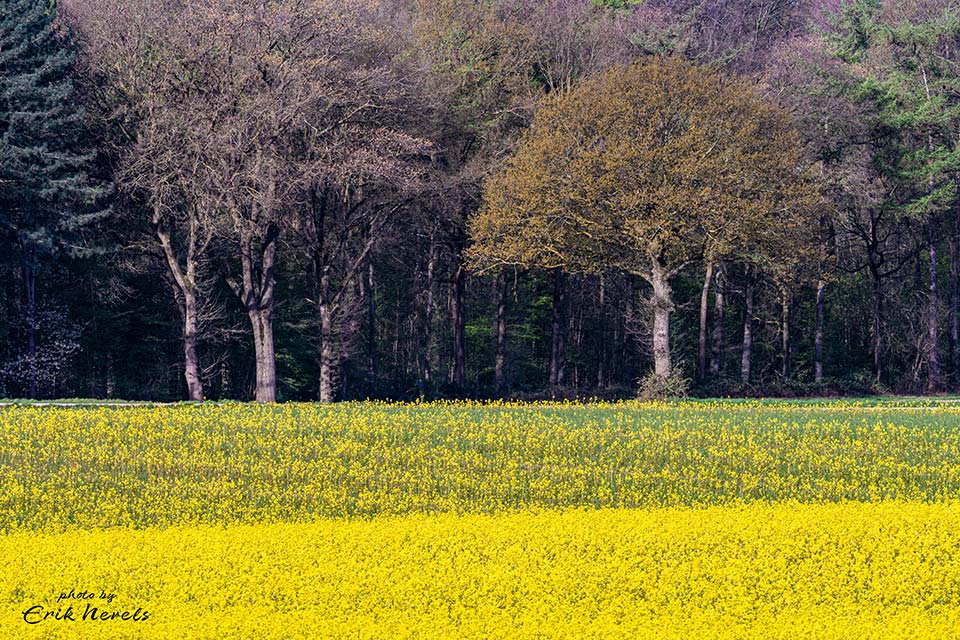
I had already seen them a few days earlier, the yellow fields beside the Linnerheide, one of my local patches.
I did not have to think long about choosing one of my favourite trees as the background. The woodland edge directly behind it completed the picture, partly because the oak contrasts beautifully with it in terms of colour. Zooming in to 422mm was enough to keep the sky just outside the frame.
Summary
Unless I know exactly which photo I am going to take and which lens I need for it, all my lenses are in my rucksack when I head out to take landscape photos.
Using telephoto lenses gives me the opportunity to look at the landscape in front of me in a completely different way. It is literally a more restrictive view, but that often makes it richer and more intimate. I limit the frame to what interests me and keep less interesting or even distracting elements out of it.
Landscapes that I previously photographed with a wide-angle lens, or even ignored, turn out to be worth zooming in on after all. So perhaps, after reading this article, you will return to your wide-angle landscape and take a closer look at it.
About the author
Steeds weer boeiend en op zoek naar de essentie! Dat is wat fotograferen in de natuur voor mij is. Gefocust op het landschap of het onderwerp in diens omgeving tracht ik meer dan alleen te registreren. Een continue uitdaging waarvan ik elke keer volop geniet. Meer foto's? Volg mij op Instagram en/of kijk op mijn website
You might also like
-
 Why zooming with your feet is not the same as zooming with a lens
by Nando Harmsen
-
 The difference between a wide-angle photo and a telephoto panorama
by Nando Harmsen
-
 Landscape photography with a telephoto lens
by Erik Nevels
-
 Landscape photography tip: zoom with your feet and your lens
by Nando Harmsen
-
 A tip for using telephoto lenses on a ball head
by Nando Harmsen
7 comments
-

 Donald Willemsen
wrote on Sunday 24 April 2022 at 09:29
| reply
Donald Willemsen
wrote on Sunday 24 April 2022 at 09:29
| reply
I prefer to photograph a landscape with a telephoto lens +/- 200 to 250mm and the camera in portrait orientation, and then take a series of photos to merge them into a panorama later. The advantage is that you have everything nicely large in the frame. The disadvantage of a wide-angle lens is that everything is shown smaller.
Translated from Dutch. -
 Nando
wrote on Tuesday 26 April 2022 at 10:38
| reply
Nando
wrote on Tuesday 26 April 2022 at 10:38
| reply
@Donald Willemsen:
Translated from Dutch.
Using a telephoto lens to photograph a wider angle is the same as using a wide-angle lens. The only difference is a higher resolution as the end result. But if you then view the photo on your 4K television, or on a 20x30 print (and larger), that panorama with a telephoto lens does not show more detail than one taken with a wide-angle lens.
The point of using a telephoto lens is precisely to bring out details, as Erik Nevels explains. -
Donald Willemsen
wrote on Tuesday 26 April 2022 at 11:06
| reply
@Nando, a telephoto lens 'compresses the image a bit', so to speak. Elements in the landscape are 'brought a bit closer to you' with a telephoto lens. They are then rendered somewhat larger compared to a wide-angle lens with a much broader angle of view. It indeed does not provide more detail, but by taking multiple photos and combining them into a panorama, you can achieve the same angle of view as with a single photo taken with a wide-angle lens, with the result that you see the elements in the landscape somewhat larger.
Translated from Dutch. -
Nando
wrote on Tuesday 26 April 2022 at 11:30
| reply
@Donald Willemsen:
Translated from Dutch.
I advise you to give it a try. Take a landscape with a wide-angle lens, then as a panorama with a telephoto lens and put them side by side.
The effect of 'squeezing together' is an optical illusion that only occurs when there is a considerable difference between the distance between foreground and background, combined with your own distance from the foreground object. However, if you stay in the same spot, there is absolutely no difference. -
Donald Willemsen
wrote on Tuesday 26 April 2022 at 12:11
| reply
@Nando, I will definitely get to work with your advice.
Translated from Dutch. -
 Hans van Sterkenburg wrote on Tuesday 26 April 2022 at 15:24 | reply
Hello photo friends,
Translated from Dutch.
At the time, temporarily without a wide-angle lens, I took a number of vertical photos at 50 to 70 mm as described above to combine them into 1 photo. Printed at 75-50 cm and fitted with a 1mm backing, presented in a box frame without glass, my customers respond delightedly without exception. My 14-35, which has since arrived, works excellently, but the vertical composite photo is here to stay.
Best, Hans -
Nando
wrote on Tuesday 26 April 2022 at 15:42
| reply
@Donald Willemsen and Hans van Sterkenburg:
Translated from Dutch.
I have written an article about the difference between a wide-angle photo and a panorama with a telephoto lens. Everything will be clear in it. It will be published online in due course.
Have your say
Please note: Articles older than a week can only be commented on by signed-in visitors.Would you still like to comment? sign in or create a free account.
Become a better photographer every week
A practical photography tip in your inbox every week.
39,023 photography enthusiasts already receive the tips! More about the weekly mail. Or keep up to date via  Facebook.

Elja Trum
Photofacts; everything to do with photography!
Would you like to take better photos and keep up with what is happening in photography? Photofacts publishes articles that teach you something about photography — from a product announcement to a practical shooting tip or a look at a website. Photofacts covers photography every day and is a hobby project of Elja Trum's that got out of hand. The articles are written by a team of volunteer authors. If you would enjoy writing one or more articles for Photofacts, do get in touch.More about PhotofactsPhotofacts is made possible in part by
