

A tip for using telephoto lenses on a ball head
Monday 12 February 2024, 17:17 by Nando Harmsen | 6,111 views | 17 commentsThis article was translated from Dutch with the help of AI. Read the original.
Do you use large telephoto and telephoto zoom lenses? Then you may have a special tripod head for them. If you don't, and use a ball head as your tripod head, this method can be a good alternative.
For large lenses, there are gimbal heads. This is literally a gimbal in which the lens and camera sit, allowing them to move freely while remaining perfectly balanced. This usually isn't necessary for a 70-200mm. But for a large 500mm or 600mm, it's recommended.
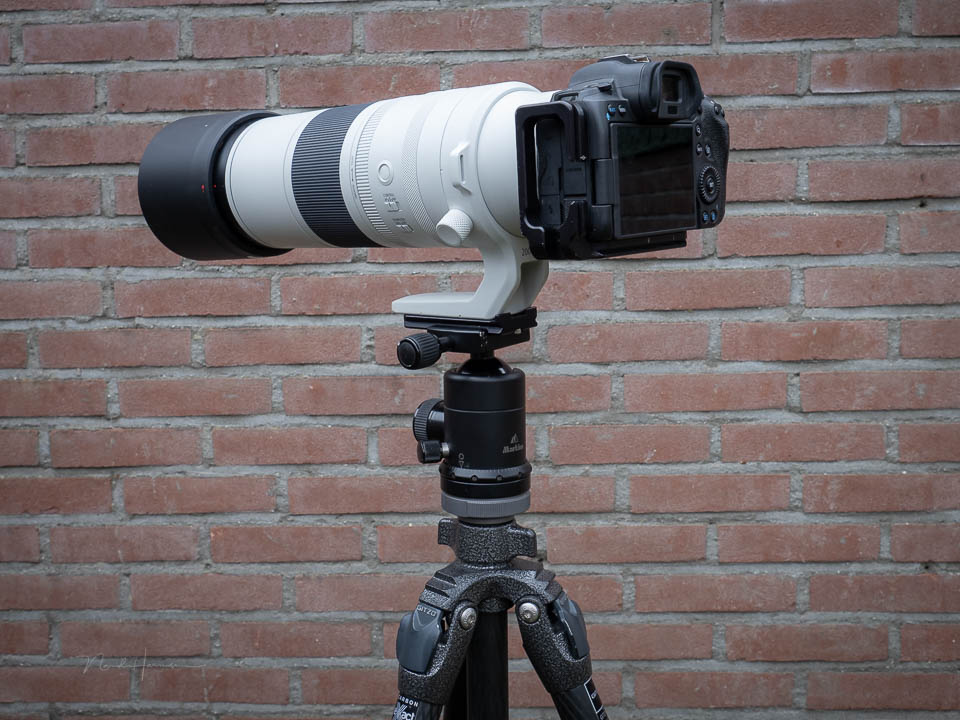
In an ideal world, you'd have a tripod with a gimbal head for huge telephoto lenses. Alongside that, a tripod with a three-way head, geared or otherwise, for architectural photography, for example, and a tripod with a ball head that's easy to take with you when travelling.
Or you could use all those specialised tripod heads on the same tripod, but that means constantly switching tripod heads. If that's not a problem, it's a good solution.
A ball head is very versatile in that respect, making it a perfect choice if you only want to use a single tripod head. But especially with large, heavy telephoto lenses, it can become top-heavy and no longer balance as comfortably.
Although a ball head offers exceptional freedom of movement, it works against you with large telephoto lenses. This is especially far from ideal when you need to follow a subject. But there's a solution that doesn't require an additional purchase.
Tilt the ball head 90 degrees, and rotate the camera and lens in the opposite direction in the tripod collar. Make sure the ball head is free to rotate, and unlock the ball head's panoramic rotation. You now have complete freedom of movement.
The camera can now be moved freely up and down, and from side to side. The camera and lens are also balanced, thanks to the tripod collar.
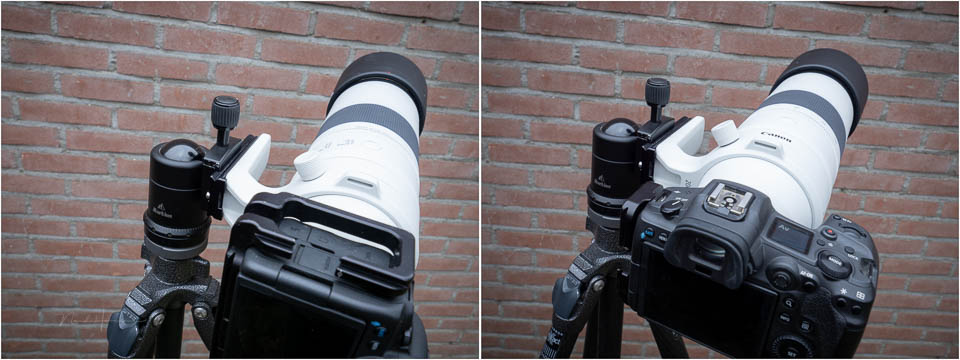
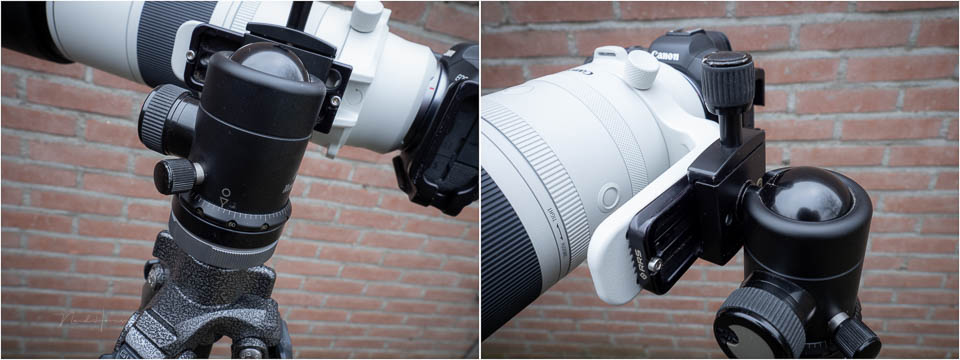
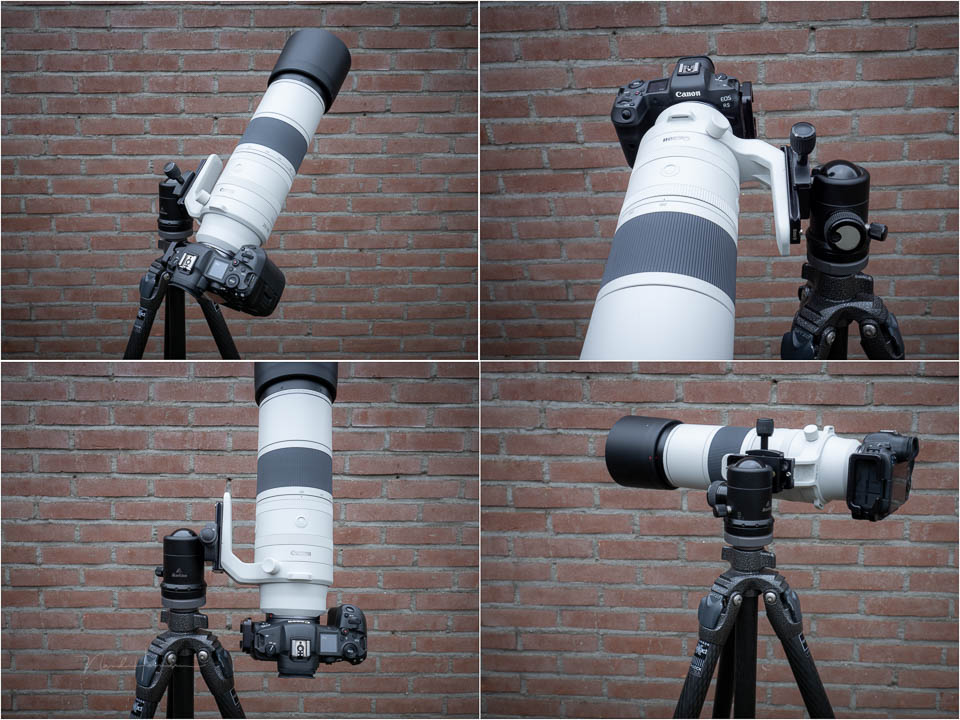
There are a few requirements. Your lens must have a tripod collar. The ball head must be able to support the weight without any problems. The ball head needs to have a panoramic rotation setting. And your tripod must be sturdy. A tall tripod is preferable too.
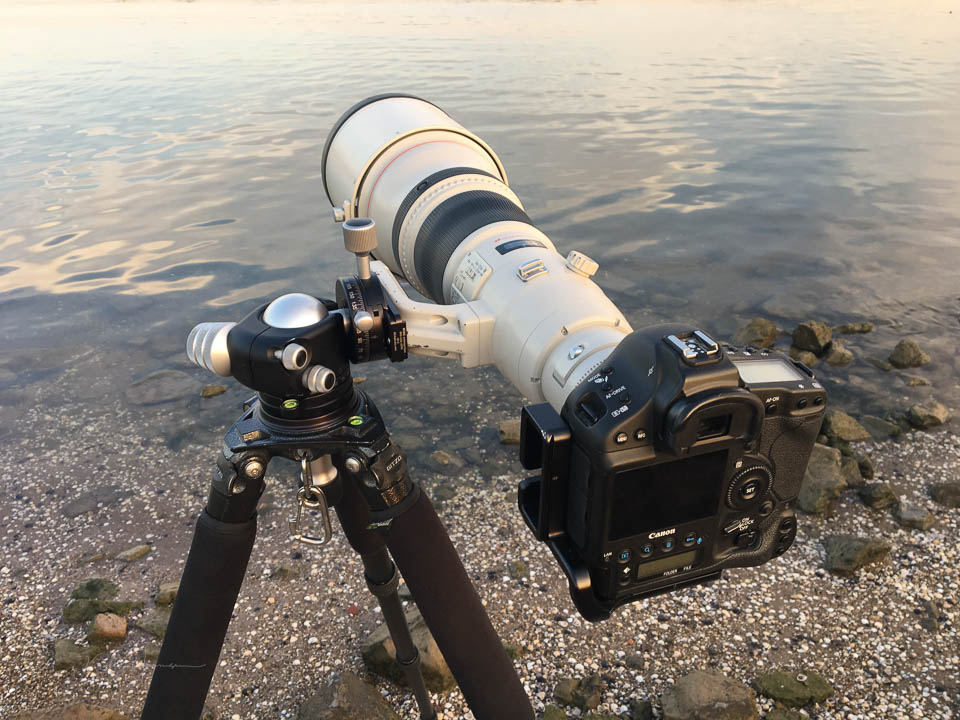
This obviously isn't a real replacement for a gimbal head. But it does give you similar freedom of movement for the camera and lens. There are also gimbal head brackets that you can attach to a ball head. That's another solution.
About the author
Nando Harmsen has been photographing for more than 40 years. He specialises in wedding photography and landscape photography. Nando also gives talks, workshops, masterclasses and photo trips, and regularly reviews new and interesting equipment.
You might also like
-
 Setting up a ball head
by Nando Harmsen
-
 Adjusting a gimbal head
by Nando Harmsen
-
 Which is best: a ball head or a 3-way head
by Nando Harmsen
-
 Review: Benro geared head
by Martin van Rooij
-
 Landscape photography with a telephoto lens
by Erik Nevels
-
 The difference between a wide-angle photo and a telephoto panorama
by Nando Harmsen
17 comments
-
 Pixeldude wrote on Tuesday 13 February 2024 at 11:45 | reply
Nice and undoubtedly useful article for FF lenses.
Translated from Dutch.
Fortunately, with my micro 4/3 cameras, even with a FF equivalent of 420mm, I don't have this problem at all due to the much smaller dimensions and weight of the lenses. 8-) -

 Nando
wrote on Tuesday 13 February 2024 at 13:20
| reply
Nando
wrote on Tuesday 13 February 2024 at 13:20
| reply
This isn't exclusive to full-frame lenses. This applies to all lenses that are large.
Translated from Dutch.
It also isn't about having trouble with it. I can also use my heavy lens upright perfectly well myself. But that doesn't mean that in some (or many) cases this doesn't offer much more flexibility and speed.
Just put the new 150-600mm from OM-Systems on your M43 camera... -

-
-
 Pieter kok wrote on Tuesday 13 February 2024 at 12:03 | reply
Is it advisable in both options to turn steady shot off ?
Translated from Dutch.
Pietet Kok. -
-
Pixeldude wrote on Tuesday 13 February 2024 at 13:57 | reply
A 4/3 150-600 is quite a lot to photograph handheld, that would correspond to a 300-1200 FF.
Translated from Dutch.
But with a 4/3 40-150 with a 2x converter, which therefore corresponds to an FF 160-600, that works fine. And with the very good stabilizers, 600mm handheld is perfectly doable, even in darker conditions without having to set the ISO above 1000. -
 Donald Willemsen wrote on Tuesday 13 February 2024 at 14:00 | reply
In itself, I think it is a valuable tip. But I too still have a few doubts.
Translated from Dutch.
By tilting the ball head 90° you place the weight of the lens/camera combination next to the center point of the tripod. Especially when using a center column, I suspect that an imbalance will then arise, or that one of the tripod legs will be loaded more heavily due to more pressure from the weight. That in itself again creates the possibility that one of the other legs may have less pressure and an imbalance will arise.
For the camera, I would then use an L-bracket to always have the camera at the center point of the tripod. With large lenses in a tripod collar, that only partially applies. You are then too limited in your movements, as you already indicate yourself.
Do you think my doubt is justified? -
-
Pixeldude wrote on Tuesday 13 February 2024 at 14:02 | reply
Nando, don't get me wrong. I really think your explanation is perfectly fine.
Translated from Dutch.
I always head out into nature without a tripod and I can photograph handheld with a 600mm. However, I usually use a 1.2 converter, which results in a max 420 FF.
One of the big advantages of a 4/3. -
 Pieter kok wrote on Tuesday 13 February 2024 at 14:30 | reply
With a “gimbal head” you move in principle! So NOT turn it off ?
Translated from Dutch. -
Nando
wrote on Tuesday 13 February 2024 at 14:38
| reply
Image stabilization is not for movement, but for the vibrations you make when trying to keep your camera/lens still.
Translated from Dutch.
If you deliberately move, image stabilization usually makes less sense and sometimes it works counterproductively because it tries to compensate for that movement.
If you pan, there is a panning mode on your image stabilization. Switch to that, so that only vertical movement is stabilized.
If your lens doesn't have a panning mode, it will probably detect panning automatically. Then you can leave it on. -
Donald Willemsen wrote on Tuesday 13 February 2024 at 15:43 | reply
Nando, why then is it advised 9 times out of 10 to switch off image stabilization when using a tripod? Is that referring to the IS in the lens or the IBIS in the camera or both?
Translated from Dutch. -
-
 Eduard Barreveld wrote on Tuesday 13 February 2024 at 16:11 | reply
Nando, I have been using this method for quite some time when I go "bird hunting" with my spotting scope with my phone on it as a camera. Even though I sometimes wonder whether the mechanical load on the GITZO ball head might be a bit too much. But I have never had a problem with it. One suggestion: make sure the weight is properly balanced, otherwise the spotting scope (or the camera with telephoto lens) could suddenly "snap" forwards or backwards!!
Translated from Dutch.
Eduard -
-
 Albert Wester
wrote on Sunday 18 February 2024 at 14:35
| reply
Albert Wester
wrote on Sunday 18 February 2024 at 14:35
| reply
Actually, what you see here are the consequences of not thinking carefully enough about buying your equipment. Yes, a ball head has a great deal of freedom of movement, but that is also the major disadvantage of a ball head. You have to adjust your camera on the ball head in 3 dimensions all at once and that is not easy!
Translated from Dutch.
A good and stable tripod is simply very expensive, and to prevent running into situations in the future, you need to look at the various compromises you will then have to make. Do you want a lightweight travel tripod, do you want a stormproof tripod, do you want it high or low, aluminium or carbon? They all have their pros and cons, but the same also applies to tripod heads. But what is often forgotten is that a tripod is only as sturdy as the head being used and the head is only as stable as the tripod being used. I see an extremely stable Gitso tripod in the photo, but with the (heavy) camera and lens next to the centre point of the tripod. You can have such a good tripod, but the consequence of this setup is that the whole thing, including the head, will be extremely unstable! Let that be a warning to everyone!
I have also used the setup Nando suggests a number of times and I had to catch the whole thing twice because it was blown over by the wind, and that made me decide to look for something else.
Through trial and error, I have become wiser and started seeing a tripod AND head as one system. I now have a Benro Mammoth TMTH44C tripod which has a leveling base with a Leofoto VH-30R 2-Way Head on top. With this, you can very easily level the tripod head and then adjust it dimension by dimension, so left/right and up/down.
This system is excellent for small and large equipment, is extremely stable in storms, has an acceptable weight and easily fits in a suitcase to take along on trips.


Have your say
Please note: Articles older than a week can only be commented on by signed-in visitors.Would you still like to comment? sign in or create a free account.
Become a better photographer every week
A practical photography tip in your inbox every week.
38,982 photography enthusiasts already receive the tips! More about the weekly mail. Or keep up to date via  Facebook.

Elja Trum
Photofacts; everything to do with photography!
Would you like to take better photos and keep up with what is happening in photography? Photofacts publishes articles that teach you something about photography — from a product announcement to a practical shooting tip or a look at a website. Photofacts covers photography every day and is a hobby project of Elja Trum's that got out of hand. The articles are written by a team of volunteer authors. If you would enjoy writing one or more articles for Photofacts, do get in touch.More about PhotofactsPhotofacts is made possible in part by
