

Why the Farne Islands Should Be on Your Bucket List
Tuesday 11 December 2018, 11:58 by Michelle Peeters | 24,235 views | 7 commentsThis article was translated from Dutch with the help of AI. Read the original.
The Farne Islands, also known as the Farnes, are a group of English islands off the coast of Northumberland. They are a dream destination for photographers.
In this article, five reasons why these islands, and Northumberland as a whole, should be on your photographic bucket list!
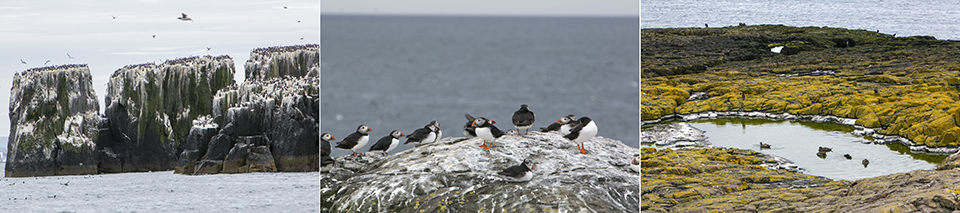
There are 15 to 28 islands, depending on the tides. They lie 2.5 to 7.5 kilometres from the mainland. The islands are divided into two groups: the Inner Group and the Outer Group.
The main islands in the Inner Group, which is closest to the mainland, are Inner Farne, Knoxes Reef, and the East and West Wideopens.
At low tide, the four islands form one large island. Megstone is also considered part of the Inner Group, but even at low tide it remains a separate island. The highest point of the island group is on Inner Farne, at 19 metres above sea level.
The main islands in the Outer Group are Staple Island, Brownsman, North and South Wamses, Big Harcar and Longstone. The Inner and Outer Islands are separated by Staple Sound.
1. Close by and easy to reach
The best way to really experience Northumberland and the Farne Islands is by car. You can take the overnight ferry from IJmuiden to Newcastle, or from Rotterdam to Hull, and drive the final stretch to Seahouses in about an hour.
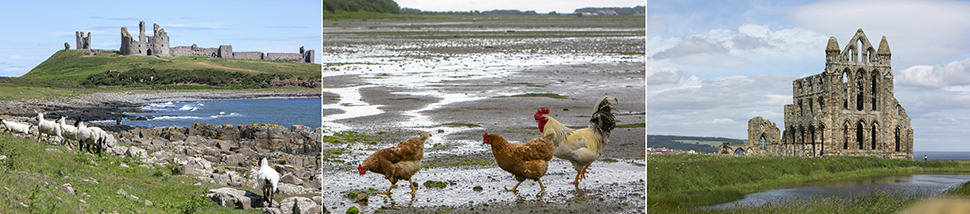
This allows you to see more of the unspoilt natural beauty and the magnificent castles, including Alnwick, Bamburgh, Lindisfarne and Dunstanburgh. This also makes the destination great for solo travellers!
Make sure you have enough days to make one or more new attempts if you cannot take photographs on the first day, for example because bad weather means the boats cannot sail. It also gives you the chance to explore the islands at a more leisurely pace and take in everything you see.
In the harbour at Seahouses, where it always smells of fish and chips, the boat companies compete for every customer they can get. Do your research, as each company offers a different trip.
If, for example, you want to land on the most distant Longstone Island, with its red and white lighthouse, which is well worth seeing, you need to go with Billy Shiel. All the boat companies have a stall on the quay in Seahouses where they sell tickets.
We booked the All day bird Watch tour. This costs around 45 euros per person. You also have to pay a landing fee of 27.50 euros per person. If you are a member of the National Trust, you do not have to pay this.
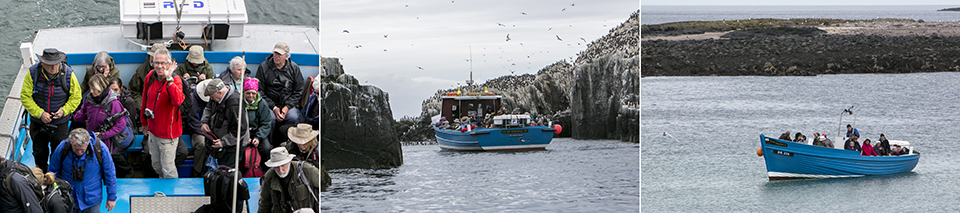
This tour is particularly suitable for keen ornithologists and photographers, or anyone who wants to spend more time observing the wealth of nesting bird species.
Do try to respect nature, though! I saw several photographers using their selfie sticks to go under the path barrier so they could photograph puffins up close. This is not on, as it greatly disturbs the birds. They have enough trouble surviving as it is!
The rangers, who also collect the so-called landing fee, which is put to good use for nature conservation, do keep an eye on things and you are not allowed to leave the designated paths, but of course they cannot see everything.
The trip leaves daily between 9.30 and 10.00 am from Seahouses harbour and only operates during the breeding season, in May, June and July. The total duration is about six hours.
You can spend two hours walking around Staple Island in the morning and two hours on Inner Farne in the afternoon. It is a good idea to bring a packed lunch, as there are no facilities on the islands.
National Trust members can land for free. Non-members pay the landing fee to the National Trust Rangers in Seahouses, at the office in the harbour. You then show your wristband on each island.
This tour also includes a cruise around all the islands, allowing you to see seabird nests on the cliff faces and the grey seal colony from various viewpoints.

2. Birds
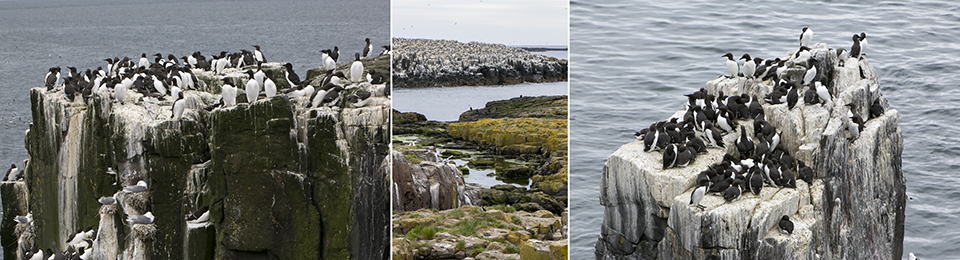
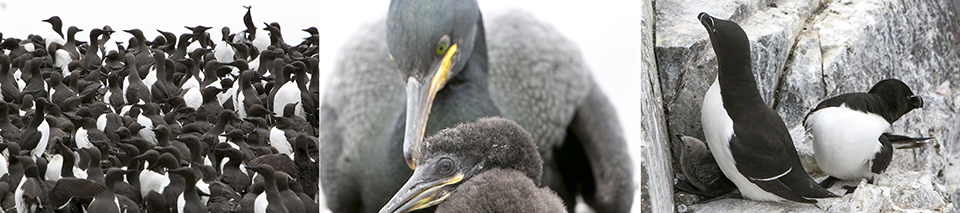
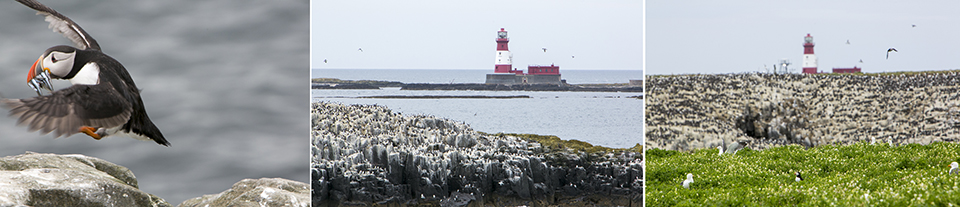
Inner Farne and Staple Island are known for the rare seabirds, 22 species, that breed there. Arctic terns and common terns are the most common. Cormorants, northern fulmars, guillemots, razorbills and kittiwakes also breed among the rocks.
Further inland, as many as 70,000 puffins live here, along with many eider ducks.
If you travel to the islands during May, June or July, you also have an excellent chance of photographing puffins.
These comical and highly photogenic creatures fill the islands during this period. They hatch their eggs there and raise their young.
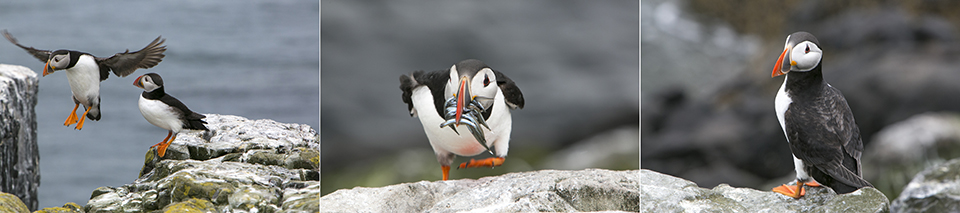
Here are a few tips for photographing puffins:
- I photographed at f/11 and a fairly high ISO value, 1600, with my 200mm lens fitted with a 2.0 extender. This allowed me to shoot at 400mm, which was an incredible luxury.
You could practically photograph a puffin with a wide-angle lens on the Farne Islands, but shooting from a distance means you can photograph the birds without disturbing them and they do not feel watched.
You also get a lovely blurred background straight away. Another advantage is that you can photograph them in flight more easily, as you have time to zoom in and follow them with your camera; - Focus on the eyes. A wide aperture is not necessary when you are using a long telephoto lens. You will have that blurred background anyway. Make sure the eyes are really sharp, otherwise it will not be an engaging photograph and you can consider it a failure;
- Try to keep raising the bar for yourself. Start with the 'easy' shots of birds sitting on their nests or on the rocks.
They often have beaks full of small sand eels that they have just caught from the sea, which is already very impressive to photograph. After that, you can try to capture them in flight.
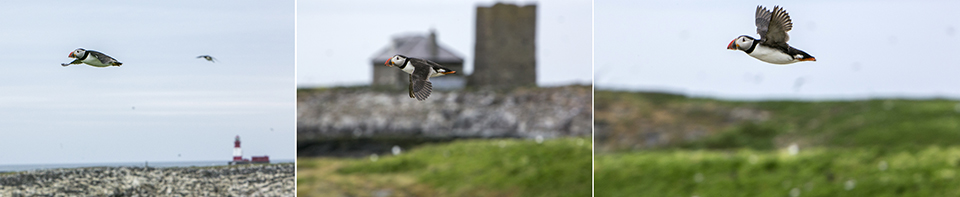
Try to spot them over the sea as they fly in and follow them with your camera until you think they are close enough to press the shutter button; - Make sure you have enough batteries, as the cold drains them quickly, and memory cards with you. I had a 64GB card with me and filled it in no time. Especially when you need to take lots of photos to get a successful shot of a puffin in flight. It takes a bit of practice before you get the hang of it.
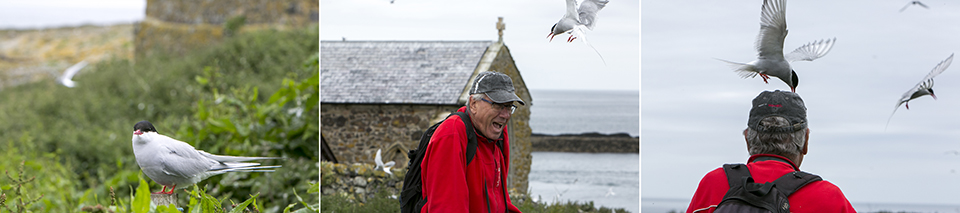
On the second island where we landed, Inner Farne, the first was Staple Island, the Arctic terns are in charge. They breed everywhere, including next to and on the path! Anyone familiar with nesting terns knows how aggressive these birds are at that point. The tip about putting something on your head is not excessive, as you are constantly attacked...
3. Lighthouses
The Farne Islands are also known for the old lighthouses found there. The islands are notorious among sailors. It is no coincidence that Seahouses has a lifeboat service.
The ultra-modern lifeboat there is called Grace Darling. Grace lived with her parents in the distinctive red-and-white lighthouse on Longstone Island and, in 1838, single-handedly rescued seven shipwreck survivors from her rowing boat.
The lighthouse on Inner Farne dates from 1809. Before that, a fire was lit on the tower of the 1370 Prior Castle during bad weather.
The lighthouses on Staple Island and Brownstone are no longer in use, although ruins of former lighthouses can still be found there.
4. Grey seals
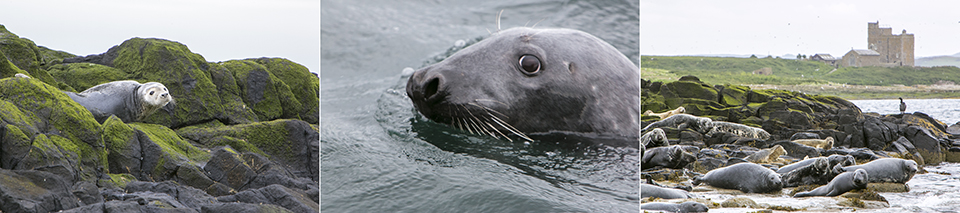
You can also see England's largest breeding colony of grey, or Atlantic, seals here. They often lie lazing on the rocks or bob about in the sea. Every autumn, from November to January, around 1,000 seal pups are born here.
The grey seals living around the islands can easily be seen from the excursion boats. The animals usually rest on the rocks around the islands.
Being surrounded by a mass of seals is not something you experience every day either. It is a fantastic spectacle, and the skipper steers the boat so close to the rocks that you can almost touch the hundreds of sunbathing animals. Without disturbing them, of course.
Here are a few tips for photographing grey seals:
- When photographing seals from the boat, set as fast a shutter speed as possible. The swell makes it particularly difficult to capture them sharply at a long focal length.
If necessary, increase the ISO to 1600 or 3200. Noise is no longer a problem at high sensitivities with most cameras; - Pay close attention to what is happening around you and around the boat. Seals are very curious, and a head regularly pops up above the water as they look at you inquisitively. Try to focus on the eyes, or the head. You can consider a photograph with blurred eyes a failure;
- Pay attention to your composition and try to include an attractive setting, such as a small castle, tower or pleasing diagonal line, in the background.
5. Photographing the Milky Way
Northumberland National Park has the darkest skies in Great Britain at night. On a clear night, you can see the Milky Way here and, if you are lucky, even the Northern Lights. You can only see the Milky Way in complete darkness.
In the Netherlands, there is often too much light pollution in many places, except on the islands. The Light Pollution Map shows you clearly where light pollution is worst, or least severe.
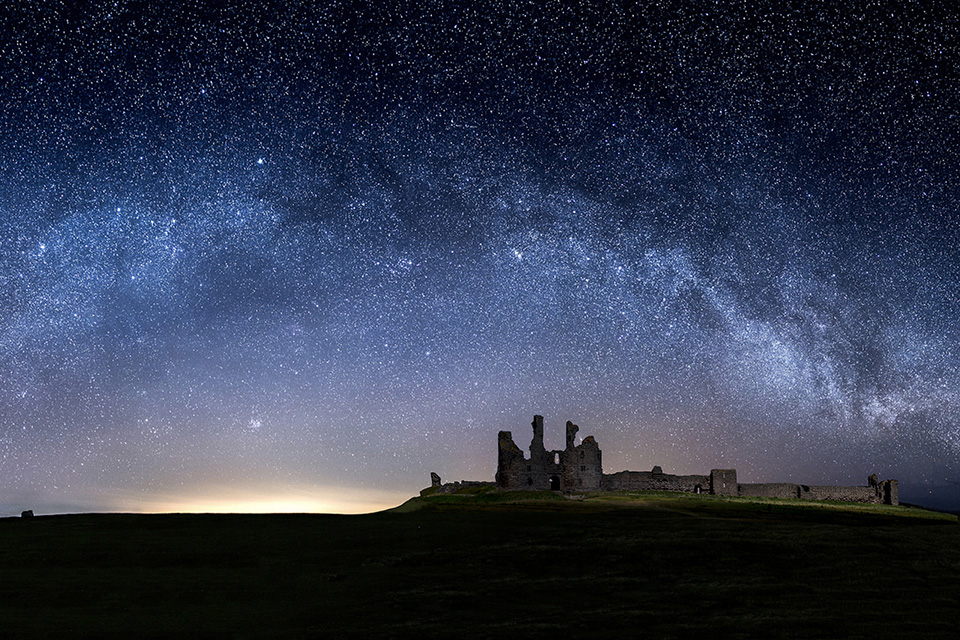
Here are a few tips for photographing the Milky Way:
- Choose a clear evening or night, otherwise there is no point going out to take photographs. The sky needs to be clear to see the stars. Also check the phase of the moon, as the glow from a full moon can seriously obstruct your view of the Milky Way;
- In summer, the centre of the Milky Way is around 15 to 20 per cent above the southern horizon in the late evening. This centre is naturally very photogenic and fairly easy to photograph, but other areas of the night sky can also be very attractive;
- As stars give off very little light, you need to work with high ISO values. A full-frame camera is therefore a real advantage, as it suffers less from noise;
- Use a wide-angle lens so you capture as much of the Milky Way as possible, 17mm on a full-frame camera and 11mm on a crop camera. With a wide-angle lens, you are also less affected by stars appearing as streaks because of the longer shutter speed. You see this effect much sooner with a zoom lens;
- Be aware that with a wide-angle lens at the same aperture setting, you let in less light than with a zoom lens. You will therefore need to open the aperture further to get the same amount of light;
- Bring a tripod, camera and lenses, as well as a blanket or chair to sit on. It will take a while. Also bring something to eat and drink;
- Use the two-second self-timer or a remote control and shoot in RAW. Put the camera on a tripod, as low as possible, to minimise movement;
- Focus manually, as autofocus is not an option for photographing stars. You can do this by zooming in on a bright star and focusing through live view. If the star appears as a point, you are in focus. Setting the focus scale to infinity is also an option, but in practice this is not accurate enough;
- Photograph in M mode and open the aperture as wide as possible, using the smallest f-number. You need to collect as much light as possible. Set a high ISO value, such as 3200. You will have to accept the noise, as the Milky Way is so faint that you need to do everything possible to gather enough light;
- A good starting point might be ISO 3200, f/2.8 and 29 seconds. Take a first shot and check your histogram to see whether there is a peak somewhere around the middle. As your shutter speed and aperture are already at their maximum, you can only adjust the ISO value if you need to change the exposure;
- When you import the photographs onto your computer, there is a good chance the Milky Way will not be immediately visible. You will therefore need to do quite a lot of post-processing. You can mainly adjust the contrast and mid-tone contrast, or clarity.
You can also give the Milky Way some extra brightness with the adjustment brushes. This does create a lot of noise, which you can correct with noise reduction. Finally, you could make the white balance a little bluer for a nice effect; - Compose an attractive image with the Milky Way as the subject. It works well to include some foreground so you can get your bearings in the photograph. A distinctive house, shed or castle, Dunstanburgh Castle in this case, works perfectly!
More tips?
If you have more tips about this beautiful area or would like to share your experiences, let us know in the comments!
Bird photography course
And if you really want to learn more about photographing birds, take the Bird Photography Course by Daan Schoonhoven and Arno ten Hoeve on Photofacts Academy.
About the author
Michelle Peeters is fotografe en oprichter van DeuxBleus Fotografie. Michelle herkent het bijzondere in het gewone en het gewone in het bijzondere. Ze heeft zich nooit willen specialiseren en is daardoor van alle markten thuis.
You might also like
-
 Nikon ambassador Sebastián Liste documents deforestation in the Amazon
by Michelle Peeters
-
 Tip: create a shot list
by Elvira Smit
-
 Make a list of your favourite places
by Nando Harmsen
-
 Should you list photography prices on your website?
by Wilmar Dik
-
 Long Exposures on the Opal Coast
by Nando Harmsen
-
 Elinchrom launches new flash, the FIVE
by Elja Trum
7 comments
-
 Petra Van Der linden wrote on Monday 2 July 2018 at 15:39 | reply
This is definitely recommended. I went there last year and was able to take some stunning photos. I will definitely go back again.
Translated from Dutch. -
 Dies Groot Fotografie wrote on Tuesday 3 July 2018 at 10:49 | reply
Michelle, compliments on the perfect article.
Translated from Dutch. -
 anneke janissen wrote on Tuesday 3 July 2018 at 13:02 | reply
That sure makes you want to go! nice travel brochure Michelle
Translated from Dutch. -

 Michelle Peeters wrote on Tuesday 3 July 2018 at 13:03
| reply
@Anneke: if you take the English weather for granted, then yes
Translated from Dutch.
-
 Jeanine wrote on Wednesday 4 July 2018 at 06:41 | reply
Yes, you can take so many beautiful photos there this year. Highly recommended for every photographer and animal lover!
Translated from Dutch. -
 Willemijn wrote on Wednesday 4 July 2018 at 08:41 | reply
What a nice, informative article! Last year we also took the boat to Newcastle, but we (like probably many others) continued on to Scotland. I had never heard of the Farnes! I would especially really like to see the puffins sometime.
Translated from Dutch.
On the way from Newcastle to Scotland (and back) we did see a small part of Northumberland. We also stopped briefly at Hadrian's Wall, which really made an impression. The English weather actually cooperated nicely in this case: it drizzled a little from time to time along the way, but just as we got out, the sun broke through the clouds, creating a wonderful effect on the view of the surrounding (rolling) hills. That also happened quite often during our holiday in Scotland: the grey sky suddenly broke open. For photography, that is often very beautiful - and low-hanging grey clouds are also somewhat part of the landscape... So don't let a fear of bad weather stop you from travelling that way! -
Michelle Peeters wrote on Wednesday 4 July 2018 at 08:52
| reply
@Willemijn: yes, Hadrian's wall is also something very special and beautiful to photograph! At certain points it resembles the Great Wall of China a bit, especially near the village of Hexam. And indeed, when under heavy cloud cover the sun just peeks through, you have the perfect light that Scotland (and also Northumberland, which is much less known and touristy) is so renowned for!
Translated from Dutch.
Have your say
Please note: Articles older than a week can only be commented on by signed-in visitors.Would you still like to comment? sign in or create a free account.
Become a better photographer every week
A practical photography tip in your inbox every week.
38,900 photography enthusiasts already receive the tips! More about the weekly mail. Or keep up to date via  Facebook.

Elja Trum
Photofacts; everything to do with photography!
Would you like to take better photos and keep up with what is happening in photography? Photofacts publishes articles that teach you something about photography — from a product announcement to a practical shooting tip or a look at a website. Photofacts covers photography every day and is a hobby project of Elja Trum's that got out of hand. The articles are written by a team of volunteer authors. If you would enjoy writing one or more articles for Photofacts, do get in touch.More about PhotofactsPhotofacts is made possible in part by
