

13 tips for wildlife photography on Helgoland
Wednesday 12 December 2018, 20:44 by Michelle Peeters | 18,171 views | 9 commentsThis article was translated from Dutch with the help of AI. Read the original.
Helgoland is a small rocky island covering just 1.7 square kilometres. It lies in the North Sea, around seventy kilometres from the German coast. The highest point on Helgoland is sixty-one metres above sea level.
Next to Helgoland lies an even smaller island called Düne. Düne is a seven-minute boat ride from Helgoland. Both islands are small enough to explore on foot and are a paradise on earth for wildlife photographers.
Birds and seals
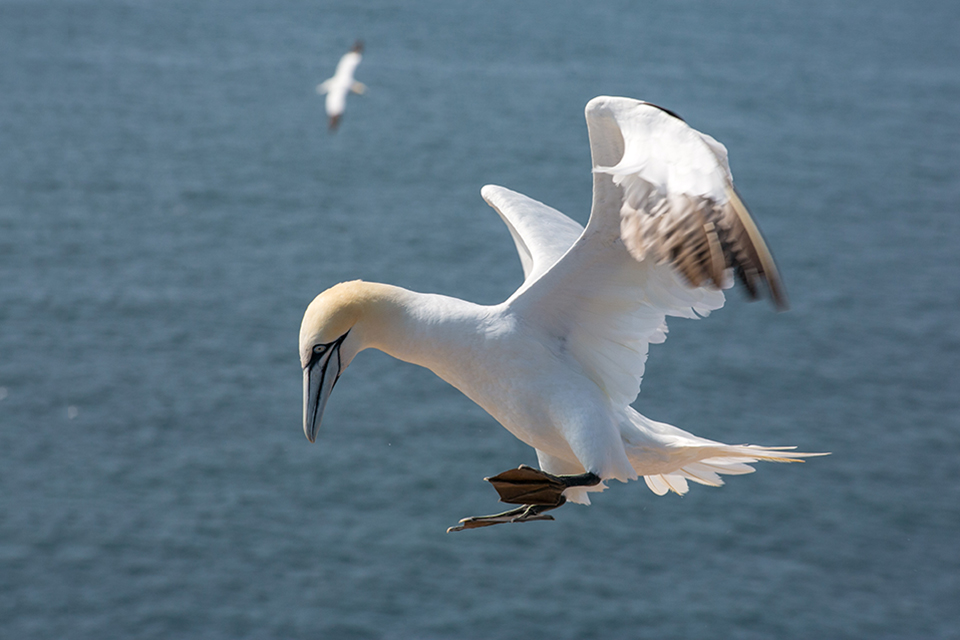
The islands are home to large colonies of gannets, guillemots, kittiwakes, lesser black-backed gulls and seals. With more than four hundred bird species recorded, this island is interesting for more than just bird photographers.
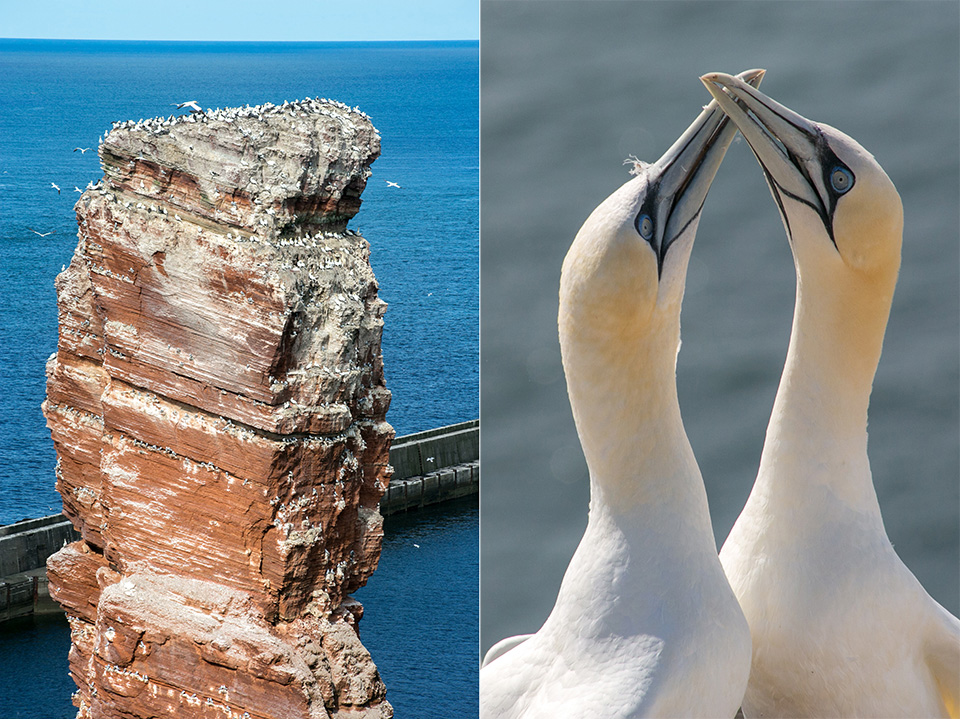
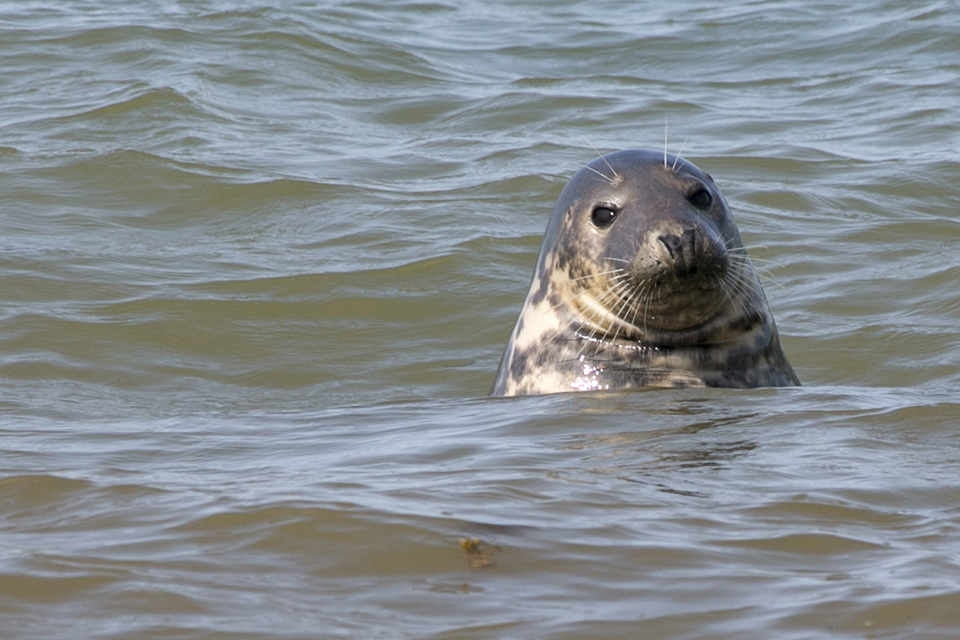
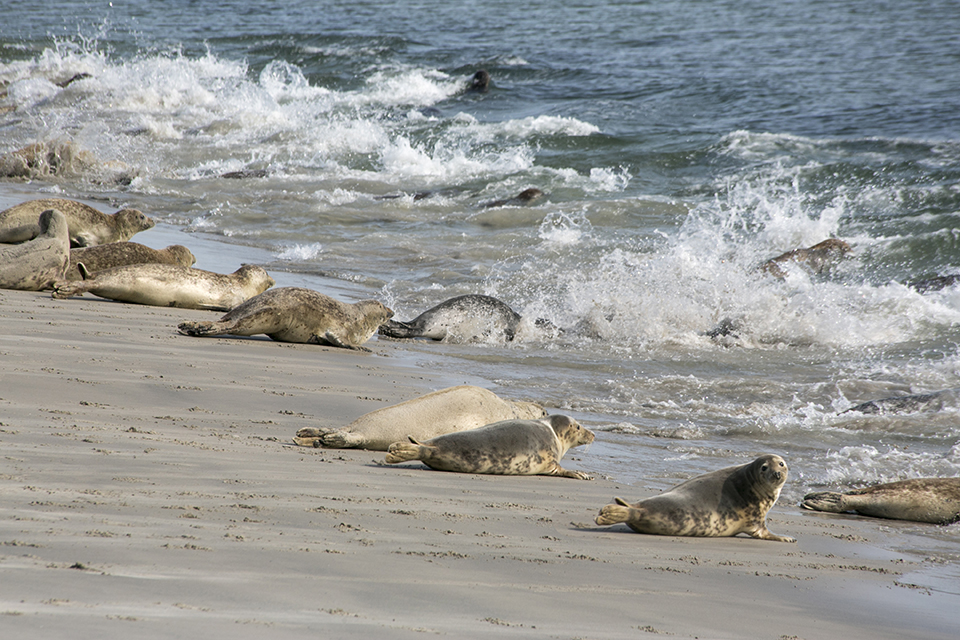
The many bird species nest on the Lange Anna rock at a relatively short distance, making for a remarkable sight. On the small island of Düne, entire colonies of grey seals can be photographed from a slightly greater distance, around thirty metres.
I experienced this in August this year. The half-grown pups were still being fed constantly, a wonderful sight! In this article, I share some practical and photographic tips for anyone planning to travel to Helgoland.
1. When should you go to Helgoland?
There is something to see at any time of year. There are three periods that are especially interesting, depending on your goal.
In spring, from April onwards, the cliffs are occupied by gannets, kittiwakes and guillemots, making them especially good subjects for photography. They remain present throughout most of the summer, but are at their peak in May and June.
In autumn, Helgoland is the Mecca for twitchers. At this time of year, rare vagrants appear almost daily. In winter, from mid-November to mid-December, you can visit Düne for the grey seal pups.
2. How do you get there?
You can reach Helgoland by boat from Wilhelmshaven, Büsum, Hamburg, Bremerhaven and Cuxhaven. We chose Cuxhaven as our port of departure.
You can choose between two different boats here. A fast catamaran or a slower ferry. The catamaran takes around an hour and a half and costs just under 100 euros. The slower ferry takes around two and a half hours but costs only 50 euros.
From the harbour in the centre of the village, which is not the harbour where the boat from Cuxhaven arrives, a water taxi leaves for Düne every hour. This small island, or sandbank really, next to Helgoland's airport is home to the seal colony on the northern beach.
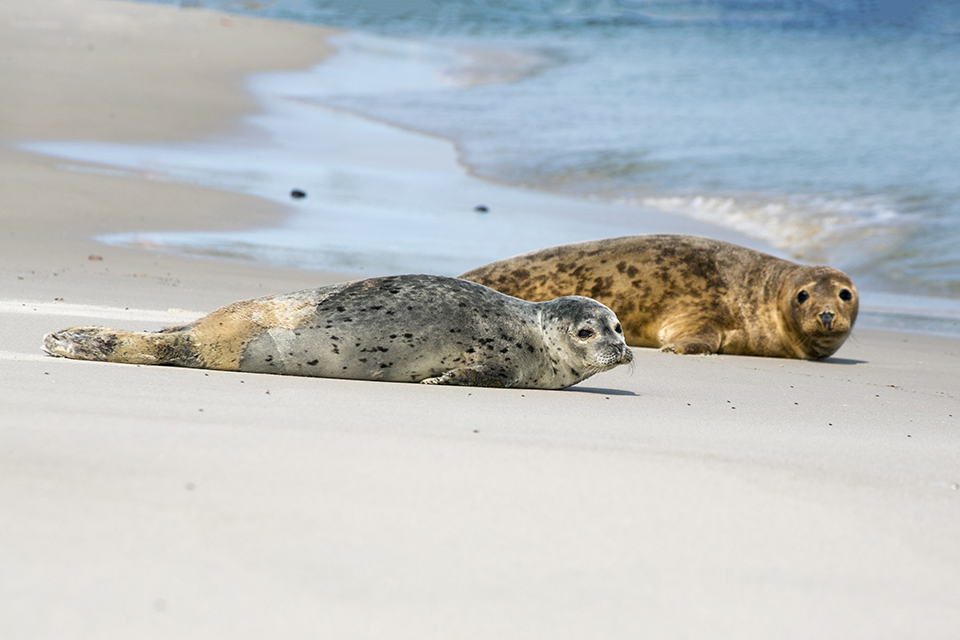
Once the boat docks at Düne, it is a five-minute walk to the start of the beach and your first view of the seals' large grey and brown bodies.
3. Accommodation
Accommodation on Helgoland mainly consists of a few simple hotels and small flats in traditional houses.
There is a campsite on Düne that is open during the summer season. Bear in mind that all camping equipment must be carried on foot, as cars and bicycles are not allowed on either island!
The island has considerable differences in elevation. Some of the buildings are in the lower part, while others are high up on the rock. It does not matter much where you stay, as a lift connects both parts of the village. Via www.helgoland.de you will find the clearest overview of the available accommodation.
4. What should you photograph, where and how?
As well as the wildlife, many birds, two types of seals and flora, both islands are also suitable for beach photography, including sand, pebbles and rocks, and landscapes. Sunrise and sunset, moving water and dunes with marram grass are just some of the many possible subjects.
There is little for photographers to see in Unterland, the low-lying, tourist part of Helgoland. You need to be in Oberland for the birds. You can get there on foot or by cable lift.
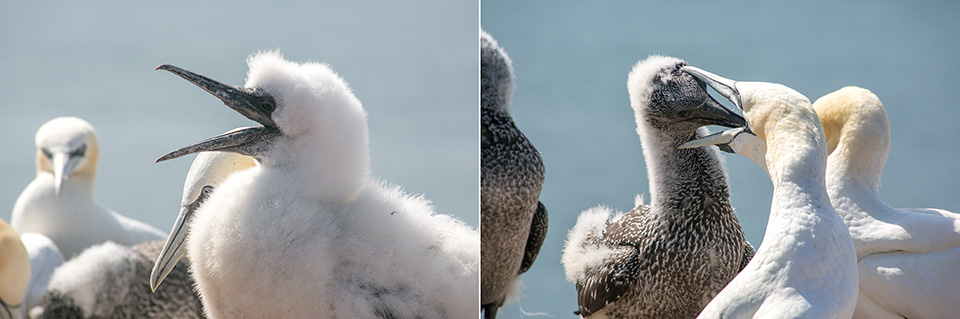
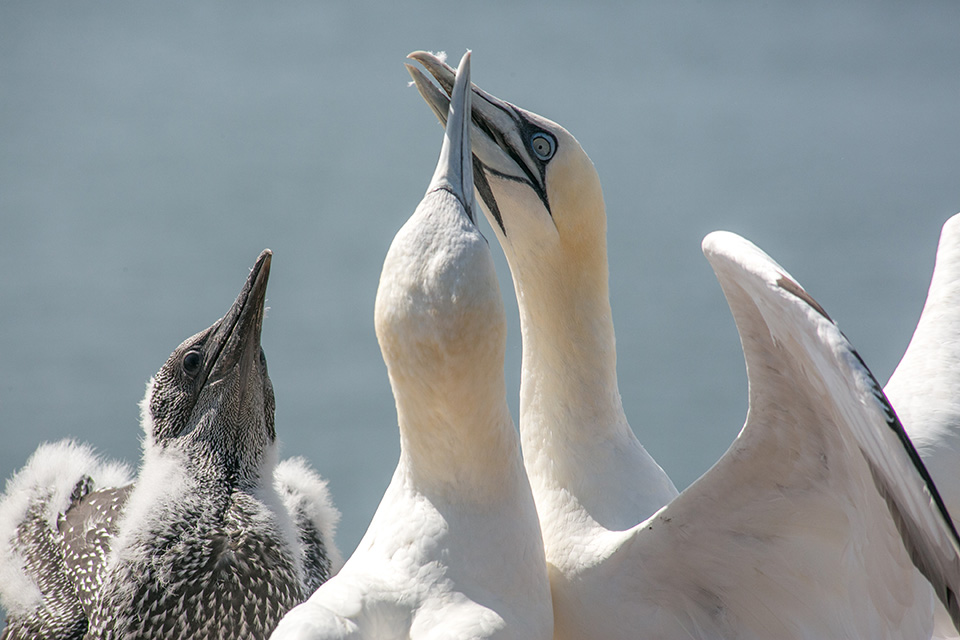
The best place for photographing birds is almost at the very tip of the island. The gannets are just one or two metres from the fenced path here.
5. Equipment
Depending on the type of photos you want to take, such as close-up portraits, habitat, birds in flight or other subjects, you will naturally need to bring several lenses and a good camera.
At a minimum, take one body, a wide-angle zoom, 17-40 mm or 24-55 mm, a telephoto zoom, 70-200 mm or 70-300 mm, and enough memory cards. If you have a fast lens, you can get excellent results with a teleconverter, 1.4 or 2.0x, especially on Düne.
If you cannot or do not want to decide, simply take everything you can or want to carry. More zoom range means more kilos, but also the possibility of capturing more detail.
It is also useful to bring a good tripod, as there is always wind at the top of the cliff.
6. Depth of field
As well as using a fast shutter speed to get sharp photos, especially of birds in flight, it is a good idea to keep a close eye on your depth of field.
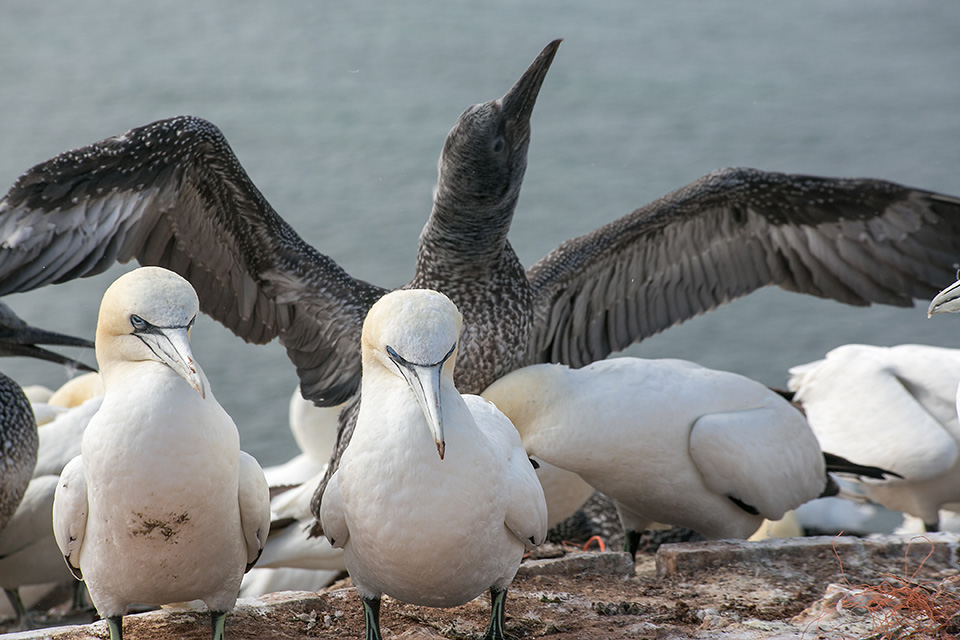
A blurred background is nice, especially when you can no longer see the wood for the trees among the huge colonies, and works particularly well with an aperture of f/5.6 or f/6.1 and/or by zooming in a lot.
However, make sure that both eyes of one bird are sharp.
7. Birds in flight
The guillemots and kittiwakes often sit lower on the cliffs, but they can also be photographed well with 300 mm or more.
For flight shots of the gannets, it is best to use a 70-300 mm lens, or longer. The birds fly in from the sea to within a few metres and then let themselves crash onto their nest.
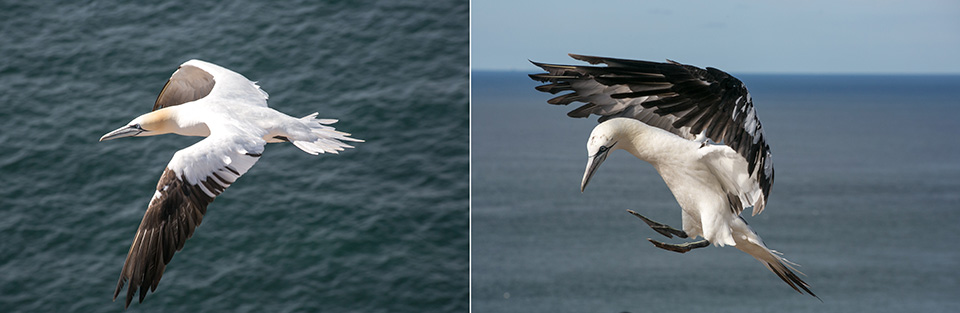
For flight shots of the kittiwakes and guillemots, it is also best to use a longer lens, and you will need to act quickly. This also demands quite a bit of speed from your lens.
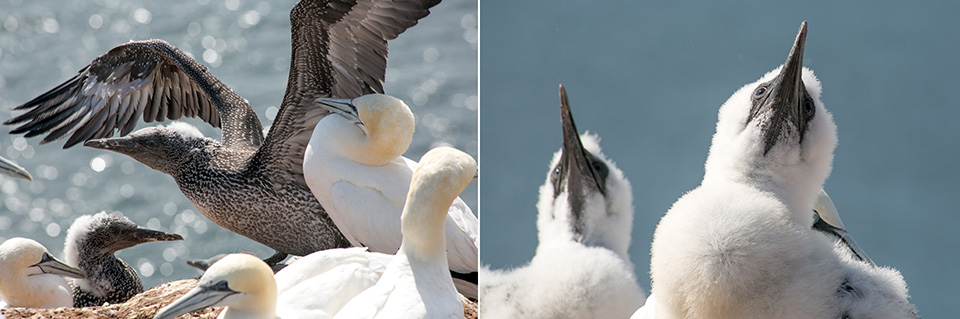
8. Side lighting
At the north-western tip of Helgoland lies the rock that provides shelter for thousands of breeding seabirds. In the morning, the sun rises behind you. In the evening, the sun sets in line with the western coast.
In June, however, you have the disadvantage that the sun rises very early. With around 25 minutes of brisk walking, this means getting out of bed at about 04:00 in the morning to be there in time for the first rays of sunlight.
This disadvantage also has an advantage, as it means you can enjoy the side light of the setting sun until late in the evening.
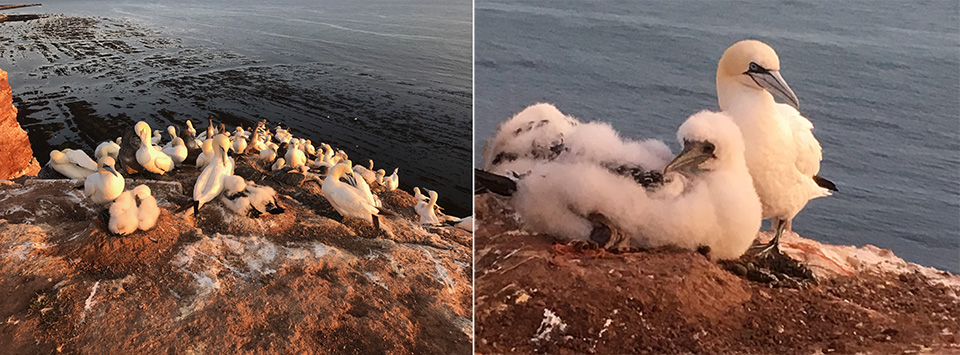
Unfortunately, I was also there a lot in the middle of the day, and I have to say that photographing almost into the sun was still quite manageable. Especially because you often point your lens slightly downwards.
With a wide aperture in particular, this creates lovely sparkles in the background, especially when you zoom in a lot.
9. Mainly seals on Düne
You need to be on Düne for seals, eider ducks, lesser black-backed gulls, oystercatchers and other waders.
A colony of lesser black-backed gulls is spread across almost the entire island. The young birds wander around the island and are very easy to photograph. However, do not get too close, as the parents may suddenly attack.
Oystercatchers also often walk around on the beach. You need to show a little more patience to photograph them well. Other waders, such as dunlins, ringed plovers and golden plovers, can also regularly be found here.
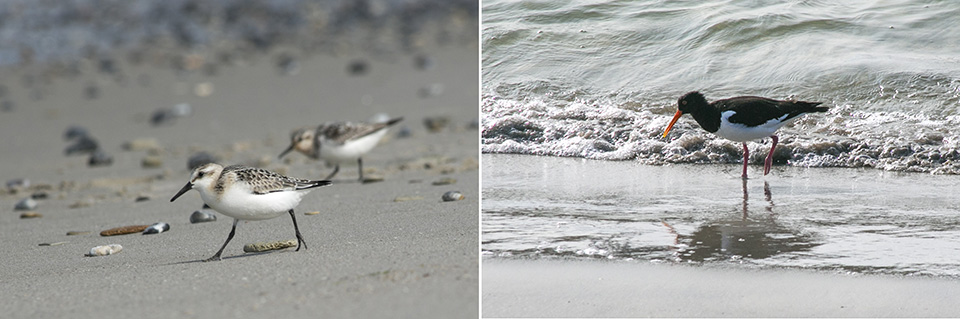
Several eider ducks are regularly found on that same beach, although you hardly ever see the males on the beach. This is because it is the females that care for the young.
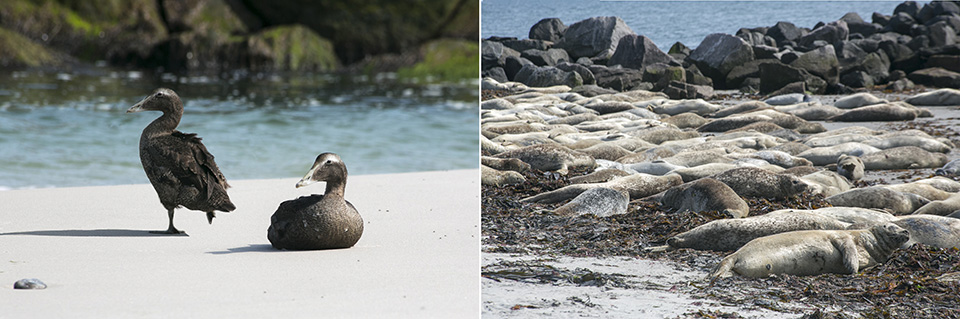
Large colonies of harbour seals and grey seals lie on the beaches of Düne. Visitors are asked to keep at least thirty metres away, but if you lie down near the seals before the water comes in, they often come closer out of curiosity.
The grey seals in particular seem to be very lazy and hardly pay any attention to photographers.
If you go to Düne in December, the grey seals have just had their pups, and these seal pups with their white downy coats are very photogenic. For the vagrants, you need to be almost anywhere on Helgoland and Düne, so the message is to keep your eyes open.
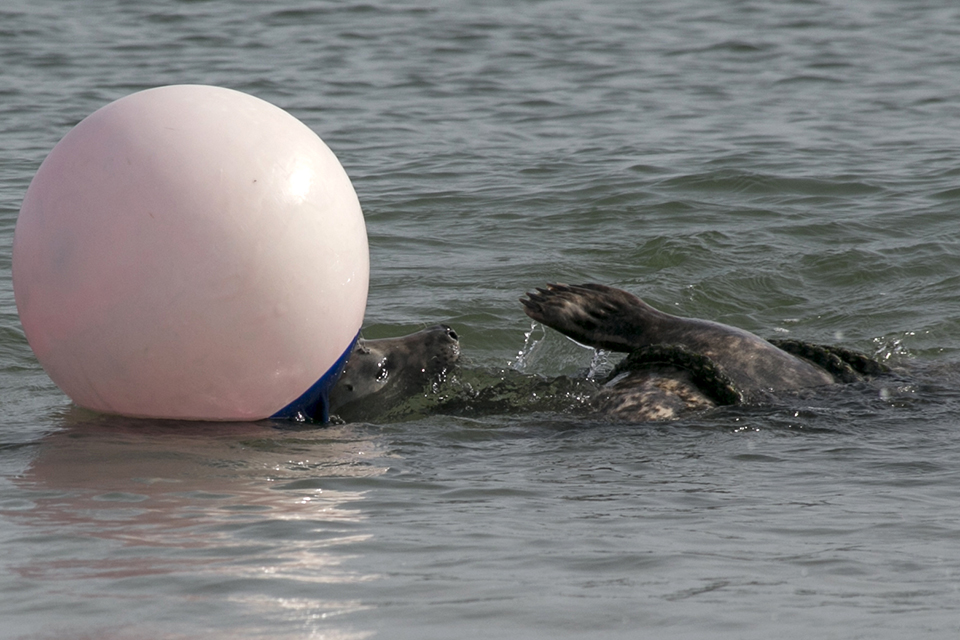
10. Rules for photographing seals
Before continuing your walk and actually getting started with photography, it is a good idea to pay attention to the rules that apply on this beach, such as:
- Keep a distance of thirty metres from the seals
- Do not make noise
- Do not feed them
- Take care, as these are predators after all.
Study the rules for visiting the grey seals in advance. You can do this, among other things, by studying the tourist office leaflet. It helps if you can focus on photography on the day itself and know what is and is not allowed.
An official Seehundenjäger walks around the beach. If you do not follow the rules, this person is authorised to fine you or remove you from the beach.
You can easily make a mistake, as I noticed myself. The distance of thirty metres can sometimes be difficult to judge. If the Seehundenjäger speaks to you, remain polite, agree with him and promise to do better.
11. Colour variations and scuffles
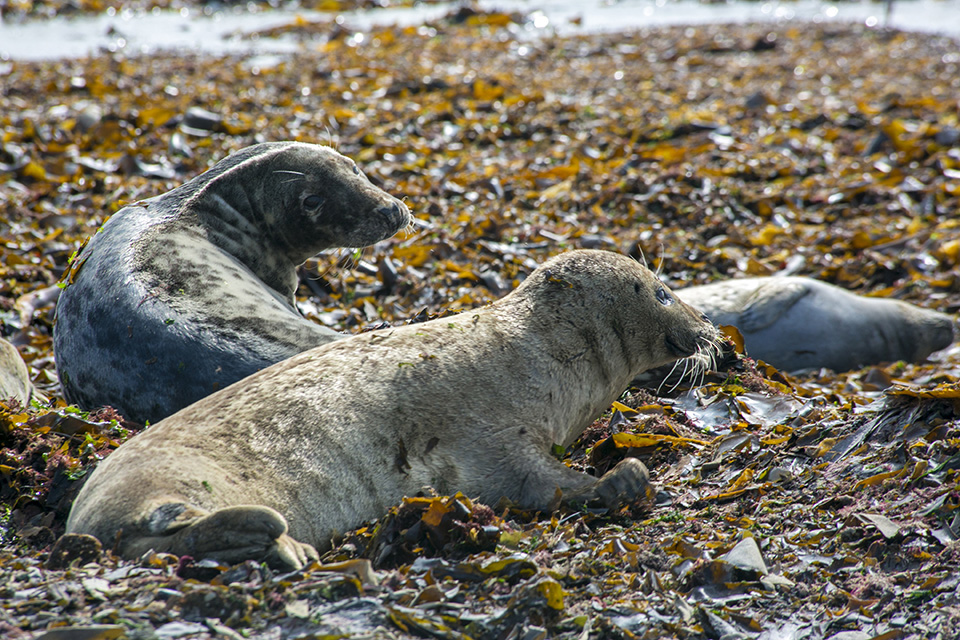
Between mid-November and mid-December, young seals are born on the beach. This period is therefore a special experience. The seal pups are very appealing, but the adult animals are also wonderful to capture.
Because of the colour variations in their coats, but also because of the fights and scuffles that are constantly taking place between the animals. The males are impressive because of their weight and length. If you enjoy photographing animals, this is highly recommended.
The distance of thirty metres means you need a decent zoom lens if you want to bring the seals closer. I used a Canon EOS 5d Mark III in combination with a 70-300 mm lens, which ultimately was mainly used at 300 mm as well.
12. Higher ISO values
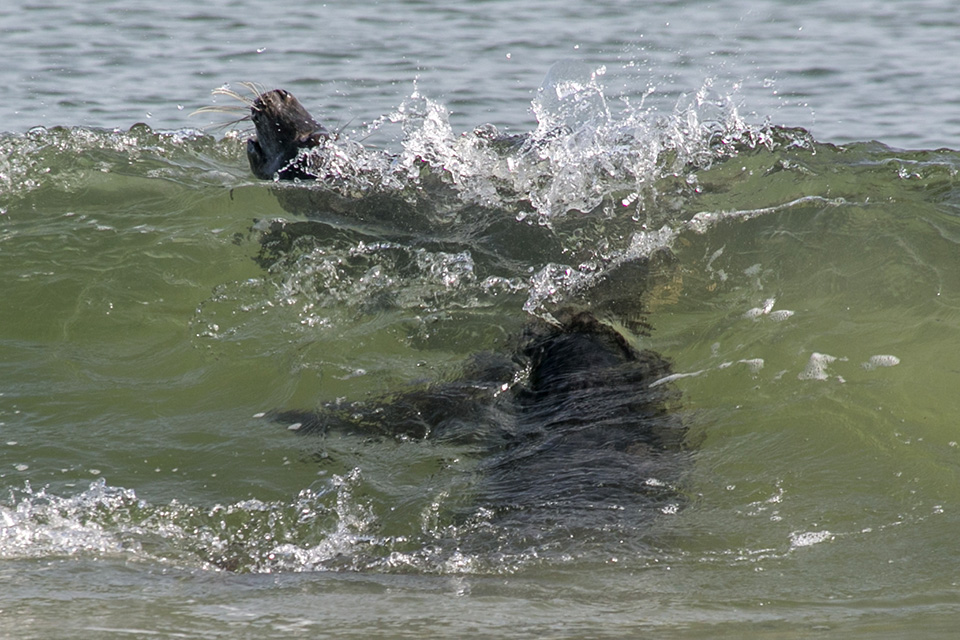
Also be prepared to use higher ISO values and slower shutter speeds. There are a few reasons for this:
- The earlier you arrive on the beach, the quieter it is and the easier it is to take your photo without fellow photographers in the background. At the same time, this is when there is the least light
- It is often foggy on Helgoland. There are wonderful photos of bright blue skies on Helgoland in circulation, but in practice the chance of fog is greater than the chance of sunshine, in the middle of the North Sea. Fog also means less light
- Seals look large and cumbersome, but they move remarkably quickly! The same applies to the birds, including those flying in. A lower ISO value does reduce noise, but it gives you blurred photos to begin with.
The animal's head is constantly moving in particular, reacting to its surroundings. If the animal is not moving, it is asleep, and those are not the most attractive photos.
13. Luck and respect
As so often in wildlife photography, it is important to be in the right place at the right time and to have a bit of luck. Respect for nature goes without saying.
Bird photography course
If you would like to learn more about photographing birds well, the bird photography course at Photofacts Academy may be for you.
» Find out what you will learn in the bird photography course
You can take this and other courses for two weeks with a free trial membership.
About the author
Michelle Peeters is fotografe en oprichter van DeuxBleus Fotografie. Michelle herkent het bijzondere in het gewone en het gewone in het bijzondere. Ze heeft zich nooit willen specialiseren en is daardoor van alle markten thuis.
You might also like
-
 Why the Farne Islands Should Be on Your Bucket List
by Michelle Peeters
-
 Freek Vonk for Nikon in the Falkland Islands
by Michelle Peeters
-
 Equipment needed for wildlife and bird photography
by Michelle Peeters
-
 17 Bird Photography Tips from Wilfried Solarz
by Michelle Peeters
-
 A telephoto lens isn't just for birds
by Erik Nevels
-
 Photographing birds? Practise first.
by Nando Harmsen
9 comments
-
 Wim Bettonviel wrote on Tuesday 5 September 2017 at 11:53 | reply
I've been there once before, it's really stunning, and I got some beautiful photos out of it. You do have to reserve the boat during the high season. A disadvantage is that if you go by ferry boat, you are put in a rowboat before Heligoland to get ashore. With the catamaran you arrive directly on shore.
Translated from Dutch. -

 Michelle Peeters wrote on Tuesday 5 September 2017 at 12:00
| reply
@Wim: yes, the chance of getting beautiful photos is really very high! It reminded me a bit of the Galapagos Islands, because you can get so close to the animals. We were there in high season and didn't have to reserve the boat. They do cram it pretty full and you can forget about getting a seat (unless it's on the floor)... Those tenders are also a thing of the past, the ferry can simply dock in the harbor!
Translated from Dutch. -
 Nico van Harskamp wrote on Tuesday 5 September 2017 at 14:35 | reply
You can also travel from the Eemshavens in Groningen to Heligoland
Translated from Dutch. -
Michelle Peeters wrote on Tuesday 5 September 2017 at 14:38
| reply
@Nico: I did indeed read something about that! That's quite a long crossing... (from Groningen you can drive to Cuxhaven in a few hours). And it's just a question whether this will go ahead in winter as well..
Translated from Dutch. -
 Richard van Duivenbode wrote on Tuesday 5 September 2017 at 16:59 | reply
Heligoland is absolutely an experience. We got home exactly a week ago after a 5-day stay.
Translated from Dutch.
Had fortunately prepared well and equipped my Nikon D7000 with new SD cards. I have I never shot so many pictures. I can wholeheartedly recommend flying with OFD (Ostfriesischer-Flug-Dienst), it was an experience for us in a 10-seater. We have now been there twice and a third time will certainly follow. -
Michelle Peeters wrote on Tuesday 5 September 2017 at 17:02
| reply
@Richard: yes indeed, I also completely filled up an 8Gb SD card. That tip about that OFD flight is perfect, is it expensive or not too bad?
Translated from Dutch. -
 Nico van Harskamp wrote on Wednesday 6 September 2017 at 11:29 | reply
You can also, I think, leave for Heligoland from Eemshaven, but then you go via Borkum.
Translated from Dutch.
The company is AGems I think, you can inquire there about the departure times too. -
Michelle Peeters wrote on Wednesday 6 September 2017 at 11:34
| reply
@Nico: you're right, it is indeed possible: AG Ems shipping company
Translated from Dutch. -
Michelle Peeters wrote on Tuesday 12 September 2017 at 10:52
| reply
Richard's comment: Flying is unfortunately not the cheapest option.
Translated from Dutch.
The boat trips with Cassen Eils are the cheapest option and the faster (catamaran) one is more expensive again.
We departed from Cuxhaven/Nordholz by plane, but there are also other airports.
Prices can be found on this website.
Have your say
Please note: Articles older than a week can only be commented on by signed-in visitors.Would you still like to comment? sign in or create a free account.
Become a better photographer every week
A practical photography tip in your inbox every week.
38,764 photography enthusiasts already receive the tips! More about the weekly mail. Or keep up to date via  Facebook.

Elja Trum
Photofacts; everything to do with photography!
Would you like to take better photos and keep up with what is happening in photography? Photofacts publishes articles that teach you something about photography — from a product announcement to a practical shooting tip or a look at a website. Photofacts covers photography every day and is a hobby project of Elja Trum's that got out of hand. The articles are written by a team of volunteer authors. If you would enjoy writing one or more articles for Photofacts, do get in touch.More about PhotofactsPhotofacts is made possible in part by
