

Should you list photography prices on your website?
Sunday 31 March 2024, 20:02 by Wilmar Dik | 3,100 views | 1 commentThis article was translated from Dutch with the help of AI. Read the original.
Without giving your client an idea of the costs, it is difficult to sell your service. So, somewhere near the start of the sales process, you will need to provide an estimate of your costs. Does that mean it is a good idea to list photography rates and/or prices on your website, or not?
The answer is actually difficult to give if you do not first take a good look at your target audience. You can broadly divide that audience into two types: the business market and the private market.
You often see prices for a standard product or service listed on websites. But with specialist services, especially creative business services, you see rates less often. Photography is far from standardised.
Every photographer has different qualities and will never take exactly the same photos, even if the situation and assignment are the same. That is why it is not always a good idea to list prices on your website. As a professional photographer, you especially want to focus on quality, not price.
In this article, I will take you through the advantages and disadvantages of mentioning rates and/or prices on your website. After reading this article, you can decide for yourself whether it is a good idea to list rates or prices on your website.

The advantage of listing prices on your website
When someone is looking for a photographer, that person, or company, will look at the quality of the work you deliver as a photographer, among other things. Before an assignment, that person will also want to know your rates.
If the latter is particularly important, someone visiting your website will quickly look for your rates. In that case, it is useful to have your rates listed on your website.
The disadvantage of prices on your website
By giving amounts on your website, you put the emphasis on price. Even though photography is primarily a very creative profession in which quality should be the main concern.
The photography market is quite crowded. The profession of photographer is an open profession. As a result, many photographers compete on price. And that is not good for photographers.
Listing prices on your website can contribute to price competition. If you list prices that are too low on your website, you are taking part in that price competition yourself and joining the race to the bottom.
There is a lot of competition in photography. Competing on your service, from communication to the design of your website, is fine. But competing on price damages the market.
If you still want to list your rates on your website, use a normal level and do not work for amounts that are too low. If you do, there is a good chance that you will not be able to keep your photography service up to standard and will not be able to continue as a professional photographer in the long term.
If you work full-time as a professional photographer for rates that are too low, your life will cost you more than your work earns. At first, you will depend on your own savings, and when those run out, on your partner's income.
Sooner or later, you will have to look for another job because you used rates that were too low.
Rates are sometimes not relevant
Whether you want to list prices and/or rates on your website also depends on the purpose of your website. If, for example, you have a website to show your photos to people, rates are not relevant.
Your aim is not to tell website visitors how much your photos cost. It is to show your photography style. My own photography portfolio website does not mention a single price or rate, because that is not what that website is about.
A solution to low rates
Do you list prices on your website because your main competitors do the same? Then get in touch with your competitors. Discuss together, or with a larger group, whether your rates are right and whether it is a good idea to mention them on your websites.
According to the Netherlands Authority for Consumers and Markets (ACM), you are allowed to discuss rates. The ACM.nl website says:
There are 2 situations in which you as self-employed people without employees may always make an agreement with each other:
1. You make an agreement with a maximum of 8 self-employed people without employees. And your combined annual turnover is no more than 1.1 million euros.
2. The combined market share of the self-employed people without employees is no more than 10% in the Netherlands. And your agreement has no influence on trade between countries in the European Union.
For clarity: this concerns point 1 or 2. Not 1 and 2. Point 2 in particular is interesting. If you make price agreements with 20 or 200 photographers, you are therefore allowed to do so.
After all, together you have nowhere near a 10% market share in the Netherlands. At the beginning of 2023, more than 42,000 photographers were registered with the Chamber of Commerce in the Netherlands.
It can therefore be a very good idea to get in touch with, and form a group with, for example, all the photojournalists in your area. Form groups and discuss rates together. This can start by listing normal prices, or no prices at all, on your websites.
At a later stage, you could even tell clients as a group of photographers that you cannot and will not work for 30 or 40 euros per hour. That is when negotiations begin.
What rate is too low?
Do you want to remain a photographer for the long term? Then your photos need to be very good. But you also need to run your business properly. Calculate your rate correctly and do not go below it. You have to calculate for yourself what a good amount for photography is.
Add all your business costs, including equipment depreciation, memberships and so on, to your desired gross annual income, before tax. Then divide that amount by the number of hours you expect to be able to bill to clients each year.
Every photographer has their own costs, desired income and billable hours. That is why hourly rates also differ from one photographer to another.
Bear in mind that those billable hours, based on full-time work, will probably be somewhere between 400 and 800 per year. That is not a great many hours, and it is a result of the number of photographers compared with the number of assignments.
You need the remaining hours, based on a full-time job, to run your business and make sure you get those paid assignments. The amounts that come from such a calculation are different for everyone. Everyone has different equipment, business costs and desired income.
A wedding photographer will also work a different number of billable hours per year from a press photographer or corporate photographer. An amount that is too low for photography is therefore any amount below your own calculated rate.
The tax authority's hours criterion
The estimate of whether you can bill 400 or 800 hours per year has nothing to do with the 1,225-hour criterion set by the tax authority to qualify for certain types of business tax relief.
The tax authority's website says: ”All hours you spend on your business count towards the hours criterion. This therefore includes more than just the hours you charge to your clients.
Time spent, for example, preparing quotes, keeping your accounts or creating your business website also counts towards the hours criterion.”
The private market
Private individuals do not buy photography very often. They are therefore less able to compare quality. Private individuals are also very price-conscious. They are spending their own money, not their employer's money or money from an available budget.
For that reason, price is often more important than quality. Do you target people who mainly buy photography based on price rather than quality? Then it can be useful to list rates on your website.
But if quality plays a considerable part in the decision to work with a particular photographer, price is less important. People then choose you as a photographer because they really want you.
Your potential clients will then be more than happy to contact you and ask about your availability and costs.
Hourly rates or package prices?
Listing package prices involves more financial risk than listing your hourly rates. You can list rates on your website for the hours you work. When it comes to rates, do not think in amounts per photo, but in hourly rates.
By listing your rate for travel time, photography time on location and image processing time, you run no financial risk. Provided you have calculated your rates correctly. You can, however, run a financial risk if you offer fixed, package prices for something that varies greatly in the time it takes to produce.
If you quote a price and have calculated it on the basis that it will take 10 hours, but in reality you keep spending 12 or 14 hours on it, that is not a good idea.
Read more about calculating photography rates. You can also read more blogs and information for photographers on my own website.
Prepare a quote
Listing hourly rates instead of package prices on your website is therefore a middle ground in which you do indicate what you charge. Potential clients can then make a rough estimate.
You can also mention on your website that you are happy to prepare a quote for specific assignments. You can also mention that the times in a quote are an estimate. And that you will invoice your actual hours after the assignment.
Do you need help preparing a good quote? The DuPho website has a free tool, the Licence Maker Pro.
You can use it when preparing a quote and concluding a usage agreement for your photos.

Can you make a good estimate of the hours yourself?
You can explain to private individuals that photography assignments vary greatly. No wedding will take exactly the same amount of time. The location is different, so the travel time is different too.
The amount of time you are present will often be different as well. As a result, it can also be difficult to estimate how many hours you will spend on image editing and delivery. If this is the case, you can still list rates on your website, but in the form of hourly rates.
You can then say that you will prepare a quote based on your hourly rate. Clients can then make a rough estimate of the total cost themselves. If you can clearly indicate how long something will take, you can work with package prices.
If you work for private individuals and have decided to list rates, list your rates on your website including VAT. It is useful to calculate all hours, including your travel time, time on location and the hours it takes you to process all the images.
Whether or not you list rates on your website is connected to the price and quality you want to deliver. Are you in the premium segment, do you deliver top quality and is price less important to your clients than quality? Then listing rates on your website is not a good idea. People will want you to take their photos and will certainly ask for your rates.
Also bear in mind that a website visit often lasts only a few minutes. Do you want your potential client to look at your best photos, or should they spend some of that time staring at your prices?
Do you work on location or from a studio?
Do you work from home or from a photo studio? And do you take photos in that studio? Then you may be able to estimate the time involved in an assignment quite easily. In that case, it may be a good idea to list rates on your website.
It is important, however, that you stick to the stated times, and you should also mention those times alongside the rates on your website. If you offer a fixed rate for something, the hours should be fixed too.
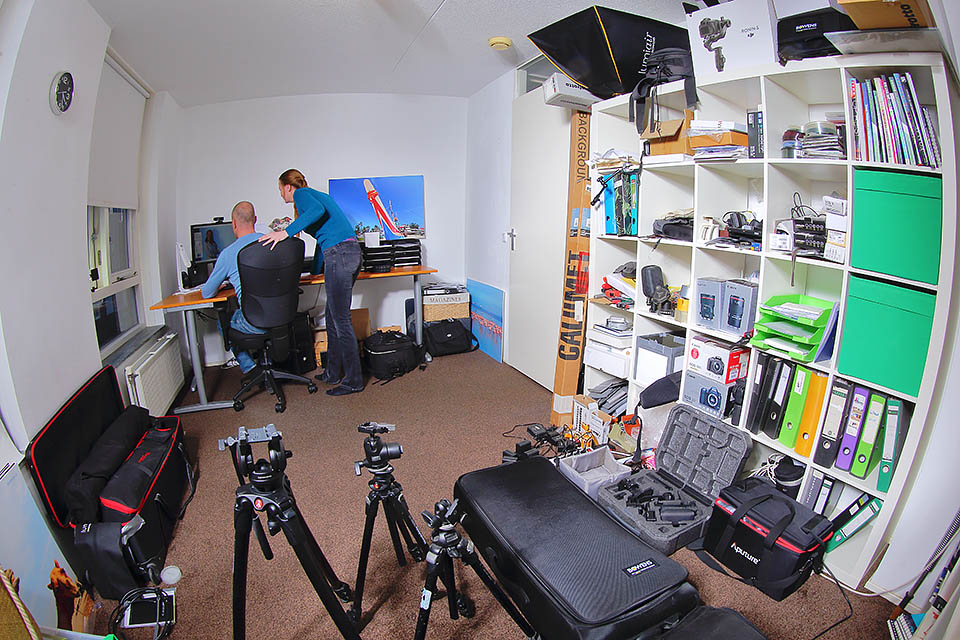
I work from home. As I do not work for private individuals, I do not have a studio at home. I can, however, build a studio at any location.
Should you list package prices?
Do your private clients really need prices, and is this part of their decision about whether or not to do business with you? Is price more important to your target audience than quality? Then it may be useful to list rates and/or package prices. That gives immediate clarity.
But it also makes clear that you mainly sell your service based on price. If you decide to list package prices on your website, calculate them properly and adjust them every year! I often come across photographers' package prices where the photographers are working for well under 50 euros per hour.
That is not professional and damages the market for photographers who do want to offer their service at normal rates.
If you take photos for a day, you usually also have to travel to a location. After that day of photography, you will probably spend another day processing the photos. A day of photography can therefore easily cost you 18 hours of work.
If you offer a day's photography to private individuals for, say, 750 euros, you are therefore working for considerably less than 50 euros per hour. Do the maths: you first have to subtract your actual car costs and other costs incurred from that 750 euros.
That 750 euros also includes VAT. Once you subtract all of that from the 750 euros, less than 600 remains. Divide that by 18 hours and less than 35 euros per hour remains. You cannot run a healthy photography business at those hourly rates.
Even if the 750 euros were excluding VAT, you would be left with a business rate of around 40 euros per hour. If you have calculated your hourly rate properly as a freelancer, you will never arrive at 40 euros per hour.
Prices on photography comparison websites
I am not in favour of websites where many photographers offer their services with prices. Photography should be bought based on quality. Is there a great deal of emphasis on prices? Can you even select photographers based on all-in prices?
Then you are more in the segment where price is important. As a good professional photographer, you want to focus on quality. The photos you take are not taken by anyone else. Price should be of secondary importance.
Do not set package prices too tightly
By giving package prices, you guarantee the client that the work will be completed for that amount. But with a fixed amount, you as a photographer have to make sure that the time you need to invest is also reasonably fixed.
A photography assignment can sometimes run over. The causes can be very varied: someone who needs to be in the photo is stuck in a traffic jam, a train leaves later, the event schedule is delayed, or the wedding cake is late.
Do you list fixed package prices on your website? Then you are the one who may have to do extra unpaid work if the assignment runs over. You may even take extra photos as a result and therefore spend extra time processing the images.
So do not set your package prices too low, and build in a margin!
When calculating package prices, you need to take your travel time, photography time and image processing into account. If you offer a package with 2 hours of photography, you can ask your client after that time has passed, if the assignment runs over, whether they want you to stay longer or whether you should invoice according to the agreed amount.
Staying longer without charging for that extra time is not sensible from a business point of view.
Mileage allowance or travel time fee?
As a freelance photographer, you work from home or a studio. During an assignment, you travel to a location for a client. For a photographer, travel time is often a considerable part of the total time spent on an assignment. Calculating only your travel costs is therefore not a good idea.
It is not pleasant to have to 'negotiate' again for every assignment about whether or not your travel time will be paid. That is precisely why it is sensible to be very clear about your travel time rates on your website, or in emails.
Think carefully about the fact that your travel time is part of the total time it takes you to carry out the assignment properly. If you want to communicate clear and consistent rates as a photographer, you cannot avoid charging a fixed amount per hour for travel time. So think in terms of time, not kilometres.
On the ANWB website, you can easily calculate your actual car costs per kilometre based on your registration number. Most cars cost between 0.40 and 0.50 cents per kilometre.
If you spend an hour in the car for an assignment and drive 80 kilometres, that will cost, for example, between 32 and 40 euros.
And because you are not doing voluntary work, you will need to add something to that so that you also earn a normal amount per hour.
Rates in the business market
Business clients usually buy based on quality. Rates are less important and simply need to be reasonable. It is normal for business clients that you calculate a healthy rate.
If you work for 35 or 50 euros per hour, there is a reasonable chance that you will have to look for another job, or additional job, next year, or when your savings run out. That is not useful for a business client.
After all, they are also investing in working with you. Business clients assess your service as a whole. Rates are one part of that. That is why it is not particularly important to make them visible on your website straight away.
Business clients assume that your service is worth what you charge. They consider it perfectly logical that this comes with a healthy self-employed rate. Besides, no assignment for a company is ever exactly the same. Everything is tailored. And companies budget for costs such as photography.
Ideally, companies set aside a budget for good photos. People who buy photography for companies know what normal freelance rates are.
You will have to prepare a cost estimate for each assignment. If you do want to list rates, only give your three hourly rates for travel time, time on location and image processing.
A client can then look at your hourly rates and see what value you attach to your photography. When they make an enquiry, you can prepare a quote based on your rates.
Do you serve both the business and private markets?
If you have prices for private individuals on your website, business clients will see them too. You must be able to explain why you charge an average of 75 euros per hour for a wedding shoot, while you want to charge companies, for example, 95 euros per hour.
Of course, this can be explained and defended, but the question is whether you want to find yourself in that situation at all.
If you serve both the private and business markets, I think it is a good idea not to mention amounts. If you still want to mention amounts, give hourly rates, not package prices.
If potential clients want to work with you, they will at least have to contact you. That is a good moment to give them your rates.
If people do not contact you because you do not list rates on your website, you can ask yourself whether you want to work with those people at all.
Apparently, price is then much more important than your qualities as a photographer. Ultimately, photography is a creative profession in which quality matters. If all goes well, you take photos that no one else takes. If a client recognises that, they will be happy for you to photograph for them.
And then your rate is less important than the quality.
So, should you list prices or rates on your website?
That depends on your target audience. Listing hourly rates for travel time, time on location and image processing can work if your target audience needs that information straight away. But when it comes to listing package prices, you need to think carefully about whether you want to do that. It immediately puts the emphasis on price.
Because photography is a very creative profession, you would rather not put the emphasis on price. If you only serve private individuals, you can consider listing hourly rates and perhaps even package prices. But calculate them properly and do not compete on price.
If you target business clients, package prices are not a good idea on your website. Everything is tailored. You could list an hourly rate, but it is not immediately relevant and it also distracts from what really matters: the quality of your photography and service.
Giving rates is part of the start of a photography assignment. As soon as it is clear what the assignment involves, you can send your rates and a quote by email.
Ideally, you want people to choose you as a photographer because you are good at taking photos and providing your service. In that case, listing prices on your website is less important.
Now that I have been able to share all this with you, thank you for reading, I can answer the question, whether or not to list prices on your website, briefly: Usually not, sometimes yes.
About the author
Wilmar Dik is beroepsfotograaf sinds 2008. Ook schrijft hij in diverse media over fotografie en is hij betrokken bij DuPho. Bij NVJ is hij vertegenwoordiger beleidsteam Werkvoorwaarden namens ledengroep NVF/Beeldmakers. Werk van Wilmar:mensen.photo, Reclamebeeld, Portfolio fotograaf en Tasfilms.nl.
You might also like
-
 How do you invoice for your photography services?
by Wilmar Dik
-
 PhotoShelter has made my life as a photographer more enjoyable
by Huub Keulers
-
.jpg "Tip: create a shot list") Tip: create a shot list
Tip: create a shot listby Elvira Smit
-
 Find models for your shoot with Modelmanagement.com
by Elja Trum
-
 Make a list of your favourite places
by Nando Harmsen
-
 What does Adobe ending its cloud services mean for Lightroom?
by Nando Harmsen
1 comment
-
 W.j.j. Wilmers wrote on Tuesday 2 April 2024 at 10:41 | reply
We mainly do wedding photography and want to be transparent about that on our website. Our prospective bridal couples can see in advance what to expect. If I don't list our prices, I get many more inquiries, which isn't a problem, but then I do have many inquiries that drop out when they subsequently learn our price because they don't have the budget for it or aren't willing to spend that much. It's a strategy and I don't think there's a right or wrong answer when it comes to mentioning prices on your website. From our point of view, I would therefore rather have the client who has already seen the price, as we almost always book them after an inquiry.
Translated from Dutch.
Have your say
Please note: Articles older than a week can only be commented on by signed-in visitors.Would you still like to comment? sign in or create a free account.
Become a better photographer every week
A practical photography tip in your inbox every week.
39,024 photography enthusiasts already receive the tips! More about the weekly mail. Or keep up to date via  Facebook.

Elja Trum
Photofacts; everything to do with photography!
Would you like to take better photos and keep up with what is happening in photography? Photofacts publishes articles that teach you something about photography — from a product announcement to a practical shooting tip or a look at a website. Photofacts covers photography every day and is a hobby project of Elja Trum's that got out of hand. The articles are written by a team of volunteer authors. If you would enjoy writing one or more articles for Photofacts, do get in touch.More about PhotofactsPhotofacts is made possible in part by
