
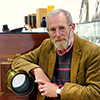
A reflector used differently
Saturday 28 December 2019, 13:31 by Leen Koper | 6,306 views | 2 commentsThis article was translated from Dutch with the help of AI. Read the original.
When I was still working as a professional photographer, six years into retirement now, and regularly shooting wedding reports among other things, I often had students from photography school come to me as assistants to see how things really worked in practice.
And what struck me most was how much, usually useless, theory they knew, but how little they understood about everyday reality.

Most of them were hobby photographers who later proudly mentioned on their websites that they had attended photography school, but in reality had never done any further practical training. Yet that is exactly how you reach a decent level in photography.
The most talented student I ever had was Paul. He had also joined a professional association, the British Institute of Professional Photography, and attended all kinds of seminars organised by it to increase his knowledge.
He later also ran a successful photography studio, as one of the few who did. He could play with light, and we both learned a lot from each other.
One such learning moment came when he was assisting me on a wedding report in Renesse in bright sunlight. I had placed the wedding couple in the shade, and about 15 metres away Paul stood behind me in the sun with a large silver reflector, casting light onto the couple.

This was to reduce the differences in contrast with the sunlit areas in the background, so that the background would not be blown out.
Those 15 metres were needed to weaken the reflected light. Otherwise, the contrast on the wedding couple's skin in the shots would have been too strong again. It was never completely ideal, but what else could you do to reduce the contrast?
Suddenly, I saw beautiful light falling on the wedding couple on the ground glass of my Mamiya 645. We were still working with film at the time. It was so beautiful that I pressed the shutter immediately, and only then turned around to see how Paul had done it. He was grinning from ear to ear!
After the report, this 'discovery' was the only subject of our conversation. Neither of us had ever seen light this beautiful. Later, during seminars I gave, it proved to be a real eye-opener for almost all the professional photographers who attended.
Just beside them
So what was special about this light, and how did it come about? It was so simple that you would hardly think of it. Instead of letting the reflector cast all its light onto the wedding couple, as you would normally do, he aimed the central part of the light just beside them.
This meant that the wedding couple was lit by the 'edges of the light'. Gone were all the harsh contrasts caused by the reflector shining onto the couple. A beautiful, soft light enveloped them.
And the differences in the strength of the fill light? They were minimal. The remaining light was more than sufficient to minimise the contrast, but it was much softer and the relatively harsh reflections on the wedding couple's skin had disappeared.
This can of course also be used in model photography. Paul and I did this often, although it is rather cumbersome when there is no assistant available to hold the reflector. But if you do have one, it is certainly worth the effort!
About the author
Leen Koper woont en had tot voor kort een fotostudio in Zierikzee. Na ruim 40 jaar als fotograaf gewerkt te hebben, houdt hij zich nu voornamelijk bezig met landschapsfotografie. Als beroepsfotograaf heeft hij in de loop der jaren vele internationale prijzen gewonnen en gaf les en ook regelmatig seminars in Engeland, België, Frankrijk, Duitsland en Oostenrijk.
You might also like
-
 Portrait photography tip: Using a reflector
by Elja Trum
-
 Review: Geekoto Y-Wing Reflector
by Elja Trum
-
 Flash photography tip: Buy a 5-in-1 reflector
by Elja Trum
-
 20 useless facts about photography
by Elja Trum
-
 7 reasons not to use a graduated ND filter, and one reason why I do
by Nando Harmsen

2 comments
-

 ErikvanRosmalen
wrote on Friday 3 January 2020 at 09:31
| reply
Clear explanation, Leen! The 'mistake' many Fotovakschool students make (at least, from what I saw during my training) is that after the theory and the mandatory bit of practical work, they go home again as quickly as they can. While that is precisely when you have time to practise and learn and soak up the knowledge from your teacher... it was there that I learned feathering too. With flashes, but it indeed turned out to work with screens as well!
Translated from Dutch. -
 Leen Koper wrote on Friday 3 January 2020 at 09:38
| reply
That is correct. Most people think that their training is completed when they finish the course. They can then proudly mention it on their website, but they are completely unaware that they only have the basics on which to build further. Techniques such as 'feathering the light' are therefore unknown to almost everyone.
Translated from Dutch.
Have your say
Please note: Articles older than a week can only be commented on by signed-in visitors.Would you still like to comment? sign in or create a free account.
Become a better photographer every week
A practical photography tip in your inbox every week.
38,938 photography enthusiasts already receive the tips! More about the weekly mail. Or keep up to date via  Facebook.

Elja Trum
Photofacts; everything to do with photography!
Would you like to take better photos and keep up with what is happening in photography? Photofacts publishes articles that teach you something about photography — from a product announcement to a practical shooting tip or a look at a website. Photofacts covers photography every day and is a hobby project of Elja Trum's that got out of hand. The articles are written by a team of volunteer authors. If you would enjoy writing one or more articles for Photofacts, do get in touch.More about PhotofactsPhotofacts is made possible in part by
