

Review: Handbook of Sports Photography
Friday 23 February 2018, 11:49 by Michelle Peeters | 7,849 views | 11 commentsThis article was translated from Dutch with the help of AI. Read the original.
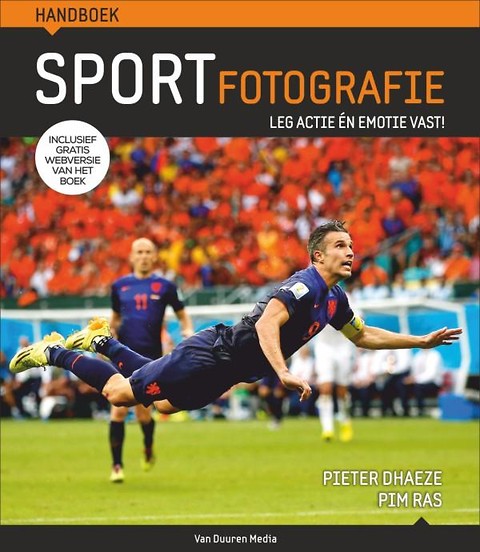
You do not just produce the perfect sports photo off the cuff, literally. It takes knowledge, experience and inspiration. This book helps you from A to Z, so you are well prepared next time with the right mix of equipment, settings, viewpoint, timing and, of course, inspiration.
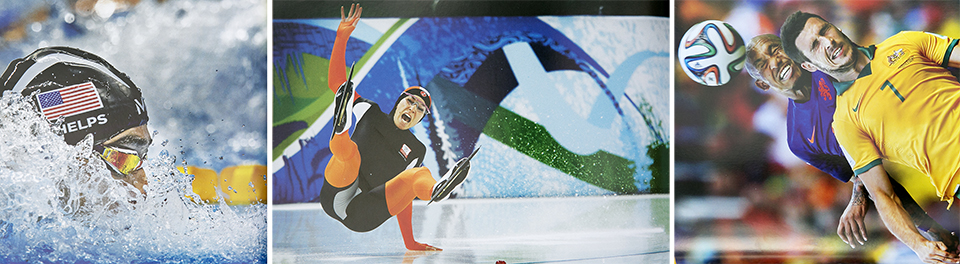
Inspiration is also well represented in this book, with truly breathtaking and spectacular sports photos by top photographer Pim Ras (Silver Camera 2009).
Sports photographer Huub Keulers also contributed to this beautiful book as a sounding board. Around 30 photos are his work, not all of them featuring his logo, including an acknowledgement.
Sports photography is actually a type of portrait photography, but with a moving subject. Capturing such a moving subject is already quite a technical challenge for many photographers.
But the real challenge in sports photography is mainly capturing the 'decisive' moment and the emotion. Pieter Dhaeze and Pim Ras wrote a substantial 232-page book about this.
Contents
The book consists of eight chapters:
1. Introduction
2. Equipment
3. Settings
4. In the field
5. Indoor and outdoor sports
6. Image editing
7. Publication
8. Pim Ras
1. Introduction
This section discusses the real challenge of sports photography. Not just mastering the technique, which is already difficult enough for many photographers, but also capturing the 'decisive' moment and the emotion.
2. Equipment
Chapter two looks in detail at the 'equipment' you need to produce a good sports photo.
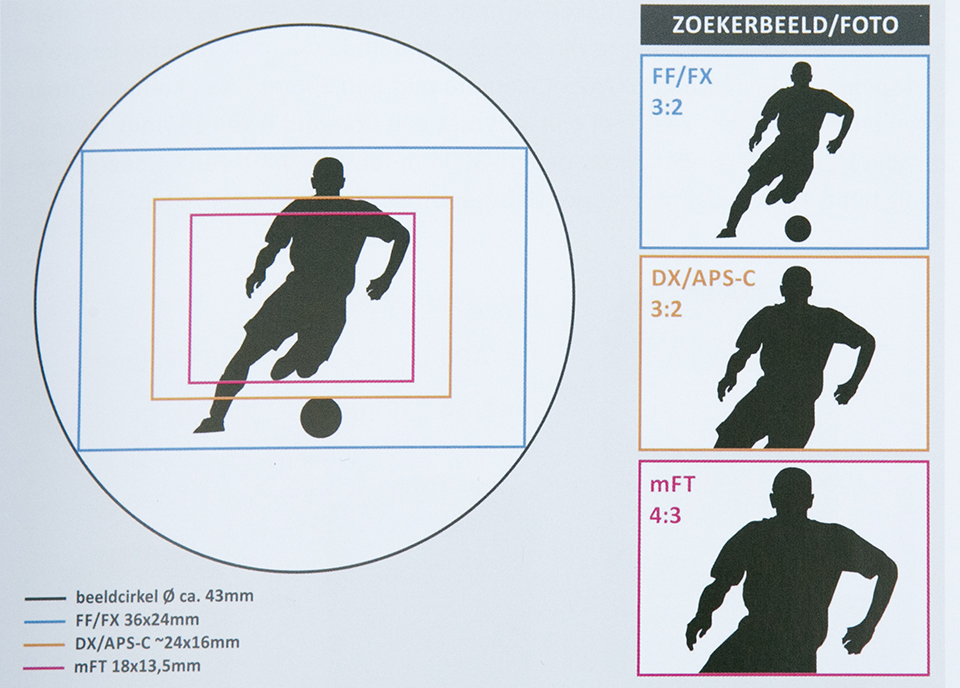
Technical aspects such as sensor size, number of frames per second, dynamic range, AF types and sensitivity, tracking settings, characteristics, maximum aperture and bokeh of different lenses, different camera bodies and the effect of using different focal lengths are discussed in considerable depth.
Attention is also paid to other tools, which you can make yourself if necessary, such as monopods, stools, Wi-Fi, GPS, bags and rain covers for your camera. In short, everything you need to have with you as a sports photographer.
3. Settings
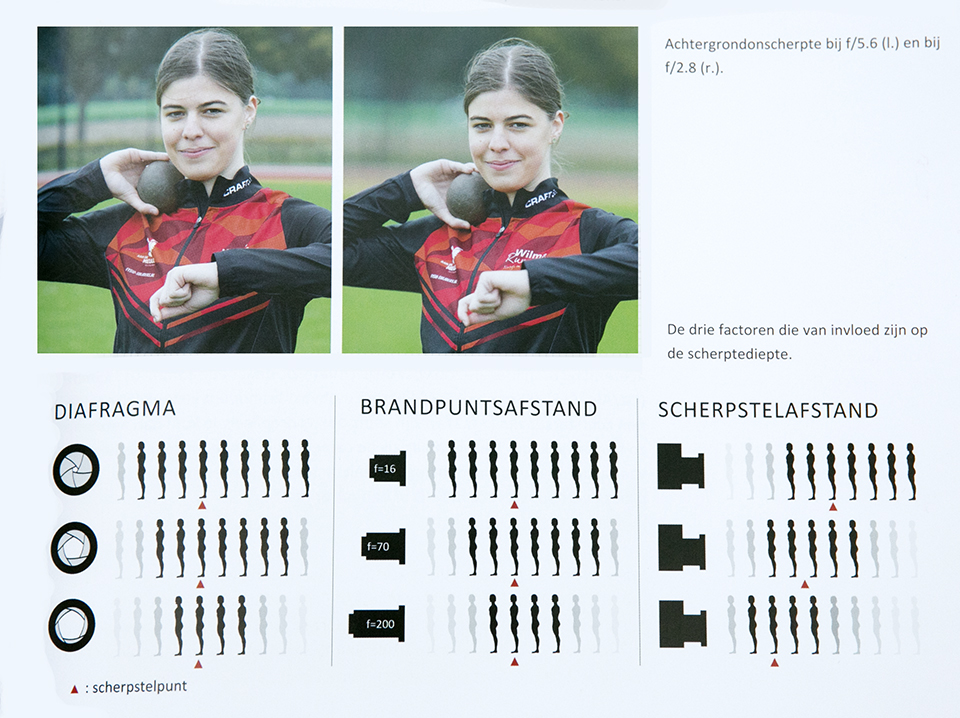
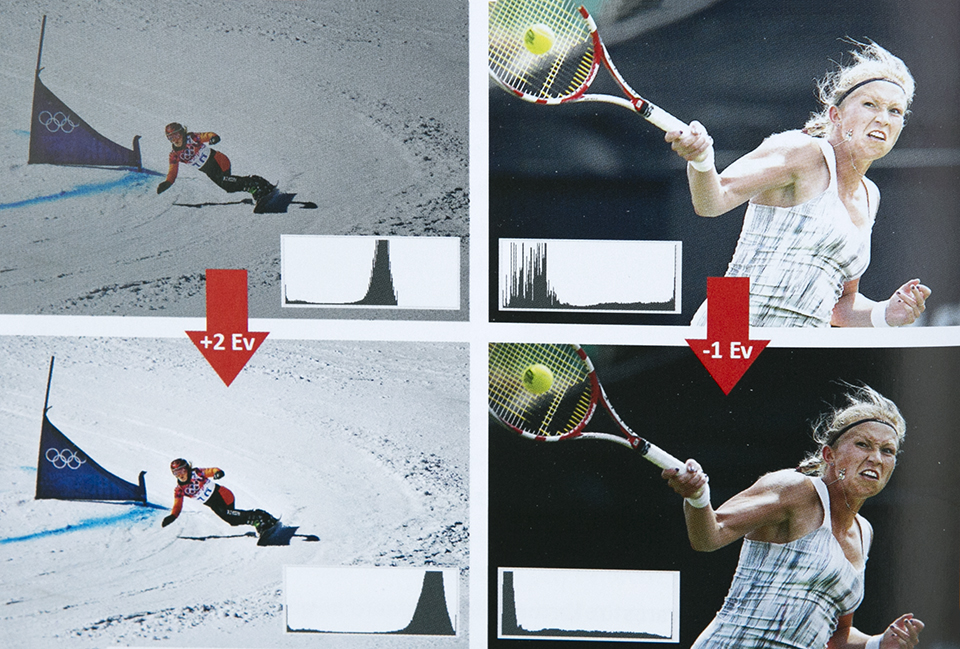
The third chapter, settings, contains many practical tips on how to set up your camera for optimal exposure, colour and sharpness. If you do this beforehand, you can focus entirely on the subject and the timing, so you do not miss a crucial moment.
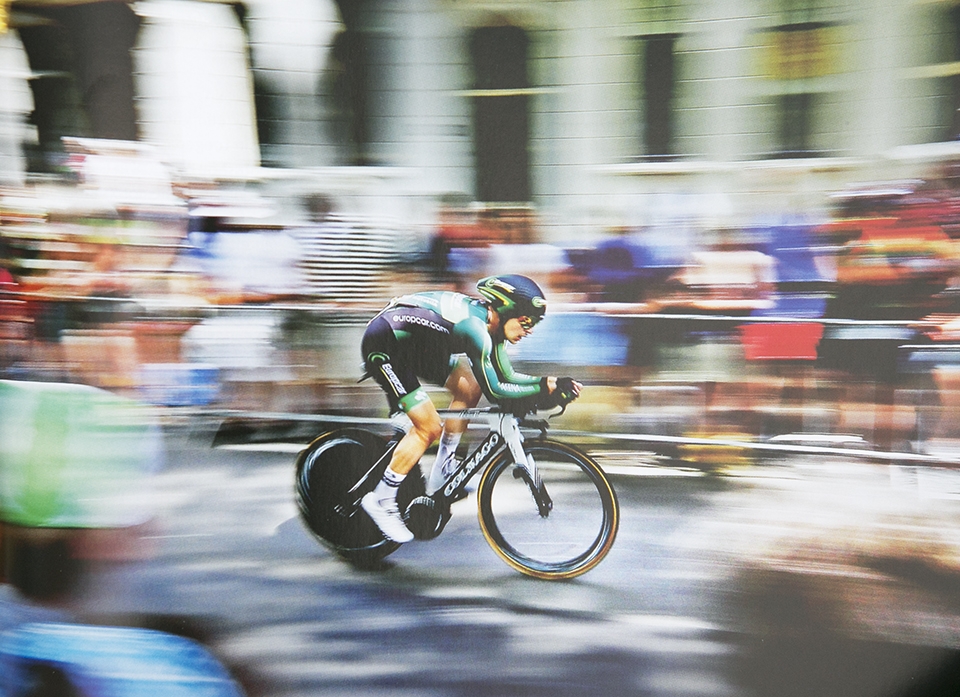
Subjects such as shooting in RAW, exposure compensation, 'pluses' and 'minuses', metering methods, M mode, flash photography when the distance is not too great, flash techniques, the 'right' shutter speed, panning, colour, colour space, lamp flicker frequencies, the AF-ON button, APS-C crop, maximum aperture and diffraction are covered extensively and illustrated with many sports photos and practical tips in coloured boxes.
This is actually done throughout the book, which makes it pleasant to read.
4. In the field
This chapter helps you get to work reasonably efficiently 'in the field' as a photographer. It provides practical tips for heading out well prepared without forgetting anything.
Checklists of equipment to take, travel times to check, locations and problem areas are provided. Tips on the weather, the position of the sun, high contrast and how to avoid it, the necessary familiarity with the sport you are photographing, timing and context, the number of cameras needed and attractive backgrounds are also explained.
5. Indoor and outdoor sports
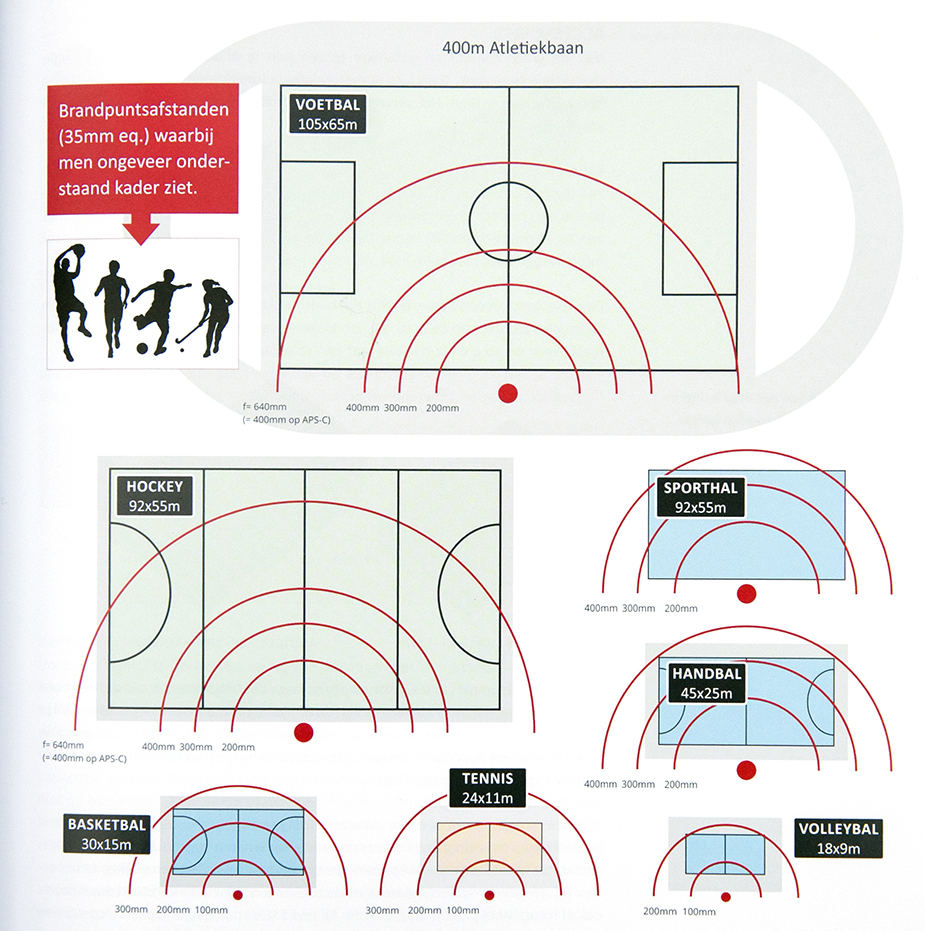
This section is about the differences in camera settings and the equipment required when photographing different sports. These differences are often very small and are actually determined only by the factors of light, distance and conditions.
In this chapter you discover how to deal with artificial light, team and individual sports, and different branches of sport.
6, 7 and 8 Image editing, Publication and Portfolio
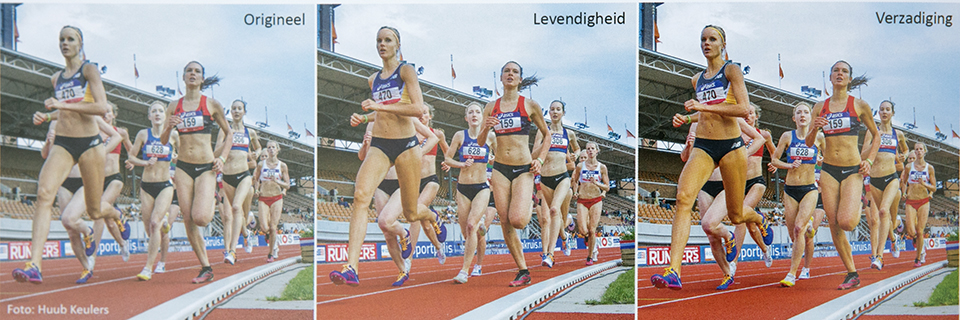
Chapters six, seven and eight cover managing, editing and publishing your best sports photos, because you should not leave them gathering dust in a forgotten folder on your computer. Show them!
Conclusion
Although some sections of the book are, in my opinion, sometimes described a little too technically, the material is still easy to understand thanks to the many supporting examples and illustrations. And because everything is covered so extensively, you quickly gain quite a lot of knowledge to get started yourself.
I think it is a good book that a beginning sports photographer can get a lot out of. Many different subjects are covered in detail, and the many examples and illustrations make it easy to follow, despite the considerable depth of the technical details.
There is actually nothing to criticise about the writing style. The book reads very pleasantly, and the balance between the text and the number of illustrations has been chosen well.
Ordering
The Handbook of Sports Photography by Pieter Dhaeze and Pim Ras costs 34.99 euros and can be ordered here. Optionally, you can also get free access to extra content by registering your book on the Van Duuren Media website here.
Sports Photography Video Course
Would you rather watch than read? At Photofacts Academy, we have a complete course on sports photography. Professional sports photographer Nico Delmeire shares his extensive knowledge of photographing athletics, football and indoor sports, among other subjects.
Nico does this with practical videos that are quick to watch. Discover how you can capture the best sports moments too.
» Watch the promo for the sports photography course (47 seconds)
Dit artikel is voor het laatst bijgewerkt op 23 februari 2018.
De eerste publicatiedatum is vrijdag 10 februari 2017, 11:22.
About the author
Michelle Peeters is fotografe en oprichter van DeuxBleus Fotografie. Michelle herkent het bijzondere in het gewone en het gewone in het bijzondere. Ze heeft zich nooit willen specialiseren en is daardoor van alle markten thuis.
You might also like
-
 Review: Book Sport Photography
by Michelle Peeters
-
 Review: Model Photography Handbook, Frank Doorhof
by Michelle Peeters
-
 20 photography books you should read!
by Michelle Peeters
-
 3 Tips for Successful Sports Photography (and get my book free)
by Nico Delmeire
-
 Review: Photography - From Capture to Print
by Michelle Peeters
-
 Review: Inspiration by Ap Dijksterhuis
by Erik van Rosmalen
11 comments
-
 Huub Sanders wrote on Friday 10 February 2017 at 13:11 | reply
Clear article. It seems like a very fine book to me. Looks well put together.
Translated from Dutch. -

 patrick180 wrote on Friday 10 February 2017 at 14:19
| reply
know everything about it. I myself am a Darts Photographer and have already had the opportunity to photograph the complete world top.
Translated from Dutch.
It remains a great tac of photography. -
 Michelle Peeters wrote on Friday 10 February 2017 at 14:22
| reply
Darts seems to me like a really difficult (fast) sport to capture well in photos! Then you definitely have to be familiar with all the technical aspects (which are described very well in the book) and also with the sport itself! Nice! 🙂
Translated from Dutch. -
 Tanja Thomas
wrote on Sunday 12 February 2017 at 21:18
| reply
A field of its own, I'd say in this kind of photography..
Translated from Dutch.
Interesting explanation and I'm curious about the book.
Wildlife animals in action is also a kind of sports photography.. -
Michelle Peeters wrote on Sunday 12 February 2017 at 21:20
| reply
That's right, here too it's a lot of anticipipating and sensing/knowing beforehand what is going to happen!
Translated from Dutch. -
patrick180 wrote on Wednesday 15 February 2017 at 08:50
| reply
Michelle Peeters
Translated from Dutch.
Indeed, being familiar with the sport itself is a plus in my eyes, yes.
That way I myself know for almost 95% of the top players when they release their dart and which throwing motion they will make for the release moment.
Furthermore, it is simply waiting for the moment and that can only be done if you know within darts what can happen.
Think of a very important finish, important score, and most importantly when you can expect an outburst and when not.
I myself don't shoot at High speed either but purely and solely on a single shot. that's where the challenge lies for me.
Personally, I think you improve yourself much more that way than when I make 10 images at once and hey presto, there is 1 in between. No challenge for me.
But well, that's of course each to their own. -
Michelle Peeters wrote on Thursday 16 February 2017 at 11:02
| reply
Look, now those are some nice tips too! Shooting in single shot mode works best for me too. If, for example, you have to take the finish photo at a running race, it's best to focus in advance on a point (for example the ribbon the runner runs through). Then it's just a matter of timing it well and pressing the shutter at the right moment. But of course this differs from sport to sport! You just have to be able to find a point that you can focus on in advance!
Translated from Dutch. -
 Huub Keulers
wrote on Tuesday 21 February 2017 at 13:04
| reply
Hi Michelle,
Translated from Dutch.
First of all, a big compliment for your photography and your clear, well-written articles here on Photofacts.
I recently also started writing for Elja and saw that you dedicated an article to Pieter and Pim's Handbook of Sports Photography. Great!
Perhaps it would be nice to mention (possibly in this article) that I collaborated as a sounding board on this beautiful book.
There are also about 30 of my photos in it (not all bearing my logo), including a word of thanks.
Good luck and lots of fun with photography.
Kind regards,
Huub Keulers
Huub Keulers Photography -
Michelle Peeters wrote on Tuesday 21 February 2017 at 13:21
| reply
Thanks for the compliment Huub! And this is indeed definitely worth mentioning, I have adapted the article and added your name and achievements to it. Thanks for the tip too!
Translated from Dutch. -
Huub Keulers
wrote on Tuesday 21 February 2017 at 13:50
| reply
That's fast Michelle. Normally I'm not one to mention this about myself, but in the case of this book I am. Thank you!
Translated from Dutch.
-
Michelle Peeters wrote on Tuesday 21 February 2017 at 13:55
| reply
Absolutely justified, I would have done the same!
Translated from Dutch.
Have your say
Please note: Articles older than a week can only be commented on by signed-in visitors.Would you still like to comment? sign in or create a free account.
Become a better photographer every week
A practical photography tip in your inbox every week.
38,764 photography enthusiasts already receive the tips! More about the weekly mail. Or keep up to date via  Facebook.

Elja Trum
Photofacts; everything to do with photography!
Would you like to take better photos and keep up with what is happening in photography? Photofacts publishes articles that teach you something about photography — from a product announcement to a practical shooting tip or a look at a website. Photofacts covers photography every day and is a hobby project of Elja Trum's that got out of hand. The articles are written by a team of volunteer authors. If you would enjoy writing one or more articles for Photofacts, do get in touch.More about PhotofactsPhotofacts is made possible in part by
