
It's No Longer About the Most Beautiful Picture
Monday 13 July 2026, 16:32 by Michiel Heijmans | 2,066 views | 11 commentsThis article was translated from Dutch with the help of AI. Read the original.
You know the feeling. You scroll past dozens of photos on your phone. Everything is right. The light falls perfectly, the colours are spot on, and there isn't a hint of noise. And yet nothing stays with you. You swipe on, and ten seconds later you can't remember what you saw. We've never taken photos as beautiful as we do now. And rarely have we felt so little.
That doesn't sit right. That's exactly what I want to talk about today. Because something is shifting in photography, and I think 2026 is the year it will really become visible. Everywhere I go, in conversations, on podcasts and during workshops, people are suddenly talking about authenticity. About emotion. About story. And much less about technique. This isn't a hype. It feels more like a correction that was long overdue.
When perfection suddenly becomes free
There is a simple reason why this is happening now. Perfection has become cheap. In a few seconds, AI can create an image that is technically impossible to fault. Flawless light, flawless skin, flawless composition. Endless, and available to everyone. In the past, you had to practise for years to make a technically flawless photo. Now you just type a sentence.
And that's where the sting lies. What everyone can do stops being special. Once the perfect picture is available everywhere and at all times, it loses its value. Not because it's ugly, but because it no longer says anything. It's just there. Like wallpaper.
That's how a strange paradox emerges. The more perfect images we see, the emptier they feel. I catch myself doing it more and more often. A photo can be aesthetically spot on and emotionally cold at the same time. Cleverly made, and yet nothing. As if you're looking at someone who says all the right words, but you can feel that nobody is home.
I noticed it in myself recently. I was looking back through my own work and found myself lingering on a portrait that was nowhere near my best technically. A little too soft, the light not quite right, a bit of movement in it. And that was exactly the image that moved me. Because I still knew exactly who had been sitting in front of me, what we had been talking about and how quiet it had briefly become. The 'mistake' wasn't a mistake. It was proof that something real had happened.
Not how it looks, but why it exists
I think that's why we've started asking a different question. Not anymore: how impressive does this image look? But: why does this image actually exist? Who made it? What story does it contain? And what is it trying to say?
That may seem like a small difference, but it's huge. Because as soon as you ask that question, the value of a photo shifts. Not towards the technique, but towards the maker and the moment. A photo is no longer an artistic end product, but a trace. Proof that someone stood there, looked, waited and pressed the shutter at the right moment. A real encounter, captured.
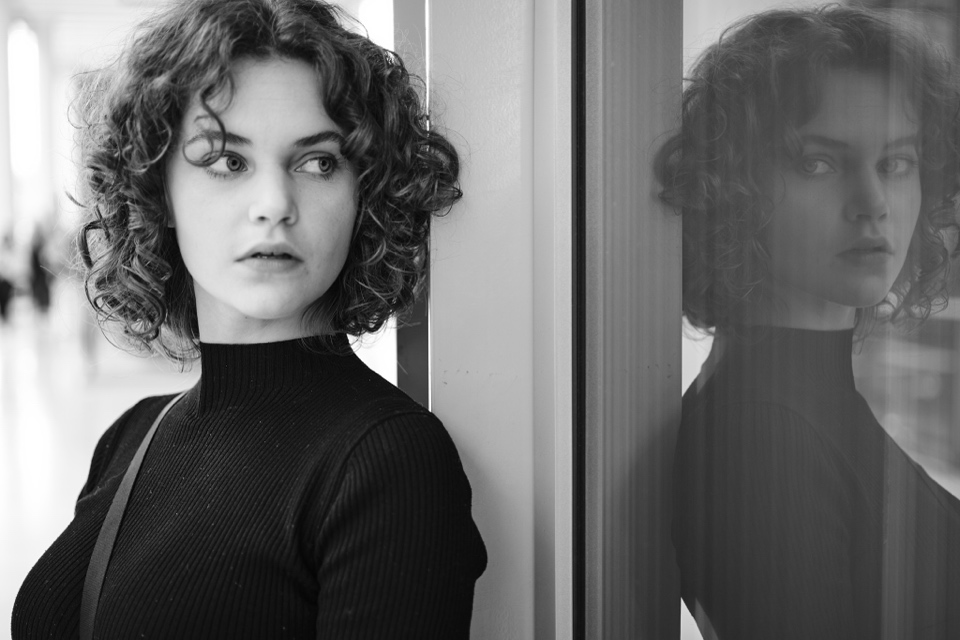
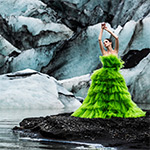
My real model in this photo: Janaika Wester
I feel that more strongly than ever in my own work. With PAUZE, everything is about presence. About the conversation, the contact and pausing for a moment with the person sitting opposite me. The portrait that comes from it is almost a by-product. The best image never comes from my camera settings. It comes from what happens in that space between two people. You can't plan that, and you certainly can't recreate it.
The process is what AI can never create
And that's the heart of the whole story for me. For years, we've talked about the result, about the photo. But I believe the process is becoming the real work. The waiting. The walking. The conversation. Simply being there.
That's exactly what AI can't do. A model can generate an image that looks like an encounter, but there was no encounter. It can imitate stillness, but it has never stood still. It calculates, guesses and combines. But it hasn't lived, waited or hesitated before pressing the shutter. There is no morning behind it, no conversation, no human being.
Because photography is more than a photo. It is time. It is attention. It is a thousand small choices and one moment of presence. The image you end up with is not the work itself. It is the result of something real that happened beforehand. The photo is the tip. Everything underneath it, the process, is what it is really about.
I think that's where the counter-movement lives. We'll start valuing the 'how' and the 'why' more highly again than the finished result. And once you start valuing the process, you automatically see what a photo really is differently. Then a small mistake is no longer a weakness, but a signature. A sign of life.
In search of stillness
That idea has acquired a name for me. My upcoming exhibition is unofficially called In Search of Stillness, and that's exactly what it is about. The opposite of the fast, perfect, disposable image. About standing still in a world that keeps scrolling.
The title didn't appear out of nowhere. I talked out loud about the photos with Annelie Willemijn Stroo, with whom I am holding the exhibition. It is the connection between her series and mine. The common thread.
The exhibition can be seen at De Drvkkery in Middelburg, from 27 July to 7 September. There's really only one thing I want to ask of the viewer. Slow down. Stand still for a moment. Look for longer than the single swipe we've become used to. Because these images don't reveal themselves in half a second. They ask for a little patience, and they give something back in return.
And there's more. On 13 August, we're organising a photo walk. No hunt for the perfect picture, but walking together and sharing the process. Looking, talking, pausing and occasionally pressing the shutter. It's not about who takes the most beautiful photo. It's about the experience of making it. Keep an eye on my socials for more information. Above all, see it as an invitation, definitely not an obligation!
Back to that empty feeling
Think back to the beginning for a moment. To scrolling past all those perfect images that leave nothing behind. I don't believe we're missing better photos. We already see more than enough of them, increasingly made by a machine. What we're missing is something else. We're missing photos that mean something.
And that's exactly why the imperfect picture is winning. Not because imperfection is beautiful in itself, but because a real image carries the entire process with it. The time it contains. The attention. The encounter. The moment when everything briefly went quiet. That's what fills a photo, and that's exactly what you can't generate. The perfect picture is empty because nobody was there. The imperfect picture moves you because someone was there.
So the next time you scroll through your feed, ask yourself a different question. Not: which photo is the best made here? But: when was the last time I really looked at a photo, instead of simply scrolling past it?
About the author
Michiel is professioneel straatfotograaf en geeft workshops en lezingen over straatfotografie. Hij schrijft columns voor Focus Magazine en is erg actief op Instagram. Daar vind je dagelijks inspiratie en tips voor je eigen straatfotografie!
You might also like
-
 Meta's AI pulls photos straight from your head
by Elja Trum
-
 The Hidden Costs of Using AI
by Nando Harmsen
-
 Adobe's AI credit system
by Nando Harmsen
-
 Lightroom update with generative AI
by Nando Harmsen
-
 Using AI to create moodboards
by Elja Trum
11 comments
-
 Margret Tielemans wrote on Tuesday 14 July 2026 at 11:57 | reply
Well put, Michiel. So recognisable as a photographer that everyone just thinks that everyone can take photos these days. But the difference is indeed in the attention and the time you take for someone. The interest in the other person. And funny, isn't it, that it is precisely the imperfect image that makes you look at a photo longer and then makes you happier.
Translated from Dutch.
Once again, thanks, with a smile, for this text. -
 Cees Castricum wrote on Tuesday 14 July 2026 at 12:07 | reply
This is a fantastic story and hits the nail exactly on the head. Everyone tries to take a photo that has to be more beautiful than the subject. But indeed, it gives more satisfaction to focus on the reason for taking a photo, and the story behind it. I completely agree with the writer. With the knowledge you have, simply take a photo that you are satisfied with.
Translated from Dutch. -
 Michiel Heijmans
wrote on Tuesday 14 July 2026 at 13:49
| reply
Michiel Heijmans
wrote on Tuesday 14 July 2026 at 13:49
| reply
Thank you, Cees! That's how it is.
Translated from Dutch. -
Michiel Heijmans
wrote on Tuesday 14 July 2026 at 13:49
| reply
Thank you for your comment! And the smile
Translated from Dutch.
-
 Bernt wrote on Tuesday 14 July 2026 at 15:25 | reply
Never say never. You can just as well add feeling to AI. For that reason, beautiful photos will also come out with the heart of the programmer and question asker. Look at how Photoshop has developed. How much better it has become. You can keep photographing analog, that authenticity remains, but digitalization is also lurking there with consequences. That doesn't have to be bad at all. To each their own. Keep being proud of your own work and choose photography that suits you. Where you put your own AI into it without others knowing.
Translated from Dutch. -

-
Michiel Heijmans
wrote on Tuesday 14 July 2026 at 15:29
| reply
Agreed, Nando. That is an image.
Translated from Dutch. -
 Donald Willemsen wrote on Tuesday 14 July 2026 at 17:02 | reply
The best perfection is imperfection.
Translated from Dutch.
Michiel, this is the first time I completely agree with you. -
Michiel Heijmans
wrote on Tuesday 14 July 2026 at 17:04
| reply
Haha, Donald - FINALLY
Translated from Dutch. -
Bernt wrote on Tuesday 14 July 2026 at 18:21 | reply
Who determines what is allowed and must be allowed or not applies if it is one or the other. To each their own thing
Translated from Dutch. -
 Dick Eduard wrote on Thursday 16 July 2026 at 17:52 | reply
Haha finally, I would say, photography is on the move. I had my training at the art academy in Rotterdam, department of monumental and decorative design, and from the start nothing was allowed to resemble someone else's work, but had to be something of your own, the technique would come later. Going through the whole scale from abstract to figurative painting/sculpting/etching etc. But it had to be your personal vision and image.
Translated from Dutch.
When photography got me in its grip, I naturally had that same attitude, so I got rid of some photos just like I used to with drawings/designs etc.
Within my experiences in art I saw 2 different aspects, namely technique and vision/experience, actually personal creativity. Within photography, in my eyes, the aspect of technique has gone too far, whole courses, workshops and books are proof of that.
I am glad that after Nando (feeling), a start has been made again to look at photography differently and add something to it
Success
Regards Dick Eduard
Ps sorry I threw away photos in the style of "Mijnheer Derden"
Have your say
Please note: Articles older than a week can only be commented on by signed-in visitors.Would you still like to comment? sign in or create a free account.
Become a better photographer every week
A practical photography tip in your inbox every week.
39,079 photography enthusiasts already receive the tips! More about the weekly mail. Or keep up to date via  Facebook.

Elja Trum
Photofacts; everything to do with photography!
Would you like to take better photos and keep up with what is happening in photography? Photofacts publishes articles that teach you something about photography — from a product announcement to a practical shooting tip or a look at a website. Photofacts covers photography every day and is a hobby project of Elja Trum's that got out of hand. The articles are written by a team of volunteer authors. If you would enjoy writing one or more articles for Photofacts, do get in touch.More about PhotofactsPhotofacts is made possible in part by
