

Too perfect to be true
Monday 9 February 2026, 14:41 by Michiel Heijmans | 3,817 views | 32 commentsThis article was translated from Dutch with the help of AI. Read the original.
Can a perfect photo be too perfect? And how can you tell whether it is AI or not? Why are we shooting more analogue and feeling the need to explain that a photo is real and not AI? I saw a video and wrote a column about it.
My sixteen-year-old daughter's phone fell on the floor last week. The screen was broken, but the thing still worked. "Dad, can you take a photo of my broken screen?" she asked. So I did.
A simple photo of a cracked glass surface, with reflections of the ceiling light showing through. Nothing special.
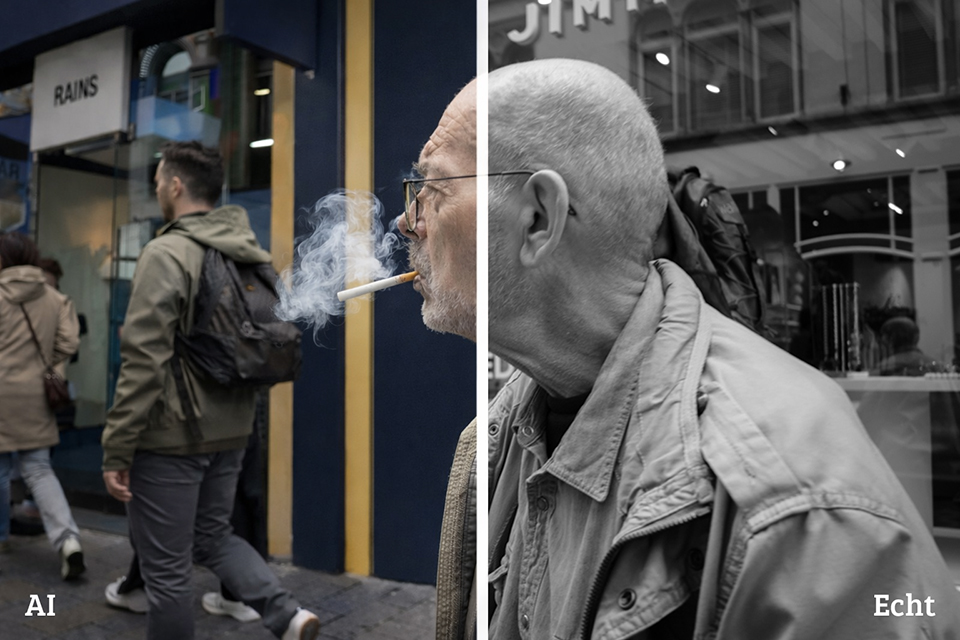
Later that evening, I was scrolling through Instagram and saw a photo that looked far too smooth, as if it had been smeared with Vaseline. You know the ones. Perfect light, perfect colours, perfect composition, overly smooth skin and overly bright eyes.
Too perfect, really. Because that is what it was. AI-generated, as the hashtags revealed. And it made me think of my daughter's broken screen. Of those cracks, of that imperfect image that told you exactly what had happened. That told a true story.
As James Popsys said
The British photographer James Popsys recently made a video about this. About how we are growing tired of that high gloss, of all the smooth perfection we see passing by every day. He called it "perfect or TOO perfect". There is a thin dividing line, I think.
We live in a time when you can create a perfect image with a few clicks. Or have AI create one for you. No strange shadows, no dust on the lens, no blurry background you did not ask for. Everything is right, everything is polished. And that is exactly why it increasingly feels unreal.
Removing one stray hair
I notice it in my own work. When I take a portrait during a PAUZE session, there is always a lock of hair somewhere that is out of place, or the light does not fall quite as I would have liked. And increasingly, I leave it that way. Because those small imperfections make a photo breathe. They show that there was a human behind the camera, at that moment, in that space.
The strange thing is, we all know that 100% perfection does not exist. Yet we pursue it. I think that certainly applies to beginner photographers, or photographers who get lost in Photoshop. We retouch away a blemish, make the sky just a little bluer, the skin just a little smoother. Until you no longer know where reality ends and fantasy begins. Sometimes you look back at your original photo and barely recognise it. Has editing become too easy for us these days?
What is real and what is not?
And now that AI can create photos that look genuinely real, it gets even more complicated. How do you show that your photos are real? Some photographers now share their RAW files as well, or show the unedited version next to the final result. Others have gone back to analogue.
Not because digital would not be good enough, but because an analogue photo tells a story about the process. About that one roll of film, that particular camera, that moment when you pressed the button without immediately knowing what would come out.
You see it happening on Instagram and other platforms. Photographers placing their RAW file beneath their polished final result with the words: "This is real", or "No AI", or that one hashtag, #SOOC (Straight Out Of Camera).
As if we suddenly have to prove that we actually pressed the shutter button. It feels a bit like an identity crisis for our profession. We have gone from makers to providers of proof.
Anna lied or analogue?
And analogue photography? It is becoming increasingly popular, especially among younger photographers. Not only because of the aesthetic of film grain and the colours of particular film types, but also because of its credibility.
An analogue photo has a physical presence. Somewhere, there is a negative. You cannot simply add or remove elements without it being visible. It is slow, it costs money per photo, and you only find out later what you have.
That last point is interesting. When shooting analogue, you have to trust. In yourself, in your camera, in the moment. You cannot immediately check whether the photo worked, whether the light fell well, or whether the expression is sharp. You press the shutter and hope. And sometimes it goes wrong. But in those failures, in those unexpected results, there is often more life than in ten perfectly composed digital photos.
Taking photos or proving them
I understand that need. At the same time, I wonder whether we are not spending too much time proving things. Because in the end, photography is about connection, isn't it? About capturing something that moves you, something you want to share. Whether that photo is analogue or digital, edited or unedited. If a photo makes you feel something, then it makes you feel something. End of story.
Maybe the solution is not to prove that our photos are real, but to consciously be a little less perfect. To leave that strange flare in the lens. Not to clone away the twig that just sticks into the frame. To accept that not every photo has to look as if it came straight from a magazine. Done is better than perfect these days.
Human imperfections
Because what AI cannot do is create imperfection with intent. An AI does not make a photo with a wonky perspective because the photographer did not have time to set up the tripod properly at that moment. It does not leave motion blur because it captures the energy of that moment. It does not choose to accept an overexposed sky because the expression of the person being photographed mattered more.
Those choices, those small moments of letting go, that is where the human element lies. That is the difference between a photo that is perfect and a photo that works.
I think of Saul Leiter's street photos, with their haze of blur and strange patches of colour seen through glass. Or Diane Arbus's portraits, in which nothing is polished but everything is honest. Could AI create their work? Perhaps, if you tell the algorithm exactly what to do. If you feed it an enormous number of images. But it would still be fake, it would lack authenticity. It would lack intent.
Intent
And that, I think, is the heart of it. Not the technique, not whether something is analogue or digital, edited or unedited. But the intent. The reason behind the choice to do or not do something.
Why do I leave this little blemish? Why do I accept that blur? A reflection in a pair of glasses? Not because I am lazy or cannot do better, but because it belongs in this photo. Because it makes the photo what it is, because it tells what I want to tell.
I think we are at a turning point. After years of increasingly smooth, increasingly polished images, I see more and more photographers going in the other direction. Consciously choosing grain, noise, and those little mistakes that make a photo human. Not because it cannot be done differently, but because it does not have to be done differently.
It seems like a counter-movement against the too perfect. A kind of statement saying: this is mine, this is real, this happened. And it works, because people are increasingly hungry for that authenticity. For photos that do not look as if they came from a catalogue, but as if they belong to someone. That have been lived. Photos of you. With your perspective, your choices, your imperfections.
I did not edit my daughter's broken screen. That photo is now on my hard drive, among thousands of others. A cracked glass surface with reflections. An example. No banger, no masterpiece, far from it. But it is an honest image of what happened, at that moment.
And perhaps that is (more than) enough. And of course, we have replaced the screen by now. You would not want to cut your finger open.
About the author
Michiel is professioneel straatfotograaf en geeft workshops en lezingen over straatfotografie. Hij schrijft columns voor Focus Magazine en is erg actief op Instagram. Daar vind je dagelijks inspiratie en tips voor je eigen straatfotografie!
You might also like
-
 New in Photoshop Beta: Generative Fill
by Nando Harmsen
-
 Review: Analogue Photography
by Erik van Rosmalen
-
 How much do Lightroom and Photoshop subscriptions really cost?
by Nando Harmsen
-
 Photoshop will help you edit with AI agents
by Elja Trum
-
 The difference between a photograph and an AI-generated image
by Nando Harmsen
-
 Review: 'Photoshop Masters' by Rob de Winter
by Huub Keulers
32 comments
-
 Cock Grandia wrote on Tuesday 10 February 2026 at 11:02 | reply
Spot on! You can't put it better. By the way, this doesn't just apply to photography. We've gone too far. We have to be perfect in everything, in our appearance, in our words, in our looks, in our.... Perfect pictures are shared and call on each other to become even more perfect. So once again SPOT ON. Thanks and let's please be able to enjoy again what is (in OUR eyes) less perfect, because who ultimately decided what perfect is...??
Translated from Dutch. -

 Michiel Heijmans
wrote on Wednesday 11 February 2026 at 10:06
| reply
Michiel Heijmans
wrote on Wednesday 11 February 2026 at 10:06
| reply
That last sentence: SPOT ON!
Translated from Dutch.
-
 august buitink wrote on Tuesday 10 February 2026 at 11:02 | reply
Completely agree ,that's why I often look back at the photos my father took in the past ,there's life in them they tell a story I photograph concerts myself ,and there you can still see the experience the feeling the moments that touch you and then a photo shouldn't be too polished
Translated from Dutch. -
Michiel Heijmans
wrote on Wednesday 11 February 2026 at 10:07
| reply
Indeed. They have to be REAL.
Translated from Dutch. -
 José wrote on Tuesday 10 February 2026 at 11:21 | reply
Very good video!
Translated from Dutch.
Aligns with my own view on A.I.
I have thought about quitting photography, but Michiel taught me to look at it differently. Very valuable! -
Michiel Heijmans
wrote on Wednesday 11 February 2026 at 10:07
| reply
How sweet! Great, José!
Translated from Dutch. -
 George D. wrote on Tuesday 10 February 2026 at 11:42 | reply
Yes, analog was honest. Your exposure on celluloid was the result of your knowledge, craftsmanship and technique. The only improvement you could still make was to dodge or burn a little in the darkroom, retouch a small blemish and your photo was done. Not always perfect……
Translated from Dutch. -
Michiel Heijmans
wrote on Wednesday 11 February 2026 at 10:08
| reply
And now photographers sometimes spend hours digitally recreating those effects on the computer...
Translated from Dutch. -
 guest wrote on Tuesday 10 February 2026 at 11:50 | reply
Nice article Michiel
Translated from Dutch. -
Michiel Heijmans
wrote on Wednesday 11 February 2026 at 10:08
| reply
Thanks!
Translated from Dutch. -
 Raphaël De Vos wrote on Tuesday 10 February 2026 at 13:24 | reply
You don't have to prove anything with photography. You don't deliver objective images -unless you're a photojournalist -"nb wow very boring", but subjective impressions as you experienced them. Finally: <<Photography is primarily seeing things, not only as they are, but also as they could have been!!!>>
Translated from Dutch. -
Michiel Heijmans
wrote on Wednesday 11 February 2026 at 10:09
| reply
It's your interpretation of reality!
Translated from Dutch. -
guest wrote on Tuesday 10 February 2026 at 14:37 | reply
Very good story.
Translated from Dutch. -
Michiel Heijmans
wrote on Wednesday 11 February 2026 at 10:09
| reply
Thanks!
Translated from Dutch. -
 Ab Kasper wrote on Tuesday 10 February 2026 at 14:39 | reply
The more we photograph digitally, the higher the value becomes of those old black-and-white snapshots, for which no negative has existed for a long time. Irreplaceable because they are unique. Take good care of them!
Translated from Dutch.
That does not alter the fact that the quality of current digital photography is many times higher than it used to be. In a development that is still continuing, AI is the next phase and certainly not the last.
As long as you are honest about its use, there is nothing wrong with it. It once again adds an extra dimension to the possibility of capturing images and creating new forms of imagery. -
Michiel Heijmans
wrote on Wednesday 11 February 2026 at 10:10
| reply
And everyone uses AI. Sometimes you don't even realize it
Translated from Dutch.
-
 paul wrote on Tuesday 10 February 2026 at 15:19 | reply
Well pointed out that the urge for perfection has gone too far.
Translated from Dutch.
I've been photographing for a while myself (since 1962) and have wonderful equipment from (just before) now,
But recently came across a working Zenit, youthful nostalgia, my first SLR was a Zenit.
Put a roll of film in it and took photos and then wait......
Nothing perfect, but much more fun to do.
AI can sometimes be fun, but too slick is dangerous even in skating. -
Michiel Heijmans
wrote on Wednesday 11 February 2026 at 10:11
| reply
And that's how it is.
Translated from Dutch. -
 Rieks wrote on Tuesday 10 February 2026 at 15:38 | reply
I still need to chew on this article for a bit. This position really appeals to me. How many scratches and specks I have already made disappear! Sometimes you are using your camera to record, with other shots I want to go more in the direction of 'art', with portraits of loved ones in between. I don't use any real exposure equipment, but I have enhanced photos by combining the light areas in one shot with the dark areas. I used to have a booklet in the darkroom, I think it was called 'About negatives'. That's where I already learned (in the 80s) what the 'conditions' for a good photo are. With negatives you had the techniques of burning and dodging. The photo I was talking about hangs on my wall. With detail in the light areas and the dark areas. Nobody will notice it, I digitally blended a crop from an overexposed shot with an underexposed shot. I enjoy looking at it. As long as I'm having fun with it, right?
Translated from Dutch. -
Michiel Heijmans
wrote on Wednesday 11 February 2026 at 10:12
| reply
Glad I got you thinking - mission accomplished! Thanks for your nice response, Rieks.
Translated from Dutch. -
 Gerrit wrote on Tuesday 10 February 2026 at 16:00 | reply
Why am I so fond of Rubens' oil sketches? Because they leave a great deal to guess. They haven't been worked out yet, aren't perfect yet, whatever that may be. We shouldn't underestimate the power of the unfinished. That's why I hate a program like Het Perfecte Plaatje. A prefect picture leaves nothing more to guess, it's already completely filled in. I've grown so tired of it. So I understand that longing for analogue photography. But is that the solution? During my student days I worked in a photo laboratory. I started in the negative department, then moved to positive as a prosser. Again and again with my head above those baths. The moment I got the chance to arrange my own time, I became a cleaner there. That's when I became aware of the enormous chemical vats with highly toxic liquids. A lot of it went straight into the sewer. Nice, that longing for analogue photography, but how polluting was that? That's why I'm happy with digital photography. What matters is attention, photos that matter in one way or another, that leave room for imagination. AI fills things in, instead of leaving them open. At the moment, there is no room for the unfinished in AI. But neither is there in a great many photos I see, whether they were made analogue or digitally. Pretty pictures, but they quickly become boring.
Translated from Dutch. -
Michiel Heijmans
wrote on Wednesday 11 February 2026 at 10:16
| reply
Haha, nice to hear. I absolutely love The Perfect Picture (and not just because I was allowed to take part), precisely because it is a program that inspires enthusiasm, that inspires. I visit a lot of photography clubs, and they are all avid viewers. They get ideas for assignments, lighting, and travel from it.
Translated from Dutch.
If you only look at it technically, I think you miss the point of hte program. Besides, it is simply entertainment too: seeing Dutch celebrities struggle with an assignment. Wonderful!
I completely agree with your comment about ATTENTION. To me, attention is the wealth of our time. And there is far too little of it. -
 Fons Bitter wrote on Tuesday 10 February 2026 at 16:42 | reply
Put some "wabi-sabi" into your photography...
Translated from Dutch. -
Michiel Heijmans
wrote on Wednesday 11 February 2026 at 10:17
| reply
I looked it up briefly:
Translated from Dutch.
In traditional Japanese aesthetics, wabi-sabi (????) revolves around the acceptance of transience and imperfection. It is often described as the appreciation of beauty that is "imperfect, transient and incomplete." It is common in Japanese art forms.
Totally agree, Fons! -
 Donald Willemsen wrote on Tuesday 10 February 2026 at 16:48 | reply
Michiel, what a good story you write here. I can really relate to it. A few things did stand out to me, however. For example, the perfection of a portrait. Especially in the glamour and fashion world, faces and figures were already edited and smoothed out quite a lot even before digital photography existed. Only back then, the models had to meet stricter requirements in terms of face and figure. To a certain extent, one thing and another could also be corrected analog og.
Translated from Dutch.
With the arrival of digital photography and Photoshop, it has all become even easier and (almost) everyone can do it.
Now AI is making its entrance into photography. Should we be happy about that? I don't think so. Why? Because it will be MISused more than it will be USED. I am not against the use of AI, but then use it in a good way, for example removing annoying (colour) noise.
In my opinion, constructing a photo using AI no longer has anything to do with photography.
For me, photography is taking a real digital (or analog) photo in which you apply the same edits to a digital photo as were already possible in analog photography.
Having to prove that a photo is real by including the RAW image, I find ridiculous. -
Michiel Heijmans
wrote on Wednesday 11 February 2026 at 10:21
| reply
Thanks, Donald!
Translated from Dutch.
In a sense, masks, selections, generative fill, content-aware fill and the healing brush are all a kind of AI, with the software helping us in our editing process. I only use it where necessary and almost never for portraits. But I do use it to extend a table, or to clean up a background. Selective use of AI can be quite handy.
The "tricky" thing is that we have to come to terms with AI. It's here, and it's growing faster than a group of rabbits. As long as we regulate its negative use, that's important. -
George D wrote on Tuesday 10 February 2026 at 17:02 | reply
Give the contestants of ‘Het perfecte plaatje’ an analog camera…..let's see if they can still take photographs…
Translated from Dutch. -
Michiel Heijmans
wrote on Wednesday 11 February 2026 at 10:22
| reply
My opinion: that’s not what the program is about.
Translated from Dutch.
And Humberto Tan, Loes Haverkort, Pauline Huizinga and more have come out of the program as better photographers. That’s worth something too, right? -
 mark vyncke wrote on Tuesday 10 February 2026 at 18:48 | reply
years ago, in pop music, the ideal drumbeat was entered by computer, but the rhythm was too perfect and minimal mistakes were generated during the recordings to make it seem completely real. The same thing is happening now with ai in photography. A shame for photography because eventually no one knows what is real and what isn't and we end up being seen in a bad light, all the more so because of those deepfake images that ruin everything thanks to Grok (Elon Musk), Midjourney etc that are only out to make money
Translated from Dutch. -
Michiel Heijmans
wrote on Wednesday 11 February 2026 at 10:23
| reply
The balance between negative and positive use must be monitored. AGREE!
Translated from Dutch. -
Donald Willemsen wrote on Wednesday 11 February 2026 at 00:15 | reply
@Mark Vyncke: In music too, because of AI, you no longer know what is real and what isn't. According to you, photography is being cast in a bad light. Then the same goes for music.
Translated from Dutch. -
 Janni wrote on Saturday 14 February 2026 at 13:48 | reply
good article. I do virtually nothing with post-processing, at most a bit lighter or darker. In the past I would look at a picture and think 'wow, how well made, the moment, the atmosphere'. Nowadays I usually think 'nicely photoshopped'. Everything has to be perfect and not only photos unfortunately.The magic is gone.
Translated from Dutch.
Have your say
Please note: Articles older than a week can only be commented on by signed-in visitors.Would you still like to comment? sign in or create a free account.
Become a better photographer every week
A practical photography tip in your inbox every week.
39,020 photography enthusiasts already receive the tips! More about the weekly mail. Or keep up to date via  Facebook.

Elja Trum
Photofacts; everything to do with photography!
Would you like to take better photos and keep up with what is happening in photography? Photofacts publishes articles that teach you something about photography — from a product announcement to a practical shooting tip or a look at a website. Photofacts covers photography every day and is a hobby project of Elja Trum's that got out of hand. The articles are written by a team of volunteer authors. If you would enjoy writing one or more articles for Photofacts, do get in touch.More about PhotofactsPhotofacts is made possible in part by
