

Digital remake of analogue photos after 20 years
Monday 24 September 2018, 20:02 by Michelle Peeters | 12,407 views | 20 commentsThis article was translated from Dutch with the help of AI. Read the original.
After 20 years, I returned to special places, Pompeii and Stromboli, to recreate some photos. This time digitally, of course, and what a difference! These are my findings.
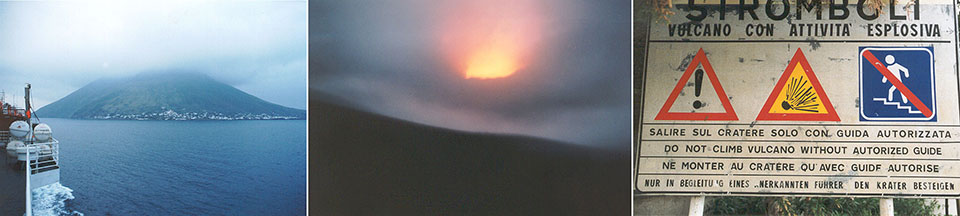
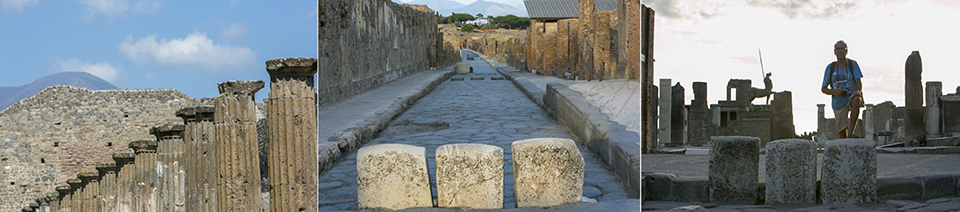
Twenty years ago, I visited Naples and the excavations at Pompeii and Herculaneum in a single week. I also climbed Stromboli, where I was able to see and photograph the eruptions up close, which happened once every 20 minutes at the time.
Stromboli
I did not have a tripod with me and had to lean on a stone. I had an analogue Canon SLR camera with a film that was not particularly sensitive, 200 ASA. Around dusk, you could see the eruptions clearly, and with a reasonable zoom lens you could also bring them fairly close.
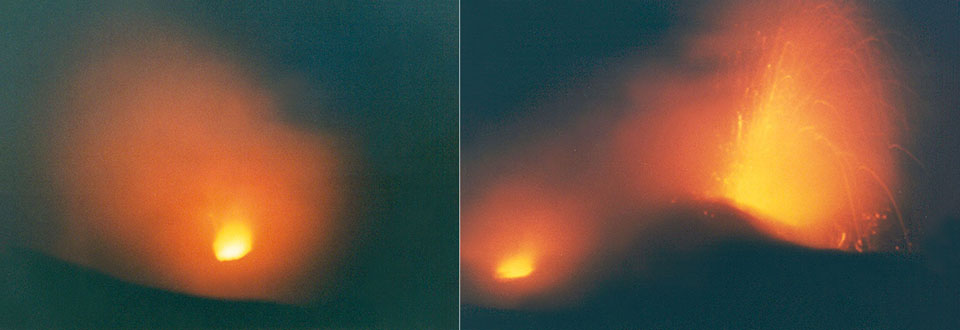
But because of the long shutter speeds, it was impossible to keep the camera still while shooting handheld. So I leaned on a stone and was convinced that I had taken good photos.
After development, this turned out to be quite disappointing. The photos were not really sharp. And of course, you could not check them straight away, so it was a painful discovery afterwards. The analogue photos included in this article are scanned 35mm negatives, by the way.
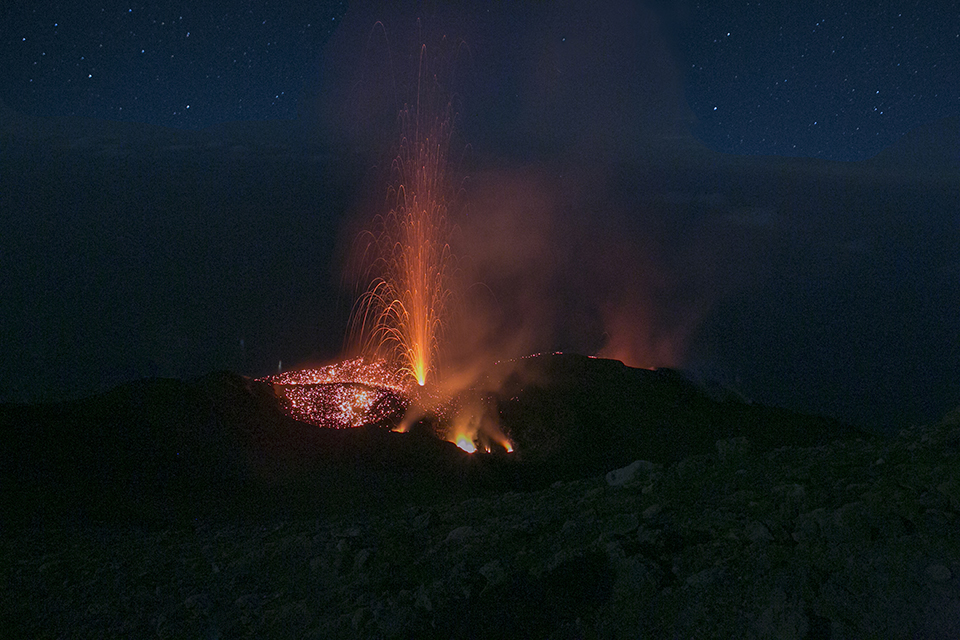
This time I did take a tripod with me, along with my digital full-frame Canon EOS 5d Mark III. The results have improved enormously! See the photos in the article about photographing a volcanic eruption.
One of the huge advantages of digital photography is that you can raise your ISO value as much as you like, allowing you to keep photographing in almost all conditions, often even handheld.
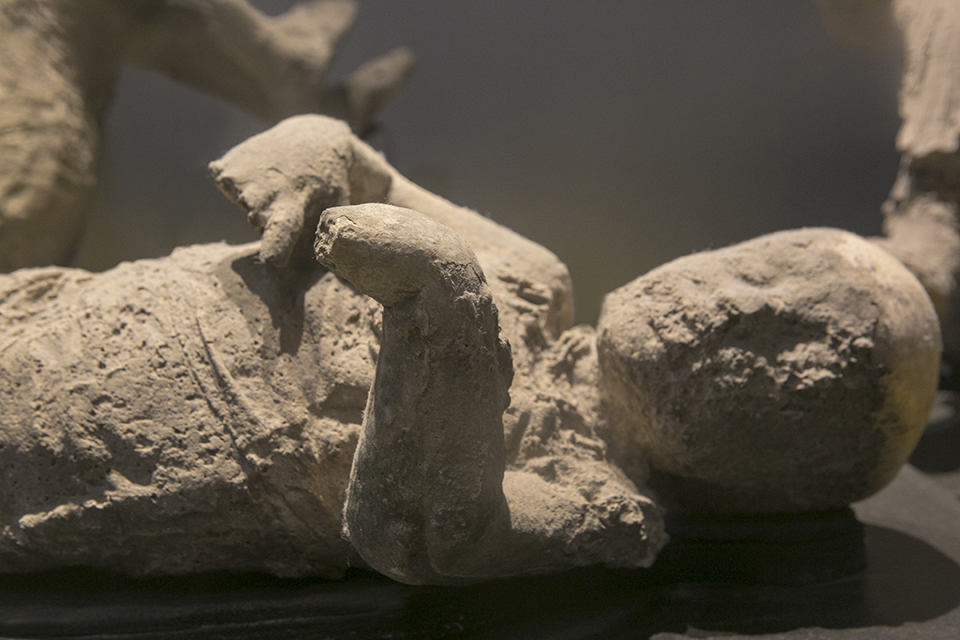
Pompeii and Herculaneum
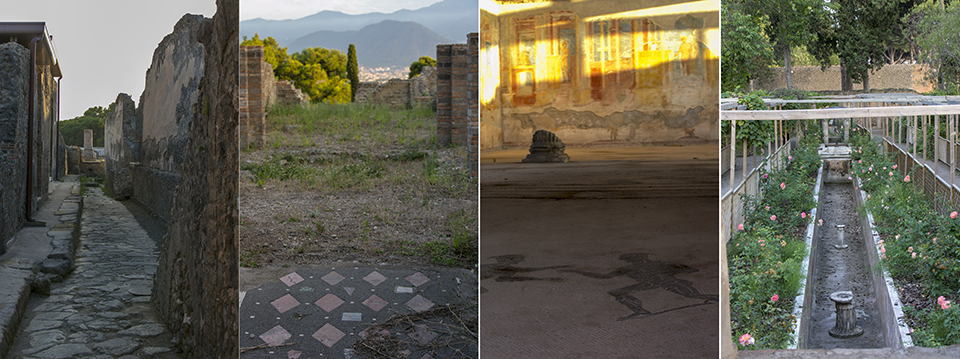
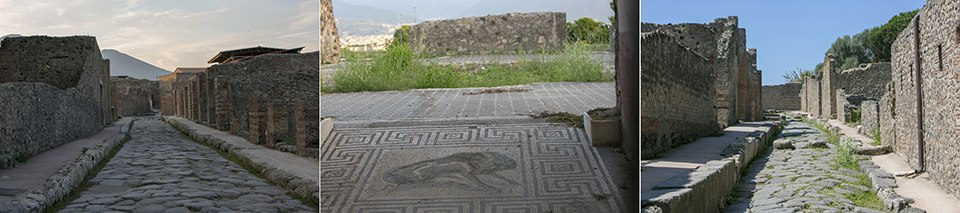
At Pompeii, and also at Herculaneum, the biggest challenge was bridging the huge contrast differences between indoor and outdoor locations. Or in the alleyways and through the openings.
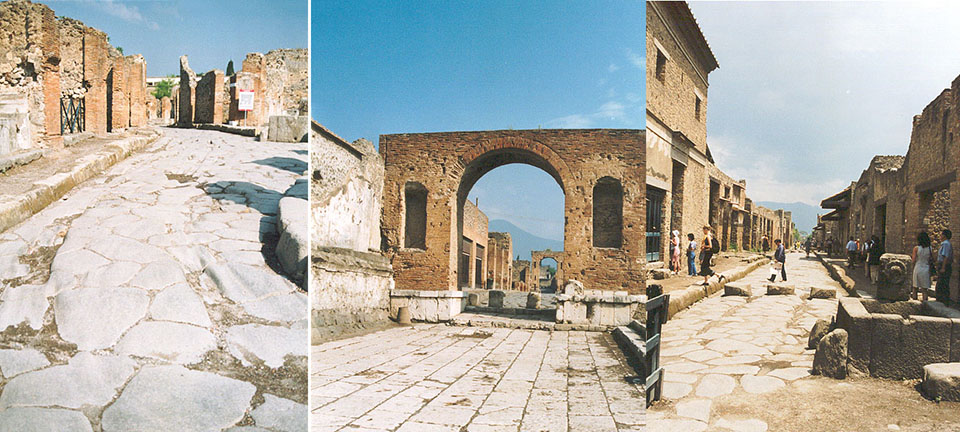
The result was an overexposed background and a dull foreground. Or a well-exposed background and a blocked-up foreground. Or a completely dull average. And the sky, which had been such a beautiful blue, had turned into a white, overexposed area.
Time of day
This is of course also a result of the time of day when you take the photos. In the middle of the day, it is very difficult to avoid the effects of the brutally harsh, direct sunlight. In that respect, you also learn a lot about photography and plan your timings more carefully.
Now you can shoot in raw and correct a lot during post-processing, as well as having a much greater dynamic range. The size of the sensor in a full-frame camera is roughly equivalent to that of a 35mm negative, 36 by 24mm.
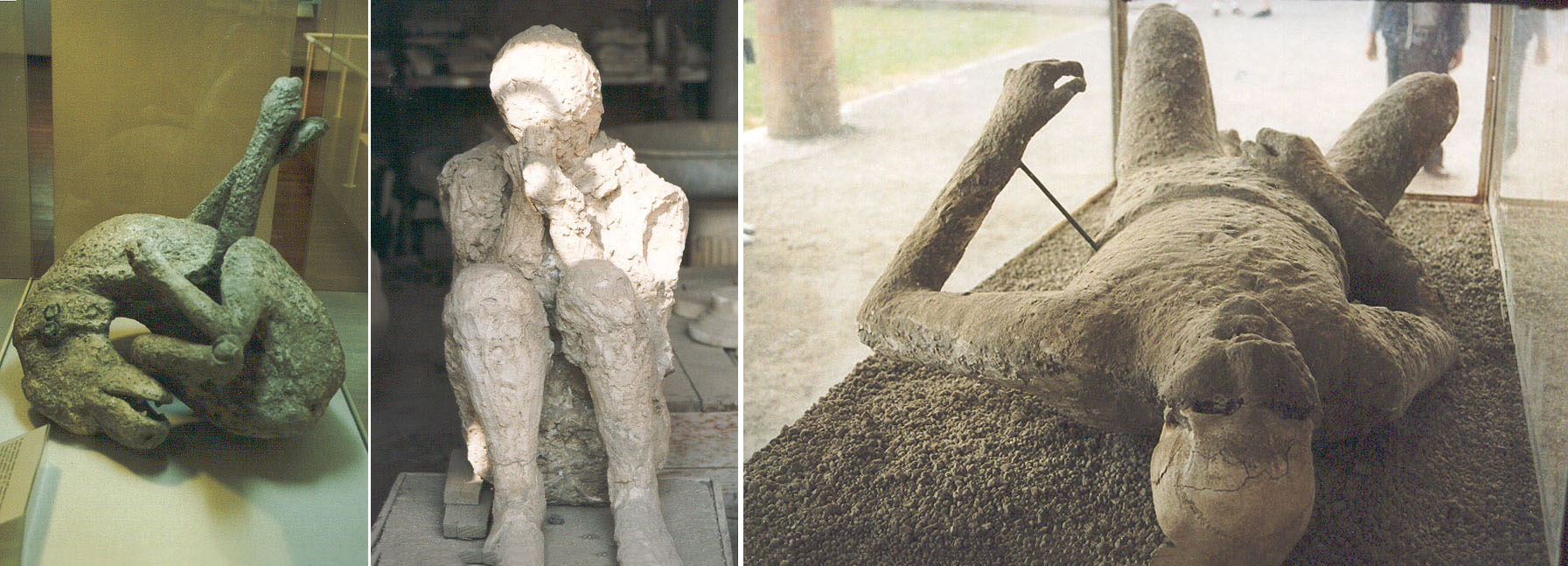
Thanks to the image stabilisation that is now often built in, it is also much easier to shoot handheld than before. It easily gives you a few extra stops.
Post-processing
And post-processing allows you to do much more than just correct an incorrect exposure. Especially if you shoot in raw, of course. Just think of:
- Making the colours warmer or cooler, and making the photos more lively by stretching your histogram using levels;
- Sharpening your photos, either locally or throughout;
- Removing noise, either locally or throughout;
- Cropping your photos so that more attention is drawn to your subject, or to improve your composition;
- Straightening crooked lines caused by tilting your camera upwards, especially in architectural photography;
- Removing unwanted objects, such as tourists, from your composition.
Darkroom
In the past, you could of course also correct a great deal in the darkroom, especially where exposure was concerned. You also had different types of paper, hard and soft, which allowed you to make your photos more or less contrasty.
And you could print your colours warmer or cooler, for example. In the past, you really did pay for the quality of a photo print. A negative only had value to the photographer themselves.
It therefore took a great deal of experience and skill to achieve an acceptable to good result. I still think the ease and speed with which you can now edit your digital photos is a huge advantage compared with how you had to do it in the past.
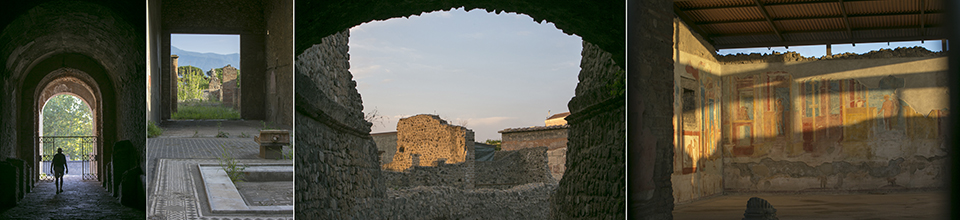
Digital is easier
Everyone should now be able, or be able to learn, to achieve good results fairly easily. Courses, either digital or classroom-based, are within everyone's reach.
In short, I would not want to do anything other than take photos digitally. It makes things so much easier, and you have to think much less. You also know immediately whether your photo worked and whether you are at least on the right track.
I am therefore always very curious about the reasons why people swear by analogue photography.
The advantage of a large 35mm negative also disappears when you use a full-frame camera.
Advantages of analogue photography
There are of course quite a few advantages to analogue photography as well. One of them is that you are forced to photograph more consciously.
With today's huge memory cards, you are no longer limited when it comes to continuing to take photos. When shooting analogue, you are limited to the maximum number of photos on your film. This forces you to think carefully about exactly what you want to capture with each photo.
Analogue photography also has a lovely colour effect. Analogue photos often have a beautiful soft and warm atmosphere. Of course, you can also add this afterwards in Photoshop. Digital photos, on the other hand, often look rather dull at first.
And as a final advantage, noise, or grain, often looks attractive in analogue photography, whereas in digital photography it is considered distracting. It can be very distracting, and strange coloured dots can even appear.
With analogue photography, grain often adds something to the photo. The colours also remain beautifully intact.
Conclusion
My opinion on digital photography is by now well known! In this digital age, you can hardly avoid it. I also wonder whether there are still any photo shops that develop film.
I still have an enlarger and some photographic paper, but I will probably never get around to using them again.
But I remain very curious about the reasons why people continue to photograph with analogue cameras. If you are an analogue photographer, it would be great if you shared your reasons in a comment!
About the author
Michelle Peeters is fotografe en oprichter van DeuxBleus Fotografie. Michelle herkent het bijzondere in het gewone en het gewone in het bijzondere. Ze heeft zich nooit willen specialiseren en is daardoor van alle markten thuis.
You might also like
-
 Digital film roll for your analogue camera
by Elja Trum
-
 Review: Analogue Photography
by Erik van Rosmalen
-
 My Struggle with Analogue Photography
by Michiel Heijmans
-
 Large-format analogue photography
by Nando Harmsen
-
 Dokaboek 2.0, all the basics of analogue photography in one book
by Erik van Rosmalen
20 comments
-

 martinphili wrote on Monday 24 September 2018 at 21:15
| reply
I hear that more often: Analog forces you to think very carefully about every photo. But is that really an advantage?
Translated from Dutch.
And if so, what exactly is the advantage? Does that mean I can do things with analog that I can't do digitally?
Personally, I think: all that thinking only takes extra time. -
 Michelle Peeters wrote on Monday 24 September 2018 at 21:33
| reply
@martinphilli: it's more the idea that you think more consciously before you just 'click away'. Which is so easy now, because you can just delete it again immediately anyway.
Translated from Dutch. -
 Huub wrote on Monday 24 September 2018 at 22:01 | reply
Nice idea to do it digitally again after so many years.
Translated from Dutch. -
 guest wrote on Tuesday 25 September 2018 at 10:52 | reply
“The number of pixels when using a full-frame camera sensor is approximately equivalent to that of a 35mm negative (36 by 24mm).”
Translated from Dutch.
Could you explain that please? -
Michelle Peeters wrote on Tuesday 25 September 2018 at 11:51
| reply
@guest: In photography, the 24 x 36mm small format film size (also called 35mm film) was, and still is, considered the standard. The negatives we used to make had this format and everyone has become very accustomed and attached to it. We still see that most photos, even in this digital age in which all formats are easy to create, are published in the 24 x 36 ratio.
Translated from Dutch.
A full-frame sensor is 24 x 36mm in size and has thus become the digital version of the small format. -
 Kees v Gogh wrote on Tuesday 25 September 2018 at 14:10 | reply
I still regularly use my mamiya 645 Pro TL with Kodak portra 400/800 with a separate exposure meter, have it developed at fuji, scanned and converted to black and white, wonderful to think for yourself again about how and what comes out, I wouldn't want to miss it.
Translated from Dutch.
Besides that I still use the 35 mm Argus brick rangefinder camera from 1941 (Malan Heslop) US army photographer also used this. -
Gerrit Van den Bosch wrote on Tuesday 25 September 2018 at 14:30 | reply
@Guest:
Translated from Dutch.
With digital photography, the smallest detail you can capture is 1px in size. If the detail in the photo would have to be smaller than 1 pixel, it will therefore still be displayed as 1 pixel in the file, or it will not be displayed at all.
So the question is what the resolving power (grain) of the film is, in other words, whether or not the detail can be captured on the film.
The above is also still strongly dependent on the quality of the lens, because the quality of the glass partly determines whether the smallest detail can be captured at all.
In short, it is very difficult to compare the resolution between analogue and digital because this depends on many factors. -
 Jan-Karel Kok wrote on Tuesday 25 September 2018 at 15:15 | reply
Recently I went back to my roots: analogue. A good experience, because it made me realise all the more just how enormously photography has progressed. In the past, sharpness was a thing. Now every camera is sharp. My mobile phone is almost better than a camera was back then.
Translated from Dutch.
That is immediately where the weak point lies. For recording, digital is unbeatable. It is even so perfect that it leaves nothing left to dream about. That is why, I think, many photographers turn to old techniques. Or create narrative photos in PS. Even a mobile phone has 'little filters'.
Analogue photography is no longer there to record, but to create. I myself started working analogue again out of curiosity. And I can't quite explain what it does to me, but I just like it. And that 4x5inch and making that print (only once more) is wonderful. And that photo, it's unique then, on paper!
There is a lot to read about it. This is roughly my story; so far. -
 Noud wrote on Tuesday 25 September 2018 at 15:19 | reply
Photography in the analog era was a craft, it required knowledge and experience. Nowadays everyone with a digital camera is a photographer.
Translated from Dutch.
It would have been interesting if, after 20 years, you had worked analog again to see whether you would now get a better result with a tripod and 20 years of experience. I shoot analog medium format and mirrorless digital with manual lenses from the 50s and 60s. Secretly, one modern Nikon 50mm 1.4 thrown in. -
 nico wrote on Tuesday 25 September 2018 at 16:18 | reply
I too still photograph extensively on film. Of course digital is easier and also better. However, it is the same as driving a vintage car or motorcycle that can do a maximum of 95 km/h. People always look at you, because most have never seen a Mamiya 645 or Yashica TLR. Films are still easy to buy and developing color negatives is already done from € 3.00. I develop black-and-white films myself. Even 20-year-old refrigerated films give good results.
Translated from Dutch.
Then scan them and edit digitally. -
 Leo Sikkenga wrote on Tuesday 25 September 2018 at 18:06 | reply
Shooting analog and printing on baryta paper is still much more beautiful than prints from a machine. It is personal and a unique copy. A feeling that only the connoisseur understands. Yes, it is difficult to get the paper flat, but that is how it should be.
Translated from Dutch. -
 Laura wrote on Tuesday 25 September 2018 at 22:03 | reply
@guest: In photography, the 24 x 36mm small-format film size (also called 35mm film) was, and still is, considered the standard. The negatives we used to make had this format and everyone has become very accustomed and attached to it. Even today we see that most photos, even in this digital age in which all formats are easy to create, are published in the 24 x 36 ratio.
Translated from Dutch.
A full-frame sensor has a size of 24 x 36mm and is thus the digital version of small format.
>> this is correct, however, it is not the answer to the question of why an analog small-format image has the same number of pixels as a digital ff sensor. There are ff sensors with 24 megapixels, but also with more or fewer. Aspect ratio is therefore separate from the number of pixels, let alone the quality of those pixels...
Apart from that; for me personally, the charm of analog photography lies at least in the patience it requires; looking for the right composition, the right settings, and... waiting until the roll is full before you can view the result. You take more time to create art; especially in the current age in which everything seems to have to go faster, harder, more, more extreme, the fact that you can take your time with analog is truly an advantage. Apart from that, an analog print has a certain feeling - the character of the grain, the subtle noise (depending on your ISO) and the dreamy, imperfect nature of the limitations attached to film such as limited dynamic range etc... Wonderful and impossible to match with digital! -
 Roland van Bezouw wrote on Tuesday 25 September 2018 at 22:59 | reply
Clear story. But your first sentence does cause some confusion. In it, you combine two situations (your visit to Pompeii and the Stromboli volcano) which, without reading further, make many an eyebrow frown..... Pompeii was, as you probably know, destroyed by another volcano (Vesuvius).
Translated from Dutch. -
Michelle Peeters wrote on Tuesday 25 September 2018 at 23:00
| reply
@Roland: that's indeed correct, a coincidental combination of circumstances...
Translated from Dutch. -
guest wrote on Wednesday 26 September 2018 at 09:52 | reply
Michelle: you are not answering my question. You state that analogue 35mm has as many pixels as FF, and that is simply not true. It is even nonsense, because pixels and emulsion have nothing to do with each other.
Translated from Dutch.
I do know of comparisons in which an APS-C sensor with 6 MP produced a more detailed image than a Velvia shot of the same scene. -
Michelle Peeters wrote on Wednesday 26 September 2018 at 09:56
| reply
@gast: Laura has already answered your question above in her comment:
Translated from Dutch.
>> this is correct, however, it is not the answer to the question why an analog 35mm format has the same number of pixels as a digital full-frame sensor. There are full-frame sensors of 24 megapixels, but also of more or fewer. Aspect ratio is therefore separate from the number of pixels, let alone the quality of those pixels...
I adjusted it in the article. Incidentally, the number of pixels a camera has also does not say everything about the image quality. -
 dezutter tjen wrote on Friday 28 September 2018 at 14:25 | reply
nice, such discussions .... whoever works with a computer is "contemporary" ,whoever still writes with a ballpoint pen is still in the "ape men" phase ???? Whoever leaves everything to chips and electronics must no longer think for themselves ??? Well take away those foolisch brains of us ...??? I have my Pentax analogue series ; 2 ME semi-automatic - 1 MZ 7 - and 1 SP1000 The Mamyia TLR C Prof. is always loaded , my little lomo LA- and then the rangefinders Kodak Retina 1a- the Yashica GS- and the Agfa Isolette L- And yes I also wanted to try the Polaroid Impulse. I go to the photography course with the Canon 50 D ...And I have never heard the cameras compete with each other in my darkroom ....I find it super wonderful to look at the contrasts in b and w on a Svema roll of film of 10 asa !!!
Translated from Dutch.
I have 1super big disadvantage ..I cannot choose a parameter of film for myself .I want to test them all ...And yes experimental photography suits me as does Haiku and ZEN Photographers .Photography serves me to show things NOW that will no longer be there tomorrow ...What I experience in the digi courses is that a lot of time is spent looking at new more expensive cameras, mirrorless, the latest gadgets...Luckily for the manufacturers the consumer is still impossible to satisfy .. So I do it with 2....in peace -
 Frank wrote on Friday 28 September 2018 at 16:53 | reply
Good to read that there are still plenty of people who still/again photograph analog. I myself have been completely back to analog for about 3 years now, including a darkroom. I tried digital, but it didn't excite me. In my humble opinion, the writer of this piece does not give the impression of having learned anything in 20 years: back then, analog didn't really work out, and now apparently he completely relies on the technical advances of today's cameras.
Translated from Dutch.
The photos shown could also have been made perfectly well with analog.
Because of the enormous latitude of film on the overexposure side, you really have to do very strange things not to come home with usable pictures, whereas with digital, if you go 1 bit too far to the left, you lose information that never comes back. But anyway, the idea of making photos again after so many years is fun. -
Michelle Peeters wrote on Friday 28 September 2018 at 22:22
| reply
@Frank: I didn't say that I now fully trust digital technology and that everything will just work out by itself, that really would be ‘the wonderful world of technology’! But what you say about that enormous latitude with 35mm film, that's absolutely true!
Translated from Dutch. -
 Marc wrote on Saturday 29 September 2018 at 17:33 | reply
I have always photographed analog. Now I photograph digitally with analog in mind. Shouldn't have to look through 50 photos for a good one. That's the difference.
Translated from Dutch.
Have your say
Please note: Articles older than a week can only be commented on by signed-in visitors.Would you still like to comment? sign in or create a free account.
Become a better photographer every week
A practical photography tip in your inbox every week.
38,889 photography enthusiasts already receive the tips! More about the weekly mail. Or keep up to date via  Facebook.

Elja Trum
Photofacts; everything to do with photography!
Would you like to take better photos and keep up with what is happening in photography? Photofacts publishes articles that teach you something about photography — from a product announcement to a practical shooting tip or a look at a website. Photofacts covers photography every day and is a hobby project of Elja Trum's that got out of hand. The articles are written by a team of volunteer authors. If you would enjoy writing one or more articles for Photofacts, do get in touch.More about PhotofactsPhotofacts is made possible in part by
