

The Sony A9 mark III with global shutter and flash
Friday 8 March 2024, 13:26 by Nando Harmsen | 2,801 views | 0 commentsThis article was translated from Dutch with the help of AI. Read the original.
The Sony A9 mark III is naturally in the news because of its global shutter. It is rightly called revolutionary. It promises no rolling shutter effects and flash at any shutter speed. That last part is not as simple as it seems.
A global shutter means that the sensor is read out completely in a single moment instead of line by line. This means you no longer have to deal with distortion of lines that are at right angles to the direction of movement. That is perfect for action photographers.
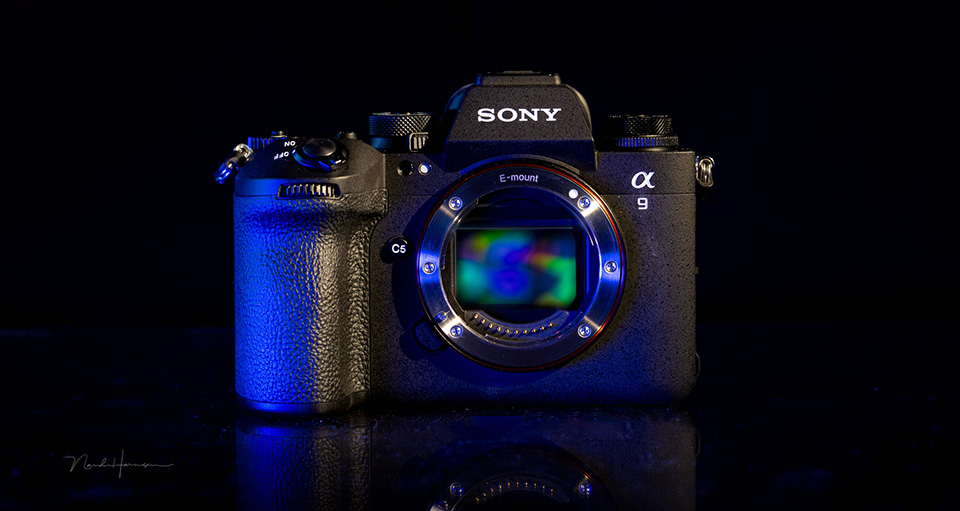
The other advantage is the absence of a flash sync speed. This means you can use flash at any shutter speed without relying on high-speed sync. The Sony A9 mark III can therefore use flash at the fastest available shutter speed: 1/80,000 second.
This is only in theory, however. In practice, it is virtually impossible. This is not down to the camera or the global shutter, but to the way a flash works.
The flash intensity is determined by the duration of the flash. This time is indicated by t0.1. The exposure is made during this time, and the rest of the flash duration has virtually no further influence on the exposure. The less light a flash has to produce, the shorter the t0.1.

If you want to take a flash photo at 1/80,000 second, the flash duration t0.1 must be 1/80,000 second or shorter. There are hardly any flashes that can do this, and if you have one, it must be set to the lowest flash intensity.
I managed to find one: the Profoto Pro 11 in combination with the Prohead Plus UV 500W. This 2,400 Ws generator can achieve a flash duration of 1/80,000 when set to 2.4 Ws. This generator costs 18,000 euros, while the matching flash costs more than 3,000 euros.
I used a Profoto B10 of 250 Ws for a test with the Sony A9 mark III. This flash has a t0.1 of 1/400 second at full power. By setting the flash intensity to 0.5 Ws, the lowest setting, the t0.1 is as short as 1/4,900 second.
In freeze mode, this flash reaches a maximum of 1/14,000 second at 0.5 Ws. This is according to the manufacturer's specifications. I set up the flash to get a good exposure at 0.5 Ws. This was at a distance of 10 cm. The exposure was ISO 250 and f/8.
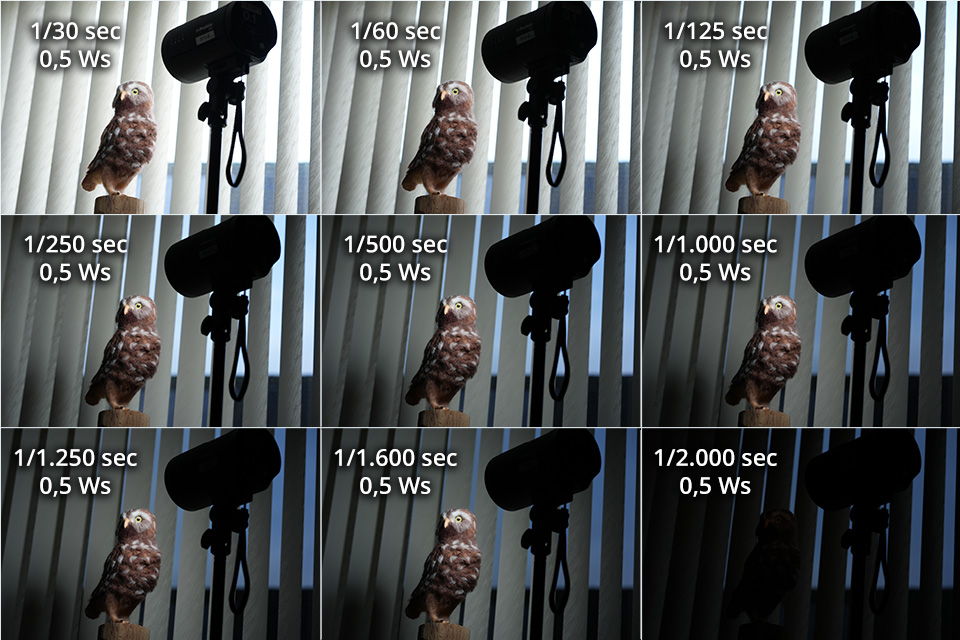
The result of this test shows that the flash can be used at shutter speeds of up to 1/1,600 second. At faster shutter speeds, the flash duration (t0.1) is so much longer that the required amount of light is not reached within the set shutter speed.
This is a shutter speed that is faster than the one specified by Profoto. This is because, according to Sony, the flash must also meet special requirements. A fully compatible flash must be used, and remote flash is also different from a flash connected directly. The exact details are difficult to determine.
The possibilities offered by the global shutter are of course fantastic. Although you could use a flash at any shutter speed you want, no flash is fast enough to make this possible. In many cases, around 1/500 second will be the maximum you can use.
About the author
Nando Harmsen has been photographing for more than 40 years. He specialises in wedding photography and landscape photography. Nando also gives talks, workshops, masterclasses and photo trips, and regularly reviews new and interesting equipment.
You might also like
-
 Review: Sony A9 mark III
by Nando Harmsen
-
 Sony introduces the Sony A9 III
by Nando Harmsen
-
 Review of the fantastic Canon EOS R6 Mark II
by Nando Harmsen
-
 Review: Sony A1 mirrorless camera
by Nando Harmsen
-
 Review: Sony A7 IV
by Nando Harmsen
-
 Sony a7 mark IV announced
by Elja Trum
0 comments
Be the first to share what you think!
Have your say
Please note: Articles older than a week can only be commented on by signed-in visitors.Would you still like to comment? sign in or create a free account.
Become a better photographer every week
A practical photography tip in your inbox every week.
39,081 photography enthusiasts already receive the tips! More about the weekly mail. Or keep up to date via  Facebook.

Elja Trum
Photofacts; everything to do with photography!
Would you like to take better photos and keep up with what is happening in photography? Photofacts publishes articles that teach you something about photography — from a product announcement to a practical shooting tip or a look at a website. Photofacts covers photography every day and is a hobby project of Elja Trum's that got out of hand. The articles are written by a team of volunteer authors. If you would enjoy writing one or more articles for Photofacts, do get in touch.More about PhotofactsPhotofacts is made possible in part by
