

Falling stars (Lyrids), photographic contributions
Sunday 3 May 2020, 20:10 by Michelle Peeters | 5,187 views | 0 commentsThis article was translated from Dutch with the help of AI. Read the original.
In the article Falling stars clearly visible on 22 April! we asked members to send us their own photographic contributions. They responded well and we received some wonderful photos of meteor showers. Nando Harmsen also sent a photo and timelapse for this article. Great for inspiration!
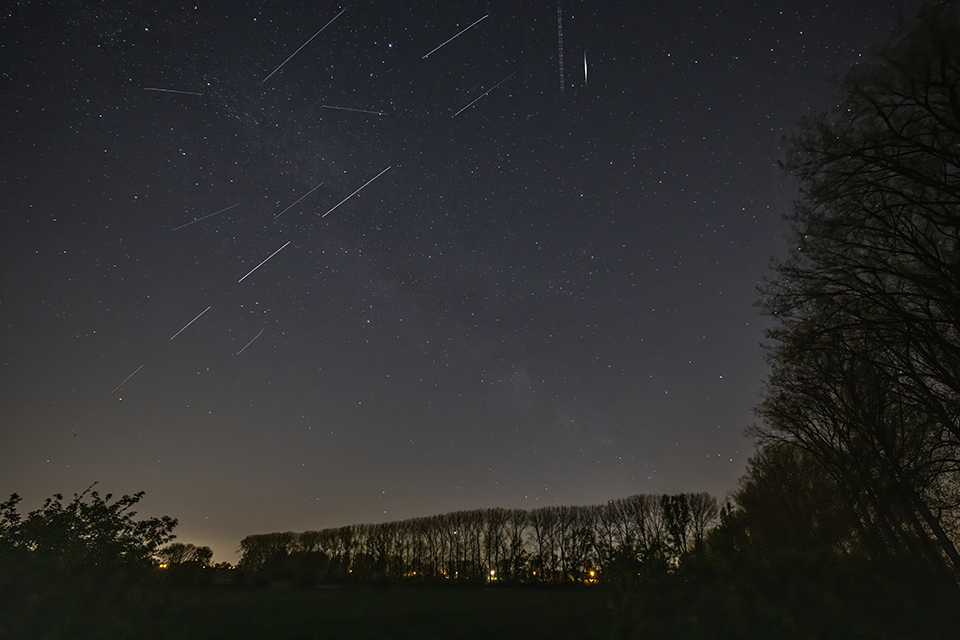
I had a go at photographing the Lyrids myself and was convinced that I had made a decent 'catch'. However, star expert Nando Harmsen told me that I had captured the Starlink satellites. He could not spot any falling stars in my image.
The short flash, which is almost vertical, looks more like an Iridium flare judging by its shape. Iridium flares are the so-called Iridium satellites. The solar panels on these satellites can reflect the sun's light very brightly, and they last for around 15 to 60 seconds. They become very bright very quickly, and then fade again just as quickly. Nice to see, though!
It is alarming how many satellites can be seen these days, and with Starlink from Elon Musk, it has become a complete disaster. You might see a few falling stars per hour, but a few satellites per minute. And we are still lucky that not many planes are currently flying.
Marc Engels
I set my alarm for 3:20 this morning after all. I was curious to see what this would produce. In fact, I had never photographed stars before.
Although I live not far from the beach, just a few hundred metres as the crow flies, I still had to set up in my garden because of the stay-at-home order in Belgium due to the coronavirus measures.
With the motto "stay in your home", we can only make essential journeys, let alone spend another hour photographing.
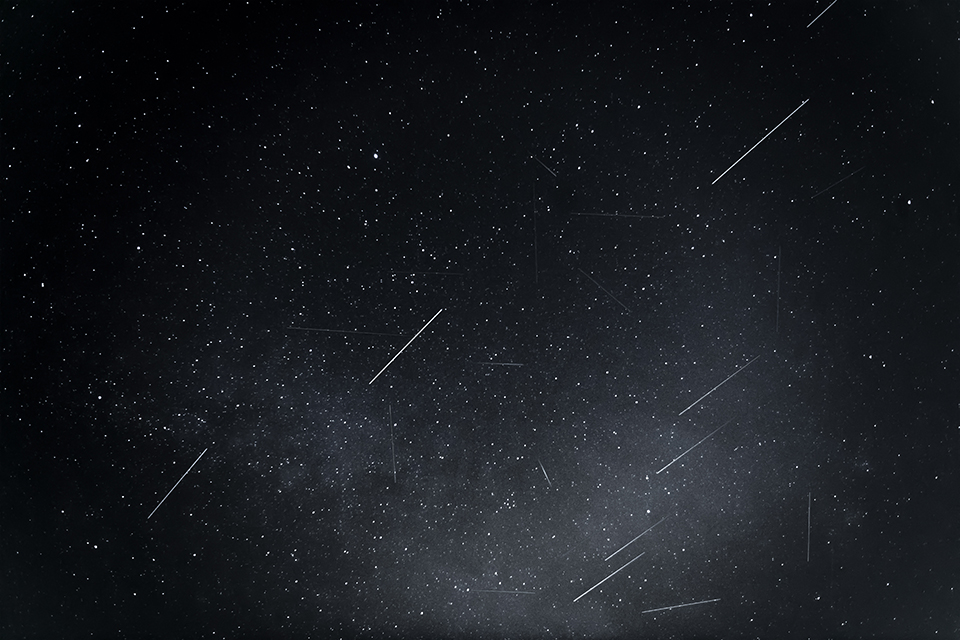
So I was in my own garden, with a lot of light pollution from the street lighting and, of course, no opportunity to create a composition. So I simply aimed at the stars and Hercules. The advantage was that I could go inside into the warmth after an hour while my camera did the work in the garden.
With 360 photos, I tried to make something of it, far from what I saw in your article... Still, I am sending you the result.
Robin van der Hijden
This was the first time I had photographed stars. Difficult, but it was quite an experience. This was taken on the Veluwe, in the middle of the forest near Hoenderloo.
Nando Harmsen took a look at the photo to see whether this really was a falling star or a satellite. That is difficult to say, as the photo is not completely sharp. It would be nice if this were a meteor, because it is a very beautiful one. However, the profile also looks like a satellite.
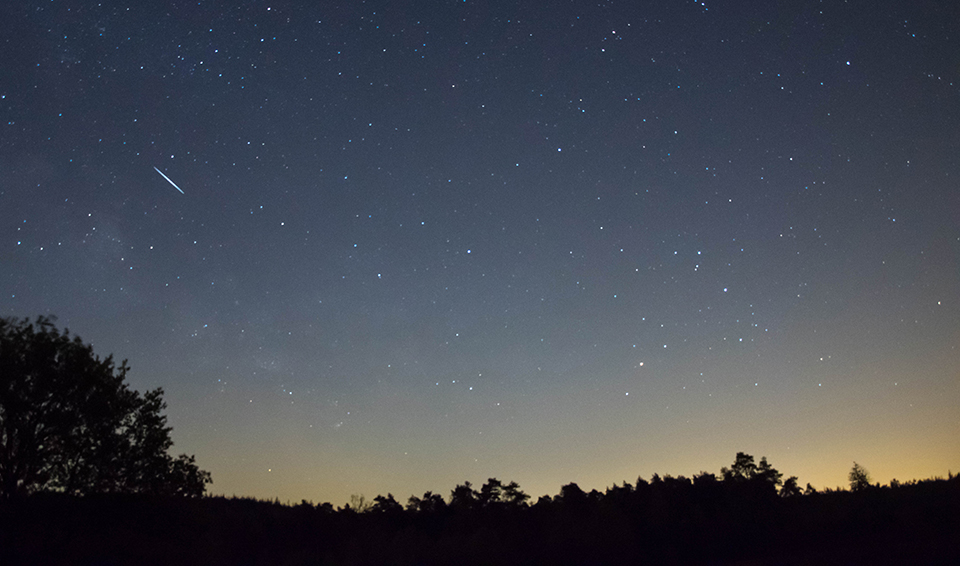
The best way to settle this is to look at the photos taken afterwards and beforehand, assuming that photos were taken continuously. If that is the case, a satellite will unmistakably also be visible in the adjacent photos. Nando's feeling is that it is not a meteor, unfortunately.
Nando Harmsen
Here is a photo with a Lyrid meteor. With a peak of no more than 5 to 11 meteors per hour, this produces no spectacular results as expected, and the number of meteors I saw during the 3.5 hours of photographing was no more than about five. After all, you cannot keep an eye on the entire sky continuously, let alone photograph it.
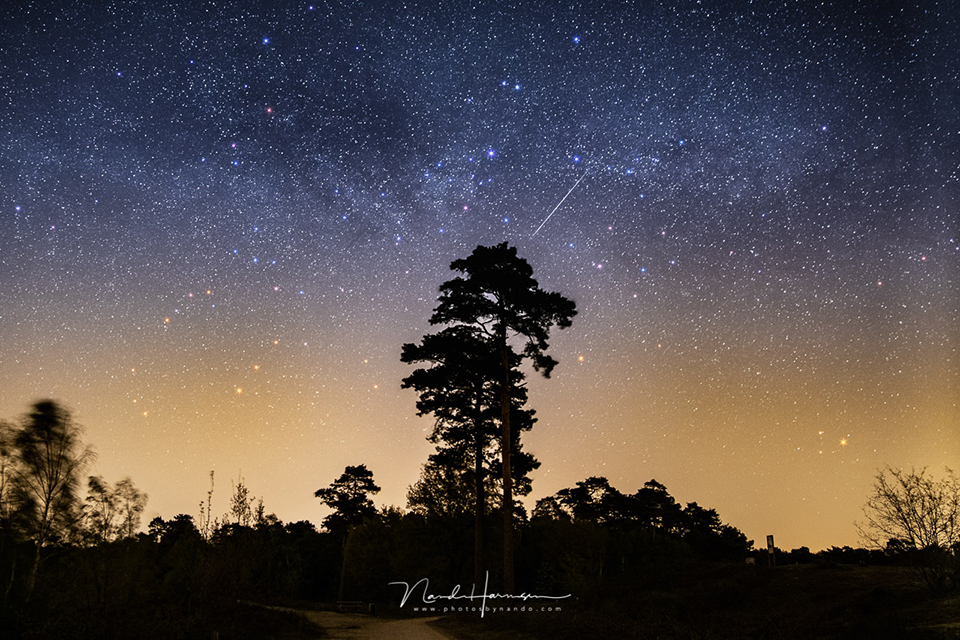
The photo above was taken in one of the darkest places in Brabant/Limburg, with a Canon EOS R and RF24-70mm f/4 lens at 24mm. The Milky Way can just about be seen, as it appeared in the eastern sky at 01:57. ISO6400, f/4 and 20-second exposure. The really interesting meteor showers do not start until August.
What was noticeable this time were the Starlink satellites, which continued to pass by for more than half an hour. The timelapse I made of them can be seen here, although unfortunately it is impossible to see falling stars in a timelapse:
Herman Kamphuis
Herman put 88 photos into a short clip. Camera settings: f/2.8, shutter speed 20 seconds, ISO3200. Focal length: 16mm. Camera: Nikon D850. The photos were taken in Polder Oosterwolde in Gelderland on 22 April from 03:30 to 03:34.
About the author
Michelle Peeters is fotografe en oprichter van DeuxBleus Fotografie. Michelle herkent het bijzondere in het gewone en het gewone in het bijzondere. Ze heeft zich nooit willen specialiseren en is daardoor van alle markten thuis.
You might also like
-
 The quiet brought by coronavirus, photographic contributions
by Michelle Peeters
-
 Tips for editing photos of shooting stars
by Nando Harmsen
-
 6 Tips for Creating Star Trails
by Nando Harmsen
-
 Combine star trails in Photoshop with an action
by Nando Harmsen
-
 Night photography tip: turn light sources into stars
by Nando Harmsen
-
 The best snow photos from our members
by Nando Harmsen
0 comments
Be the first to share what you think!
Have your say
Please note: Articles older than a week can only be commented on by signed-in visitors.Would you still like to comment? sign in or create a free account.
Become a better photographer every week
A practical photography tip in your inbox every week.
39,027 photography enthusiasts already receive the tips! More about the weekly mail. Or keep up to date via  Facebook.

Elja Trum
Photofacts; everything to do with photography!
Would you like to take better photos and keep up with what is happening in photography? Photofacts publishes articles that teach you something about photography — from a product announcement to a practical shooting tip or a look at a website. Photofacts covers photography every day and is a hobby project of Elja Trum's that got out of hand. The articles are written by a team of volunteer authors. If you would enjoy writing one or more articles for Photofacts, do get in touch.More about PhotofactsPhotofacts is made possible in part by
