
Bird photography often requires a lot of patience
Saturday 17 September 2022, 16:08 by Erik Nevels | 4,305 views | 2 commentsThis article was translated from Dutch with the help of AI. Read the original.
As a nature photographer, I regularly photograph animals, including birds. That is usually not easy! Birds are generally shy, move around a lot, hide and often fly away from you. In short, bird photography is quite a challenge and often requires a lot of patience.
Great crested grebe with chicks in September
It is early September. In the early morning, I walk along the shore of the Oolderplas, a local lake on the Meuse in Central Limburg for me. I have the camera with the 200-600mm lens in my hand in case birds appear in my viewfinder.
I have already seen a group of mallards, three cormorants and a tern, but they have not produced any good photos yet. As so often happens, the heron, hidden behind a bush right by the shore, sees me before I see it and flies off squawking.
I carry on walking and, a little later, when I see the water again behind a row of bushes, I suddenly stop. A great crested grebe with two chicks right by the water's edge. The smallest chick is still sitting on its parent's back. So sweet!
Just like the heron, they spot me before I spot them and the three of them swim away from me. They are in no hurry, but I am. They are still close by and I do not want to disturb them with my presence for long.
I crouch down and quickly take a series of 10 photos. I calmly walk away from them and decide to try to photograph them unseen the next day.
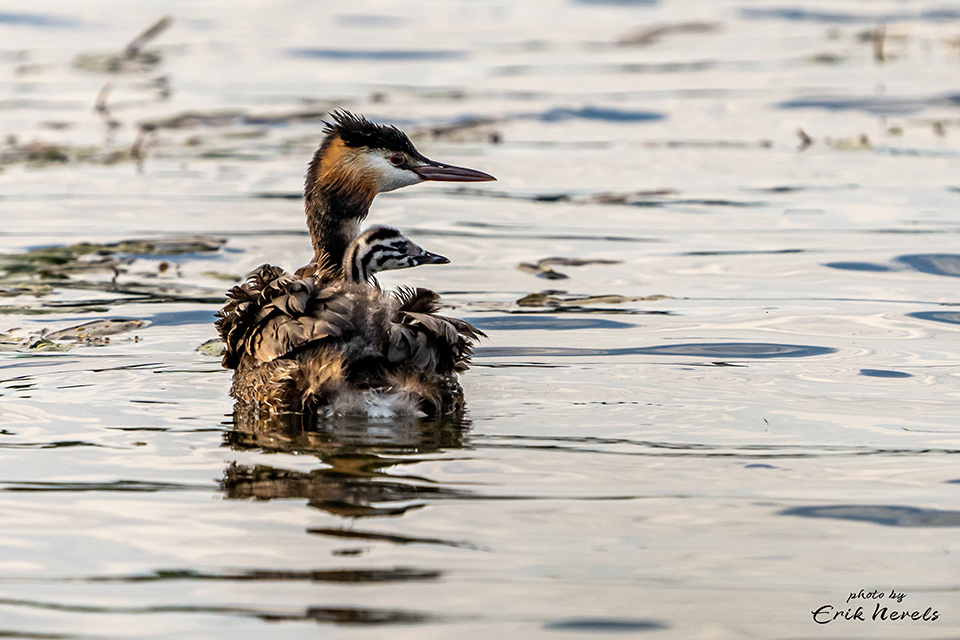
Sony A7 mark III, 600mm, f/7.1, shutter speed 1/2000s, ISO 1600
Preparation.
The sun has only just come up and I am on my way to the place where I saw the grebes yesterday. I carefully walk along the shore, hiding behind bushes as much as possible.
The camera with telephoto lens, 200-600mm, is hanging around my neck again and, just like yesterday, I have done some preparation regarding the settings. As I want to be able to act quickly and do not know exactly what lighting conditions I will encounter, I choose the auto ISO setting.
As water will probably form the foreground and background, I work with 1 stop of overexposure, which I can quickly turn back to 0 if the background is darker.
I also set the shutter to Hi-speed with a shutter speed of 1/1250 second to prevent motion blur. After all, the birds are moving and I am also shooting handheld with a telephoto lens.
I set the aperture to f/10 in advance because I want a little more depth of field than yesterday with f/7.1. Finally, I turn off the sound made by the shutter.
Sneaking
When I reach the place where I saw them yesterday, I prick up my ears. I can hear the chicks cheeping, so they are nearby. I decide how I am going to walk, making as much use as possible of the cover along the shore.
Step by step, I move closer. Two metres further on there is a gap in the bushes and I want to photograph through it. I sneak towards it and then I see them.
All my movements are extremely slow now. From their behaviour, I can tell that they have not noticed me. I especially want to keep it that way, because it can produce the best photos and because I do not want to disturb them.
My position for photographing through the gap at the right height is quite awkward and requires one knee on the damp ground. Hopefully they will stay where they are.
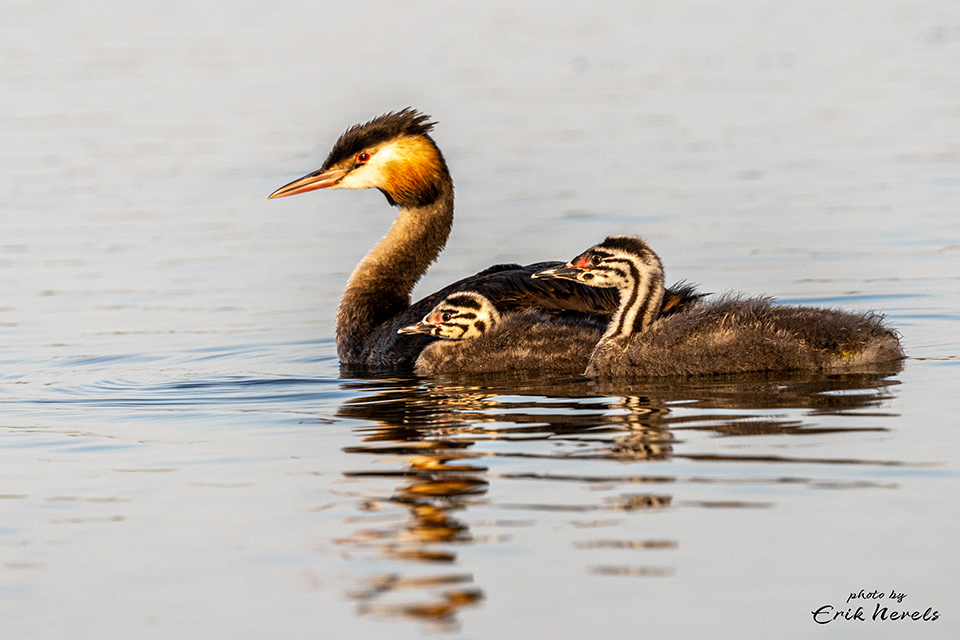
Sony A7 mark III, 600mm, f/10, shutter speed 1/1250s, ISO 1250
Even more patience
I only take the first photos when the chicks are close to the parent and the composition is to my liking. If there is some action as well, that is even better. I patiently wait for the right moments. After about five minutes and many photos, the camera becomes too heavy for me and I let it rest for a moment.
Luckily, the birds stay where they are and a little later I work for another five minutes. Then I decide that is enough and I am glad that they still have not seen me. I carefully sneak away from the spot and away from the shore.
I can stretch my legs again and the somewhat sluggish blood flow caused by the awkward position while photographing starts moving properly again.
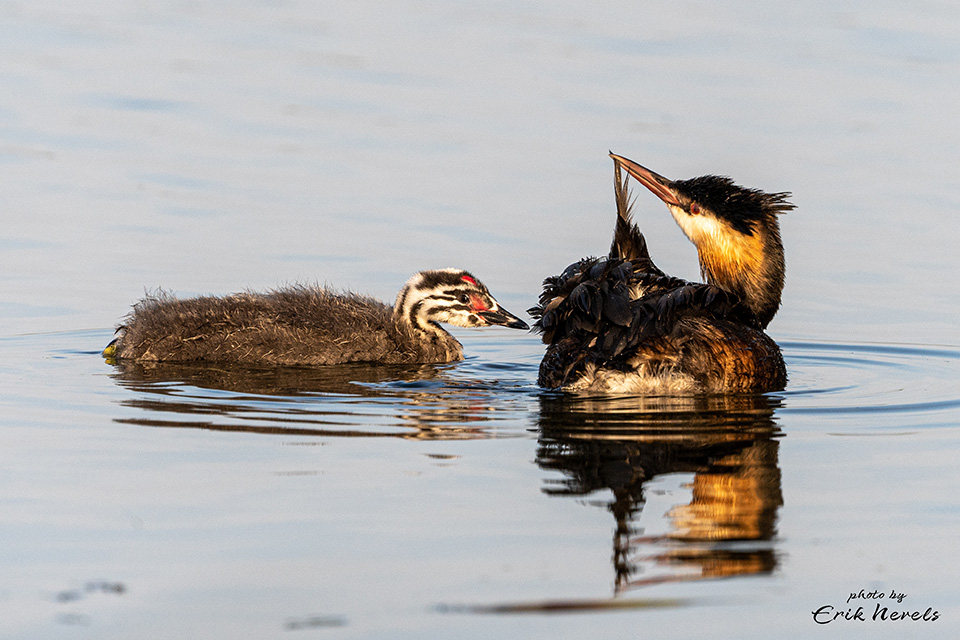
Sony A7 mark III, 600mm, f/10, shutter speed 1/1250s, ISO 1250
Bonus
As I walk back, very pleased with my morning so far, I see a complete family of coots to my right, busily preening their down feathers and foraging. Although they can see me clearly, they make no attempt to leave.
My pace slows and not long afterwards I crouch down again. I am now so close that I do not need my 600mm. Neither the parents nor the chicks take any notice of me and I can choose which chick I want to photograph.
Just as with the grebes, I patiently wait for photogenic moments and call it a day after about 10 minutes. Only when I stand up do they swim a little further away, and I calmly walk backwards. Doubly pleased with what I have been able to capture in front of my lens this morning, I walk home.
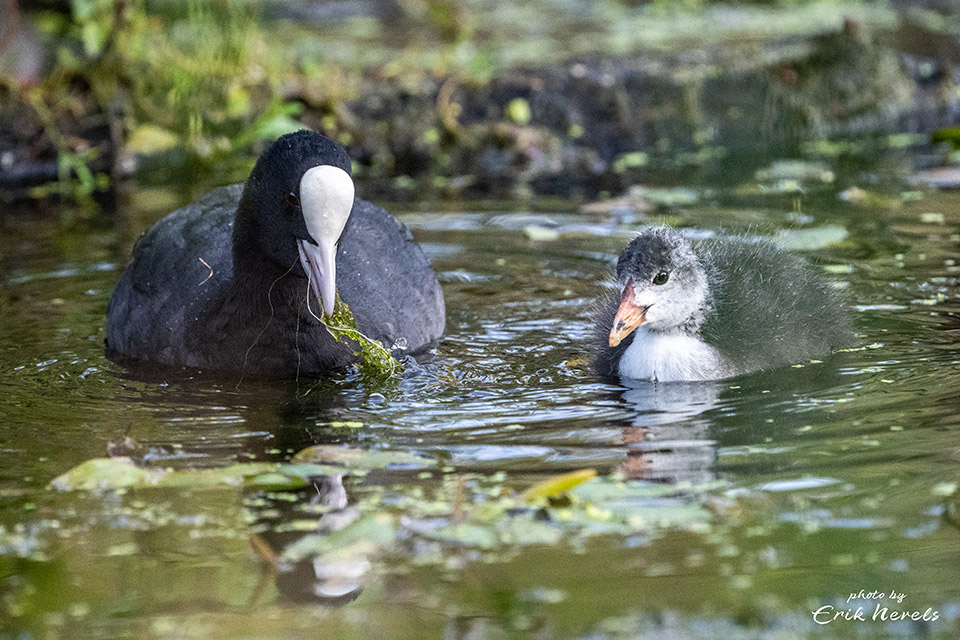
Sony A7 mark III, 524mm, f/9, shutter speed 1/1250s, ISO 6400
A lot of patience.
Getting birds close to your lens in the wild is no easy feat. It requires a lot of patience and the time that goes with it.
But patience pays off, not least for the birds themselves. If your patience allows them to carry on undisturbed, that is certainly a plus.
About the author
Steeds weer boeiend en op zoek naar de essentie! Dat is wat fotograferen in de natuur voor mij is. Gefocust op het landschap of het onderwerp in diens omgeving tracht ik meer dan alleen te registreren. Een continue uitdaging waarvan ik elke keer volop geniet. Meer foto's? Volg mij op Instagram en/of kijk op mijn website
You might also like
-
 A telephoto lens isn't just for birds
by Erik Nevels
-
 Photographing birds? Practise first.
by Nando Harmsen
-
 Bird photography? Don't forget the common species.
by Nando Harmsen

2 comments


Have your say
Please note: Articles older than a week can only be commented on by signed-in visitors.Would you still like to comment? sign in or create a free account.
Become a better photographer every week
A practical photography tip in your inbox every week.
39,079 photography enthusiasts already receive the tips! More about the weekly mail. Or keep up to date via  Facebook.

Elja Trum
Photofacts; everything to do with photography!
Would you like to take better photos and keep up with what is happening in photography? Photofacts publishes articles that teach you something about photography — from a product announcement to a practical shooting tip or a look at a website. Photofacts covers photography every day and is a hobby project of Elja Trum's that got out of hand. The articles are written by a team of volunteer authors. If you would enjoy writing one or more articles for Photofacts, do get in touch.More about PhotofactsPhotofacts is made possible in part by
