
Wildlife and nature photography in 'Quick Draw'
Sunday 19 February 2017, 14:28 by Tanja Thomas | 11,188 views | 8 commentsThis article was translated from Dutch with the help of AI. Read the original.
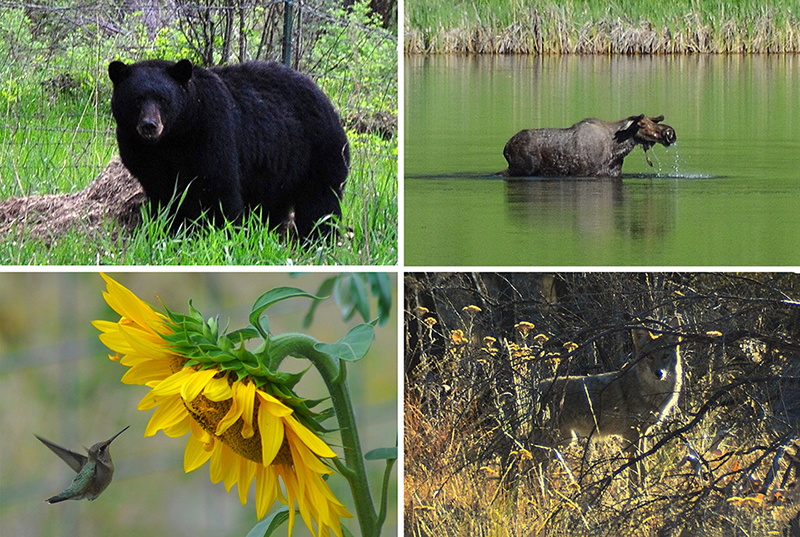
Living remotely high in the mountains of Methow in Washington State, USA, has clear advantages when it comes to nature and wildlife photography. Opportunities to spot wildlife and discover beautiful subjects are literally there for the taking.
Photographing all that wildlife seems easier than it is, though. The wild animals in this area are truly 'wild' and not used to people at all.
The area is also enormous, so you have to cover many kilometres. You already need plenty of skills if you want to spot wildlife at all.
And you can imagine how quickly you have to act if you also want to take a photo of it, preferably one that is 100 per cent perfect. Further on, I will discuss these kinds of challenges in more detail, illustrated with a few examples.
Quick Draw
My way of photographing wildlife works slightly differently from simply hiding somewhere for hours, waiting under a camouflage net with a tripod and telephoto lens. I simply do not have the patience for that.
As I mentioned in my biography, my motto is 'Quick Draw'. It is a phrase my husband and I use to describe always being on standby and reacting quickly with your camera, so you never miss a moment of wildlife hopping past by chance or an interesting patch of light in nature.
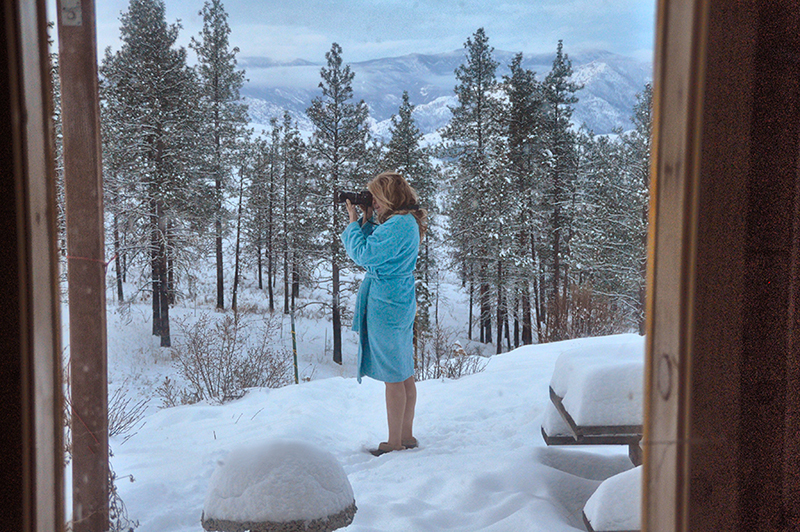
For me, 'quick draw' also means that when an opportunity presents itself, I leap out of my warm bed like a shot, grab my camera and slippers, and immediately run outside into the snow, wearing nothing but a morning robe.
And all that for a potentially good wildlife shot, often found right around the house. On occasions like this, it is very useful that we do not have any curious neighbours...
Equipment
At the moment, I use Tamron lenses on my Nikon D5100 and D90 cameras. They can handle many situations, from macro and telephoto to landscape photography. I also use lenses with a wide zoom range, such as the 18-200 and the 16-300mm.
They are not the most desirable lenses for beautiful photography, mainly because of their weight and somewhat lower quality due to the enormous zoom range. Prime lenses often perform better when it comes to beautiful bokeh and sharpness.
But for showing this landscape with its wild animals and rugged nature as it really is, including the completely unexpected and often exciting moments, these lenses are very practical to use.
These lenses require quick skill, insight and steady hands, the latter especially when using telephoto lenses. Getting the best possible image in an ad hoc situation is a fun challenge for me every time.
Considerations
Other challenges include carrying heavy or lighter equipment. What do you take with you when you know you have a difficult climb in the mountains ahead, jumping from rock to rock across rivers and past waterfalls, and crawling through dense undergrowth?
Sometimes you have to make do with just one camera, with only the 16-300mm lens, for example. A lens with such a huge range is very welcome in that situation, as it saves an enormous amount of carrying! You also do not have to change lenses, so you do not miss any precious moments. That is why these lenses are often recommended to people who travel a lot.
Mutual respect for territories!
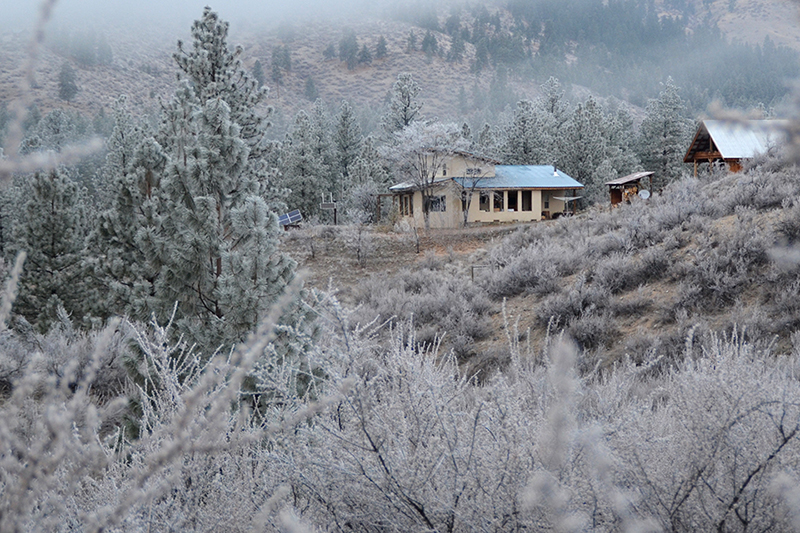
Even though bears, coyotes and so on literally walk through our garden, it remains difficult to photograph them 'at close range'. This is because these animals show respect, both for my husband and for our two dogs, who mark their territory in our garden.
Yes, you read that correctly, my husband deliberately urinates in the garden so that bears, coyotes and/or other animals can smell it. Before you wrinkle your nose at the thought and think 'how disgusting', you really cannot find any trace of it in this dry climate and this soil, unless it has snowed...
Urinating in the garden
The same applies after a rain shower. We hardly ever have puddles here that remain on the ground for long. Everything is absorbed directly by the soil and enriches the nutrients in the poor ground.
If I were to urinate in our garden myself, as a female 'animal', I would attract the male animals instead. Good for close-up photos, but not desirable for safe everyday life in the mountains.
Bear this in mind if you go camping in the woods or mountains as a woman. You can of course do this deliberately to attract animals and take beautiful photos, but remember what else it may attract. It will then also be able to follow you more easily. If that is not your intention, make sure you mask or bury your 'waste'.
Unperturbed...
Despite the warning above, a wild animal occasionally comes very close to our house. Such as this Northern Saw-whet Owl:
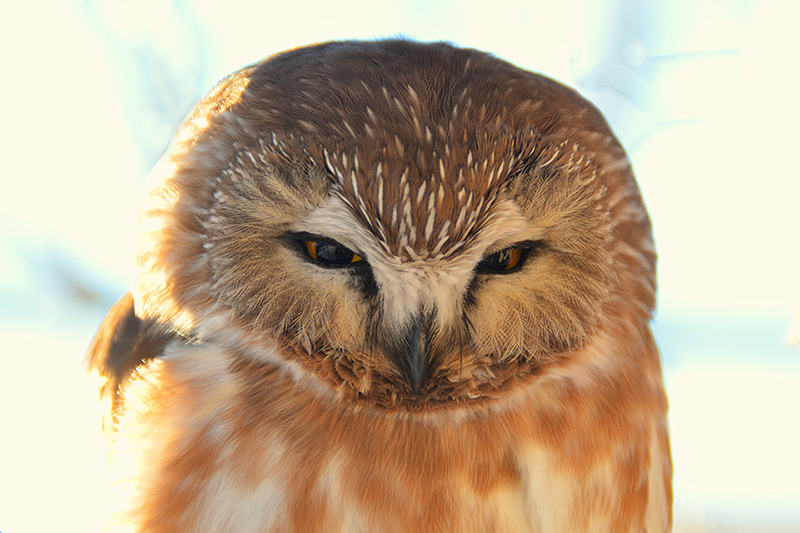
This owl is mainly active at night. It is small and has an innocent look, sharp eyes and a huge hunting instinct. Yet it tears its prey, such as mice and other small rodents, roughly into pieces.
I found this sweet-looking owl asleep against the warm wall of our house in the winter sun. It was so small that at first I thought it was a young and possibly injured animal. Disturbed by one of my dogs, it flew into a tree close to our house.
After that, it was completely unbothered by me and my camera, and I was able to get my lens to within 30 centimetres of it. The light was harsh because of the low sun, and I tried to find the best exposure for the owl from different angles. But of course, you cannot direct a wild owl.
Taking into account that this beautiful creature could fly away at any moment, I had to quickly decide how to set my camera. Do I take a photo as if the animal is posing for me, or do I already allow for the possibility that it could suddenly fly away? And do I also want to take such a possible action shot?
Sometimes setting my camera is therefore a quick choice between a 'less than perfect exposure' or somewhat less sharpness. But in both situations, I can make the best of it.
Camera settings:
This photo was taken with the NIKON D5100 and my Tamron Lens 18-200 mm f/3.5-6.3 at a distance of about 30 cm. Because I had to zoom in somewhat in this case, to 150 mm, I had to use a slightly faster shutter speed, 1/125th of a second. As it was daytime and there was plenty of light, I could photograph at a fairly low ISO value, 200.
I had to overexpose slightly, to 'add exposure', so it would not become a silhouette and the main subject would be properly lit. The aperture is set to f/6.3 to provide the necessary depth of field. Otherwise, twigs and other unwanted things that only distract from the main subject would be too sharp in the image. I did digitally remove some of these twigs.
A good conversation with the Bald Eagle
Driving from our house to the nearest village, which is about a 45-minute drive in a four-wheel drive, along a dirt road beside a steep mountainside and looking out over the Methow River, we suddenly saw three eagles sitting high in a tree. As we approached in the truck, two of them unfortunately flew away immediately.
I was not quite ready to take photos, but was very impatient and eager to photograph them. I got out while my husband continued driving slowly in the truck. The trick is not to let the truck door slam shut and to close the windows beforehand for our two dogs, who are always present and travelling with us.
Because the tree the remaining eagle was sitting in stood on the edge of a cliff, I could only take a photo from one side.
I fiddled around with my lens and, because everything was not going as quickly as I wanted, muttered a few words under my breath that are best not repeated. I then started a somewhat friendlier conversation with the eagle, softly and in a slightly high-pitched voice. Looking at this photo makes it clear that it really did understand me.
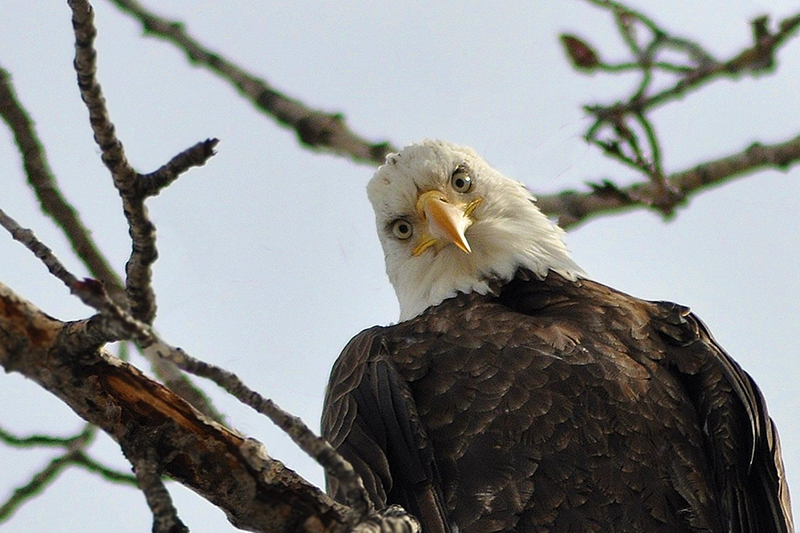
Camera settings:
This photo was taken with the Nikon D90 and a Nikon 70-300 mm f/4-5.6 lens on the automatic setting, the so-called Sport setting, ExposureTime: 1/2000, ISO-400. As time was short, I was not completely prepared. Hence the 'panic' setting with automatic sports mode.
Because the eagle stayed so still, this was not necessary in hindsight, and a shutter speed of 1/125th of a second would also have been sufficient. The aperture, f/11, actually gives too much depth of field, as well as the fact that I was close and did not need to zoom in very much.
The twigs around the animal were therefore rendered far too sharply and distracted attention from it. I digitally removed some of them during post-processing.
Smearing yourself with faeces?
As I described earlier, scent is important when photographing wildlife. What many people do not think about at first is how you smell yourself and how you will come across to the animals you want to photograph.
I do not mean just your own body odour, although you need to take that into account too. Living in a civilised world, it is almost impossible to imagine how, for example, our freshly washed clothes smell to wildlife.
Think of the detergents that are commonly used. Almost all of them contain added fragrance, which you cannot simply wash out of your clothes again.
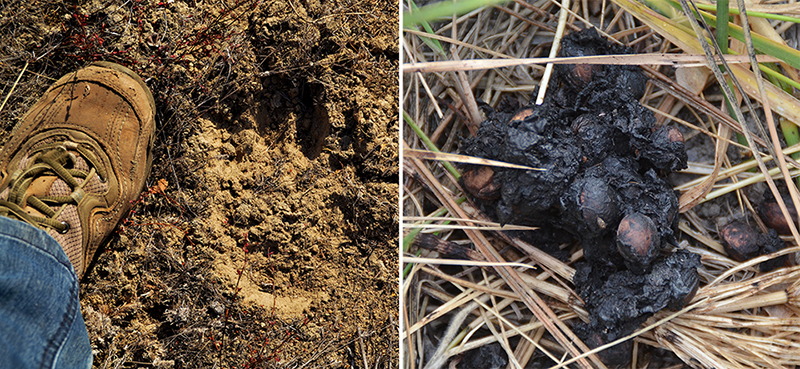
Wild animals have a very sensitive nose and are immediately warned from a great distance by an unfamiliar smell. So before you try to take that close-up photo, try to get rid of those scents.
Shampoo, deodorant and similar products also have a major influence and continue to smell for a long time. No, you do not have to smear yourself with faeces, but try to adapt your scent to the surroundings as much as possible.
Local, organic products
Another difficult point to discuss, but an undeniable truth: eat healthily with local, organic products. Whatever your view, eating local products without chemical additives means that you smell like your surroundings.
I know that this is not even partly achievable for many people, perhaps simply because of medication, but remember that everything in your surroundings can help determine how you come across to the wildlife you want to photograph.
Watercress and bear tracks
Rubbing yourself with twigs and leaves from the surroundings, or crawling into the mud for a while, can certainly help. Living remotely for many years has made me particularly sensitive to scent.
In summer, for example, I can smell where a bear has walked. Many people say that bears stink, but that is not true of bears in their own natural surroundings.
Even my husband thought I was taking it too far, but I have proved it to him many times. The bear here eats large quantities of watercress from the ditch, a very green and nutritious plant with a particular smell to me. The combination of bear scent and watercress means that I can always find its tracks.
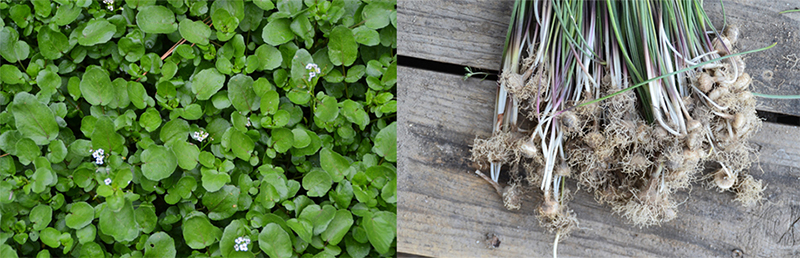
Shopping in a supermarket is therefore different for me than it was in the past. You have no idea how much scent products give off. I can describe exactly which supermarket the groceries my husband brings home in a sealed box came from.
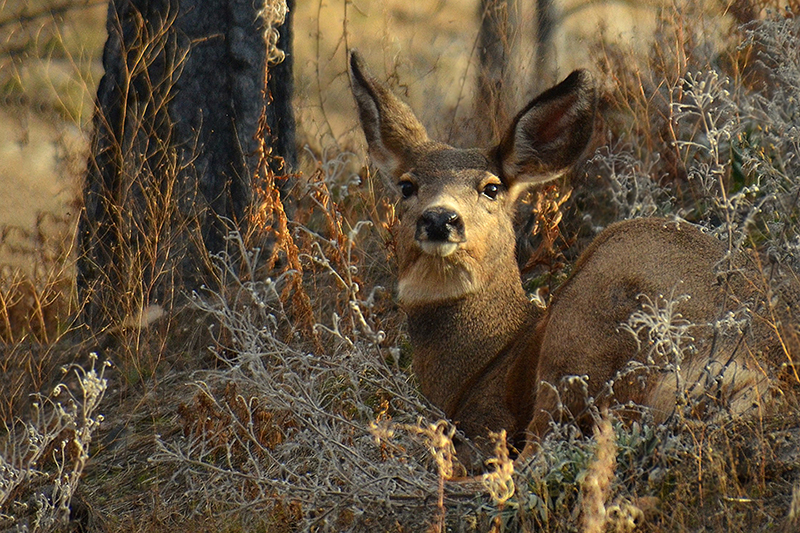
By keeping my own scent completely natural to wildlife, this female Mule deer accepted me coming very close to her while she rested in the early winter sun.
Camera settings:
This photo was taken with the Nikon D5100 and a Tamron 16-300mm f/3.5-6.3 lens. The photo was taken at ISO800.
Because the winter sun was low, there was not much light, and you must always be alert to the fact that such a wild animal can suddenly jump up and flee. So a fast shutter speed had already been set as a precaution. In hindsight, this was not necessary.
Irresistible curiosity...
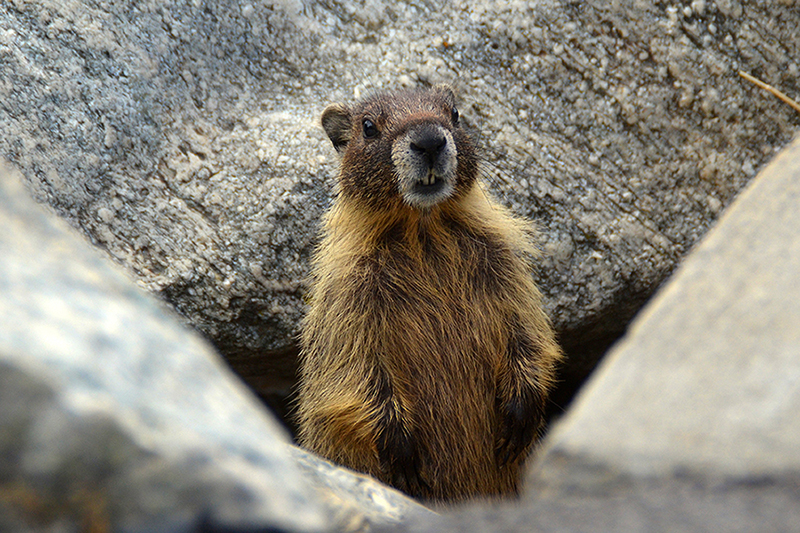
A somewhat less shy wild animal that is used to strange smells is this marmot, sitting here beside a pier on the Pateros River. They live among the rough embankment stones that have been placed there.
Many tourists come here and make a short stop at the attractively laid-out but simple recreational grass field with facilities.
The marmot came to have a look when I was standing on the pier taking photos of the river. It could not resist its curiosity. The rough stones and the calmly watching animal allowed me to create a nice 'triangle' composition with the stones.
Camera settings:
This photo was taken with the Nikon D5100 and a Tamron 18-200mm f/3.5-6.3 lens. The same story actually applies to this photo as to the Mule deer photo.
The ISO was set slightly lower, at ISO 720, because the animal is often less shy and there is less risk of unexpected flight behaviour. But here too, you must always be prepared, hence the fast shutter speed again.
New rounds, new opportunities!
Every day in nature brings new photo opportunities. No day is the same, and I will certainly never get bored!
About the author
Altijd 'ready and alert' en gewapend een fotocamera wandelt Tanja Thomas dagelijks in het ruige landschap van Methow (Washington State). De kansen op het spotten en fotograferen van wildlife liggen hier voor het grijpen, maar je moet alert zijn. 'Quick draw!' is hierbij haar motto.
You might also like
-
 How do you find and photograph owls in the wild?
by Tanja Thomas
-
 Photographing owls nearby
by Erik Veldkamp
-
 Wildlife photography and switching to mirrorless
by Evert Doorn
-
 7 tips: Wildlife photography for beginners
by Rob Dijkstra
-
 7 Tips for Unique Wildlife Photos
by Michelle Peeters

8 comments
-
 Huub Sanders wrote on Sunday 19 February 2017 at 15:07 | reply
Very nice article Tanja. You do live in paradise there!
Translated from Dutch. -

 Tanja Thomas
wrote on Sunday 19 February 2017 at 17:11
| reply
Thank you Huub Sanders!
Translated from Dutch.
There are indeed many moments when it is a real paradise, but don't forget the very "primitive" way of life and sometimes harsh conditions such as wildfires and, as now, a thick layer of snow.
Charging the batteries of the camera and other equipment, for example, all happens via solar panels and, if there is no sun, a generator! Planning a photoshoot with all the equipment, for example, involves a bit more than simply plugging your plug into the socket.
Daily life and work are therefore like "sailing a ship". -
 Harold wrote on Sunday 19 February 2017 at 19:22 | reply
Dear sweet Sister,
Translated from Dutch.
How wonderful to bring the " world " of yours so close. I devoured your story in one go . Because of the intention of the photos themselves combined with the way you wrote your story, it almost feels as if I was standing next to you when you told it ... Keep it up and let as many people as possible enjoy your experiences. I wish you an incredible amount of fun in your Wild life -
 Erik wrote on Sunday 19 February 2017 at 19:36 | reply
What a nice and interesting story. It was a pleasure to read.
Translated from Dutch. -
 Michelle Peeters wrote on Sunday 19 February 2017 at 23:59
| reply
I also found it very interesting to read. Especially the side issues (unpredictable behavior of animals, smells, etc.) that you as a wildlife photographer have to deal with and that can increase or decrease your chances of success. You also gave some good tips about this!
Translated from Dutch. -
 Rian wrote on Monday 20 February 2017 at 09:04 | reply
Hi Tanja, what an interesting article! Especially the part about scents was an eye-opener. I always really enjoy your photos, but thanks to this information I'll look at them with extra respect from now on. Keep it up!
Translated from Dutch.
Lots of love from Rian -
Tanja Thomas
wrote on Monday 20 February 2017 at 20:56
| reply
Thanks! The tips described in my article are only a small amount that you can take into account for this type of photography. The almost daily new possibilities teach me more and more.
Translated from Dutch.
Perhaps I can describe these sometime in a possible next blog. -
 Jan wrote on Tuesday 21 February 2017 at 18:33 | reply
Very interesting story and what beautiful photos
Translated from Dutch.
Have your say
Please note: Articles older than a week can only be commented on by signed-in visitors.Would you still like to comment? sign in or create a free account.
Become a better photographer every week
A practical photography tip in your inbox every week.
38,764 photography enthusiasts already receive the tips! More about the weekly mail. Or keep up to date via  Facebook.

Elja Trum
Photofacts; everything to do with photography!
Would you like to take better photos and keep up with what is happening in photography? Photofacts publishes articles that teach you something about photography — from a product announcement to a practical shooting tip or a look at a website. Photofacts covers photography every day and is a hobby project of Elja Trum's that got out of hand. The articles are written by a team of volunteer authors. If you would enjoy writing one or more articles for Photofacts, do get in touch.More about PhotofactsPhotofacts is made possible in part by
