

Photographing clearwing hawk-moths and hummingbird hawk-moths
Wednesday 19 July 2017, 21:12 by An Vanden Abeele | 18,572 views | 9 commentsThis article was translated from Dutch with the help of AI. Read the original.
During a photography trip to Brenne in France, I spotted and photographed clearwing hawk-moths and hummingbird hawk-moths. Both are moths, but they can also be active during the day.
Macro photography is my speciality and my favourite thing to do in photography. In this article, I will try to share my experiences and tips with you.
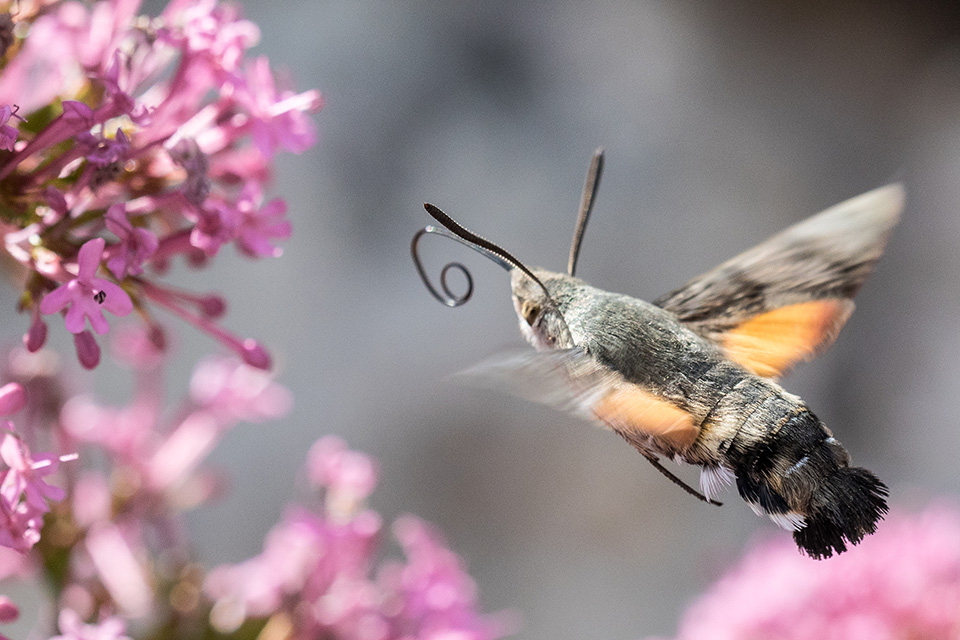
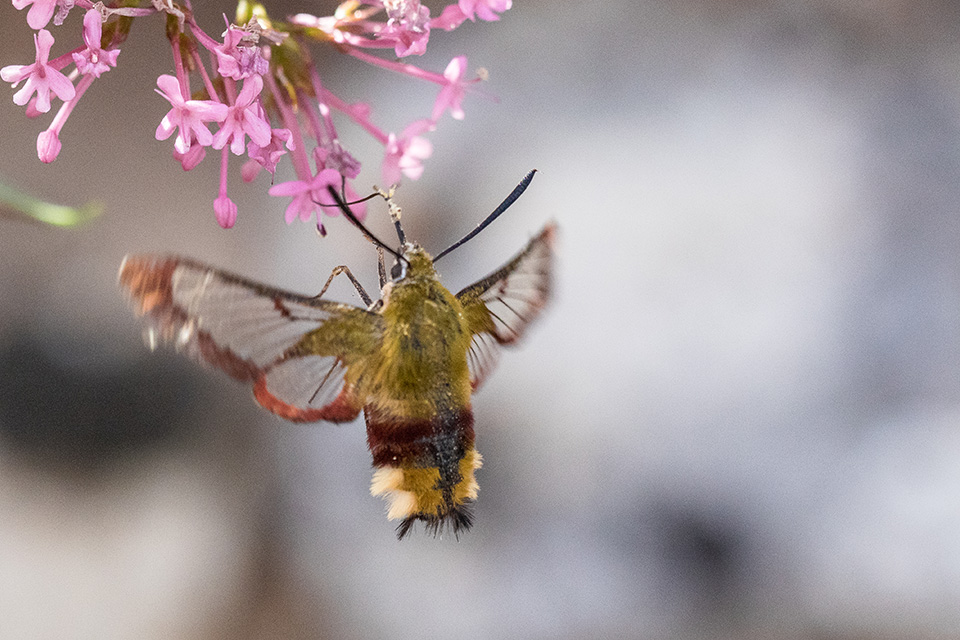
Clearwing hawk-moth and hummingbird hawk-moth
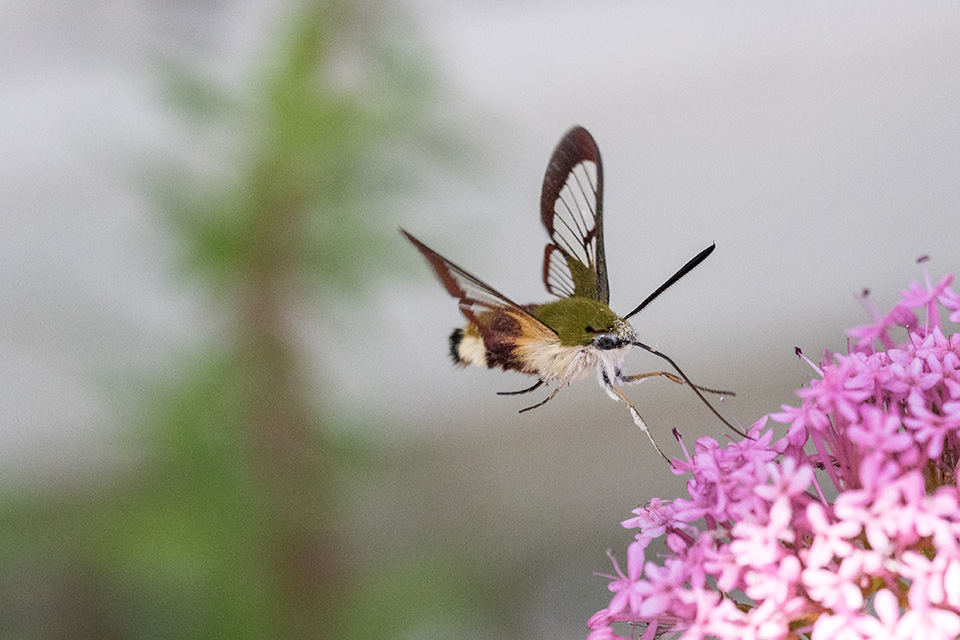
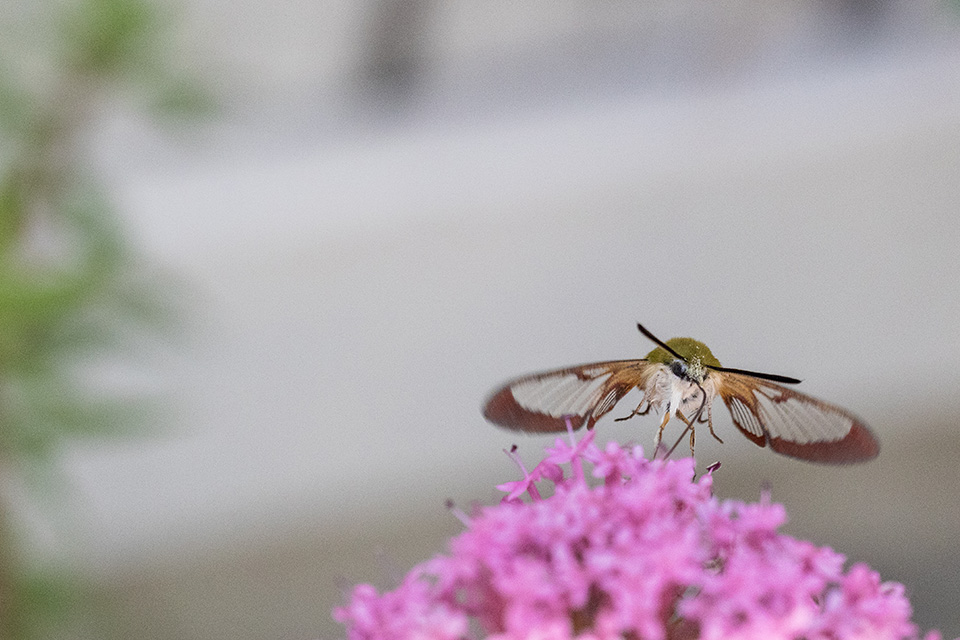
The clearwing hawk-moth extracts nectar from flowers while flying. It has a short, stocky abdomen covered in dense, light-brown hairs. A reddish-brown band runs across the centre of the abdomen. The wings are largely transparent, with a broad reddish-brown edge.
The hummingbird hawk-moth finds its nectar in the same way as the clearwing hawk-moth, using its long proboscis. It has grey forewings and orange hindwings, rather than transparent wings.
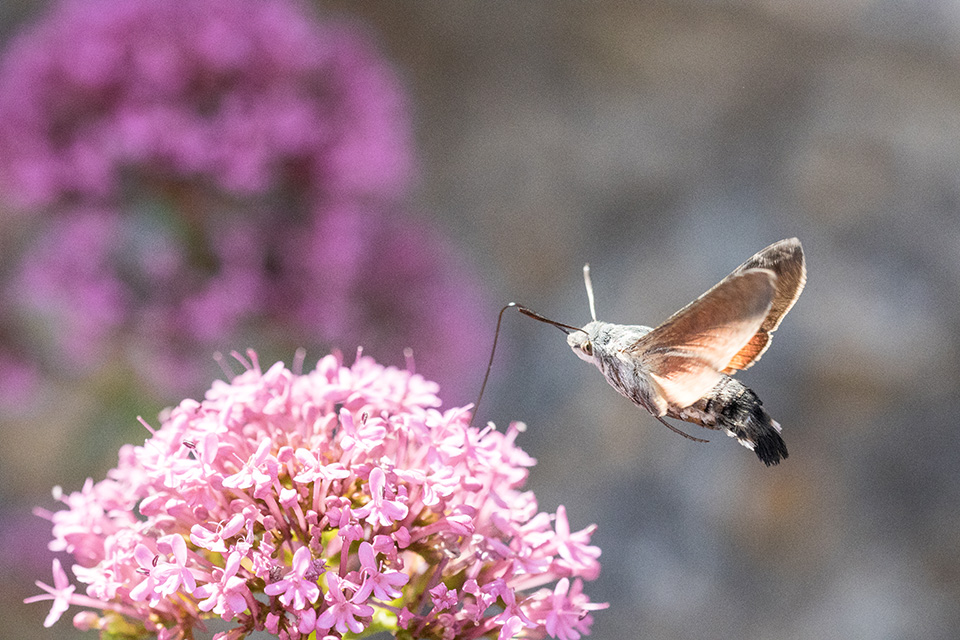
Photographic challenge
Once I had discovered the insects, the real challenge began for me. How should I set up my camera? Aperture priority? Metering? ISO setting? Shutter speed? Tripod? Monopod? Handheld?
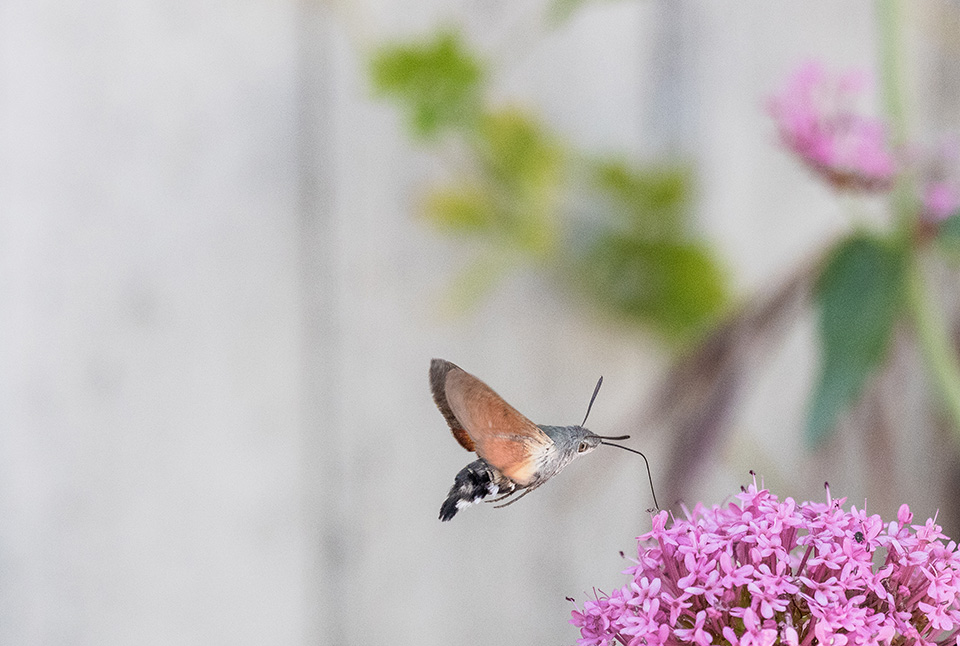
My first experiences showed me that getting them sharp and in a good composition was difficult. There was no question of using a setup here. After a lot of patience and experimenting with different settings, I eventually managed to take a few photos I was happy with.
Camera type and settings
The photos above were all taken with a Canon 7D Mark II and a Sigma 150 mm macro lens. I use this focal length because it is not possible to get close to the insects. They are quite easily startled, so it is better to photograph them from a distance.
I chose aperture priority (AV or A), spot metering and a higher ISO setting. This causes noise, as you can see in the photos. Personally, I do not mind this. I do not use noise reduction in post-processing because it affects sharpness.
The shutter speed often determines the sharpness of your photo in this type of macro photography. Along with focusing carefully, of course. With these very active butterflies, I tried to keep my shutter speed above 1/4000 of a second.
The settings I chose naturally always depended on my camera, lens and the natural light at the time of shooting.
About the author
An komt uit Deinze (Oost-Vlaanderen) en is sinds 8 jaar intensief actief bezig met fotografie. Heeft verschillende workshops gevolgd en natuur- en macrofotografie is nu haar passie en specialiteit. Ze neemt dikwijls deel aan boeiende foto-natuurreizen.
You might also like
-
 7 Tips for Macro Photography
by Mike Muizebelt
-
 Photographing butterflies with morning dew
by Erik Nevels
-
 Create creative stories with your macro lens
by Michelle Peeters
-
 Photographing a common blue butterfly at 't Ham
by Erik Nevels
-
 How Much Macro Should You Choose?
by Nando Harmsen
-
 Review: SmallRig RM-03 Macro Photography LED lights
by Nando Harmsen
9 comments
-
 Peter wrote on Wednesday 19 July 2017 at 22:05 | reply
The hummingbird hawk-moth was just in my backyard 1.5 weeks ago! Thanks to our butterfly bush. Unfortunately, when I finally had my camera, I didn't see it anymore
Translated from Dutch. -
 Patrick Mincke wrote on Thursday 20 July 2017 at 15:01 | reply
Beautiful photos! We are always amazed at how An manages to capture that little animal at precisely that particular moment. I can hardly imagine that the animal in question comes peeking in front of the lens on command. An: very well done.
Translated from Dutch. -
 luc baert wrote on Tuesday 25 July 2017 at 10:58 | reply
Beautiful An,your patience and perseverance can be seen in those with beautiful photos
Translated from Dutch. -
 Peter wrote on Tuesday 25 July 2017 at 11:47 | reply
Beautiful pictures, An!
Translated from Dutch.
In France I see both butterfly species very regularly and in greater numbers at the same time on red valerian, lavender and butterfly bushes. They are restless fliers, collecting nectar while flying like a helicopter. Give it a try sometime, spending an hour photographing them with slower shutter speeds. The end result is surprising. In a number of photos it becomes visible that the wings not only move up and down but that the forward speed is also slowed down by turning the wings. I myself use a 400 mm lens for this and photograph handheld. Don't be surprised that people look strangely at someone standing by the side of the road photographing a "flower" with a telephoto lens for an hour. Photography and nature study go hand in hand. With a number of butterfly species it is difficult to determine the species without catching them. A number of photos can provide the proof without disturbing nature and often also produces the "beautiful picture".
Success, Peter -
 Dirk Borst wrote on Tuesday 25 July 2017 at 14:00 | reply
Fantastic beautiful pictures, An, very well done, you really have the patience for it. But then you also have something to be proud of.
Translated from Dutch.
I am sure you will go far and hope that we may see many more beautiful things from you. Good luck
Dirk Borst -
 Rik wrote on Tuesday 25 July 2017 at 18:13 | reply
They're so fast ! I once spent an hour trying to get one onto the lens !
Translated from Dutch.
https://www.shutterstock.com/nl/image-photo/macro-nature-hummingbird-hawkmoth-461318674?src=hFX2lze4A3ph4nH3_jMlPA-4-26 -
 Robert wrote on Tuesday 25 July 2017 at 18:18 | reply
Great, An!
Translated from Dutch.
Robert -
 J. Flinkenflögel wrote on Tuesday 25 July 2017 at 23:15 | reply
By coincidence, a hummingbird hawk-moth flew by the phloxes during breakfast today, right here in the Netherlands (Steenbergen, North Brabant).
Translated from Dutch.
I had seen one in a flash before, but now we could see it well and take a good look at it.
But photograph it? I wouldn't know how, just a mere second at each flower and then on to the next, hats off to you for the photo series. -

 pmhoogduin wrote on Saturday 7 September 2019 at 12:04
| reply
Dear An, I have a lot of experience with photography of butterflies, dragonflies etc. I use a fixed Canon lens of 300 mm and a 7D from Canon and often an expender as well. These kinds of butterflies are fine to catch with this lens. Sufficient distance up to 2 meters and flying away rarely happens.Shutter speeds that 1/6000 . Iso 320 and if possible aperture 10 or higher. Take lots of photos and your chance of getting a good one is high. So macro with a telephoto lens and often beautiful backgrounds. greetings
Translated from Dutch.
Have your say
Please note: Articles older than a week can only be commented on by signed-in visitors.Would you still like to comment? sign in or create a free account.
Become a better photographer every week
A practical photography tip in your inbox every week.
38,764 photography enthusiasts already receive the tips! More about the weekly mail. Or keep up to date via  Facebook.

Elja Trum
Photofacts; everything to do with photography!
Would you like to take better photos and keep up with what is happening in photography? Photofacts publishes articles that teach you something about photography — from a product announcement to a practical shooting tip or a look at a website. Photofacts covers photography every day and is a hobby project of Elja Trum's that got out of hand. The articles are written by a team of volunteer authors. If you would enjoy writing one or more articles for Photofacts, do get in touch.More about PhotofactsPhotofacts is made possible in part by
