

De Polar Pro Quartzline ND, het ideale ND-filter?
Friday 11 January 2019, 17:17 by Liesbeth van Asselt | 6,667 views | 2 commentsThis article was translated from Dutch with the help of AI. Read the original.
When Degreef & Partner asked me to test the new Polar Pro Quartzline ND filters, I didn't have to think for long. I have a love-hate relationship with ND filters.
They add a colour cast, make your photos blurry, break or scratch easily. So I was curious, would this filter live up to its promises?
I am sent the ND1000/PL filter. A big stopper, which blocks 10 stops of light, combined with a polarising filter. Both are made of (quartz) glass. It all looks neat and complete.
The filter comes in a nice box, but you also get a pouch for when that fits better in your camera bag. It even comes with a cleaning cloth.
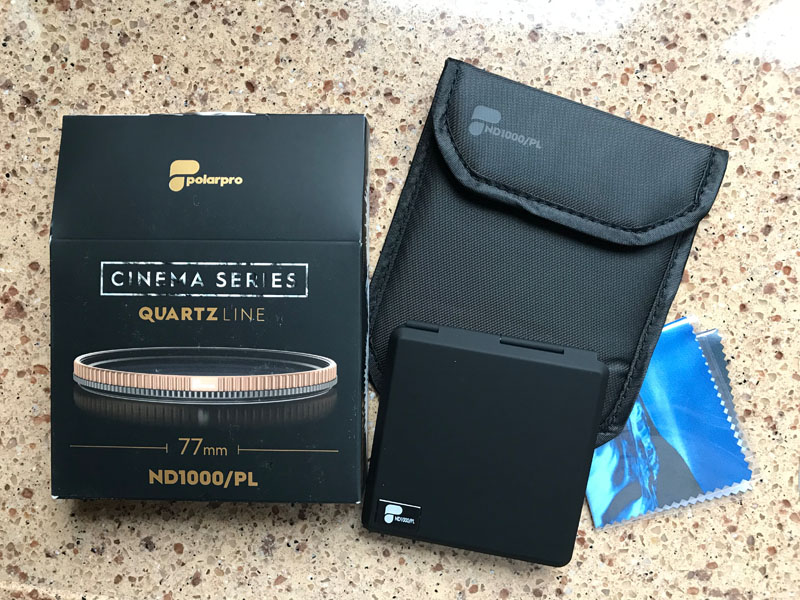
I also get a 72-77 mm step-up ring. One of my lenses has a diameter of 72 mm, and this filter is not available in that size.
Two things immediately stand out
First, I can unscrew the filter from my lens very easily. Even if I forget to remove my UV filter first, taking the filter off is no problem. That is quite different with other filters!
I have no idea how many course participants I have already helped remove their filters, but there have certainly been more than I can count on the fingers of both hands. Looking at the specifications, this seems to be because the thread is made of brass rather than aluminium. Whatever the reason, I am pleased with it!
Secondly, when the step-up ring is on the lens, I can no longer fit my lens cap. That is logical, but it would have been nice if Polar Pro had supplied a suitable lens cap in the otherwise very complete packaging. But you can't have everything...
Right, time to put it to the test, the practical test. This year's weekend with the participants in my Stapfoto group, advanced photography students, took us to Ameland. A great location to try out the filter. The weather conditions were very helpful: rain and a sandstorm.
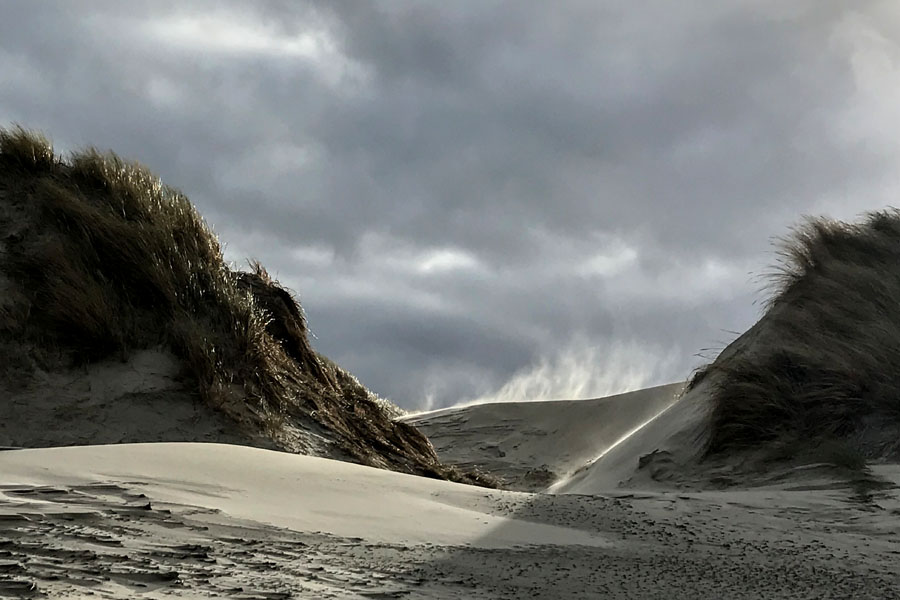
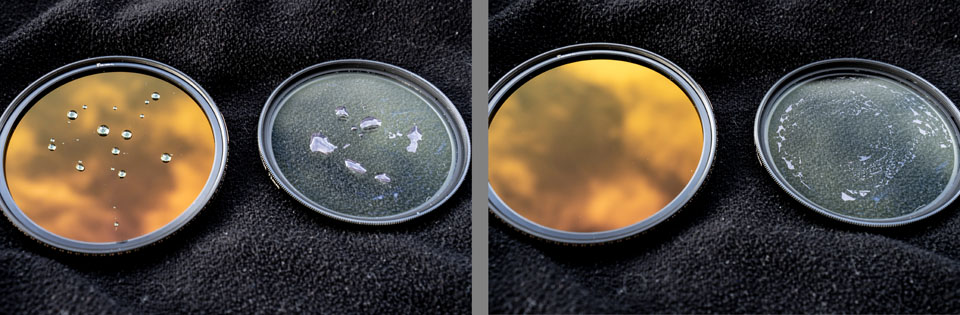
What stands out is that the rain forms lovely spherical droplets on the filter. They can be wiped off again without leaving any residue. The same applies to fingerprints, which are very easy to remove from the filter.
Back at the cottage, I put it to the test: I drip water onto my UV filter and onto the Polar Pro ND filter. Then I wipe it off with the cloth supplied by Polar Pro. The difference is clear, in both photos the Polar Pro filter is on the left and the UV filter on the right.
Of course, in conditions like these, sand always blows onto your filter. This has already caused me plenty of headaches with the graduated ND filters from another brand. Those plastic filters scratch incredibly easily!
With the Polar Pro filter, most of the sand simply falls off again. I remove what remains with a blower brush and the cloth. And guess what? Not a single scratch! Even when I wipe the sand off with my T-shirt without blowing first, there is not a scratch to be seen. Wow! I would not try this with your own filter, but it can be done!
Here too, I took another look at the specifications to find out what makes it different from other filters. It turns out that the 16 coating layers, 8 on each side, are the reason this filter remains scratch-free.
Drop damage?
You get a lifetime warranty on manufacturing defects with this filter. Not if you deliberately damage it. And yet I want to try it. What happens if this filter falls on the ground?
The major disadvantage of the filters I used previously is that there is a button on the filter holder which causes the holder to fall off your lens at the slightest touch. This has already cost me two broken big stoppers and three scratched graduated ND filters.
So I drop the filter on the ground. Pretty scary. But... no harm done! The filter is still undamaged. I have no idea how they do it, but I think this is absolutely superb.
Screw-in filter
One disadvantage of using this screw-in filter instead of a slide-in filter in a holder is that I cannot put a graduated ND filter in front of it. This is something many landscape photographers are used to doing. Polar Pro does have graduated ND filters in its range, but only for drones.
I assume they will also make some for mirrorless cameras and DSLRs. These will probably be screw-in filters, which means that with a graduated ND filter the transition will always be in the middle. There has to be something left to wish for 😉.
I have solved this for now by putting a filter holder with a graduated ND filter from another brand in front of it. There is a thread on the front of the filter, so you can screw all sorts of things onto it. In most cases, that 'all sorts of things' will be a graduated ND filter.
The consequence is that one of the advantages of this Polar Pro filter is lost. The raindrops and sand will naturally end up on the front filter from the other brand.
The problem of sometimes wanting to combine an ND filter with a polarising filter has already been solved. You can buy a regular ND filter, but also an ND/PL filter.
That is the filter I was sent to test. The difference compared with a filter without a polariser is clear. When using the polarising filter, the glare from the stones is gone.
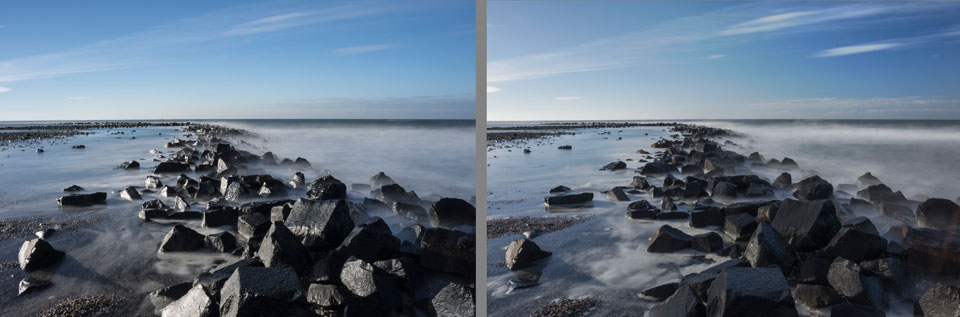
Image quality
But what about the quality of my images? Colour casts are always a major problem with ND filters, aren't they? Indeed, some produce a blue cast, while others produce a magenta cast.
And this Polar Pro? Nothing. Zilch. Nada. I saw that they claimed this in their marketing, so I was extra critical. But it really is true, there is no colour cast to be seen.
The sharpness is fine too. I see no difference in sharpness between photos taken with and without the filter. With the much cheaper variable ND filters, it is often a very different story. The sharpness of your photos visibly decreases.
Conclusion
You use an ND filter for the special long-exposure look, with the sea looking like milk and clouds blurred. And to be able to use wide apertures in bright daylight and get a nicely blurred background. Both are reasons for me to want to carry such a filter with me.
Would I buy the Polar Pro? On impulse, I say, 'it is a very expensive filter'. But when I look at the quality of my photos, the combination of an ND filter and a polarising filter, two for the price of one, and how resistant they are to drops and scratches, the five broken and scratched filters I had to replace cost more, I say an emphatic 'yes'.
The only tip I would give the manufacturer is to come up with a solution for the graduated ND filter very soon!
About the author
Liesbeth fotografeert met haar bedrijf stapfoto.nl voor websites van bedrijven. Daarnaast verzorgt ze al sinds 2004 (vooral creatieve) workshops zoals lightpainting, flitsen in de natuur, fine art, frozen flowers, paintsplash, infrarood, icm en multi exposure. Daarnaast is er een Stapfoto vakgroep voor de meer gevorderde fotografen.
You might also like
-
 Which ND filters should you choose as a beginner?
by Nando Harmsen
-
 De K|Lens, een light field-lens met 3D-beeldinformatie
by Nando Harmsen
-
 Variable ND filter, or not?
by Nando Harmsen
-
 Interview with photographer John Geven
by Michelle Peeters
-
 Review: Haida variable ND filter with built-in polarisation
by Nando Harmsen
-
 Komt Canon ook met een retrocamera?
by Elja Trum
2 comments
-

 Jorgc wrote on Saturday 2 February 2019 at 13:55
| reply
Where can I order this filter (online)?
Translated from Dutch. -
 Liesbeth van Asselt
wrote on Thursday 14 February 2019 at 12:09
| reply
Hi Jorgc, sorry for my late response, I was on vacation..... I think you can buy this filter at all camera shops. I know for sure that CameraTools has it because I go there regularly
Translated from Dutch. .
Have your say
Please note: Articles older than a week can only be commented on by signed-in visitors.Would you still like to comment? sign in or create a free account.
Become a better photographer every week
A practical photography tip in your inbox every week.
38,938 photography enthusiasts already receive the tips! More about the weekly mail. Or keep up to date via  Facebook.

Elja Trum
Photofacts; everything to do with photography!
Would you like to take better photos and keep up with what is happening in photography? Photofacts publishes articles that teach you something about photography — from a product announcement to a practical shooting tip or a look at a website. Photofacts covers photography every day and is a hobby project of Elja Trum's that got out of hand. The articles are written by a team of volunteer authors. If you would enjoy writing one or more articles for Photofacts, do get in touch.More about PhotofactsPhotofacts is made possible in part by
