

3 tips for a great composition in your photo
Wednesday 12 December 2018, 12:56 by Elja Trum | 16,251 views | 3 commentsThis article was translated from Dutch with the help of AI. Read the original.
Composition is about placing objects in your frame and the number of elements in it. Your composition leads the viewer to the parts of the photo you want them to focus on. So composition is very important for a good photo.
For taking a good photo, composition is much more important than the equipment you use. Even if you use the most expensive camera you can find, if your composition isn't right, your photo won't be nearly as attractive as a photo with good composition taken with the cheapest toy camera there is.
1. Use a shallow depth of field
A commonly used and very good way to ensure fewer elements, and therefore more peace and quiet, in your frame is to use a shallow depth of field. This allows you to 'tidy up' a cluttered background in one go.
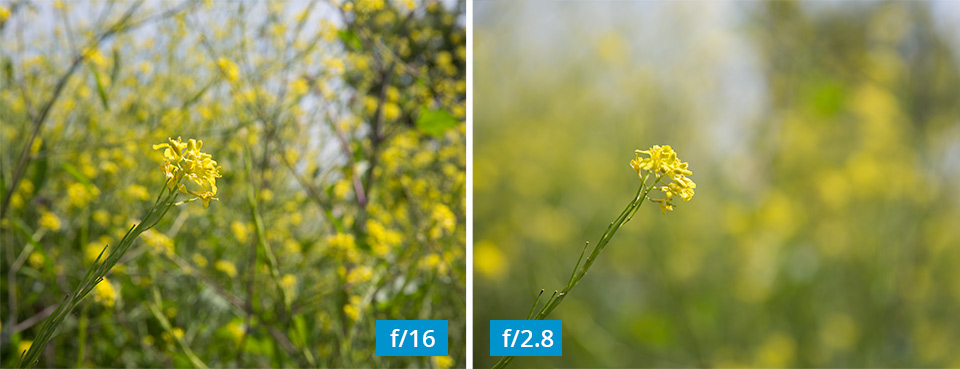
Use a wide aperture (low aperture number) for this, such as f/1.8. Then make sure there is enough distance between your subject and the background and you'll see that your background disappears into a soft blur.
2. Fewer elements in the frame
Another way to get a good composition is to make sure there are fewer elements in your frame. A common problem is that your photo is too cluttered. As a result, the viewer doesn't know where to look.
You can solve this by simply making sure there are fewer different elements in your frame. There are various ways to do this, and it naturally also depends on the type of photography you do.
Sometimes it's as simple as actually tidying up a location. If, for example, you are photographing in a house, the photo will look much less cluttered if you first make sure everything is tidy.
You can also sometimes remove something from your frame in nature. For example, by moving leaves, branches or stones.
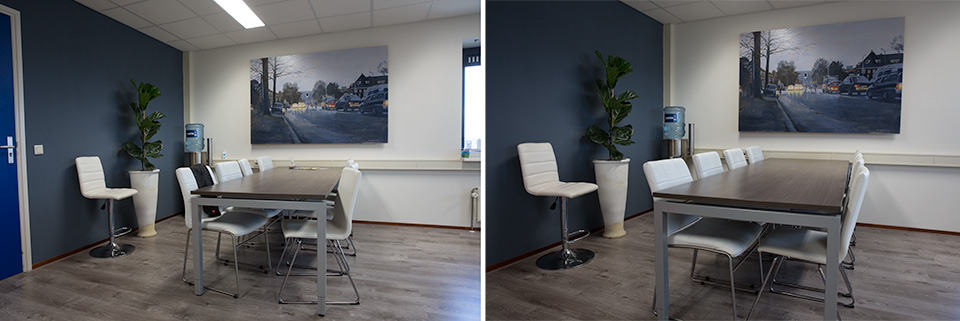
You can also create a tidier image by zooming in or taking a step closer. This simply cuts the uninteresting parts out of your photo.
3. Rule of Thirds
In my view, the most important tip when it comes to composition is the Rule of Thirds. The Rule of Thirds gives you a guide for placing the elements in your frame.
With the Rule of Thirds, you divide the frame both horizontally and vertically into three sections by drawing two (imaginary) lines across it. By placing important elements in your frame on these lines, and especially at the points where the lines intersect, you almost automatically get a pleasing composition in your frame.
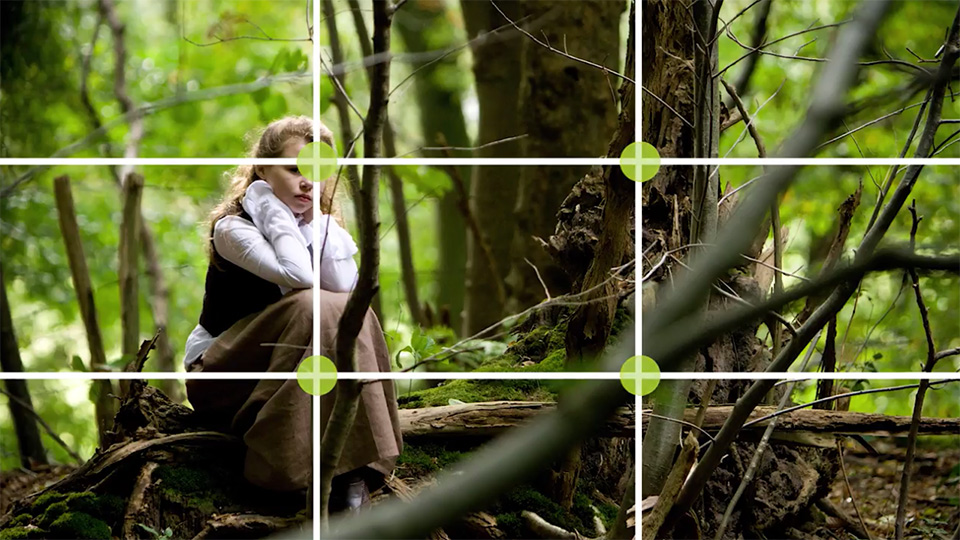
This 'rule' actually works in all situations. If you don't do this yet, I really recommend paying close attention to it. Your photos will genuinely improve as a result.
By the way, there's nothing wrong with breaking the rule. Sometimes it can work very well to deliberately deviate from it, but it's good to be aware of what you're doing in any case.
Many cameras also have the option of showing the Rule of Thirds as guide lines in your viewfinder. This is a very useful aid for quickly applying the rule in practice.
Get started
As you take more and more photos, you'll find that you no longer have to think about these composition rules. You'll start to 'see' them automatically. You'll sense when an image has a pleasing composition.
Taking a photo with a good composition then becomes easier. However, it's always a good idea to pause and consider your composition before taking the photo, and afterwards when you look at the photo. This way, you continually discover how to improve your compositions.
Have fun!
Learning composition
Would you like to learn more about how to create a good composition in your photos? At Photofacts Academy, the subject of 'composition' is covered in several courses.
For example, in Cropping tools as part of the Photoshop Elements for Photographers course. Or in the course Macro photography by Johannes Klapwijk. How you determine your composition is also covered in the course Sports photography by Nicol Delmeire and the course Landscape photography by Bart Heirweg.
You can follow these courses for two weeks with a free trial membership.
About the author
Elja Trum is the founder of Photofacts and online photography course website Photofacts Academy. He has been writing about photography since 2006. Elja is also the author of (Dutch) books on composition, black-and-white photography, flash photography and portrait photography.
You might also like
-
 Photoshop Elements 2020 with AI-powered photo effects
by Michelle Peeters
-
 Human Element in a Landscape, or Not?
by Nando Harmsen
-
 Street photography tip: Use leading lines to guide the viewer
by Michiel Heijmans
-
 Adobe previews new Sensei-powered Object Selection Tool
by Michelle Peeters
-
 Composition techniques for landscape photography
by Michelle Peeters
-
 Review: Discover Photoshop Elements 2022
by Elja Trum
3 comments
-
 Gerrit Bos wrote on Tuesday 10 July 2018 at 18:37 | reply
Good tips, especially for beginners. One small point of criticism regarding depth of field. I don't think there is a 'toy camera' with a lens aperture of F1.8. Such a lens usually comes with a hefty price tag. But I understand the metaphor.
Translated from Dutch. -

 PCfoto@de-moor.de wrote on Tuesday 10 July 2018 at 18:41
| reply
I fully support the rule of thirds in composition, and indeed it is not always necessary. The blurred background of the yellow flowers, yes but crop 60% of the photo away. And the table, here I would crop out the door and window in the 1st photo, then it would be a different format photo, but the table completely in the frame. Fortunately, the photographer determines what is shown. Although it is good to study other opinions.
Translated from Dutch. -
 Elja Trum
wrote on Wednesday 11 July 2018 at 09:17
| reply
@Gerrit; Yes, that shallow depth of field is more difficult with a 'toy camera', but you can apply the other two tips with any camera and they will immediately improve your photo.
Translated from Dutch.
By the way, an f/1.8 lens doesn't have to be very expensive. I always recommend the 50mm f/1.8 to beginning photographers. This lens usually costs less than 150 euros and the optical quality is excellent. With this lens you can really take much better photos than with the kit lens that comes with your camera.
@PCfoto; Yes, the composition could indeed be even better by including the legs of the table as well. That's what you get when you quickly take some example photos, right.
Have your say
Please note: Articles older than a week can only be commented on by signed-in visitors.Would you still like to comment? sign in or create a free account.
Become a better photographer every week
A practical photography tip in your inbox every week.
38,900 photography enthusiasts already receive the tips! More about the weekly mail. Or keep up to date via  Facebook.

Elja Trum
Photofacts; everything to do with photography!
Would you like to take better photos and keep up with what is happening in photography? Photofacts publishes articles that teach you something about photography — from a product announcement to a practical shooting tip or a look at a website. Photofacts covers photography every day and is a hobby project of Elja Trum's that got out of hand. The articles are written by a team of volunteer authors. If you would enjoy writing one or more articles for Photofacts, do get in touch.More about PhotofactsPhotofacts is made possible in part by
