

Advantages and disadvantages of continuous lighting for portrait photography
Wednesday 12 December 2018, 14:39 by Michelle Peeters | 27,205 views | 12 commentsThis article was translated from Dutch with the help of AI. Read the original.
Studio flashes are being used more and more because they are becoming cheaper. Even so, continuous lighting is becoming popular again. What exactly are the advantages and disadvantages for portrait photography?
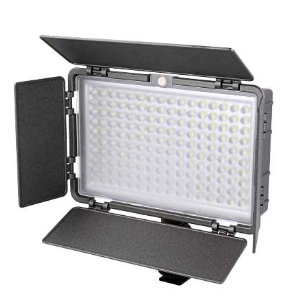
LED continuous lighting
In the past: construction lamps and film lights
Before the first studio flashes were available, which were still unaffordable at the time, there was really only continuous lighting. For portrait sessions, artificial light was provided by construction lamps or film lights.
However, construction lamps and film lights produced a colour temperature that was too warm, so for colour photography you had to use special film for artificial light or filters for your lens. This meant losing a lot of the light that was already in short supply, leaving you dependent on very sensitive film or a tripod.
Studio flashes
Over the past ten years or so, the prices of studio flash kits have fallen so much that a basic version has become affordable for almost every amateur photographer.
The advantages and possibilities are extensive. As a studio flash is connected to the mains, or to a battery, it can produce much more light than a flashgun. The modelling light lets you see how the light falls before taking the photo.
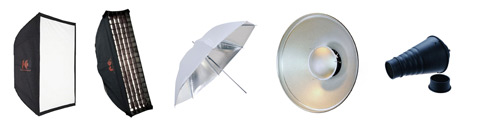
And you can fit the studio flash with different light modifiers, allowing you to direct the light onto and around your model exactly as you want.
The colour temperature is the same as daylight, so you do not need filters to correct overly warm colours.
Modern continuous lighting: LED or spiral lamps
So why is this old-fashioned continuous lighting becoming popular again? In terms of price, weight and size, flashes and continuous lighting are now quite similar.
The key term with continuous lighting is, of course, 'LED'.
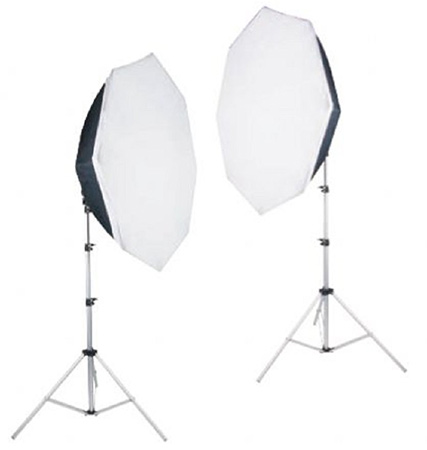
But there are still other types of continuous lighting, in the form of spiral lamps, also affectionately known as 'wokkel' lamps. These fluorescent lamps are similar to what you may use at home, but much larger and more powerful.
They are a much cheaper solution than LED lighting, although the price of the latter has also fallen sharply recently. Energy-saving lamps use five times less energy for the same light output. LED lamps are another five times more efficient!
Because they use so little power, little energy is lost as heat. This means they do not need active cooling, such as fans, making them perfect for video.
The colour temperature is neutral white, usually around 5500 Kelvin, similar to normal daylight on an overcast day. However, the colour temperature cannot be changed, as it can with LED lamps.
They also cannot be dimmed. They can only be switched on and off. You cannot reduce the light output gradually, but you can switch the individual wokkel lamps on and off separately.
You can use reflectors, to bundle the light, and softboxes, to soften and spread the light, as light modifiers. With LED lighting, it is not possible to use light modifiers.
Photofacts has had good experiences with the Falcon Eyes LHD-B628 continuous lamps. This handy kit costs just 285 euros. It comes with a complete set including two stands, lamps and octaboxes.
Advantages of continuous lighting
- LED lighting in particular scores better in terms of power consumption than a flash, which can be an advantage when working on location without a power socket and you therefore have to use a generator, built-in or otherwise
- With flashes, weak ambient light sources are overpowered, which can completely change the atmosphere.
- Continuous lighting has the advantage that you can keep shooting one photo after another, because you do not have to wait for the flash to recharge after taking a photo.
- Flashes can only provide daylight colour temperature. LED lamps can produce almost any colour of light, including neutral daylight. This allows you to match the colour to the existing ambient light and avoid colour casts, for example from fluorescent lighting.
- You can use continuous lighting for filming as well. This does not work well with the rather weak modelling light of a flash.
- What you see is what you get. You can judge how the light falls more accurately than with the modelling light of a flash, which often differs from the 'real' flash light.
- It is easier to use because, compared with flash lighting, you have far fewer buttons and adjustment options.
- You can use your camera's built-in light meter to measure the exposure. With flashes, this has to be done with a light meter that measures the 'incident' light rather than the 'reflected' light. This is especially relevant because most studio flashes do not have TTL functionality.
- You also do not need a flash trigger for good synchronisation between the main flash, the camera and the various flashes. This can sometimes be prone to interference at critical moments.
- LED lamps get less hot than studio flashes, which can be more comfortable for the model. Especially on hot summer days!
- Models do not have to blink because of the flash.
Disadvantages of continuous lighting
- Flashes still produce much more light than LED lamps, allowing you to use smaller aperture openings. With cheap flash kits where you can only reduce the light to a limited extent, for example by a maximum of 4 stops, this can also be a disadvantage because you cannot work with a shallow depth of field. When using continuous lighting in the form of energy-saving lamps, this disadvantage does not apply, of course!
- With flashes, you rarely suffer from camera shake, caused by the photographer, or motion blur, caused by the model, because you can use very fast shutter speeds and the very short flash duration, less than 1/500th of a second, freezes every movement. With continuous lighting, you may still have to use a tripod.
- Continuous lighting offers few or no options for using light modifiers such as softboxes or reflective umbrellas to make the light more diffuse and the shadows softer. Because LED lamps still get quite hot and a softbox retains heat, this creates a fire hazard. When using spiral lamps as lighting, it is possible to use light modifiers.
- Very bright lamp light can be unpleasant to look into for a long time. A softbox, for example with spiral lighting, greatly reduces this disadvantage!
- A whole series of little lights looks unnatural, just like the familiar ring flash effect. You can see from the reflection in the eye which light modifier has been used. A round light modifier, such as an umbrella or beauty dish, looks better.
Conclusion
If you do not need a lot of light, for example for a simple portrait, not a group photo with lots of people who need to be lit, LED lighting as continuous lighting is a fine solution.
Especially because it is easy to use. If you need more light, spiral lighting is recommended, for example for filming.
In mixed-light situations with ambient light, such as a classroom with lots of fluorescent lights switched on, LED lighting is a better option than a studio flash kit. With spiral continuous lighting, it is not possible to adjust the colour temperature, so this advantage does not apply.
Want to learn more about studio photography?
At Photofacts Academy, our online learning environment for photographers, we have several courses on studio and portrait photography.
- Basic Studio Photography Course (Frederik Herregods)
- Advanced Studio Portraits (Richard Terborg)
- Portrait photography tips (Elja Trum)
- Portrait photography in practice (Elja Trum)
- Corporate portrait photography (Maurice Jager)
- From Image to Art (Micky Hoogendijk)
- Basic On-location Flash Course (Piet van den Eynde)
You can follow these courses for two weeks with a free trial membership.
About the author
Michelle Peeters is fotografe en oprichter van DeuxBleus Fotografie. Michelle herkent het bijzondere in het gewone en het gewone in het bijzondere. Ze heeft zich nooit willen specialiseren en is daardoor van alle markten thuis.
You might also like
-
 When do you use flash and when do you use LED light?
by Liesbeth van Asselt
-
 Creating high-key portraits with LED lighting
by Elja Trum
-
 LED versus flash: which is better?
by Elja Trum
-
 Elinchrom announces LED 100 C continuous light
by Elja Trum
-
 Film Noir look in photos with LED lights
by Elja Trum
-
 Review: Sirui Bi-Colour LED CS100B lighting
by Anno Huidekoper
12 comments
-

 Reinoud
wrote on Monday 13 March 2017 at 19:46
| reply
If you are bothered by the fact that you are washing out the available light with flash, you can play with your shutter speed. This actually gives flash photography more flexibility and gives you, as a photographer, full control over your photo. (of course, you do need to make sure that the colors of the available light match the color of your flash, or deliberately form a contrast, depending on what you want)
Translated from Dutch. -
 Michelle Peeters wrote on Monday 13 March 2017 at 20:16
| reply
@Reinout: yes, to a certain extent. Because it's not the case that flash freezes all movement either, in my experience. So I never dare use very long shutter speeds to let the ambient light come back in. And it remains a shame that you can't adjust the color temperature of the flash light. That is a major advantage of LED lighting if you suffer from color casts caused by mixed light.
Translated from Dutch. -
Reinoud
wrote on Monday 13 March 2017 at 20:23
| reply
Whether you freeze all motion depends on the flash duration (rule of thumb: the cheaper the flash, the longer the flash duration).
Translated from Dutch.
And you adjust the color temperature of your flash with gels. I have a set with around 30 colors (which can also be combined) -
Michelle Peeters wrote on Monday 13 March 2017 at 20:26
| reply
@Reinout: okay, I didn't know that, thanks for the tip! And indeed, it works with those gels too!
Translated from Dutch. -
 Paul Oosterlaak wrote on Monday 13 March 2017 at 20:34
| reply
"Energy-saving lamps save a factor of five in energy, with the light output remaining the same. LED lamps are another five times more economical!"
Translated from Dutch.
LED lamps can be more economical than "energy-saving lamps", but really a maximum of 2x as economical.
"This means that they therefore do not need active cooling (fans), which makes them perfect for video. "
If you have LED lamps with a high power output, they definitely do need active cooling for a long lifespan (and also light output). LED lamps become less efficient at higher temperatures, and in addition they quickly start to malfunction.
"In terms of power consumption, LED lighting in particular scores better than a flash lamp and that can be an advantage if you work on location without a power outlet and therefore have to use a (built-in) generator "
Huh? Are you now claiming that leaving a lamp on for minutes consumes less power than an occasional flash? In addition, there are also mobile flashes with a built-in battery.
"With flash lamps, weak (ambient) light sources are flashed away, which can completely change the atmosphere."
A matter of using the right settings. If you use the same total exposure with flash as with continuous light, you get the same end result.
"With LED lighting it is not possible to use light modifiers. "
There are also LED lamps nowadays with a standard mount for light modifiers.
"Models do not have to blink because of the flash."
The downside is that their pupils are much smaller and they often have to squint with continuous backlighting. -
 Donald Willemsen
wrote on Tuesday 14 March 2017 at 10:55
| reply
The power of studio flashes is indicated in Wsec. For example 200Wsec, 400Wsec etc. The cheaper flash sets for the 'amateur' have a much lower light output at maximum power than a professional set. Because of this, you have to place amateur sets much closer to your subject than a professional set. Otherwise you have too little light. I find that an important limitation of amateur sets. Moreover, they may then also be ' in the way '.
Translated from Dutch.
I find continuous lights to be power guzzlers. Since electricity here in Belgium is terribly expensive, I therefore want to use energy as economically as possible. Otherwise there is too little left for my hobby photography.
I have more or less decided to wait with getting my own set until the use of light shapers with LED lighting is commonplace and affordable. -
Michelle Peeters wrote on Tuesday 14 March 2017 at 11:24
| reply
@Reinout: isn't it the case that if you already have too much ambient light, freezing your subject with flash doesn't really work? I actually can't find your theory about the quality of the flash and the flash duration anywhere... It is a very interesting subject though, I regularly run into this myself! My experience is that freezing your subject at slower shutter speeds does work if your subject is in the shade (or at least isn't being lit by a light source).
Translated from Dutch. -
Michelle Peeters wrote on Tuesday 14 March 2017 at 11:26
| reply
@donniebelg: amateur kits are indeed only of limited use due to the low light output. A kit with 400W lamps is definitely recommended, I think. And the more lamps the better, of course! A hair light, lighting up the background a bit, it all helps!
Translated from Dutch. -
Reinoud
wrote on Tuesday 14 March 2017 at 11:42
| reply
Of course you don't freeze your subject when there is sufficient ambient light falling on it and you make your shutter speed too slow. But that's what hypersync is for, so in those cases you can use a faster shutter speed.
Translated from Dutch.
Or you combine a frozen subject with streaks that indicate how fast it is going. It's perfectly achievable by working with your settings. (slightly underexposing the continuous light, and then using flash and freezing) -
Michelle Peeters wrote on Tuesday 14 March 2017 at 11:50
| reply
@Reinoud: interesting, that hypersync, I’ll look into it. And that trick with a model at night in the middle of the road with streams of traffic on both sides (where you flash the model with a slow shutter speed) has been on the list to try for a while, fun experiment. Thanks for your tips, very useful!
Translated from Dutch. -
 rudyc wrote on Tuesday 14 March 2017 at 20:55
| reply
What I miss as a comment regarding LED is "CRI" Color rendering index , an index for the quality of color rendering. how well does the light source render all colors. cheaper LED panels in particular can suffer from this. definitely something to take into account when choosing LED.
Translated from Dutch. -
Paul Oosterlaak wrote on Tuesday 14 March 2017 at 23:21
| reply
@rudyc: absolutely true. Small addition: energy-saving lamps also certainly don't always have a good CRI and, moreover, CRI is far from a perfect method for indicating color fidelity. CQS is a better method: https://www.olino.org/articles/2015/02/16/color-quality-scale-cqs/
Translated from Dutch.
Have your say
Please note: Articles older than a week can only be commented on by signed-in visitors.Would you still like to comment? sign in or create a free account.
Become a better photographer every week
A practical photography tip in your inbox every week.
38,764 photography enthusiasts already receive the tips! More about the weekly mail. Or keep up to date via  Facebook.

Elja Trum
Photofacts; everything to do with photography!
Would you like to take better photos and keep up with what is happening in photography? Photofacts publishes articles that teach you something about photography — from a product announcement to a practical shooting tip or a look at a website. Photofacts covers photography every day and is a hobby project of Elja Trum's that got out of hand. The articles are written by a team of volunteer authors. If you would enjoy writing one or more articles for Photofacts, do get in touch.More about PhotofactsPhotofacts is made possible in part by
