

Consistently sharp photos in 3 steps
Wednesday 12 December 2018, 21:10 by Michelle Peeters | 74,889 views | 73 commentsThis article was translated from Dutch with the help of AI. Read the original.
Many photographers struggle with this: how do you consistently take sharp photos during every shoot? I did too. Sometimes I got a pin-sharp, perfect photo, and sometimes the photos were not as sharp as I had expected or wanted.
But once I knew what I needed to do to improve sharpness, it practically never went wrong again.
In this article, I will try to explain how easy it is to set up your camera so that every photo is sharp.
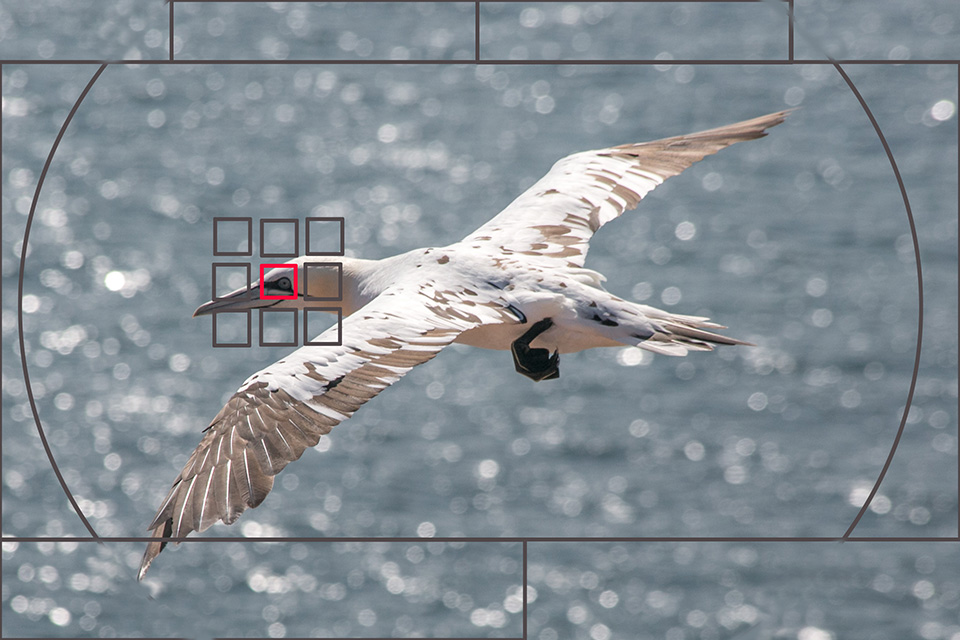
There are only three important pitfalls that can ruin the sharpness of your image. The next time you take a blurry photo, you can run through these problems to find out what went wrong. Because without knowing the cause, you cannot solve the problem.
Problem 1: Shutter speed too slow
You use shutter speed to control movement. You use a fast shutter speed to freeze movement and a slow shutter speed to blur movement or to 'show movement'.
A slow shutter speed can produce great results for landscape photographers with the right equipment, such as a tripod and neutral density filters. The colours also come out much better.
But if that is not your aim, you need a shutter speed that is fast enough to prevent camera shake when shooting handheld and also to 'freeze' moving subjects.
Example 1: at a wedding, you want to take photos of the couple. You only have natural light and are using a 70-200 mm lens, at 70mm. Your subject is not moving or barely moving, so the only movement you need to account for is camera shake caused by shooting handheld without a tripod.
Your minimum shutter speed should then be 1/70 of a second according to the rule: 1 / focal length. This rule only applies to a full-frame camera. If you use a crop sensor, the formula is: 1.5 x focal length. In that case, you would end up with a shutter speed of 1/100.
If you have image stabilisation, in the lens or body, this gives you a few extra stops, and a subject shot at a focal length of 200mm with a shutter speed of 1/70 can still be sharp. As long as your subject is not moving!
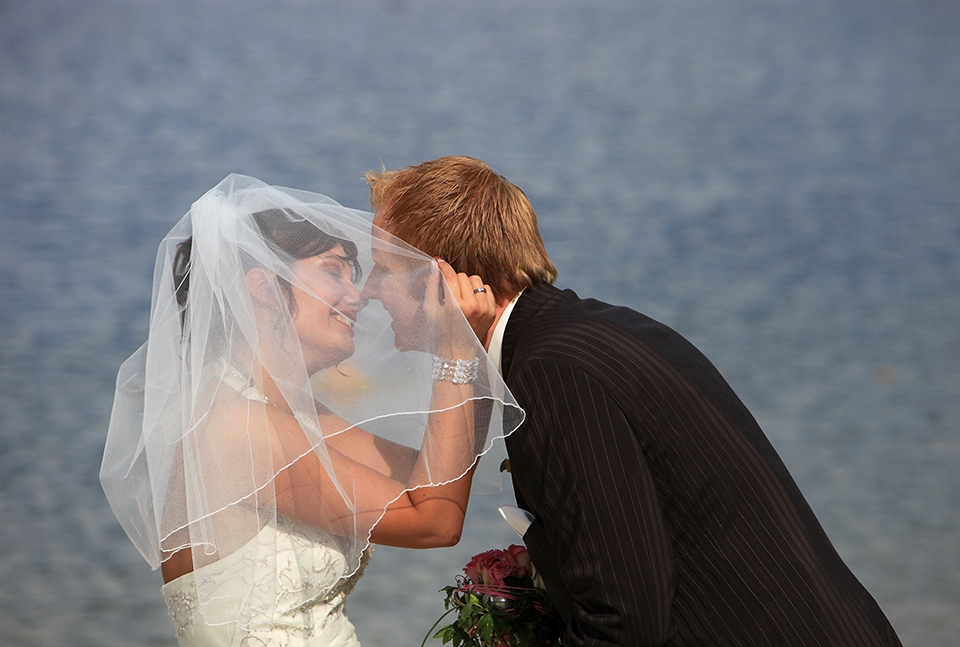
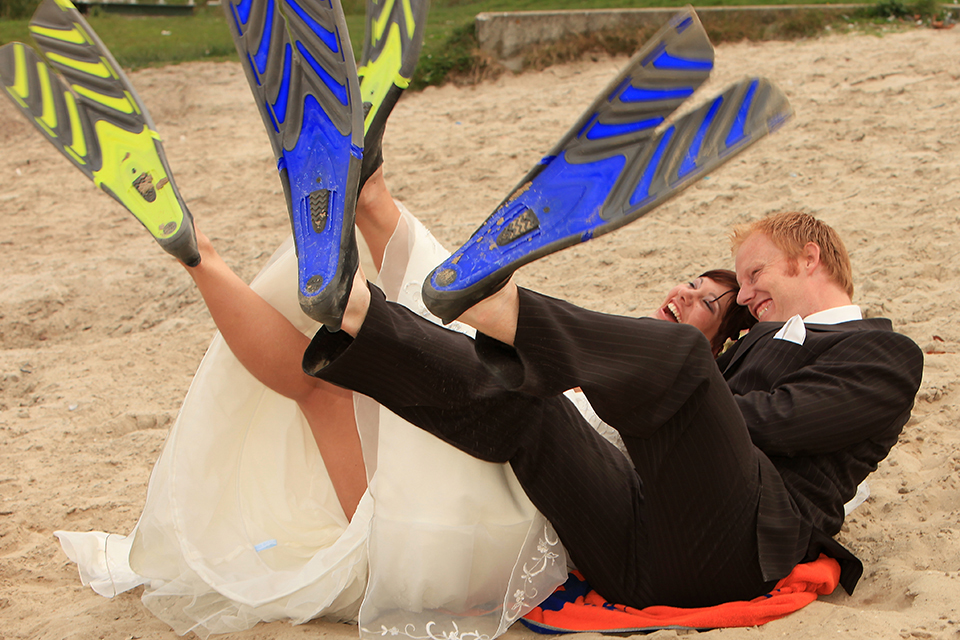
Example 2: The same wedding as above, with the same 70-200 mm lens, now at 200mm.
The couple are about to do something unexpected and will move. In this case, they fell backwards onto the ground. The situation is more difficult now because you have to guess how fast your shutter speed needs to be to freeze their movement for a sharp photo.
However, you cannot predict how or how quickly they will move. Sometimes 1/125 is fast enough, while sometimes you need 1/1000 if they are moving really fast.
I therefore recommend using the fastest shutter speed possible in this situation without compromising too much on the other exposure elements, such as an insanely high ISO value or an aperture that is too wide to keep everything that needs to be sharp in focus.
The most important consideration in the examples above is this: when you are trying to determine how fast your shutter speed needs to be, you first need to decide whether your subject is stationary or moving, and if it is moving, how quickly.
Solution 1: Shutter speed too slow
Reasons why your shutter speed may be too slow and how to fix it:
- Too little light / shooting indoors - You are often dependent on the location and the available elements within which you have to shoot. If there is not enough natural light, using a flash is the best solution.
Read all about simple flash techniques on the camera; - Aperture not wide enough - Lower your f / stop to let in more light. Are you still using the kit lens? That may be the problem. A fast lens can work wonders.
Read more about writing with light; - ISO too low - Increase the ISO to get a faster shutter speed.
Read this article to learn all about ISO.

Problem 2: Autofocus not optimal
Some time ago, I wrote a very detailed overview of various camera settings for beginners, including autofocus and which setting to choose, depending on what exactly you are photographing.
Never rely on the camera's autofocus system to decide what you want to focus on. The camera cannot know what you want to focus on in your photo. Manually select a single AF point in the viewfinder, preferably in the centre, or focus manually to avoid missing focus.
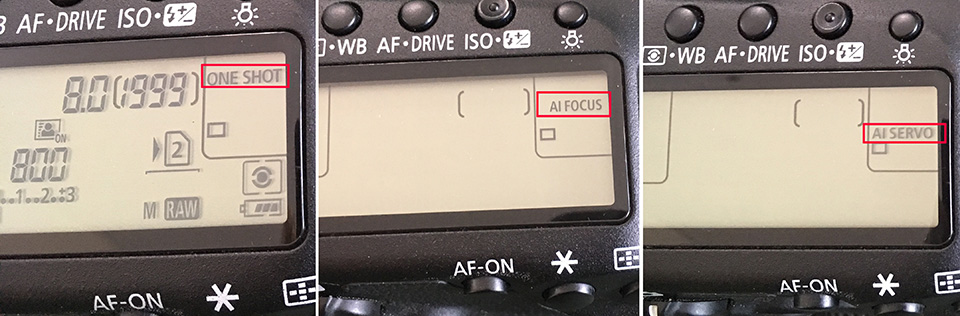
With moving subjects, it is best to use your camera's 'continuous' focus setting. On Nikon: AF-C, and on Canon: AI Servo.
Problem 3: Aperture too wide
Technically, this is not a 'problem', but rather a limitation of lenses in general. However, regardless of which lens you use, your lens is always at its sharpest when you stop the aperture down by two to three f/stops from its maximum opening.
So if you have a 50 mm f/1.4 lens, it only starts performing at its best, in terms of sharpness, at an aperture of f/2.8 or f/4 or higher.
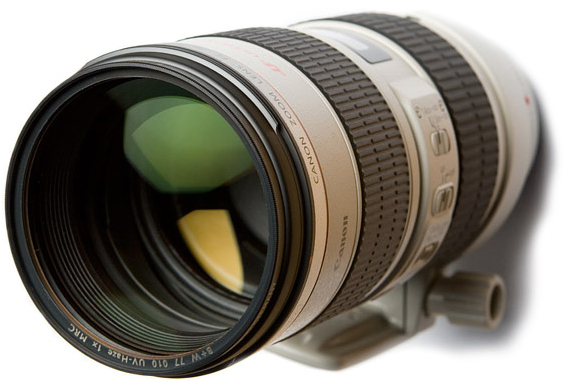
How to always take sharp photos
Although it is impossible to make 100% of your photos 'perfect' in terms of sharpness and focus, these general pitfalls can help you take sharp photos more consistently.
They can also help you quickly diagnose a blurry photo, allowing you to take measures for your next shots. I hope these ideas help you get started.
If you know of any other measures for preventing blurry photos, please let us know in the comments!
Want to learn more about the basics of photography?
At Photofacts Academy, our online learning environment for photographers, we have a complete basic photography course. You can take this course for two weeks with a free trial membership.
About the author
Michelle Peeters is fotografe en oprichter van DeuxBleus Fotografie. Michelle herkent het bijzondere in het gewone en het gewone in het bijzondere. Ze heeft zich nooit willen specialiseren en is daardoor van alle markten thuis.
You might also like
-
 Avoid Blurry Photos With These 10 Tips
by Nando Harmsen
-
 Playing with blur
by Laura van der Burgt
-
 Street Photography Tip: Blurry Isn't Always Bad!
by Michiel Heijmans
-
 Using Motion Blur to Your Advantage
by Nando Harmsen
-
 Blurry Christmas Photos (Advent Calendar)
by Elja Trum
-
 Does Lens Blur in Lightroom have any value for photographers?
by Nando Harmsen
73 comments
-

 Arthur Wittendorp
wrote on Tuesday 16 January 2018 at 07:42
| reply
@Michelle,
This comment was written in another language and has not been translated yet.
Een kleine correctie op je verhaal. Je stelling in voorbeeld 1 klopt niet. Je minimale sluitertijd (beeldstabilisatie even buiten beschouwing gelaten) met 70mm op een cropsensor (1,5 bij Nikon en 1,6 bij Canon) is nog steeds 1/70. Een cropsensor is geen extra tele het is 'slechts' een uitsnede van fullframe. -
 Michelle Peeters wrote on Tuesday 16 January 2018 at 09:17
| reply
@Arthur: de cropfactor heeft inderdaad geen invloed op de werkelijke brandpuntsafstand, wel op de vergrotingsfactor. Een 70mm objectief op een cropcamera heeft immers een beeldhoek die overeenkomt met de brandpuntsafstand vermenigvuldigd met de cropfactor; een 70mm objectief op een 1,6 cropcamera levert dus een beelduitsnede op die overeenkomt met 113mm (als de afstand tot het onderwerp gelijk blijft, natuurlijk). Het lijkt dus of je met een langer brandpunt aan het fotograferen bent waardoor de bewegingen op afstand dus ook evenredig toenemen! Dat is de reden waarom je toch rekening moet houden met de cropfactor om de minimale sluitertijd uit te rekenen.
This comment was written in another language and has not been translated yet. -
 RAWshooter wrote on Tuesday 16 January 2018 at 10:00 | reply
That rule of thumb applied a long time ago, when a lens had the physical length that corresponded to the focal length. So a 70mm lens had a front element that was (approximately) 7 cm from your film. Because it is about the movement you cause yourself, and the front element moves the most then.
Translated from Dutch.
Nowadays, physical length and focal length have long since had no relation at all. You see that most with wide-angle lenses, but also with telephoto zooms.
So measure the distance from the front element to the sensor and you know what minimum shutter speed you need to eliminate motion blur caused by your own shaky hands. So the size of the sensor has absolutely NOTHING to do with it! -
Michelle Peeters wrote on Tuesday 16 January 2018 at 11:19
| reply
@RAWshooter: nowadays, isn't the distance from your front lens to your sensor equal to the distance from your front lens to your film (in the past)?
Translated from Dutch. -
 geerjanssen
wrote on Tuesday 16 January 2018 at 11:31
| reply
I always get so tired of those people who know everything better when it comes to technology! (I call those people people in the fog, from whom you never see a photo) Enjoy the things that are offered, you may have your thoughts about them but you don't always have to air them!
Translated from Dutch. -
Arthur Wittendorp
wrote on Tuesday 16 January 2018 at 11:46
| reply
@Michelle:
Translated from Dutch.
As you yourself already indicate, it seems as if you are photographing with a longer focal length. In reality, you are still photographing at 70mm. By using a smaller sensor (crop sensor), you only get a crop compared to a full-frame image. The myth that using a smaller sensor also increases the motion factor. That is complete nonsense.
@RAWshooter:
You are absolutely right. The focal length no longer says anything at all about the distance between the front lens and the sensor/film. It only says something about the angle of view used for photographing. 35mm, for example, has an angle of view of 63.4 degrees, 70mm an angle of view of 34.3 degrees and 12.4 degrees. -
Arthur Wittendorp
wrote on Tuesday 16 January 2018 at 11:50
| reply
@geerjanssen:
Translated from Dutch.
I invite you to come and take a look at my photography websites www.klikaf.nl and www.arthurwittendorp.nl!
-
 Jos wrote on Tuesday 16 January 2018 at 12:19 | reply
@Arthur: I’ve come across a discussion about shutter speed in relation to focal length on the internet before. What I understood from it: whether a photo is sharp or blurry depends, among other things, on the size at which you view a photo. A photo that has some motion blur (whether it’s the camera and/or the subject doesn’t matter for now) can look sharp at a very small size. You only start to see it (or "experience" it) when the photo, and therefore the pixels, are enlarged sufficiently. A photo from a camera with a crop factor does indeed make a kind of crop compared to a full-frame image. However, if you then enlarge this photo to the same size as that photo from the full-frame, every pixel has therefore become 1.5x larger than that of the full-frame (at least if the sensors have equally sized pixels). Your photo will therefore appear blurry sooner. Agree?
Translated from Dutch. -
Michelle Peeters wrote on Tuesday 16 January 2018 at 12:20
| reply
@Jos: hit the nail on the head!
Translated from Dutch. -
geerjanssen
wrote on Tuesday 16 January 2018 at 12:25
| reply
@Arthur Nice that you point this out, I immediately went to your site and enjoyed your work, what really appeals to me is that the photos are very natural (no messing around with Adobe to make something more of them)
Translated from Dutch. -
RAWshooter wrote on Tuesday 16 January 2018 at 12:38 | reply
Sharpness is not a relative concept. A photo (or subject) is sharp or blurry. Zooming in (or applying a crop factor, which is the same thing in this case) on a photo that is a bit blurry will make the photo appear blurrier. But that photo was already blurry to begin with. Zooming in on a sharp photo will never make that photo blurrier. So the crop factor has no effect, except if you already had a blurry photo. And that was precisely not the intention.
Translated from Dutch.
Michelle: that has nothing to do with the digital camera but with developments in the field of lenses. Just measure the distance with a wide-angle zoom, and you will see that it is much greater than the focal length. With a 28mm, the physical distance is easily 8-10 cm. And if the lens “extends” while zooming, it is often even more.
Geer: Stay strong. -
Michelle Peeters wrote on Tuesday 16 January 2018 at 12:49
| reply
@RAWshooter: with a crop factor, you do bring the subject closer! That's why a crop camera is also popular among wildlife photographers; their telephoto zoom gets the subject even closer! And you immediately see every small movement reflected in your image. The same effect as with macro photography, where you actually can't do without a tripod. That's how I've always understood it and that's how I read it on other (reliable) sites too!
Translated from Dutch. -
RAWshooter wrote on Tuesday 16 January 2018 at 12:51 | reply
Michelle: sharpness is not a relative concept. Read my previous comment again.
Translated from Dutch. -
Michelle Peeters wrote on Tuesday 16 January 2018 at 12:53
| reply
@RAWshooter; I didn't claim that either!
Translated from Dutch. -
Jos wrote on Tuesday 16 January 2018 at 13:10 | reply
@RAWshooter: I think sharpness is indeed relative (or perhaps better: subjective). I think you are referring more to resolution. This is nicely explained on the site below (but there are many more on this subject):
Translated from Dutch.
Sharpness, Acutance and Resolution.
@Michelle: Great overview! Articles like this always provide plenty to discuss. But the core of your article is useful and well written! -
Michelle Peeters wrote on Tuesday 16 January 2018 at 13:14
| reply
@Jos: indeed a nice discussion (I’m learning from it too!). Thanks for your input, this is another fun one.
Translated from Dutch. -
 Noor wrote on Tuesday 16 January 2018 at 13:36 | reply
So I can use a shutter speed of 1/50 sec. with a 50mm on both a crop camera and a full-frame camera?
Translated from Dutch. -
RAWshooter wrote on Tuesday 16 January 2018 at 13:41 | reply
Jos: it's about motion blur: The blur that occurs because the front lens is not completely still during the exposure. And that really is an absolute concept. Exactly still means exactly still. A little movement is movement and therefore blurry. On a tripod, with no wind, using the self-timer/remote control, no flipping mirror, electronic shutter: then you are guaranteed to have no motion blur. Image stabilization helps enormously if you don't have (all of) those conditions.
Translated from Dutch.
Of course there are all kinds of degrees of motion BLUR, but sharp is sharp. And if we take that as our starting point, the size of the sensor (or how much a photo is cropped later) no longer matters.
-
Michelle Peeters wrote on Tuesday 16 January 2018 at 13:41
| reply
@Noor: no, exactly! With a crop camera, you end up at a shutter speed of around 1/75th of a second. Because with a crop camera you are photographing at 75mm instead of 50mm (that is the specific crop factor of 1.5 or 1.6). But anyway, they are only indications. With a steady hand and stabilizer, in practice you can still get a sharp photo with much longer shutter speeds.
Translated from Dutch. -
 Guy wrote on Tuesday 16 January 2018 at 13:42 | reply
Dear Michelle,
Translated from Dutch.
thanks for the info.
Question, does this then also mean that, for example for BIF, you should preferably photograph in S-priority?
I myself have been doing that for years, yet I hear that some of my friends photograph in A-priority.... -
Michelle Peeters wrote on Tuesday 16 January 2018 at 13:46
| reply
@Guy: what is BIF? Whether you shoot in S or A priority depends on your subject. (Fast) moving subjects are best photographed in S. If depth of field is decisive, then in A or Av.
Translated from Dutch. -
 Lenie wrote on Tuesday 16 January 2018 at 13:53 | reply
Michelle, you explained it very clearly. The target audience can follow you. The know-it-all versions of the anonymous commenters are of no use to anyone. Actually, it shouldn't be possible to comment because you always get criticism. People who already (think they) know everything don't need to read it here anymore. It is just very annoying for the writer themselves to always be corrected, right? This is about basic information that many beginners are looking for. They have no use for those pointless discussions that arise underneath.
Translated from Dutch. -
RAWshooter wrote on Tuesday 16 January 2018 at 13:54 | reply
When it comes to the ability to learn, there are three degrees at the lower end of the scale: headstrong, stubborn and stupid.
Translated from Dutch. -
Guy wrote on Tuesday 16 January 2018 at 13:58 | reply
BIF = Birds In Flight....
Translated from Dutch. -
Michelle Peeters wrote on Tuesday 16 January 2018 at 13:59
| reply
@Lenie: I actually do find this an interesting discussion and a sign that articles are being read properly! As long as it's substantive, I think it's fine. It makes you think and it's good to occasionally delve a little deeper into things you've taken for granted for years. It keeps you sharp!
Translated from Dutch. -
Lenie wrote on Tuesday 16 January 2018 at 14:03 | reply
@Michelle, well, that's fortunate then! It just seems very annoying to me that you write an article and then all sorts of people correct you on the content. And people who comment anonymously, that's simply a shame. I'd ignore them
Translated from Dutch. -
Michelle Peeters wrote on Tuesday 16 January 2018 at 14:07
| reply
@Lenie: I don't see this as correcting. I still think that the formula in the article about that crop factor/full frame versus shutter speed is correct! But that is precisely the fun thing about such a discussion, that you also start thinking about other factors that could possibly play a role in it. Educational!
Translated from Dutch. -
 Henk wrote on Tuesday 16 January 2018 at 14:17 | reply
Clear explanation again, Michelle!
Translated from Dutch. -
Michelle Peeters wrote on Tuesday 16 January 2018 at 14:27
| reply
@Guy: I would personally shoot a BIF (Bird In Flight) in A or Av priority. Because you move along with the flying bird, you don't need such a very fast shutter speed, but you do want the entire bird to be sharp. Aiming for the eyes (so that they are at least sharp at a wide aperture of, for example, f/2.8) is too difficult with this subject...
Translated from Dutch. -
Arthur Wittendorp
wrote on Tuesday 16 January 2018 at 15:27
| reply
@Noor,
Translated from Dutch.
You can always take a sharp photo with 50mm at 1/50. Regardless of whether it is full-frame or a crop sensor. With a crop factor, you don't bring the subject closer. It is only a crop of a fulframe image. Michelle's statement is not correct. Especially @RAWshooter explains it well in the above-mentioned reactions!
@Geerjanssen
Thanks for your compliment
@Lenie
If the story is correct, you hear that nobody will start a discussion. Unfortunately, Michelle's statement is not correct. In my opinion, there is nothing wrong with a good discussion as long as we continue to respect each other! -
 Kees wrote on Tuesday 16 January 2018 at 15:34 | reply
Nice, that theoretical discussion, but I’m starting to realise that my steady hand apparently isn’t so steady anymore.
Translated from Dutch.
Photos right on the edge of the shutter speed are sometimes not completely sharp. If I use a tripod, even a monopod, I have no problem. A friend apparently with a steadier hand can go much lower in speed without motion blur. Oh yes, it’s not the camera’s fault but, just as with a good photo, more the guy behind it. So I’ll continue reading these articles with interest and take from them what can help me further. Keep it up Michelle -
Michelle Peeters wrote on Tuesday 16 January 2018 at 15:37
| reply
@Kees: what does it matter if you don't have a tripod or support at hand: inhale, exhale halfway and then take the photo. Apparently you're 'the most stable' at that moment.
Translated from Dutch. -
 Evert wrote on Tuesday 16 January 2018 at 15:56 | reply
Hello everyone,
Translated from Dutch.
You will all surely know what you're talking about, but I started as a little boy and never had any training for this. The only thing that, despite my many years of experience in photography, is difficult for me, is sharpness.
I have a Nikon D7000, it doesn't matter which lens I use for now, but the following is what confuses me.
I always set my points to AF-C, but I often have doubts with people, like at this wedding, about whether I should set the number of points to 1-9 or 21 if I want to get the entire body sharp. Just like with a standing person. I focus on the body or eyes of, for example, someone at a distance of 2 meters. I then have to let the camera do the focusing because of the speed at which I take the photo. how many points should I use to get the entire body sharply in the picture and still keep the background blurry? -
 Peter van Balen wrote on Tuesday 16 January 2018 at 16:22 | reply
Without claiming that Wikipedia is always 'right', here is a link to the secondary effects of a crop factor:
Translated from Dutch.
https://en.wikipedia.org/wiki/Crop_factor#Secondary_effects and a quote from it:
"The extra amount of enlargement required with smaller-format cameras increases the blur due to defocus, and also increases the blur due to camera motion (shake). As a result, the focal length that can be reliably hand-held at a given shutter speed for a sharp image is reduced by the crop factor. The old rule of thumb that shutter speed should be at least equal to focal length (in millimetres) for hand-holding will work equivalently if the actual focal length is multiplied by the FLM first before applying the rule."
Michelle's explanation is (therefore) the correct one. To calculate a safe shutter speed, you should (therefore) use 1/FF-equivalent focal length.
It also makes sense/is understandable, if you think of a much smaller sensor. For a superzoom compact with a 1/2.3" sensor, with a crop factor of 5.62, at, say, FL = 100mm = 562mm
FF-equivalent, a safe shutter speed of (rounded) 1/500 sec. still applies. (and not just 1/100 sec) -
 Hans den Boer
wrote on Tuesday 16 January 2018 at 16:23
| reply
I think almost everyone assesses the sharpness of a photo by zooming in on the image to 100%. Then you really do see a difference in the likelihood of motion blur at a given shutter speed with a 12MP camera or a 30+MP camera. And that makes sense. Furthermore, things like having a steadier or less steady hand and image stabilisation obviously play a major role (leaving optical quality out of the discussion for the moment).
Translated from Dutch. -
Peter van Balen wrote on Tuesday 16 January 2018 at 16:30 | reply
PS: I can imagine that it doesn't make much difference for an APS-C crop factor, but I know from personal experience that with my 1/1.7" sensor (crop factor 4.6) Nikon P7800 at 200mm FF-eq I really do have to shoot at 1/250, especially when I have VR turned off, and not 'only' at 1/40 sec.
Translated from Dutch. -
Michelle Peeters wrote on Tuesday 16 January 2018 at 16:40
| reply
@Peter: thanks, now we're getting somewhere!
Translated from Dutch.
@Evert: I would never let the camera determine what you get in focus in your photo. I myself always have just 1 focus point active (or a number of them in the center). You make sure that central focus point falls on the eyes (or the face) and then you're reasonably good. With your aperture size you determine how much of the rest of the body you get in focus (apart from the eyes, which you're focusing on).
For wedding photography I wouldn't use the 'continuous AF' mode. That one is more suitable for, for example, sports shots or fast-moving wildlife.
You can also use the hybrid mode ("AF-A" on Nikon and "AI Focus AF" on Canon), which automatically switches between Single Area Focus Mode and Continous / AI Servo Focus Mode, depending on whether or not your subject keeps moving. Handy if you find it difficult to constantly switch between AF-S and AF-C camera modes. -
Peter van Balen wrote on Tuesday 16 January 2018 at 16:53 | reply
Just to come back to the difference between problem (and therefore solution) #1 and #2:
Translated from Dutch.
* you (used to) solve the first one with shutter speed = 1/FL (FF-eq), but nowadays, with stabilization in the body and/or lens, you can 'gain' up to 6.5 stops (high-end m43); provided that problem #2 (movement in the subject) is not an issue
* you can't solve the second one with body and/or lens stabilization -
Peter van Balen wrote on Tuesday 16 January 2018 at 17:01 | reply
Here's another link to practical tips for 'bracing' techniques (sorry, in English), to reduce camera shake:
Translated from Dutch.
https://digital-photography-school.com/how-to-avoid-camera-shake/ -
Peter van Balen wrote on Tuesday 16 January 2018 at 17:03 | reply
PS: it's just like with university-level football (read: Barcelona):
Translated from Dutch.
making triangles, just like your tripod (which is also called tripod in English) -
Michelle Peeters wrote on Tuesday 16 January 2018 at 17:07
| reply
@Peter: nice article about how to stabilize your camera when shooting handheld!
Translated from Dutch. -
Peter van Balen wrote on Tuesday 16 January 2018 at 17:20 | reply
For problem #3 (aperture), you can perhaps take a look here and see for a particular FL what depth of field a particular f-number gives you:
Translated from Dutch.
https://www.pointsinfocus.com/tools/depth-of-field-and-equivalent-lens-calculator/#{"c":[{"f":13,"av":"8","fl":50,"d":3048,"cm":"0"}],"m":0} -
 Evert wrote on Tuesday 16 January 2018 at 17:40 | reply
Thanks Michelle.
Translated from Dutch.
I never use AF-A (Nikon) anymore precisely because of the focus continuously moving, hence AF-C
Or do you get sharper photos on average with AF-A?
But can you still determine the focus point then? So left, right, top and bottom? -
RAWshooter wrote on Tuesday 16 January 2018 at 17:52 | reply
Fortunately, there are still people who want to have a discussion based on content. It's just a shame that only URL references are mentioned and no arguments of their own. Thinking for yourself and using your common sense is always better.
Translated from Dutch.
To help you with that, I will explain it once again in a different way:
Suppose you have a 50mm lens with a physical length of 3cm. And you have a 50mm with a length of 10cm. Would both (on the same camera) then be equally sensitive to motion blur? Of course not: The movement of your camera is caused by you holding it. That movement is "amplified" towards the front of your lens. Because the front lens moves, there is motion blur in your photo. The farther away your front lens is, the more movement you have. So the physical distance from the front part of your lens to the point where you hold the camera. For convenience (it doesn't come down to the centimetre), that is the middle of the body.
The phenomenon of focal length(-distance) plays no role in this whatsoever. That there is an old rule of thumb that equates the physical length of your lens with the focal length for convenience is understandable if you know the lenses of that time. It was reasonably accurate then, and such a rule of thumb is useful. But nowadays we have zoom lenses, very large fast standard lenses, etc. Just measure that 50mm f/1.2, the physical length is well over 5cm.
If you understand this, you also understand that sensor size is irrelevant. The only factor that determines how much movement occurs in the front lens is the physical length of the lens. At most, it SEEMS to be important, because you assume that some degree of movement always occurs. And when zoomed in, blur looks worse to the eye.
That is why the short shutter speed; in a short time you simply can move less. But it was about "consistent sharpness" and not about as little blur as possible. We want zero blur, not a little. And that is quite possible. A photo with motion blur has by definition failed. The blur covers the entire image. That is therefore something completely different from a moving object in an otherwise sharp photo.
Regarding all those other websites that do take the crop factor into account and (much more importantly in my opinion!) ignore the physical length of the lens: Does a statement automatically become true if you keep repeating it often enough? Because that is what happens. No one can determine what the scientific evidence for this rule of thumb is. It simply does not exist and cannot be created either.
A great many people do not feel like thinking for themselves and blindly copy what they find elsewhere. There are plenty of examples where that goes completely wrong in the world.
Somewhat philosophically: Do you want to believe or do you want to know?
I want to know and understand, which is why I think for myself. That is a choice, but everyone can make it. It would just be nice if I were left to my own worth with that choice and not dismissed as a contrarian or unreliable because I respond anonymously. That is very unfriendly. -
Michelle Peeters wrote on Tuesday 16 January 2018 at 18:18
| reply
@Rawshooter: I'm going to look into it more deeply after all.
Translated from Dutch. -
 Sander wrote on Tuesday 16 January 2018 at 18:36 | reply
I think it's a good story. I always teach my students the 1/focal length rule as well. With the added note that a number of additional factors also play a role, such as image stabilization and how steady your hand is at that moment.
Translated from Dutch.
So just adjust this rule according to your needs. I once had a student who had been a sniper and he could still take a sharp handheld photo at 200mm with a shutter speed of 0.5 seconds. Everything is relative. -
 Hans Egelmeers wrote on Tuesday 16 January 2018 at 18:52 | reply
I recently bought a system camera. ( Fuijifilm X-T20 ) It has a mechanical and electronic viewfinder. What is best to choose? Can also use both at the same time.
Translated from Dutch. -
 José wrote on Tuesday 16 January 2018 at 18:56 | reply
Hello Ms Peters,
Translated from Dutch.
thank you for your article, it is always good to refresh certain things.
I do still have a question and it concerns this comment:
So if you have a 50 mm f/1.4 lens, it only starts to perform at its best (in terms of sharpness), at an aperture of f/2.8 or f/4 or higher.
I have been pondering for a while about buying a 50 mm. f1.8 prime lens and the comment above got me thinking.
What is actually the added value of such a lens if you have to start taking photos with an aperture that lets in the same amount of light as my 18-50mm kit lens. ?
I am probably making a mistake in my thinking, because I am not technical at all and I hope that you can explain this to me.
Thank you very much in advance for your answer.
kind regards
José -
Evert wrote on Tuesday 16 January 2018 at 19:10 | reply
It is a lot clearer to me now after Michelle's explanation, Thanks for that.
Translated from Dutch.
I still see far too many blurry photos in my own work, especially indoors, so I think it is mainly due to my not-too-good focus point settings, I mean the AF-C, just to give an example. I am going to work hard on improving this.
Thank you all for the good tips. -
Michelle Peeters wrote on Tuesday 16 January 2018 at 19:32
| reply
@Evert: read through the article General camera settings for beginners and especially the paragraph about the best autofocus mode.
Translated from Dutch. -
Michelle Peeters wrote on Tuesday 16 January 2018 at 19:39
| reply
@José: a prime lens doesn't necessarily have to be more light-sensitive than a zoom lens. You have zoom lenses that are light-sensitive (for example f/2.8) throughout the entire range. So for example from 70 to 200mm. What you probably mean is why you would buy such a fast lens of, for example, f/1.8 if it doesn't perform at its best at that widest aperture anyway? That's a question many people ask themselves, but I don't think it's a reason not to go for such a fast lens. If you were to buy a less light-sensitive lens of, for example, f/4, it would only perform at its maximum in terms of sharpness at f/6.7. That immediately costs you a few stops of light! And it's not to say that such a lens performs 'badly' at its widest aperture, just not optimally! No reason not to do it then!
Translated from Dutch. -
 100
wrote on Wednesday 17 January 2018 at 02:44
| reply
@RAWshooter
Translated from Dutch.
You have to compare apples with other apples and not with pears, then you will see that points of view that seem different are not that different. With sharpness, for example, the relationship between pixel size and angular displacement plays a role, but there are many more factors.
To stick with your example of that 50mm lens, the following:
I can mount that 50mm lens on both FF and crop, and that makes the physical length irrelevant because the distance between the front element and sensor is then the same in both cases.
Suppose that both cameras also have the same number of pixels, the pixels of the FF camera are then larger than those of the crop camera and can therefore have a larger angular displacement at pixel level, or tolerate slightly more movement.
If you print the photos from both cameras at the same size, the pixels from the crop camera are enlarged more than those from the FF camera and the blur is also enlarged. In that specific case, Michelle's statement is correct.
The difference in this case is that the angle of view of the photo on crop is different from that on full frame. 50mm on 1.5 crop gives an angle of view comparable to 75mm on full frame.
Make the same comparison with the same lens between a 1.5 crop camera with 20 megapixels (for example a Nikon D500) and an FF camera with 45 megapixels (for example a Nikon D850) where the pixels are therefore the same size, then the sharpness will be the same because the pixels are enlarged to the same extent.
In that specific case you therefore need the same shutter speed for both cameras for the same sharpness.
A 1.5 crop of a D850 at the same shutter speed, aperture and ISO gives the same photo as a D500, both in resolution, as in sharpness, as in angle of view, as in depth of field, as in noise.
The difficult thing with this kind of comparison (equivalence) is that it only applies if all other factors are exactly the same. If not, you quickly end up comparing apples with pears and discussions arise like in the thread above, where both points of view can be correct in specific cases but not as a generally applicable rule.
As for the old rule of thumb that the shutter speed must be at least 1 divided by focal length, I think that rule of thumb has little value these days. In just under 20 years, the number of megapixels on a sensor has increased by a factor of 10 or more and that affects the minimum shutter speed for sharp photos. -
Arthur Wittendorp
wrote on Wednesday 17 January 2018 at 07:34
| reply
My last response to this article is an off-topic response:
Translated from Dutch.
I enjoy a heated discussion like this. The condition for me is that the discussion is based on substance and that we show respect for one another. Even if we have a different opinion. I deliberately respond under my full name because I want to discuss openly and honestly. I therefore cannot appreciate that someone, who also responded in this topic, contacted me through my website and still tried to prove that he/she was right by referring to another website/page, which, incidentally, are full of inaccuracies, and subsequently demanded a public apology from me. -
Jos wrote on Wednesday 17 January 2018 at 09:58 | reply
RAWshooter’s statement keeps occupying my thoughts
Translated from Dutch.
In my opinion, it is easy to undermine. Suppose you manage to take a perfectly sharp photo with a zoom lens zoomed in to 70mm and a shutter speed of 1/70. Why is it then that you rarely manage to take a sharp photo with the same equipment zoomed in to 200mm and a shutter speed of 1/70? The physical length of this lens remains the same, only the zoom changes.
In my opinion, the explanation is simple and in fact a repetition of an earlier argument: if you zoom in further, motion blur becomes noticeable sooner. If you were to zoom in extremely on the first photo, you would probably also see that the photo is not 100% free of motion blur.
If you really managed to keep the camera perfectly still (which of course does happen every now and then), then that rule of thumb concerning focal length and shutter speed would be unnecessary. The fact that this rule of thumb does indeed make sense has to do with the fact that it is rarely possible to hold the camera 100% still in your hand and you make the motion blur "invisible" by using fast shutter speeds.
RAWshooter is essentially saying that this is not possible: the photo is either sharp, or it has motion blur (free translation of: We want zero blur, not a little. And that is perfectly possible too.). If that were true, then there would have to be one shutter speed that you must stay below to prevent motion blur, regardless of lens size or focal length. And that statement seems easy to disprove experimentally to me.
P.S. This text is a combination of knowledge I have acquired on the internet and thinking for myself -
 Jos Reijn wrote on Wednesday 17 January 2018 at 11:40 | reply
Why do we always talk about Nikon or Canon in all these stories. Does Olympus not count at all with a crop factor of 2.
Translated from Dutch. -
Michelle Peeters wrote on Wednesday 17 January 2018 at 11:58
| reply
Nando Harmsen (someone who really knows what he's talking about) explains the crop factor in relation to shutter speed perfectly on his site.
Translated from Dutch.
Quoted here:
Although a crop factor has no influence on the actual focal length, it does influence the magnification factor. A 50mm lens on a crop camera does, after all, have a field of view that corresponds to the focal length multiplied by the crop factor; a 50mm lens on a 1.6 crop camera therefore produces a crop that corresponds to 80mm (if the distance to the subject remains the same, of course). It therefore seems that you are photographing with a longer focal length, causing movements at a distance to increase proportionally as well. That is why you need to take the crop factor into account when calculating the minimum shutter speed. The rule should therefore look like this:
shutter speed = 1 / [focal length * crop factor] -
RAWshooter wrote on Wednesday 17 January 2018 at 12:02 | reply
Of course Olympus counts. Don't worry, the crop factor plays no role at all in this story.
Translated from Dutch.
And I'm happy to respond to comments, as long as they also address my explanation. I don't see a rebuttal anywhere to my example of the physical lengths of the 50mm lenses, for instance. And that is precisely the essence of my story. “Talking” past each other is just as pointless as comparing apples and oranges. -
Jos wrote on Wednesday 17 January 2018 at 13:35 | reply
@ RAWshooter. I would like to respond to that: I had not considered that the core of the story. But I think that is correct: the physical length of the lens is more important than the focal length. But the conclusions you draw from that and the continuation of the argument are incorrect. And that was what my response was about.
Translated from Dutch. -
 Donald Willemsen
wrote on Wednesday 17 January 2018 at 22:45
| reply
I enjoyed reading this interesting article. I also read that you shouldn't always rely on AF. I actually always do, and even then it happens that some of my photos can be out of focus. Part of that can also be traced back to motion blur. Taking photos standing up is no longer possible. I now have to do everything sitting down.
Translated from Dutch.
Because AF now exists, I started photographing again 12 years ago. In the analogue era AF did not yet exist and I regularly had blur in the photo where it shouldn't be. Manually focusing goes wrong 9 times out of 10 because of the condition of my eyes. I wear glasses and photographing with glasses on limits the view through the viewfinder. Use Live View then, you might say. That only eats up power. I prefer to take a lot of photos. Adjusting the dioptre on the viewfinder is not possible, because it doesn't reach +6.
Actually, the AF sensors should be able to give a signal when the focus is correct with MF. I haven't really dared to use MF anymore. I don't want to take the risk. -
Michelle Peeters wrote on Wednesday 17 January 2018 at 23:54
| reply
@Donald: what can be helpful if you have trouble seeing it (I indeed also often find manually focusing not an option) is setting one focus point in the center (or a number of them, but in the center) and turning on the beep in the camera settings. Your camera will then beep as soon as it has focused properly. Because you know that your focus point is always exactly in the center, you can 'aim' more easily and also work a bit by feel. Usually you're then fine with your focusing on AF.
Translated from Dutch. -
Ad Fondo wrote on Thursday 18 January 2018 at 00:18 | reply
No AF on analogue cameras? My Minolta from 1990 already had it. Millions of Nikons and Canons were sold with AF when digital photography wasn't even a thing yet!
Translated from Dutch. -
100
wrote on Thursday 18 January 2018 at 02:35
| reply
@RAWshooter
Translated from Dutch.
“I don’t see a rebuttal anywhere to my example of the physical lengths of the 50mm lenses, for instance. And that is precisely the essence of my story.”
There you go. The physical length of a lens is not relevant.
It’s about the angle of view.
If the angle of view is the same, then the sensitivity to motion blur is also the same, whether the lens is 3cm long or 10cm, it doesn’t matter.
As an example, two actual lenses:
A Sigma 35mm f/1.4 Art is 94mm long and has an angle of view of 63 degrees
A Canon EF 100mm f/2 is only 74mm long and has an angle of view of 24 degrees
If I shake while taking a photo and the lens shifts by, say, 1 degree, then the movement in the photo is 1/63 of the photo with the 35mm lens and 1/24 of the photo with the 100mm lens.
Which photo will then have the greatest blur?
With your reasoning, the 100mm lens would do better than the 35mm lens because the 100mm is physically shorter.
You say you don’t want to believe but to know.
Fine, test your hypothesis in practice with real lenses and see whether the results correspond with your hypothesis. My experience is that I can still get reasonably good results handheld with my 35mm f/1.4 Art at 1/30, but I can’t do that with a 100mm lens. -
RAWshooter wrote on Thursday 18 January 2018 at 13:16 | reply
@100: You do state that the angle of view is decisive and the physical length is not, but you do not substantiate that anywhere.
Translated from Dutch.
The angle of view does not matter at all. A moving front lens leads to a blurry image on the sensor. The front lens of a wide-angle lens moves just as much as that of a telephoto lens. The sensor behind it records a blurry image. Hypothetically, you could project the surface of a sensor onto the front lens. The motion blur occurs on that front lens, not in the lens system behind it. So it does not matter whether there is a wide-angle lens or a telephoto lens behind it.
You also state that the physical length of a lens does not matter. Imagine two dogs: one has a short tail, the other a long one. Both wag their tails equally hard. Which tail tip moves the most? Or are you claiming that motion blur is not caused by the movement of the front lens? What causes it then? -
Michelle Peeters wrote on Thursday 18 January 2018 at 13:21
| reply
@RAWshooter: motion blur occurs because you yourself move (unintentionally), not because of movement of the front lens!
Translated from Dutch. -
RAWshooter wrote on Thursday 18 January 2018 at 14:01 | reply
Think of that dog Michelle, think of that dog. What happens to the tip of his tail? That's your front lens.
Translated from Dutch. -
 Matt wrote on Thursday 18 January 2018 at 19:36 | reply
The 1 divided by the focal length of the lens dates back to the days of film and is outdated. There are more factors that come into play nowadays, such as crop factor, image stabilization, sensor resolution.
Translated from Dutch.
See this video, item#3: https://m.youtube.com/watch?v=IsWGkUT5A_Y -
Donald Willemsen
wrote on Thursday 18 January 2018 at 22:39
| reply
@Michelle, I have always used just one focus point. The middle one. I already know that it is the most reliable.
Translated from Dutch.
What I would actually like; to focus manually without actually using AF, by putting the lens on MF, and for the camera to then be able to give a signal that I am in focus, a kind of camera thinking along, so.
If, for example, you want to make a series of macros to stack, then AF is no use to you. That simply has to be MF. But if you can't see it well enough with MF, then you can be well off. -
Michelle Peeters wrote on Friday 19 January 2018 at 00:03
| reply
@Donald: as far as I know, nothing like that exists. But I could be wrong...
Translated from Dutch. -
Michelle Peeters wrote on Friday 19 January 2018 at 00:30
| reply
@Matt: I watched item #3 of your video and it once again confirms that you need to take the crop factor of your lens into account when calculating your minimum shutter speed. And indeed, you also need to take things like image stabilization into account, which can then make a difference of a few stops.
Translated from Dutch. -
100
wrote on Friday 19 January 2018 at 02:37
| reply
@RAWshooter
Translated from Dutch.
I thought I had given a fairly clear substantiation, but fine, here it is again.
If I shake while taking a photo and the camera moves 1 degree during the set shutter speed, then:
1 - At an angle of view of 63°, the image shifts by 1/63 of the image.
2 - At an angle of view of 24°, the image shifts by 1/24 of the image.
1/63 is smaller than 1/24
This is basic mathematics, which is difficult to deny, surely.
The smaller the displacement, the sharper the photo, that also seems irrefutable to me.
Conclusion from the substantiation:
The lens with the widest angle of view produces the sharpest result with equal amounts of shake.
Now apply this to the dog's tail from your example.
If both tails rotate by 10°, the tip of the longest tail will cover a greater distance in centimetres, but the angle of rotation remains the same. The key is that the displacement is not expressed in length, but in degrees of arc, and you do that because camera movements are rotational movements.
If I move the camera in a straight movement, for example 1mm to the left, then the front of the lens also only moves 1mm, it is only with a rotational movement that a difference arises between the front and the back.
The longer the lens, the more the front moves during a rotational movement, that's true, but light does not travel through a lens in a straight line, the light is refracted again by each lens element. The many different glass elements in a lens then create a complex path. The result of all those refractions is that the final image that falls on the sensor has a certain angle of view, and that angle of view determines what is still called the focal length, even though it actually hasn't been that for a long time.
If you look at the specifications of lenses, you will see that every 35mm lens has an angle of view of approximately 63°, regardless of the physical length of the lens, and the same applies to other focal lengths.
The difference in length is due to the optical construction. Modern retrofocus lenses are more complex and have more lens elements than the older types and are therefore often longer. Long telephoto lenses, on the other hand, are often shorter than the focal length. For example, an EF 400mm f/4 DO IS II is only 233mm long.
Yet the angle of view remains the same regardless of the physical length, and that is the determining factor for motion blur caused by shaking, as explained above.
Now compare those 233mm with the 94mm length of my 35mm lens, that's about 2.5 times as long.
According to your reasoning, if I can just about take a sharp enough handheld photo with my 35mm lens at 1/30, I should be able to shoot sharply with that 400mm lens at 1/75.
I can't do that, and that's because the angle of view of a 400mm lens (even though it is only just over 200mm long) is only 6 degrees (approximately 9.5% of the angle of view of a 35mm lens). So I need at least 1/300 with a non-stabilised 400mm lens for sharp photos, and that is also what I experience in practice.
But anyway, as I said earlier, you don't have to agree with the argumentation I give, theory is nice, but practice is what counts, so just test it yourself. -
Donald Willemsen
wrote on Friday 19 January 2018 at 07:41
| reply
#Michelle, AF drives the lens. That happens based on readings from the sensors. The motor in the lens starts working and focuses the lens. But what if the sensors DO measure but do NOT activate the lens motor, then you would have to focus manually and the sensors could still give a signal when you're in focus, right? If you set your lens to MF, the only thing it does is switch OFF the motor in the lens. In fact, the sensors continue doing their job.
Translated from Dutch. -
Michelle Peeters wrote on Friday 19 January 2018 at 10:51
| reply
If you look at the animated gif images on Nando Harmsen's site, you can see and understand exactly how it works.
Translated from Dutch.
1st image:
The angle of view (focal length) determines how clearly the camera movements become visible. The larger the angle of view, meaning a shorter focal length, the smaller your subject becomes, and the less such a movement will be visible. In that case, the shutter speed does not need to be as fast.
2nd image:
The same movement but now with a telephoto lens. The magnification of the movement is nearly equal to the increase in focal length. If the previous one had been with a 50mm focal length, this is what a 200 mm would show: with a movement that is amplified 4x. Since the movement in the image is much larger than with a shorter focal length, a faster shutter speed is also needed to ‘freeze’ this movement.
What about the crop factor? Does that rule still apply? Although a crop factor has no influence on the actual focal length, it does influence the magnification factor. A 50mm lens on a crop camera does after all have an angle of view corresponding to the focal length multiplied by the crop factor; a 50mm lens on a 1.6 crop camera therefore produces an image area corresponding to 80mm (if the distance to the subject remains the same, of course). So it seems that you are photographing with a longer focal length, meaning that movements at a distance also increase proportionally. That is why you need to take the crop factor into account when calculating the minimum shutter speed. -
 Paulussie wrote on Tuesday 3 September 2019 at 18:26
| reply
Good article in itself, but the discussion about sharpness is over the top. The old rule 1/f. still remains the starting point, so x crop factor seems like a fine starting point to me.
Translated from Dutch.
Another thing I read surprised me. I've only been photographing for 59 years, and have always known that you increase the aperture if you want to let in more light. So increase the value from 5.6 to 2.8, not decrease it. And then in the same paragraph: a light-sensitive lens???? That's called fast. A sensor (or film) is light-sensitive, glass isn't.
I know it sounds nitpicky, but under point 3 there's also a little thing that hasn't really been true for years: a fast prime lens really doesn't need 2 or 3 stops of stopping down. For optimal sharpness, most less light-sensitive zooms and primes are already fine at one stop down, some even at their best wide open.
But your piece does get people (including me) thinking, and that's worth something too!
Regards Paulussie
Have your say
Please note: Articles older than a week can only be commented on by signed-in visitors.Would you still like to comment? sign in or create a free account.
Become a better photographer every week
A practical photography tip in your inbox every week.
38,884 photography enthusiasts already receive the tips! More about the weekly mail. Or keep up to date via  Facebook.

Elja Trum
Photofacts; everything to do with photography!
Would you like to take better photos and keep up with what is happening in photography? Photofacts publishes articles that teach you something about photography — from a product announcement to a practical shooting tip or a look at a website. Photofacts covers photography every day and is a hobby project of Elja Trum's that got out of hand. The articles are written by a team of volunteer authors. If you would enjoy writing one or more articles for Photofacts, do get in touch.More about PhotofactsPhotofacts is made possible in part by
