

Don't be afraid of backlighting and light meters
Thursday 12 October 2017, 17:17 by Frank Doorhof | 6,500 views | 10 commentsThis article was translated from Dutch with the help of AI. Read the original.
Many people seem afraid to use a light meter. A light meter is simply a basic measuring device that makes our photography much easier and speeds up the process.
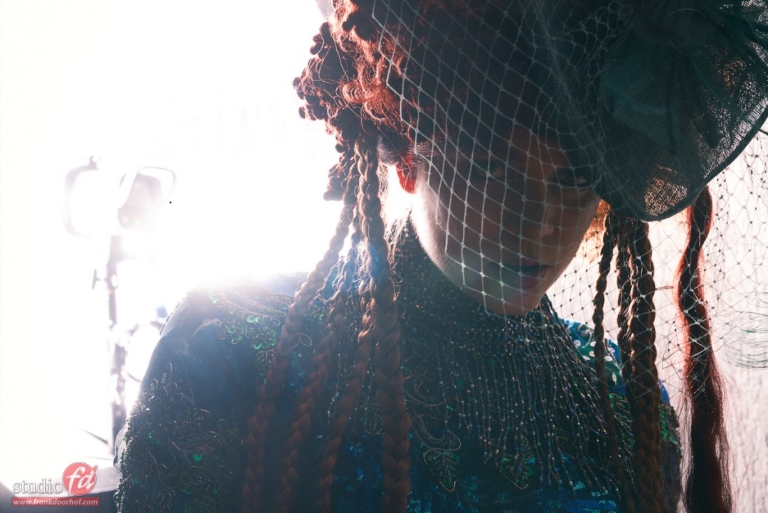
Take a photo like the one above. You can take several shots to work out the right settings, but wouldn't it be much easier to hold the light meter in front of the part of your photo that you want to be lit exactly right? You can then simply read the correct aperture value from the light meter.
Now you know the exact right settings for the diffuse values. You set your camera and voilà... But wait a moment! Do you actually want to use the correct setting? Well, usually you do, but sometimes you really don't!
Sometimes it looks much more natural to keep the image slightly underexposed with strong backlighting (background lighting). This is also how we normally see a similar scene with our own eyes.
So we can use the light meter as a starting point. From there, we can play around with it until we 'find' the right exposure. That works exactly like our own eyes do.
At some point, you will know exactly that a certain number of stops of overexposure or underexposure gives you precisely the atmosphere you want in the image. Next time, you can simply set that same value on your light meter and experiment further from there.
What is the best thing about a light meter? It always gives you the ideal starting point. From there, you can adjust and experiment.
About the author
Frank Doorhof blogt dagelijks in het Engels op zijn website en geeft wekelijks workshops model fotografie in zijn studio in Emmeloord, maar ook op locatie in binnen en buitenland. Van beginners tot gevorderde, iedereen kan bij Frank terecht. Ook voor specifieke 1 op 1 workshops, of maatwerk voor groepen.
You might also like
-
 The Light Meter, How Do You Read It?
by Frank Doorhof
-
 Different Metering Methods Don't Make Better Photos
by Nando Harmsen
-
 Flash photography tip: Consider a flash meter
by Elja Trum
-
 Street photography tip: Create beautiful silhouettes with spot metering
by Michiel Heijmans
-
 Learn How the Exposure Meter Behaves
by Nando Harmsen
10 comments
-
 DarioF wrote on Thursday 12 October 2017 at 17:24 | reply
If you use a light meter that way, you waste a lot of time. You can do the same with the light meter in your camera. Spot metering and exposure compensation, for example.
Translated from Dutch.
And what are the “settings for the diffuse values? A photographic expression of newspeak? -
 Frank doorhof wrote on Thursday 12 October 2017 at 17:40 | reply
You do hopefully realize that this isn't possible for several reasons.
Translated from Dutch.
1. The camera uses reflective metering, so only the value for 18% gray. You can calculate from that, but it certainly isn't faster.
2. The camera cannot possibly meter flash.
In fact, the light meter is the fastest method for getting exposures correct. Provided you know how to use it. In the beginning it will certainly take you longer. But as you gain more experience, you will quickly see that nothing works faster than a meter. -
mm wrote on Friday 13 October 2017 at 11:32 | reply
I don't think using the aperture to control the exposure is a good idea. The aperture largely determines your image. I assume you're mentioning it as an option. I would manipulate the shutter speed instead.
Translated from Dutch. -
Frank doorhof wrote on Friday 13 October 2017 at 11:56 | reply
Shutter speed will not work with flash.
Translated from Dutch.
The shutter speed = available/continuous light
Aperture = the flash.
So outside you use the shutter speed to determine how much available light you want in the scene. But the aperture must not be adjusted. If you were to, for example, stop down the aperture, you would underexpose the model. If you increase it, you would overexpose the model.
In this case it is exactly the other way around.
We shoot with 100% flash, so you will have to determine the atmosphere via the flash. You can do that by adjusting the flash or the aperture. Aperture often works just a bit faster. Of course the depth of field changes. So that is a trade-off.
If you were to take this photo with continuous lighting, then of course you could work with shutter speed. But with flash in the studio, shutter speed has no influence. Until you go above a certain limit. Above, for example, 1/125 (1/160), you get black bars in the image (shutter curtain). Unless you use an HS system, but let's not get into that.
-

 Paul Oosterlaak wrote on Friday 13 October 2017 at 22:44
| reply
I just use my camera's light meter and estimate how it will turn out in terms of light. A separate light meter can't do a 3D measurement, it can only measure at 1 point and nothing else. You still have to take a test shot then.
Translated from Dutch.
In both cases, you take your photo and see how the light falls in different places (or doesn't fall) and then you make adjustments (positions of your lights and settings of your lights/camera).
Using the aperture to adjust the light when you work with flash is a quick solution, but actually not the correct one. Yes, I do it sometimes too if I want to get through it quickly, or am simply too lazy to adjust the flash(es), provided it doesn't involve too much correction. 1 stop more/less isn't really a problem, but if I have to correct by 2 or more stops, then I really won't do that with the aperture, but will simply adjust the flash (or if it's already at its max, set the ISO to 200 or 400). -
Frank doorhof wrote on Friday 13 October 2017 at 23:08 | reply
Don't fall for marketing like 3D measurements. For AF that's a thing. For exposures it isn't. You can actually measure an average with a meter, which a camera can't, again
Translated from Dutch.
You simply can't measure flash with a camera meter, so how you do that is a mystery to me. Then you might as well not measure at all and just shoot. A camera meter is a reflective meter and only works with continuous lighting.
As indicated, if depth of field is important to you, then you adjust the flashes.
The article was purely written to indicate how you can use a meter for non-standard situations.
Of course you can say that you adjust the flash and the other person adjusts the aperture. But in the end everyone does the same thing. Interpreting the set and adjusting. The article is purely about showing how you do that with a meter. -
 Huub Keulers
wrote on Saturday 14 October 2017 at 00:09
| reply
Good article Frank! I've been using an external light meter for years, even in sports photography at the start of a sporting event or match. Of course, you can get a long way with your camera's internal light meter, but I also use the values from the external light meter as a starting point. From there I adjust my camera settings to the circumstances on location. I often photograph in Manual with Auto ISO active. That's often my way of photographing, but everyone has their own method that suits the person.
Translated from Dutch.
One of my first workshops, about 10 years ago together with my then photography colleague/girlfriend at your studio hall, also taught me the convenience of a flash meter, by the way. -
Benno wrote on Saturday 14 October 2017 at 19:19 | reply
I really don't understand why people prefer an external light meter over the camera's meter. What's the advantage of that?
Translated from Dutch. -
Huub Keulers wrote on Sunday 15 October 2017 at 09:27 | reply
Some people probably also find using an external light meter outdoors somewhat cumbersome, but the advantage may be that under somewhat difficult lighting conditions (backlighting, large areas of light or dark) the external light meter gives a more reliable reading than your camera's light meter (which measures reflected light). However, what matters is that you are satisfied with the end result of your photo; whether that was done with an internal or external light meter is basically irrelevant. Every method has its pros and cons.
Translated from Dutch. -
 RiPa-Photo
wrote on Tuesday 9 April 2019 at 23:05
| reply
I don't understand the resistance to a light meter, a light meter works exactly and gives you control. You'll always have to take multiple shots to achieve your personal preference. I completely agree with Frank and wouldn't want to miss it anymore.
Translated from Dutch.
Have your say
Please note: Articles older than a week can only be commented on by signed-in visitors.Would you still like to comment? sign in or create a free account.
Become a better photographer every week
A practical photography tip in your inbox every week.
38,836 photography enthusiasts already receive the tips! More about the weekly mail. Or keep up to date via  Facebook.

Elja Trum
Photofacts; everything to do with photography!
Would you like to take better photos and keep up with what is happening in photography? Photofacts publishes articles that teach you something about photography — from a product announcement to a practical shooting tip or a look at a website. Photofacts covers photography every day and is a hobby project of Elja Trum's that got out of hand. The articles are written by a team of volunteer authors. If you would enjoy writing one or more articles for Photofacts, do get in touch.More about PhotofactsPhotofacts is made possible in part by
