

How high can your camera go in ISO?
Monday 16 December 2024, 20:02 by Nando Harmsen | 6,463 views | 26 commentsThis article was translated from Dutch with the help of AI. Read the original.
The days when a digital camera couldn't handle a high ISO setting are long gone. These days, ISO 3200 is no problem at all. Your camera can probably handle even higher ISO settings. Do you know when you reach the limit of what is acceptable?
In the past, you had to make an effort to find a roll of film rated at ISO 1600, which was called 1600ASA at the time. Once you had taken photos with it, the grain was clearly visible. That could look atmospheric in black and white, but you often lost the fine details in your photo.
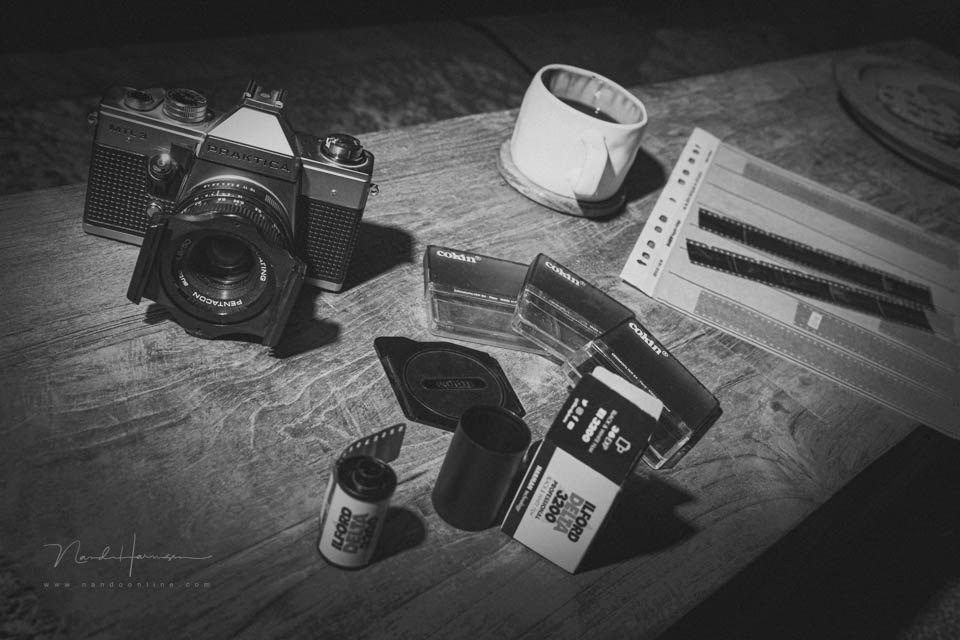
These days, we worry about a little bit of noise. Some people already consider a photo taken at ISO 800 unacceptable. Someone else photographs with the same camera without any problems up to ISO 6400.
That means everyone has a personal opinion about which ISO setting produces an acceptable amount of noise. Do you want to know where your personal limit lies with your camera? Find out.
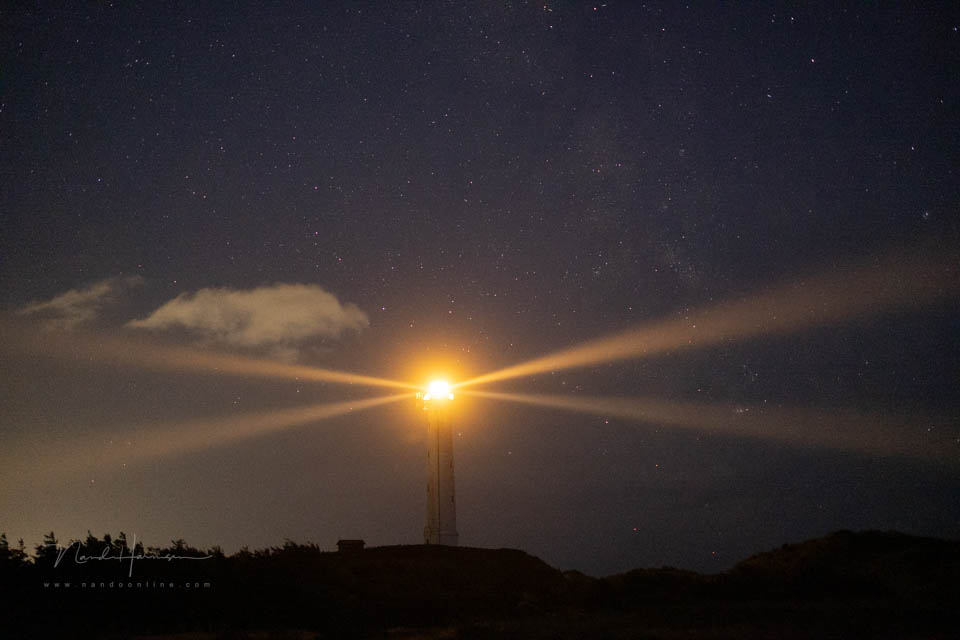
It is very simple. In the evening, create a small still life in your living room or kitchen. Place a lamp next to it, put the camera on a tripod and take a series of photos at different ISO settings. Then see at which setting the noise becomes distracting.
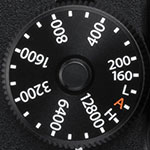
The light must remain constant. The exposure must remain constant too, with only the ISO setting increasing by one stop for each photo. ISO 100-200-400-800-1600-3200-6400-12800-25600-51200... Until you can't go any further. Adjust the shutter speed each time so that the exposure remains the same. That is important.
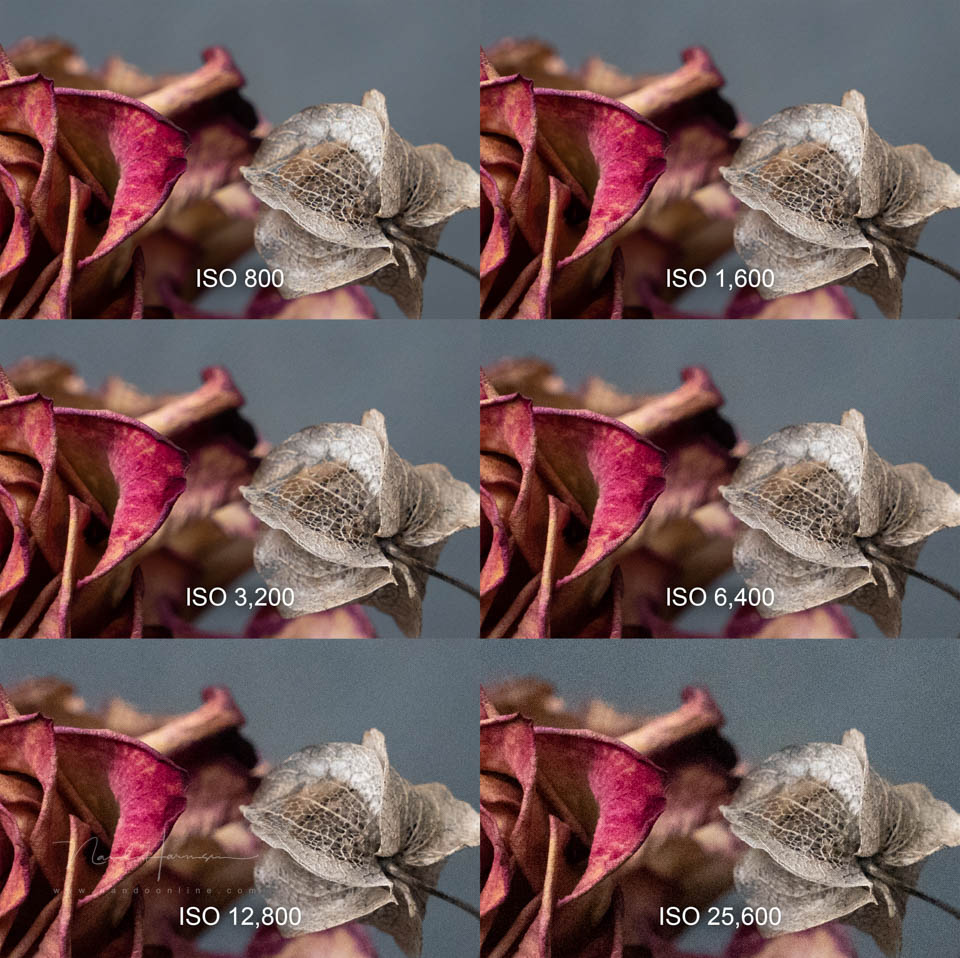
Then check in your photo-editing software at which ISO setting the noise has become distracting. Ideally, view the images at 50% size, which is often better than 100%. But you can use 100% if you prefer. Do not edit the photos, as that is important at this stage.
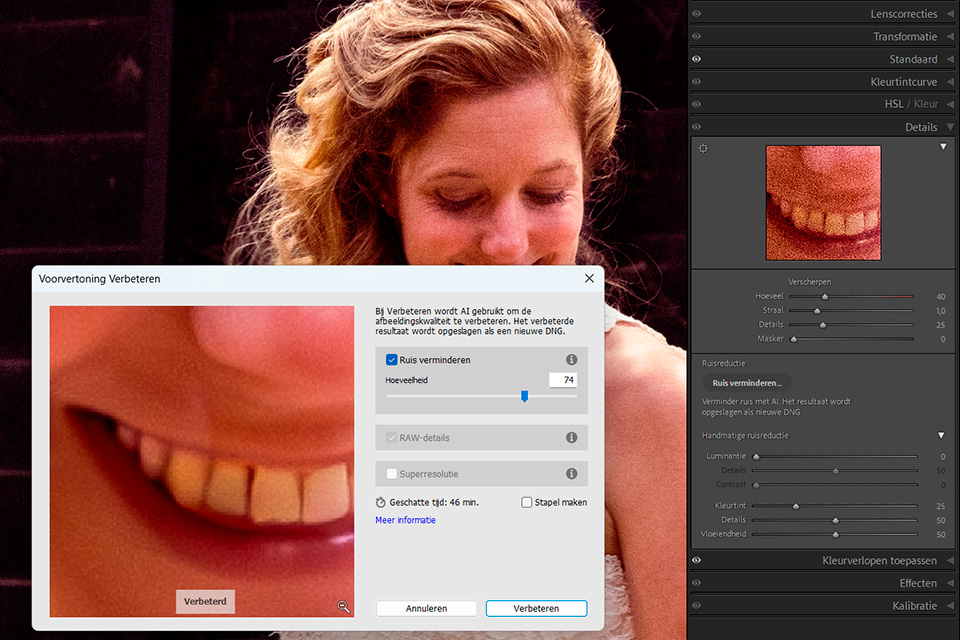
Then edit all the photos with the different ISO settings. Apply exactly the same edits to each one and see what happens to the noise levels. As a third step, you can apply noise reduction. You could use smart AI noise reduction, and see up to which ISO setting you still find the result acceptable.
Bear in mind that brightening dark areas can cause additional noise. That is why it is also interesting to take a series of photos with underexposure: one stop, two stops, three stops and even four or five stops.
Ideally, take one series at ISO 400, one series at ISO 800 and one series at ISO 1600. The result can be different at each ISO setting.
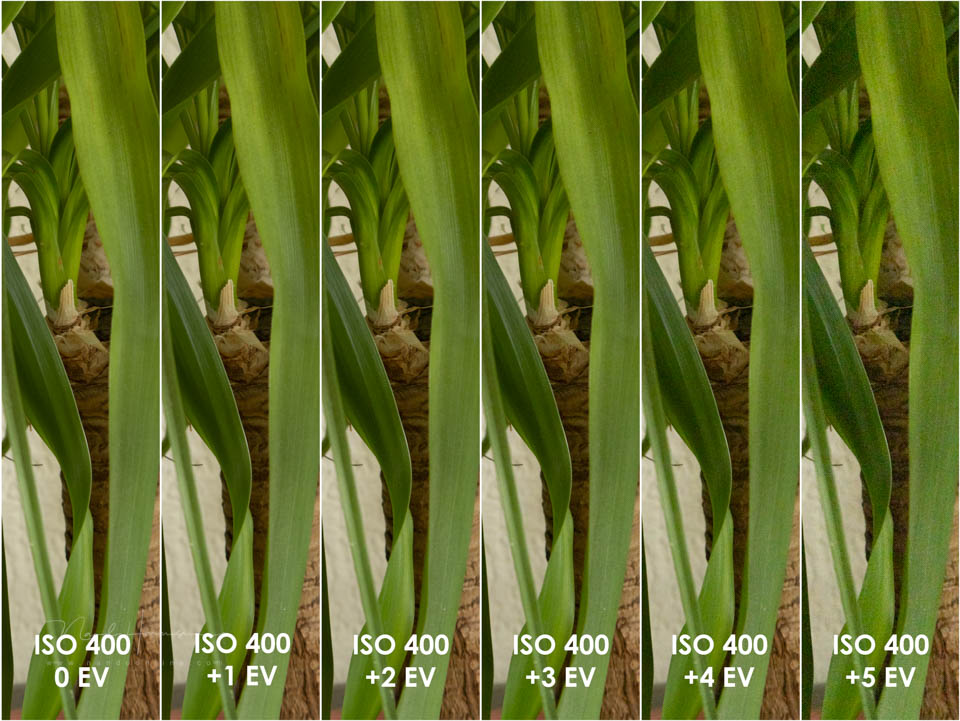
Correct the underexposure and see how much noise you get. You will then know how much you can safely underexpose. Also run these photos through noise reduction software to see what difference it makes.
This way, you learn where the limit lies for your camera and for you personally. Just because someone may find ISO 6400 acceptable with your camera, that does not mean you have to agree. Find out, so you know how high you can set the ISO.
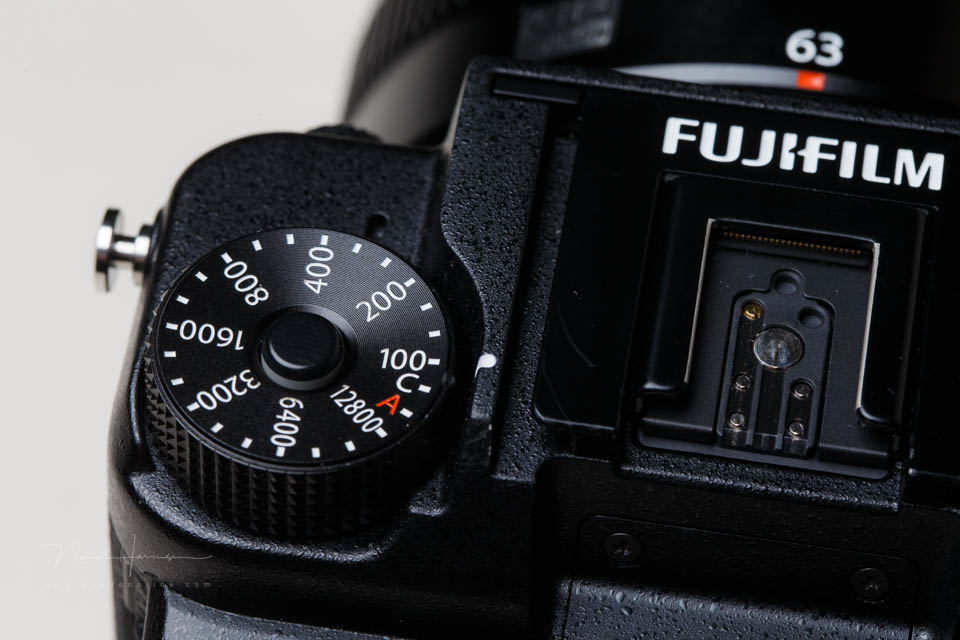
The winter months, with their long evenings, are perfect for this. Have you tested it? Let us know below this post. Which camera do you use, and up to which ISO setting do you consider the result acceptable? I am curious.
About the author
Nando Harmsen has been photographing for more than 40 years. He specialises in wedding photography and landscape photography. Nando also gives talks, workshops, masterclasses and photo trips, and regularly reviews new and interesting equipment.
You might also like
-
 Street photography tip: Limit your ISO value and therefore your noise
by Michiel Heijmans
-
 How can you avoid and reduce noise in your photos?
by Huub Keulers
-
 What can you do with EV (Exposure Value)
by Michelle Peeters
-
 Removing noise? Use it in moderation
by Nando Harmsen
-
 A high ISO value? Or corrected underexposure?
by Nando Harmsen
-
 Why I Usually Don't See Noise as a Problem
by Yljas Roeper
26 comments
-
 Mac wrote on Tuesday 17 December 2024 at 08:26 | reply
I go as high as necessary to be able to take the photo.
Translated from Dutch.
Yes, you have limitations, but you have to learn to deal with them, and to work with them.
But of course there are also a lot of misconceptions about noise.
1: As you describe, look at 50% and not at 100%. Because especially when you view photos on phones, tablets (and even laptops), noise is often not distracting, because the photo is not viewed large enough for you to notice the noise. (just look at your example of that flower, when does the noise actually become distracting at this size. Is there a difference, absolutely, you can see that. But personally I don't find it distracting)
2: If you're going to print, a lot of noise also disappears, especially with inkjet. And if you print on canvas, a lot of noise really disappears, because the photo is already going to be softer anyway.
3: Noise only becomes distracting with dark photos. I've often had it happen that I wasn't paying attention for a moment and the camera was still at a very high ISO when I went from inside to outside. And just took photos. But because there is enough light falling on your sensor, there is hardly any noticeable noise at that high ISO. -
 Evert wrote on Tuesday 17 December 2024 at 11:17 | reply
I photograph a lot in theaters with my Z6II and Z8 without a flash, usually at 3200 ISO or higher depending on the light beams on stage and the distance where I’m allowed to stand. Usually little noise but sometimes too much noise. I sometimes give extra or less light using the plus and minus button. (usually extra) so I can keep the shutter speed high. The result is generally good and sharp in my case.
Translated from Dutch. -
 Martin wrote on Tuesday 17 December 2024 at 11:45 | reply
I use a Nikon Z6ii in M mode, often with auto ISO. The ISO is limited to 12800, previously to 6400. My Nikon guru (Steve Perry) recommends 12800 for this camera. However, I do get nervous when the ISO value reaches 10,000, but I do need this value. This noise is visible in the photo viewer on my laptop. Once in PSE 2020 and/or Topaz, I can often manage to remove the noise.
Translated from Dutch. -

-
 Evert wrote on Tuesday 17 December 2024 at 12:08 | reply
I never set ISO to automatic because I prefer to be able to make adjustments in between. I also don't want to depend on the automatic settings that can be set on the camera, which means there's a good chance the photo will fail or at least not meet my wishes.
Translated from Dutch. -
 Nando
wrote on Tuesday 17 December 2024 at 13:10
| reply
Nando
wrote on Tuesday 17 December 2024 at 13:10
| reply
The idea that you are dependent on your camera when something is set to automatic is not correct. The idea that you would miss a photo opportunity is simply nonsense.
Translated from Dutch.
Even with something set to automatic, you have full control. -
 Van Bloemendael Roderick wrote on Tuesday 17 December 2024 at 12:44 | reply
With this article, the A7 is exposed at higher ISO.
Translated from Dutch.
With my Dx II and III, 6400 and 12800 are no problem at all -
Martin wrote on Tuesday 17 December 2024 at 13:19 | reply
The subjects I photograph move quickly from light to dark and back again. I then don't have time to set the ISO manually and leave that to the camera. I should add that I also don't understand some of the values the camera comes up with. It has happened that I set everything manually myself and then had a well-exposed photo. Under exactly the same lighting conditions and with auto ISO, I got a considerably overexposed photo. I'm still trying to figure out how that can be...
Translated from Dutch. -
Nando
wrote on Tuesday 17 December 2024 at 13:43
| reply
Manually setting the aperture and shutter speed with auto ISO means letting the camera set the ISO value based on the amount of light.
Translated from Dutch.
That is the same as aperture priority and shutter priority: the camera determines the exposure. -
 Donald Willemsen wrote on Tuesday 17 December 2024 at 13:53 | reply
I photograph with a Canon Eos R7 and up to ISO 6400, as far as I'm concerned, it doesn't cause any problems at all in terms of noise, at least in normal lighting conditions.
Translated from Dutch.
It becomes a bit different when you start photographing in somewhat darker conditions, because noise at ISO 6400 quickly becomes noticeable then.
What I find strange is that you can't set it lower than ISO 100, while some cameras in automatic mode can go as low as ISO 50.
I remember that in the analogue era, a slide film was rated at ASA/ISO 50 or 18DIN. I would like current cameras to also be able to be set to ISO 50, which is possible with some professional models. There are situations imaginable where you could make very good use of ISO 50. -
Evert wrote on Tuesday 17 December 2024 at 14:04 | reply
I have often tried this in dark theaters but was very dissatisfied with the often poor results due to too much noise that I wanted to remove, which meant the quality was no longer rendered well. I would appreciate your advice because I am often standing in a dark, poorly lit venue at too great a distance, with many changes in lighting on stage and movement.
Translated from Dutch. -
Nando
wrote on Tuesday 17 December 2024 at 15:22
| reply
When it’s dark, and the shutter speed becomes too slow to be usable, the aperture needs to be opened further.
Translated from Dutch.
If you’re at the widest aperture, there’s only one thing left to do: raise the ISO.
I photographed concerts for decades. Aperture priority with a high fixed ISO value worked perfectly for me. I used exposure compensation continuously.
You can also choose shutter priority, and then auto ISO. In almost all cases, the camera chooses the widest aperture and raises the ISO if necessary. Here too, continuously with exposure compensation. -
 Francis Verhaeghe wrote on Tuesday 17 December 2024 at 15:18 | reply
@Nando, no: in a theater, for example, you do want control over your shutter speed (you want to freeze the dancers/actors in motion, for example) and the light changes suddenly and unpredictably => you lock the shutter speed, the aperture as well (depending on depth of field) and let the camera adjust the ISO to get a good exposure.
Translated from Dutch. -
Nando
wrote on Tuesday 17 December 2024 at 15:25
| reply
If the light suddenly and unpredictably changes, the camera will also suddenly and unpredictably adjust the ISO.
Translated from Dutch.
You can only deal with sudden and unpredictable lighting situations with exposure compensation in Av or Tv mode, or with the shutter speed/aperture in manual mode.
For many shows it is good to prepare, so that you know when and how the light is going to change. You won't capture everything, but you will capture a lot, I know from experience. -
Van Bloemendael Roderick wrote on Tuesday 17 December 2024 at 16:01 | reply
setting aperture and shutter speed and ISO to auto is widely used in street photography
Translated from Dutch. -
Evert wrote on Tuesday 17 December 2024 at 16:31 | reply
I always prepare well in the theater every two months, but in 1 theater it is always very unpredictable and yet on average I take good photos but also very many photos.
Translated from Dutch.
The light is and remains a challenge and also the movements that you have to capture in it, but very high iso is nice but for post-processing sometimes terribly time-consuming work with loss of sharpness etc. Furthermore, I always react very quickly but I once ended up at a gigantically high iso and I don't like doing that again. in my case I have everything on manual and therefore in my own hands, but that can sometimes be disadvantageous when there are sudden changes that you cannot keep up with in terms of speed. In any case, my last photos from a dinner show turned out well. I had taken 1641 photos and fortunately kept around 700 good photos from them, but it has been different sometimes. Maybe I have gained a bit more experience after all? -
Nando
wrote on Tuesday 17 December 2024 at 16:48
| reply
I assume you have set the maximum ISO value for your auto-ISO setting correctly. That prevents that ridiculously high, and unusable ISO value.
Translated from Dutch.
The most important thing in the whole story is that you need to know how high your ISO is usable. You have to find that out and set the limit in your camera, both for regular and auto-ISO.
That way you stay in control and prevent problems.
How you subsequently use the camera, in which mode, is a personal preference. There is more than one way to achieve a good result. What works for one person does not necessarily work for another. -
Donald Willemsen wrote on Tuesday 17 December 2024 at 17:06 | reply
Nando, doesn't it simply come down to many of us being too afraid of noise?
Translated from Dutch.
I hear many people complain bitterly about their new camera, as if it produced too much noise. I then think it's mainly down to the photographer.
Moreover, noise reduction/removal in editing software has become so good nowadays that noise isn't really a problem anymore. -
-
Donald Willemsen wrote on Tuesday 17 December 2024 at 17:30 | reply
Nando, so far my upper limit is set to ISO 6400 and with that I very rarely need to correct noise in post-processing. But I will take you up on your suggestion to investigate whether it is possible to go even higher without having to intervene afterwards.
Translated from Dutch. -
 Jef Langenaeken wrote on Tuesday 17 December 2024 at 17:50 | reply
With my Sony A1 I can also push the ISO quite high!
Translated from Dutch. -
 Jan Weide wrote on Tuesday 17 December 2024 at 20:16 | reply
Underexpose by 2 stops. 1600 asa. Push processing in microdolX. Beautiful light, detailed negatives. No DSRL can match it.
Translated from Dutch. -
-
Jef Langenaeken wrote on Tuesday 17 December 2024 at 23:56 | reply
A professional photographer with long experience claimed that at elevated ISO (between roughly 100 and 2000 ISO), every camera has a specific ISO value at which noise is present to a minimum.
Translated from Dutch.
There should be a list of all camera models regarding this, but I haven't found it so far. Does anyone have experience with this? -
Nando
wrote on Wednesday 18 December 2024 at 09:18
| reply
That's nice, such little lists. But it has nothing to do with photography anymore.
Translated from Dutch.
My advice I wrote in the article: find out where your limit is and set it on your camera.
Then go take photos and don't worry about ISO or noise anymore; use what is needed. -
 Bart Rijvers wrote on Wednesday 18 December 2024 at 19:09 | reply
People are always looking for a clear-cut rule for 'acceptable noise' but that is actually highly situation-dependent. If your shutter speed becomes too slow so that your noise does become acceptable, you could get motion blur. So use the right shutter speed, the shallowest depth of field that is acceptable and then hopefully the ISO will be acceptable. I think it is a good idea to experiment with this so that later, in a similar situation, you can estimate beforehand how much noise you are going to get. In such situations I personally like to shoot in Manual mode with automatic ISO.
Translated from Dutch.
Many cameras have multiple native ISOs and it is worth investigating which of the other ISOs produce the least noise (see also the photonstophotos website). If you still have more noise than you would like and noise-reduction software is not entirely satisfactory, you could consider converting the photo to black and white.
Have your say
Please note: Articles older than a week can only be commented on by signed-in visitors.Would you still like to comment? sign in or create a free account.
Become a better photographer every week
A practical photography tip in your inbox every week.
39,009 photography enthusiasts already receive the tips! More about the weekly mail. Or keep up to date via  Facebook.

Elja Trum
Photofacts; everything to do with photography!
Would you like to take better photos and keep up with what is happening in photography? Photofacts publishes articles that teach you something about photography — from a product announcement to a practical shooting tip or a look at a website. Photofacts covers photography every day and is a hobby project of Elja Trum's that got out of hand. The articles are written by a team of volunteer authors. If you would enjoy writing one or more articles for Photofacts, do get in touch.More about PhotofactsPhotofacts is made possible in part by
