

How do you get started with infrared photography?
Monday 25 December 2023, 13:26 by Nando Harmsen | 6,151 views | 12 commentsThis article was translated from Dutch with the help of AI. Read the original.
Are you interested in infrared photography with your digital camera? What does it involve? Will you start with small steps or dive straight into this type of photography? I’ll tell you how I would approach it.
This article was written in response to my question about what the readers of this blog would like to read. This subject, infrared photography, was suggested by Donald Willemsen, for which I thank him.
I should mention beforehand that I have absolutely no experience with this form of photography myself. What I describe in this article is the result of researching this form of photography myself.
What is infrared?
It is important to understand what infrared is, but in a very simplified way. Infrared, abbreviated to IR, is light that lies beyond red in the spectrum. We cannot see this with the naked eye, so we are normally not aware of it.
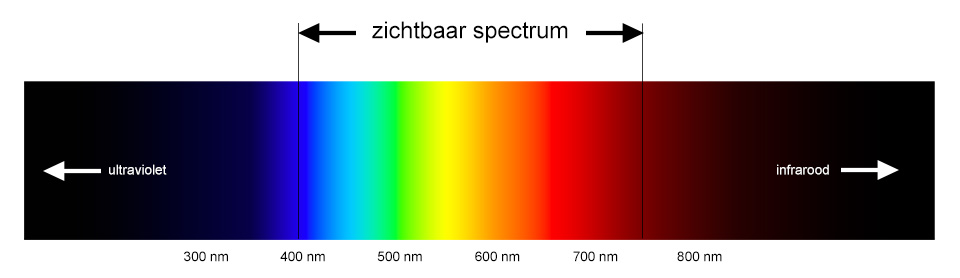
A camera sensor is sensitive to infrared, however. So sensitive, in fact, that a special infrared filter is needed to block this light. This is the only way to create a realistic-looking photo whose colours match what we see with the naked eye.
This filter therefore makes the camera insensitive to infrared. It still lets a small amount through, but this is very little.
Buying an IR filter
The simplest and cheapest way to take an infrared photo is to use a filter that only lets infrared through. One example is a 720 nm high-pass filter. Apart from a small amount of red, all other colours of light are blocked.
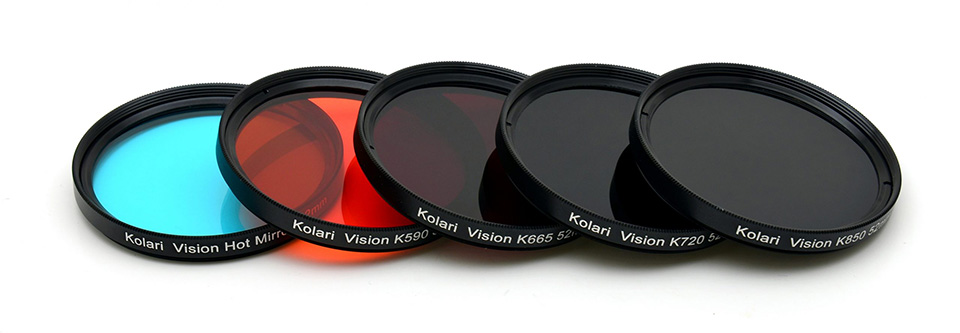
However, because there is an IR filter in front of the camera sensor that blocks most of the infrared, very little light reaches the sensor. This type of filter therefore requires very long exposure times. You can hardly take handheld photos with it.
An IR filter is very suitable for getting started with infrared photography. The investment is relatively small, and you can discover whether this type of photography is really for you.
Modifying the camera for IR photography
As you have seen, using an infrared filter is rather contradictory. On the one hand, you only let infrared light pass through your lens, while on the other hand you block it because your camera blocks as much infrared as possible.
You can solve this by modifying your camera. In that case, you need to remove the infrared filter in front of your sensor, or have it removed. This means that you can no longer use the camera as a normal camera. So buy a separate, second-hand camera for this purpose.
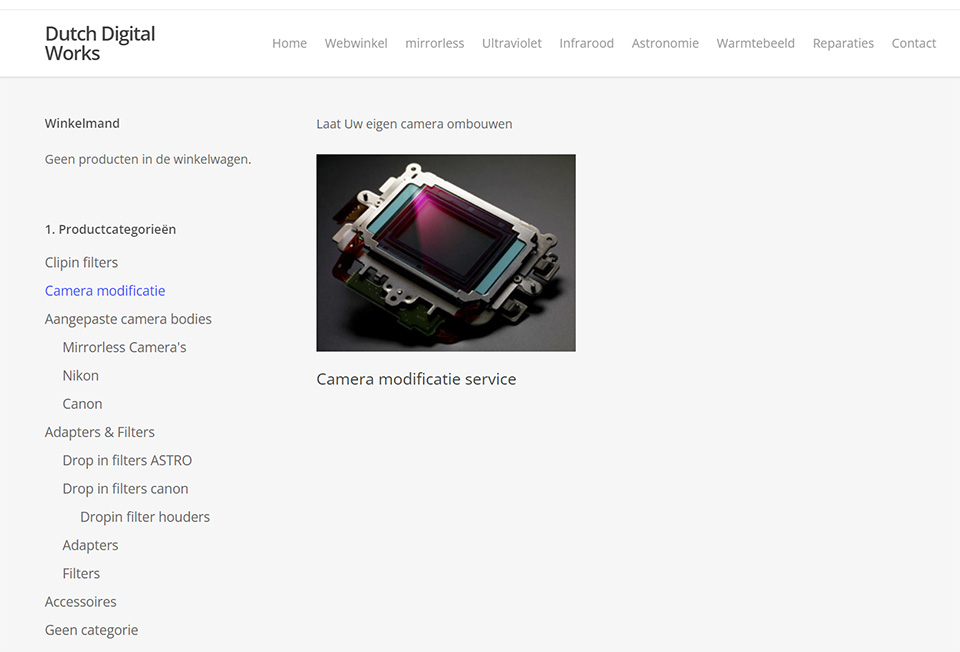
Once the filter that blocks infrared has been removed, you can use the camera normally again. You are no longer tied to long shutter speeds. You can still use infrared filters to let a particular part of the spectrum through.
Different types of IR photography with a converted camera
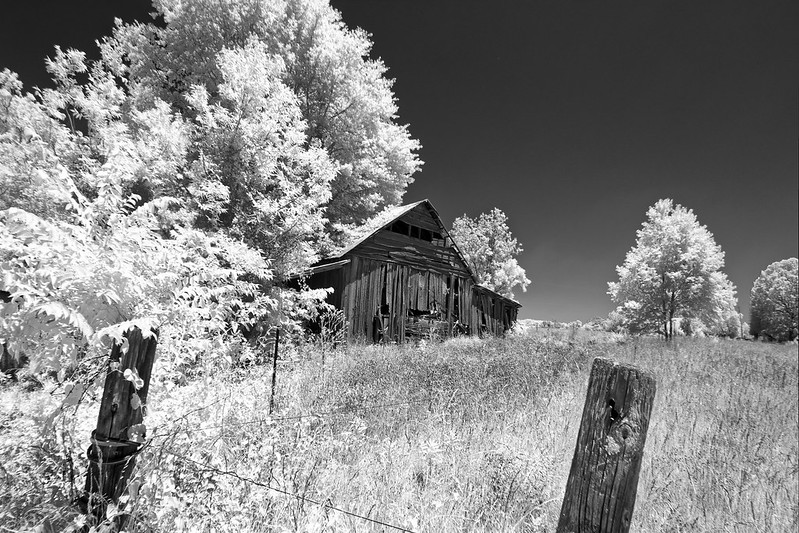
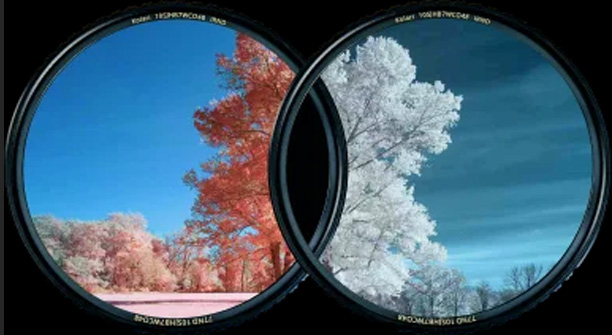
For example, using an 820nm filter gives you only deep-infrared light. This always produces a black-and-white photo, as no colour information is available at all. This form of infrared photography would appeal to me the most.
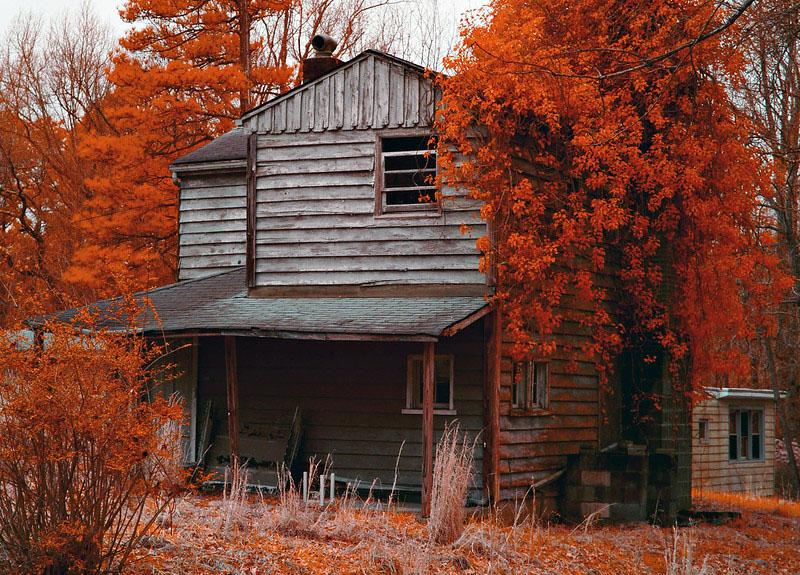
A filter that lets through light between 470nm and 665nm, from blue to normal red, produces a colour photo with a shifted colour spectrum. What you photograph is often shown in unnatural colours. It is something you have to like.
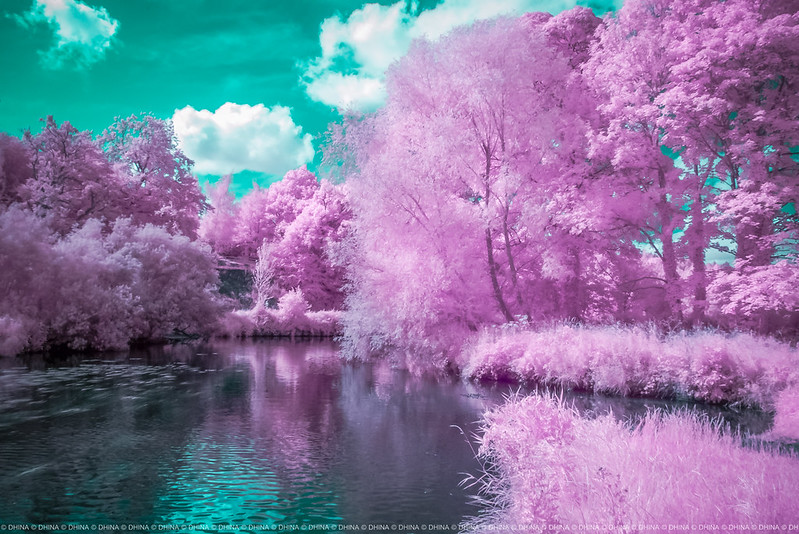
Without any filter, the camera will record both infrared and normal light. Here too, the colours will look unreal because of the presence of infrared light.
The lens and focusing
There is something else you need to take into account, regardless of whether you have a converted camera or are only using an infrared filter.
Because most lenses were not designed and built for this type of light, you can no longer use normal focusing. At least, the focus is no longer based on the distance scale that applies to normal light. I cannot say whether autofocus works.
Another thing I read was the adverse effect modern coatings can have on the lenses of lenses. Some coatings become visible in infrared light. This is something to bear in mind. It may mean that you also need a separate, older lens.
My conclusion and advice
Infrared photography is not something you just start doing. If you are interested, search online for photos taken in infrared. Try to discover whether it is something you really like.
If it looks like something for you, start with an infrared filter. It brings limitations such as long shutter speeds, but it is a relatively inexpensive way to start. The filters are not cheap, of course, but they are always cheaper than the next, more permanent step.
Buy a second-hand camera if this type of photography is really for you, and have it converted into an infrared camera. Do the necessary research into which camera is best suited, and where you can have this done.
Once you have an infrared-converted camera, you can really enter the world of infrared photography. For me, it is not interesting enough at the moment to invest in it. But perhaps in the future. Who knows.
Have you ever looked into infrared photography? Or are you already actively involved with it? You might then find it interesting to write about it. Let us know in a comment below this post or send us an email.
About the author
Nando Harmsen has been photographing for more than 40 years. He specialises in wedding photography and landscape photography. Nando also gives talks, workshops, masterclasses and photo trips, and regularly reviews new and interesting equipment.
You might also like
-
 DIY: Taking infrared photos using an old floppy disk
by Elja Trum
-
 Review: Pro Line photobook by Saal Digital
by Erik van Rosmalen
-
 Digital film roll for your analogue camera
by Elja Trum
-
 The search for a digital version of Agfa Record Rapid photographic paper
by Anno Huidekoper
12 comments
-
 Donald Willemsen wrote on Tuesday 26 December 2023 at 11:26 | reply
Nando, thank you very much for the effort you have put in and for writing this article. I am interested in infrared photography in black and white photography. In the analogue era I did that with an infrared filter and black and white film. I find the effect with b&w very beautiful.
Translated from Dutch.
I had not realized, however, that infrared photography is not easy to do digitally. My technical knowledge does not extend that far. That is why I am very pleased with your article. It does lead me to wonder whether it is possible to simulate it digitally in post-processing without it looking too artificial.
Nando, once again many thanks and I wish you a healthy and photographic top year 2024. -

 Nando
wrote on Saturday 30 December 2023 at 11:00
| reply
Nando
wrote on Saturday 30 December 2023 at 11:00
| reply
Since you capture virtually no IR light, you can't imitate this in post-processing. As you say, it often looks contrived.
Translated from Dutch.
That doesn't mean you can't edit something in the direction of an IR image. However, it will never be IR photography. -
 Henk v Hoek wrote on Tuesday 26 December 2023 at 12:27 | reply
I think IR is incredibly beautiful ! Seeing IR photos restarted my photography hobby completely all over again years ago ! I bought an IR filter (720nm) and was sold! Then I saw a converted d70 with a 765nm filter for sale on mp. Ideal ! Let's just say click and go. They are not higher-resolution photos and small files, but they are a lot of fun to photograph with ! The best time is when the sun is out, you have a place with lots of greenery and also water with clouds. Take a photo of green grass and set that as the white balance! You edit the photos using colourswap in PS and otherwise play around with the sliders. With this filter you unfortunately don't always get the white leaves that I like so much , but oh well , some colour is also beautiful.
Translated from Dutch.
You can test your camera by taking a picture of your IR TV remote control, then you can see whether your camera sees IR. Otherwise, take a look at the Lifepixel site , they convert them but also sell converted cameras.
Regards, Henk -
-
 Wil wrote on Tuesday 26 December 2023 at 12:54 | reply
Hi, I once wrote for the Oegstgeester Courant about Lisa Gerson Lohman who exhibited infrared photos in Warmond. See: https://www.lisegl.nl/aboutmyself.php. Perhaps she...?
Translated from Dutch. -
 PixelDude wrote on Tuesday 26 December 2023 at 13:03 | reply
@ Nando,
Translated from Dutch.
I have been practicing IR photography for a little over 2 years and love it.
To find out whether you like it, you can indeed best put an IR filter on your camera and start working with a tripod. Exposure times do become extremely long this way, sometimes minutes. I immediately had my oldest Olympus OM-D E-M1 successfully converted and have not regretted it for a moment. By placing a CUT UV IR filter on it, this camera even works normally again. After all, the filters that were removed from in front of the sensor are compensated for by the filter at the front of the lens.
I have a variable IR filter from 530 to 750 nm on my lens, with which you can experiment to your heart's content. Probably not the best filter choice but for a reasonable price you can explore all IR directions. Be aware that you should be able to work with some editing programs to achieve what you want. The blue-red conversion is usually necessary, otherwise you will never get what you find on the internet as IR photos. The white balance must be set to green to get the best results. I find that grass is the best choice for this.
Full sun at noon in summer, the best time to practice IR, contrary to classical photography.
In my opinion … worth it. -
-
-
Donald Willemsen
wrote on Tuesday 26 December 2023 at 14:06
| reply
@PixelDude, I didn't expect anything else. I know IR photography from the analog era and was able to achieve some surprising results with it back then. Now with the digital camera it turns out to be a bit more complicated and you can't just get started by simply placing an IR filter on the lens. I also understand from your response that IR simulation through post-processing has little to no point, for the time being at least.
Translated from Dutch. -
-
 jeepee wrote on Wednesday 27 December 2023 at 21:30
| reply
jeepee wrote on Wednesday 27 December 2023 at 21:30
| reply
Last year I scored an infrared filter from the clearance bin and experimented with it a bit on my Nikon Z7. What I did notice is that with some lenses and aperture openings, a hot spot effect occurs. But it is fun to experiment.
Translated from Dutch. -
 guest wrote on Saturday 30 December 2023 at 19:20 | reply
You're welcome !
Translated from Dutch.
Have your say
Please note: Articles older than a week can only be commented on by signed-in visitors.Would you still like to comment? sign in or create a free account.
Become a better photographer every week
A practical photography tip in your inbox every week.
39,024 photography enthusiasts already receive the tips! More about the weekly mail. Or keep up to date via  Facebook.

Elja Trum
Photofacts; everything to do with photography!
Would you like to take better photos and keep up with what is happening in photography? Photofacts publishes articles that teach you something about photography — from a product announcement to a practical shooting tip or a look at a website. Photofacts covers photography every day and is a hobby project of Elja Trum's that got out of hand. The articles are written by a team of volunteer authors. If you would enjoy writing one or more articles for Photofacts, do get in touch.More about PhotofactsPhotofacts is made possible in part by
