

Photographing noctilucent clouds
Wednesday 26 June 2019, 11:22 by Nando Harmsen | 6,416 views | 5 commentsThis article was translated from Dutch with the help of AI. Read the original.
For several months each year, around midsummer, noctilucent clouds may become visible. They are relatively rare, although they seem to have been seen more often in recent years.
The conditions have once again been suitable for the formation of these unusual clouds in recent weeks. Good reason not to go to bed just yet.
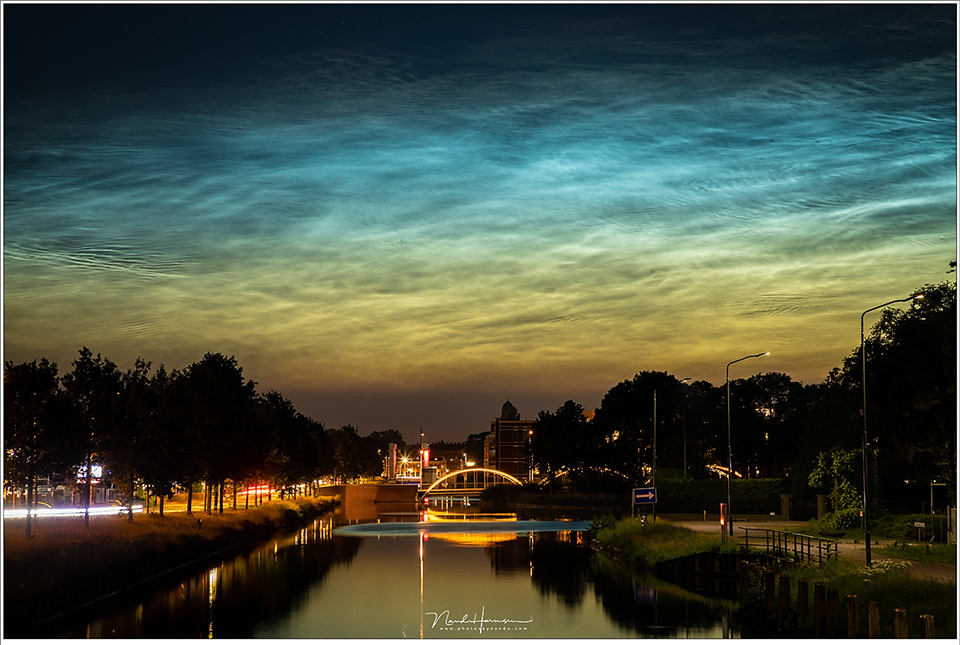
Noctilucent clouds, abbreviated to NLC, are the highest clouds in our atmosphere. They form just below the mesopause, the part of the atmosphere that begins at an altitude of 80-85 kilometres and where temperatures fall to -160°C between mid-May and mid-August.
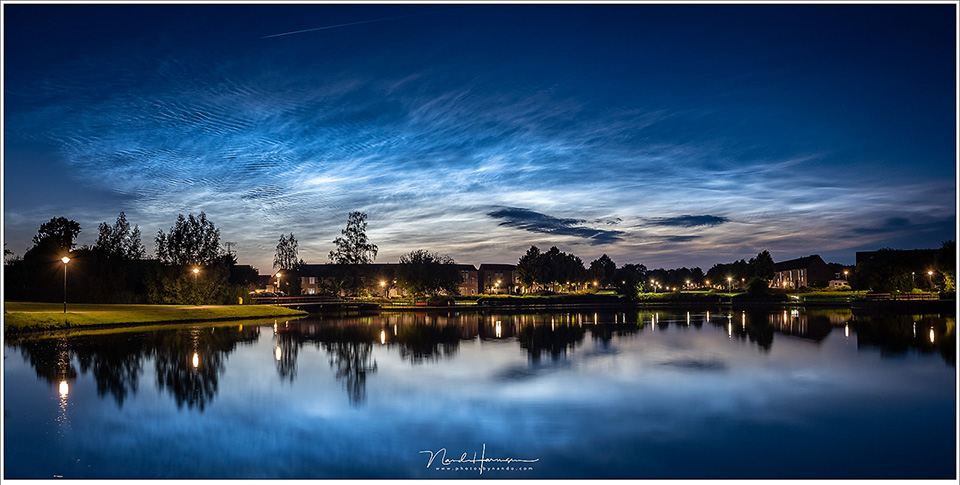
Tiny ice crystals form on dust particles that probably come from meteorites and volcanic activity. These wispy clouds are invisible, except when they are illuminated in the darkening evening twilight by the sun, which has already disappeared far below the horizon.
When there are noctilucent clouds, they can only be seen from an hour after sunset, in a west-north-westerly direction. They hang fairly low above the horizon. After midnight, they can be seen towards the north-east.
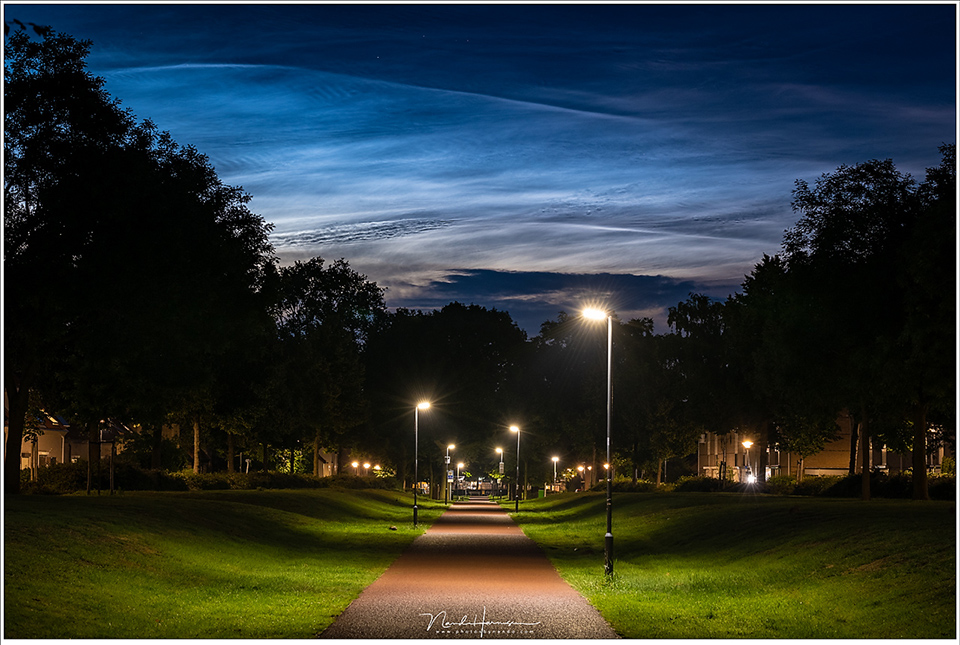
Photographing noctilucent clouds is fairly simple. You should preferably use a tripod, as it is already dark. Also choose a nice location in advance. Finding a location when they appear is possible, but not easy.
I recommend the following settings:
• Focal length between 24mm and 70mm for wide views,
• Focal length between 70mm and 200mm for more detail,
• White balance around 4000-5000K,
• Shoot in RAW,
• Image stabilisation off,
• Aperture between f/4 and f/8,
• Shutter speed between 2 and 10 seconds,
• Adjust exposure with the ISO, which is often between 400 and 1600,
• Use the self-timer or a remote,
• Keep an eye on your histogram for the correct exposure,
• If necessary, take an extra exposure for the foreground
Try to use a reasonably short shutter speed and adjust the exposure with your ISO setting. The clouds move fairly quickly, causing patterns and ripples in the clouds to change. A shutter speed that is too long will make those details fade.
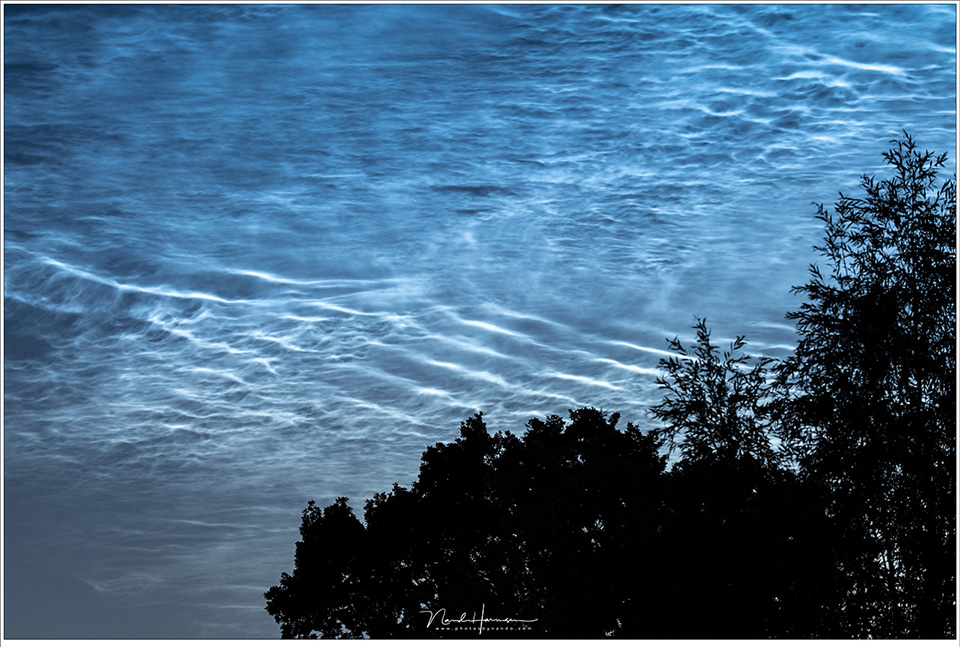
Predicting noctilucent clouds is very difficult. Often, only a probability can be given, although special radar measurements of the atmosphere can provide an indication. Fortunately, there is the internet, and social media often gives a good indication of whether there is anything to see.
Do you want to photograph noctilucent clouds? Make sure you know one or more suitable locations, and from half an hour after sunset, regularly look at the sky in the direction of the sunset. You only know for sure from an hour after the sun has gone down.
And of course, the weather must be clear. If there is a thick layer of cloud, you can be sure they will not be visible, and you do not need to take them into account.
About the author
Nando Harmsen has been photographing for more than 40 years. He specialises in wedding photography and landscape photography. Nando also gives talks, workshops, masterclasses and photo trips, and regularly reviews new and interesting equipment.
You might also like
-
 Photographing noctilucent clouds
by Nando Harmsen
-
 Photographing noctilucent clouds
by Nando Harmsen
-
 The season for noctilucent clouds is here again
by Nando Harmsen
-
 Night photography on Schiermonnikoog, part 1
by Erik Nevels
-
 Night photography on Schiermonnikoog (part 2)
by Erik Nevels
-
 Make clouds soft and fluffy, not hard and harsh
by Nando Harmsen
5 comments
-
 Stefan Verkerk wrote on Wednesday 26 June 2019 at 14:38 | reply
Noctilucent clouds are one of the most mysterious weather phenomena that we can observe in our little country. The unpredictability combined with the chance of cloud cover makes it exciting every year whether you will see them. This year there have been a number of extreme 'displays', where the clouds could be seen all the way over the 'zenith' (straight above you and then towards the back). That is rarely seen even by the most experienced amateur and professional weather enthusiasts.
Translated from Dutch.
Precisely because of the small chance that the conditions will be perfect, it is an interesting weather phenomenon to photograph. You only have a limited window of time in which you can capture it and you also have to be lucky enough to be in a position to photograph.
Last week I captured it myself in the countryside. I personally prefer the countryside to the urban surroundings because I find some elements (especially residual light) distracting: it draws attention away from the beautiful clouds with sometimes amazing structures.
My photo series from last week can be found here. -
 Nando Harmsen wrote on Friday 28 June 2019 at 18:17 | reply
@Stefan Verkerk
Translated from Dutch.
Thank you for your response. It was indeed very impressive the last few times. However, the photos I posted were not of the most intense sighting I have witnessed.
Your photos look good too. You mention a dark place for photographing the clouds, so as not to be distracted by a foreground. I do miss that foreground in a large part of your photos. The clouds alone don't tell you much, offer no support, no reference. It is precisely a foreground that gives that little bit extra to what is a special phenomenon.
Take a look at my website for more images of these beautiful clouds. -
 René Peterse wrote on Tuesday 2 July 2019 at 20:28 | reply
I too enjoyed the noctilucent clouds. Looking out from our rooftop terrace over Delft city centre to the right, and towards Rijswijk and the coast in front of us, we saw a beautiful spectacle. I was lazy though, didn't feel like using a tripod and shot handheld. With stabilisation, ISO 1600 to 2000, f2.8 and the lens at wide angle, in my case 16 mm and varying from 0.30 to 0.15 sec. Here and there with support from the railing. Good results and no blurring from too long an exposure (which is a risk, I understand from your piece). In post-processing I did remove some noise, but not too much, to preserve that fantastic rippling and waves.
Translated from Dutch. -

 Paulus
wrote on Tuesday 2 July 2024 at 16:16
| reply
Hello Nando,
Translated from Dutch.
I read the article about Noctilucent clouds in the latest newsletter.
When I was standing on the balcony around 11:30 p.m. on Saturday evening, I immediately recognized this phenomenon because of that.
Then I quickly walked to an open spot where I could see the phenomenon well. It was in Weert in the direction of North-North-East. It was probably already visible a little earlier. Around 12:30 a.m. it had almost completely disappeared. I also took a beautiful photo of it. I don't see any possibility here for an attachment, otherwise I would have attached the photo.
Kind regards, Paul Kahlert -

Have your say
Please note: Articles older than a week can only be commented on by signed-in visitors.Would you still like to comment? sign in or create a free account.
Become a better photographer every week
A practical photography tip in your inbox every week.
38,982 photography enthusiasts already receive the tips! More about the weekly mail. Or keep up to date via  Facebook.

Elja Trum
Photofacts; everything to do with photography!
Would you like to take better photos and keep up with what is happening in photography? Photofacts publishes articles that teach you something about photography — from a product announcement to a practical shooting tip or a look at a website. Photofacts covers photography every day and is a hobby project of Elja Trum's that got out of hand. The articles are written by a team of volunteer authors. If you would enjoy writing one or more articles for Photofacts, do get in touch.More about PhotofactsPhotofacts is made possible in part by
