

5 autofocus techniques explained
Wednesday 12 December 2018, 14:51 by Michelle Peeters | 24,214 views | 17 commentsThis article was translated from Dutch with the help of AI. Read the original.
What exactly is sharpness? To people, a photo is sharp when the image in the photo is just as clear and not even a fraction blurrier than the real image you see.
A camera works differently. A camera uses contrast detection, phase detection and sometimes a combination of the two to determine whether your subject is in focus.
1. Contrast detection
With contrast detection, the digital image is analysed. In a sharp image, you can see clear transitions, for example along the edges of an object. With an out-of-focus image, the edges are blurred.
To focus, the camera has to look for the highest contrast. It makes the lens focus progressively closer or further away.
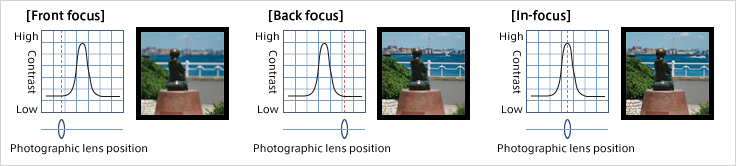
It keeps doing this until the camera notices that it has passed the sharpest point. The lens is then moved in the other direction to return to the maximum. This process is repeated several times with increasingly smaller steps, to focus as accurately as possible. This takes much more time than phase detection.
As a mirrorless camera does not have a mirror box, it has no focusing sensors at the bottom of the body. Contrast detection was therefore often used.
In recent mirrorless cameras, the sluggishness of contrast detection has been solved with phase detection via autofocus sensors on the image sensor. This allows them to focus extremely quickly after all. These focusing sensors can be grouped together in the centre of the image or spread nicely across the frame. The latter naturally offers the most flexibility.
2. Phase detection
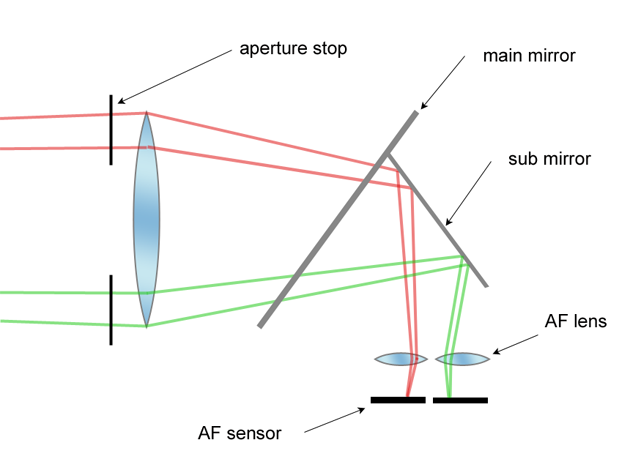
Do you use a DSLR? The image sensor is not used to capture light. Instead, special optical focusing sensors, AF sensors, which are slightly separated from each other, are used to focus automatically.
That is why a DSLR is so incredibly fast. When the contrast on both sensors is the same, the image is at its sharpest. This is a different technique, comparable to how our two eyes focus.
These sensors are located at the bottom of the mirror box. The light passing through the lens is reflected upwards inside the body by a mirror, entering the optical viewfinder.
That is why you can still see an image even when the camera is switched off. The mirror does not send all the light to the viewfinder, though. A fraction of it passes through and reaches the focusing sensors at the bottom of the camera via a second, smaller mirror, allowing them to do their work.
When you look through the viewfinder, you see focusing points. These are lights or symbols on an LCD panel. This tells you roughly where the focusing sensors are located in the image.
Phase detection is incredibly fast and accurate. A mirrorless camera also uses it, although it does not have a mirror. Instead, it has phase detection pixels on the sensor, which is divided into two sections and can determine focus in this way.
The biggest disadvantage of phase detection, however, is that the AF module becomes 'blind' for a moment as soon as the camera's main mirror flips up. No more light falls on the AF module. When you use a DSLR in Live View mode, either for taking photos or filming, the AF module therefore does not work.
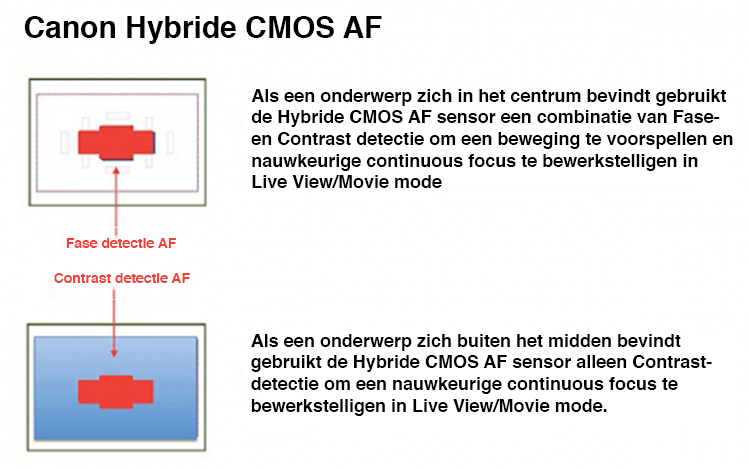
DSLRs therefore switch to contrast detection in Live View mode. Canon DSLRs now have Hybrid CMOS AF sensors, which allow a combination of contrast and phase detection in Live View mode.
3. Hybrid autofocus
Phase detection, using focusing sensors on the sensor, is used to quickly find the approximate correct point. Contrast detection is then applied for fine-tuning.
4. Dual Pixel CMOS AF
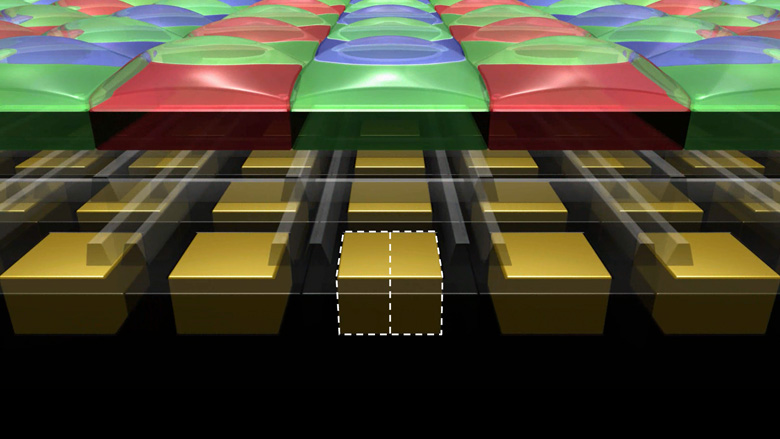
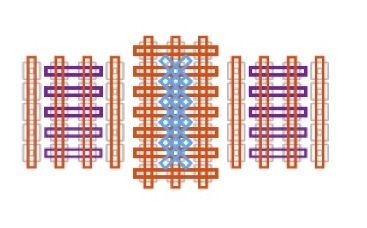
This is a unique technology designed by Canon. It is a sensor-based phase detection AF technology. Each pixel is divided into two photodiodes that measure the angle at which the light enters.
This technology was designed to provide smooth, high-quality focusing in movies and achieve fast autofocus when taking photos in Live View mode.
The subject remains in focus as it moves towards the camera, while the background remains soft and out of focus. The ability to make a subject stand out using a limited depth of field also means that you need to keep control of the focus.
Especially when the subject is moving or the focusing point changes. Dual Pixel CMOS AF was developed to make it easier to focus more accurately while filming.
Thanks to this groundbreaking development, it is easier than ever to capture a moving subject while keeping it sharp in the frame.
5. Cross-type AF sensors
More and more DSLRs have extra-sensitive cross-type AF sensors for even more accurate and faster focusing. Sometimes all the AF sensors are of this type, which is an unprecedented luxury.
Most cameras only have a few, roughly in the centre. They are usually extra sensitive from f/2.8 onwards, almost twice as sensitive. Combined with a fast lens, this allows you to get the most out of your autofocus.
Want to learn more about the basics of photography?
At Photofacts Academy, our online learning environment for photographers, we have a complete photography course. You can follow this course for two weeks with a free trial membership.
About the author
Michelle Peeters is fotografe en oprichter van DeuxBleus Fotografie. Michelle herkent het bijzondere in het gewone en het gewone in het bijzondere. Ze heeft zich nooit willen specialiseren en is daardoor van alle markten thuis.
You might also like
-
 Setting tip: eye detection combined with back button focus
by Thijs Schouten
-
 Review: Special Photography Techniques, Panoramas, HDR, Virtual Tours and More
by Michelle Peeters
-
 Fujifilm X-T100 with large EVF and phase-detection AF
by Michelle Peeters
-
 The downside of a camera with lots of pixels
by Nando Harmsen
-
 How was it again with bits?
by Michelle Peeters

17 comments
-

 Donald Willemsen
wrote on Tuesday 4 April 2017 at 15:31
| reply
Particularly instructive article if you don't have a Canon, but are faced with the choice of buying a camera. Maybe it would also be useful to indicate which Canon cameras have dual pixel CMOS AF.
Translated from Dutch.
I myself have the EOS 70D and 80D. I can find the technical details in the manual. -
 guest wrote on Tuesday 4 April 2017 at 16:32 | reply
Thanks for the interesting info!
Translated from Dutch. -
 Matt wrote on Tuesday 4 April 2017 at 16:48 | reply
Not a word about Sony SLT. Too bad, because it offers continuous live view combined with ultra-fast phase autofocus. An example is the new Sony A99II.
Translated from Dutch. -
 Michelle Peeters wrote on Tuesday 4 April 2017 at 16:49
| reply
@Donniebelg: that is a very interesting question! I know that the Dual Pixel Cmos AF technology was announced in July 2013 together with the EOS 70d camera. So it definitely isn't in the 60d. Nor in the Canon EOS 5d Mark III (the IV does have it). A number of cameras (the 100c, I think) could be upgraded to this. I'll look into it!
Translated from Dutch. -
Michelle Peeters wrote on Tuesday 4 April 2017 at 16:59
| reply
@Matt: is this actually phase-detection autofocus on the Sony SLT? I'm not very familiar with Sony, but from what I've read about it, it's a Live View system where the mirror is simply flipped up and the shutter opened. So you can also make video recordings, but then without phase-detection autofocus.
Translated from Dutch. -
 Evert wrote on Tuesday 4 April 2017 at 17:09 | reply
Great story even though I don't understand a damn thing about it. What can I do with this now? I try to pull the focus towards me as best I can and find a focus point in the camera. What more can I do than what is described above, however interesting? NB I have a Nikon D7000 and pay attention to the dots on the lens, is that also good?
Translated from Dutch. -
mac wrote on Tuesday 4 April 2017 at 17:19 | reply
the picture with contrast detection is wrong. contrast detection does not have front or back focus. Phase detection can have front or back focus if the calibration is slightly off.
Translated from Dutch. -
Michelle Peeters wrote on Tuesday 4 April 2017 at 17:22
| reply
@Evert: this story is also more about the technical (new) features in the field of autofocus that are built into digital cameras to achieve a sharp photo. As a user, you don't have much to do with them when it comes to setting options. Still interesting and useful to know for the technical enthusiast, especially if you do a lot of photographing and/or filming with your DSLR in live view mode.
Translated from Dutch. -
 Maikel wrote on Tuesday 4 April 2017 at 19:44
| reply
@Michelle, you should really read up on Sony SLT technology a bit more, because what you're saying isn't right. no mirror is flipped up. it's a translucent mirror that continuously lets a bit of light through to the autofocus sensor, which is why it can easily shoot 12fps while you run towards it and everything still stays sharp. i have the a77II myself and would never want another brand.
Translated from Dutch. -
Michelle Peeters wrote on Tuesday 4 April 2017 at 19:46
| reply
@Maikel: I’ll look into it, interesting!
Translated from Dutch. -
Maikel wrote on Tuesday 4 April 2017 at 19:56
| reply
definitely! and nice article by the way!!
Translated from Dutch.
-
Matt wrote on Wednesday 5 April 2017 at 09:02 | reply
@Michelle:
Translated from Dutch.
A Sony SLT camera is actually a system camera with the autofocus system of a DSLR. The "mirror" inside it does nothing other than split off part of the light for the phase autofocus module; the rest goes to the sensor. This is also where you immediately find the only disadvantage of SLT: the sensor has less light available compared to a DSLR, approximately 1/3 to 1/2 stop. This translates into somewhat poorer performance from ISO6400 onwards compared to a DSLR. This disadvantage of SLT is largely eliminated in the latest models by the excellent quality of Sony's sensors.
Unlike with a traditional DSLR, you only have live view, even when looking through the viewfinder. The viewfinder is therefore (just like with system cameras) an electronic viewfinder.
Unlike with a DLSR, your phase autofocus always remains active, including during video.
Because it does not contain a traditional flip-up mirror, the camera is quieter and you can achieve a higher framerate, up to 12 frames per second.
Because the camera always uses live view, you also always have things like live histogram, zebra etc. available. And above all: you can already see in advance what the photo is going to look like with regard to white balance, exposure etc.
There are plenty of lenses; the Sony A-mount lens mount is used: this is essentially the Minolta AF mount that Sony acquired after taking over the camera division of Konica-Minolta. So all Minolta AF lenses fit it, while retaining all functionality. Sony itself also makes a whole range of A-mount lenses, just like Tamron and Sigma.
Here is a video in which the new Sony A99II is compared with the Nikon D5, which is twice as expensive:
https://www.youtube.com/watch?v=LgWkqO7zlMk -
Michelle Peeters wrote on Wednesday 5 April 2017 at 09:51
| reply
@Matt: awesome, thanks for the extensive explanation and info!
Translated from Dutch. -
Donald Willemsen
wrote on Wednesday 5 April 2017 at 10:44
| reply
For some (beginners), this is of course a very technical and incomprehensible story. They cannot do much with it. Except for those who are considering buying a new DLSR. They can get enough from this article to be able to ask the seller the right questions before making the purchase.
Translated from Dutch.
It is a shame, though, that attention was mainly paid to the AF methods developed by Canon.
Several manufacturers have attempted to reinvent the wheel with regard to AF methods. Those could also be covered, in my opinion. Their systems may have even more advantages. Only then could you make comparisons with the different systems and benefit from them. I therefore welcome a comparative study. -
Michelle Peeters wrote on Wednesday 5 April 2017 at 10:51
| reply
@Donniebelg: good idea for a new article!
Translated from Dutch. -
 geerjanssen
wrote on Tuesday 2 May 2017 at 13:04
| reply
This bit reminds me of a question I asked an engineer
Translated from Dutch.
Can you explain to me exactly how a battery works?
He answered: do you know how to use a battery?
I said: yes, okay, then do that.
P.s a very beautiful lady though. -
Maikel wrote on Tuesday 2 May 2017 at 18:10
| reply
the attractive lady probably didn't understand it herself
Translated from Dutch. if you can't explain it simply, you don't understand the subject matter well enough....
Have your say
Please note: Articles older than a week can only be commented on by signed-in visitors.Would you still like to comment? sign in or create a free account.
Become a better photographer every week
A practical photography tip in your inbox every week.
38,764 photography enthusiasts already receive the tips! More about the weekly mail. Or keep up to date via  Facebook.

Elja Trum
Photofacts; everything to do with photography!
Would you like to take better photos and keep up with what is happening in photography? Photofacts publishes articles that teach you something about photography — from a product announcement to a practical shooting tip or a look at a website. Photofacts covers photography every day and is a hobby project of Elja Trum's that got out of hand. The articles are written by a team of volunteer authors. If you would enjoy writing one or more articles for Photofacts, do get in touch.More about PhotofactsPhotofacts is made possible in part by
