

Tom Meerman's Light Quadrant
Friday 24 June 2022, 15:51 by Frouke Ringenoldus | 4,638 views | 2 commentsThis article was translated from Dutch with the help of AI. Read the original.
For many people, setting up their camera, and therefore using the exposure triangle, is not easy.
I notice that my students keep struggling with this, and I also found it difficult when I switched from a compact camera to an analogue SLR camera many years ago.
To clarify how it works, Tom Meerman has added an important element to the exposure triangle in his book 'The Light Quadrant', namely the available light, the light value.
This can be natural or studio light, or a combination of the two. With this fourth pillar, all the factors of light in a photograph have been brought together.
.jpg "Light Quadrant 3(3)")
Measuring light
To determine your camera settings, it is important to measure the amount of light. Measuring is knowing, and that applies to light too.
The amount of light is indicated in the unit LUX. Light values, or Light Value, are indicated as Lv and in whole stops.
You can leave measuring the light to your camera, or do it yourself with a light meter. I would not advise relying on your eyes, because your eyes are so ingenious that they adapt to the light.
Your camera measures what is known as reflected light. This is the light that falls on your subject and is then reflected towards your camera. You can also measure this with a light meter.
A light meter can also measure incident light. This is the light that falls on your subject. The latter is usually used in the studio.
Sometimes the light from the entire frame is measured, and sometimes only part of it. If you set your camera to (semi-)automatic mode, your camera calculates the different settings itself.
It assumes average grey, 18% grey. But then you want to photograph a snowy landscape, and the camera makes the snow grey, which is exactly what you do not want. I will come back to this later. In short, exposure is about the amount of light that falls on your sensor.
Okay, measuring light? Average grey, how does that work? And why do hardly any photographers walk around with a light meter? In the analogue era, using a light meter was necessary. These days, your camera can measure the light for you.
But as a photographer, you can still influence the light. You can simply open the curtains if there is too little light, use a flash or just pick up a torch. Too much light can be flagged off.
If you photograph on location, the light varies greatly, depending on the direct sunlight and the shadows.
Some photographers think they can determine the amount of light themselves and always advise photographing in M mode. For many people, this causes a lot of frustration.
My question is always: who can measure the amount of light better, the exposure meter or you?
Photography should mainly be about Pleasure (yes, with a capital P), and how much Pleasure do you get from spending a long time struggling to get the exposure you want? If you are unlucky, the bird has flown in the meantime, in other words your subject or situation is gone.
Exposure versus lighting
One point of confusion is the use of the words exposure and lighting. Exposure is about the amount of light that falls on the sensor and is measured by a light meter.
Lighting is about how the light falls on your subject, so ambient light, flash lamps and so on.
Even more variables
A photograph can contain many different light values, sometimes so many that your camera's dynamic range is not sufficient, even though your eyes have no problem with it.
At that point, you make other decisions. For example, you can choose HDR or use exposure compensation. Filters can also help you.
All these factors affect the light quadrant. Filters and exposure compensation are the fifth and sixth additions. Tom gives examples of this in his book and has listed the different pillars:
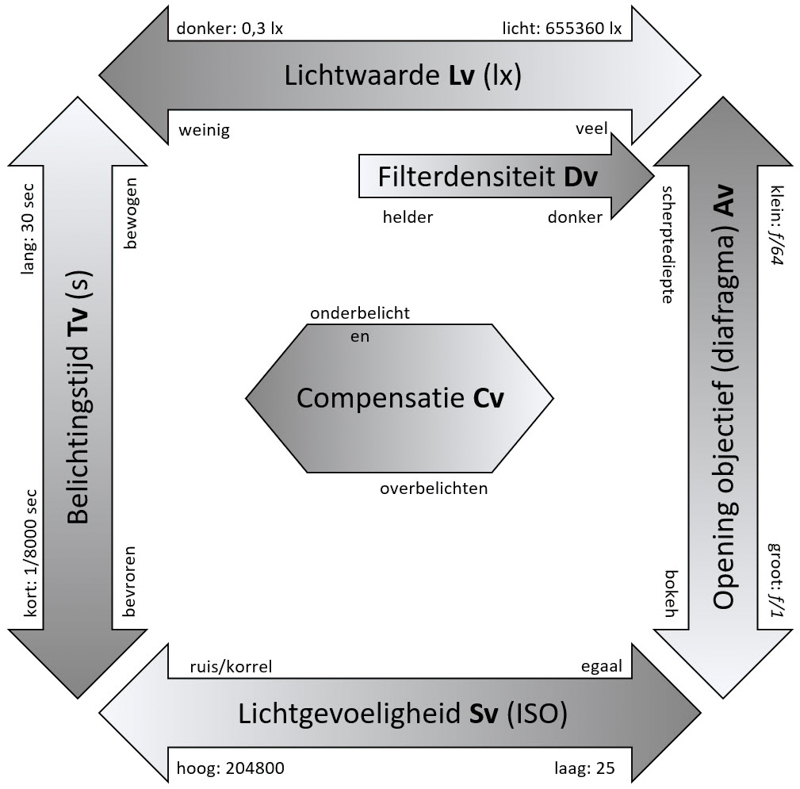
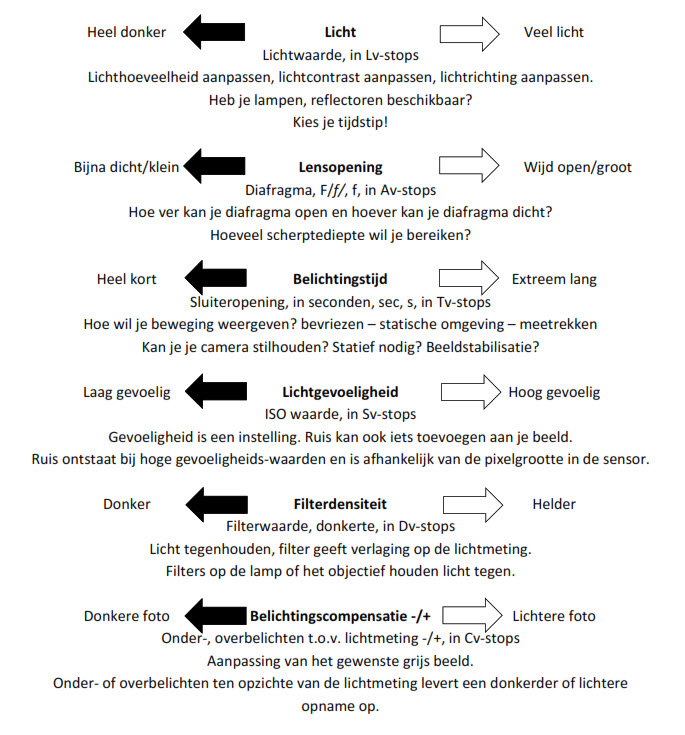
You can read all about this in his book The Light Quadrant.
And as the description says;
'What is explained in the exposure triangle seems so logical, yet it is difficult to understand. The book The Light Quadrant combines the light factors aperture, exposure time and light sensitivity with light in an understandable and revolutionary new system, creating a coherent whole.'
It is an easy-to-read book with lots of examples, and it is also manageable for someone who is not a reader. The book can be ordered from van Duuren media, ISBN 9789463562195.
About the author
Al van kinds af is Frouke aan het fotograferen, toch koos ze indertijd voor de opleiding tot opticien. Na verschillende omzwervingen besloot ze haar hart te volgen en naar de fotovakschool te gaan. Nu is ze gespecialiseerd in portret- en afscheidsfotografie. Daarnaast geeft ze verschillende cursussen.
You might also like
-
.jpg "15 practical tips for sharper panning photos") 15 practical tips for sharper panning photos
15 practical tips for sharper panning photosby Huub Keulers
-
 5 photography techniques you should know
by Elja Trum
-
 Have you ever heard of the Pep Ventosa technique?
by Nando Harmsen
-
 Cyanotype: a photographic technique from 180 years ago
by Erik van Rosmalen
-
 Out with a plan... or without one?
by Juliette Gribnau
2 comments
-

 Jack
wrote on Wednesday 29 June 2022 at 22:36
| reply
Jack
wrote on Wednesday 29 June 2022 at 22:36
| reply
Is it correct that the light quadrant is intended for situations in which you as the photographer can influence the light yourself, such as in portrait photography, still lifes and macro photography, but not, for example, landscape photography and architectural photography?
Translated from Dutch. -
 Frouke Ringenoldus
wrote on Thursday 30 June 2022 at 09:13
| reply
Frouke Ringenoldus
wrote on Thursday 30 June 2022 at 09:13
| reply
The light quadrant applies to all situations, so also landscape and architectural photography. There too, you have to deal with and take ambient light into account.
Translated from Dutch.
Have your say
Please note: Articles older than a week can only be commented on by signed-in visitors.Would you still like to comment? sign in or create a free account.
Become a better photographer every week
A practical photography tip in your inbox every week.
39,079 photography enthusiasts already receive the tips! More about the weekly mail. Or keep up to date via  Facebook.

Elja Trum
Photofacts; everything to do with photography!
Would you like to take better photos and keep up with what is happening in photography? Photofacts publishes articles that teach you something about photography — from a product announcement to a practical shooting tip or a look at a website. Photofacts covers photography every day and is a hobby project of Elja Trum's that got out of hand. The articles are written by a team of volunteer authors. If you would enjoy writing one or more articles for Photofacts, do get in touch.More about PhotofactsPhotofacts is made possible in part by
