

Does Lens Blur in Lightroom have any value for photographers?
Monday 27 November 2023, 16:32 by Nando Harmsen | 4,444 views | 32 commentsThis article was translated from Dutch with the help of AI. Read the original.
Lightroom Classic version 13 has gained the Lens Blur option (lensblur). This lets you simulate a shallow depth of field in your photo. How useful is this option, and what is this Lightroom feature intended for?
With Lens Blur, you can blur the background in a photo. The technique is genuinely impressive. The so-called A.I. engine creates a depth map. This lets you choose what you want in focus and what you don't.
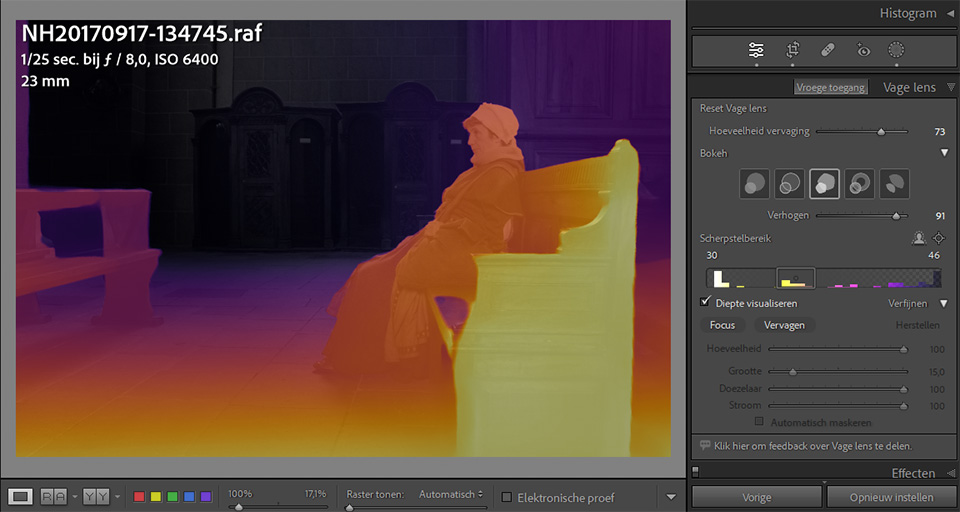
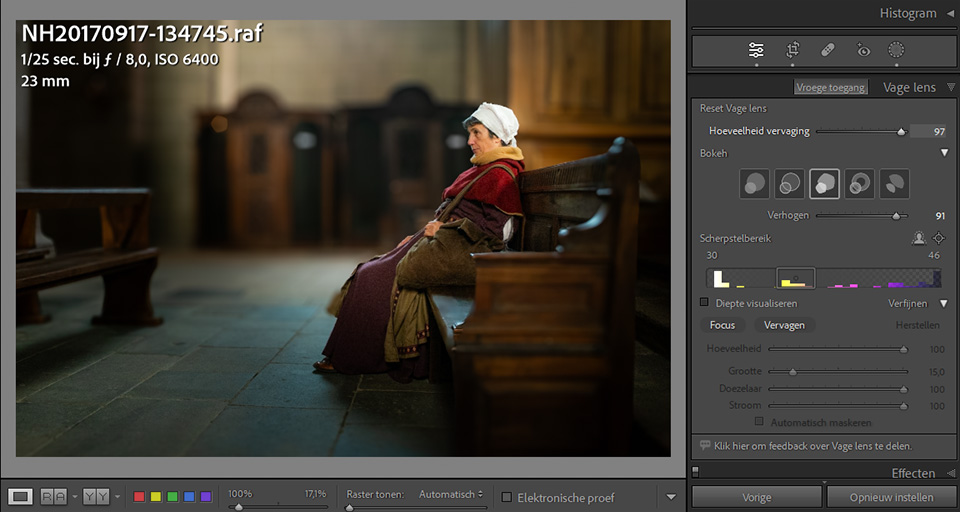
Lens Blur lets you choose the amount of blur and change how the blur is rendered (bokeh). But however you look at it, it remains a simulation of a shallow depth of field. It isn't real.
As a photographer, you choose to photograph with a shallow depth of field. You specifically chose a suitable lens for this, with a wide aperture, to make it possible. For example, a 50mm with f/1.2, an 85mm with f/1.4, or a 70-200mm with f/2.8.
What is the point of digitally simulating a shallow depth of field in Lightroom? After all, as a photographer, you wouldn't choose a large depth of field only to turn it into a shallow depth of field with Lens Blur.
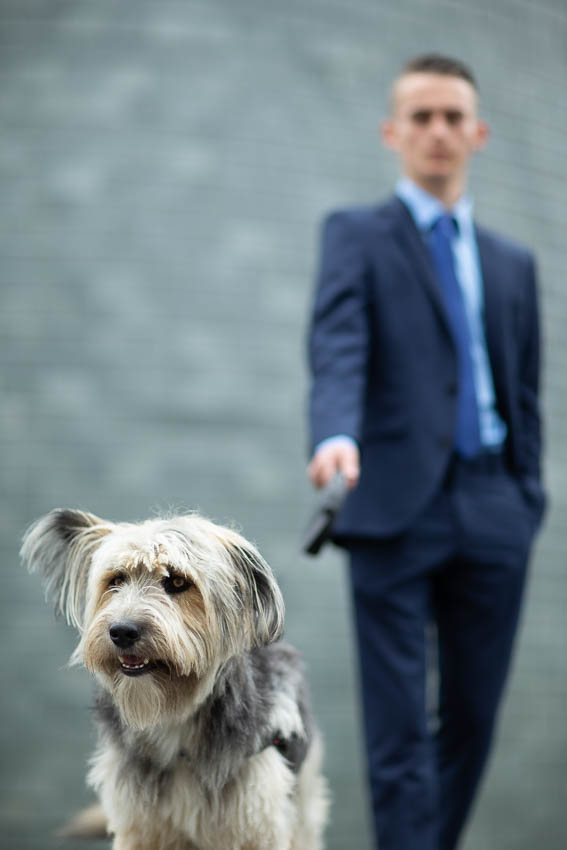
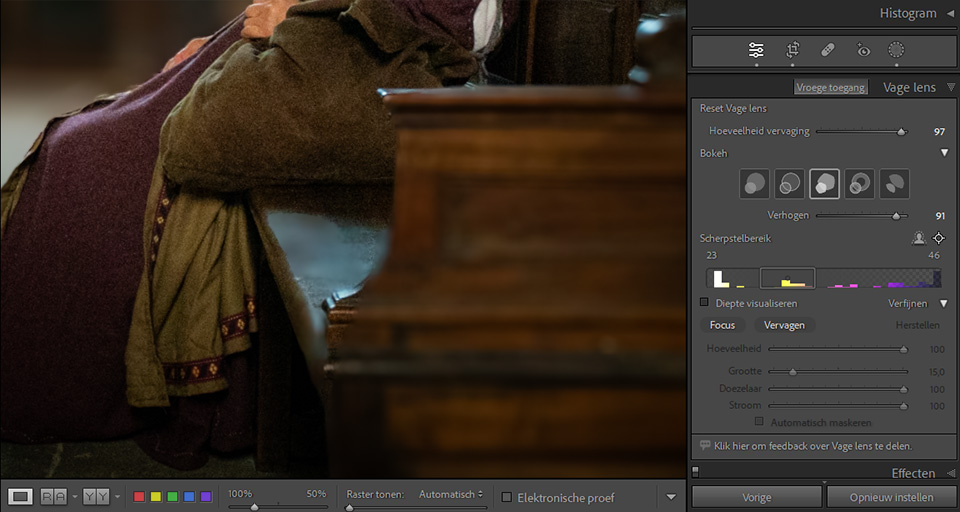
Bear in mind that the effect never matches 'the real thing'. What's more, it can never produce a perfect result, especially with hair or small details. You still have to spend a lot of time and energy correcting the mistakes Lens Blur makes with its A.I.
Who is Lens Blur made for, then? I wondered about that and thought of two reasons. The first is very simple: because it can. To show what is possible.
The other target group I can see is smartphone photographers. They can never get a shallow depth of field with their smartphone camera. With those sensors, everything is always in focus, from front to back. Lens Blur then offers the option of imitating a shallow depth of field.
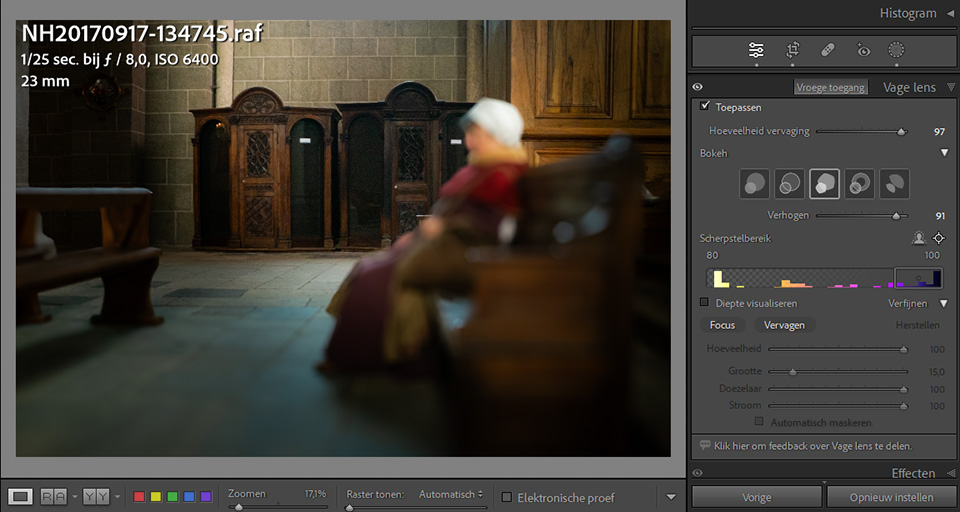
But there is a flaw in that last reason. Modern smartphones often already have that function built in. What's more, I think there are very few smartphone users who will use Lightroom.
I will never use Lens Blur myself. I simply choose a lens that makes a shallow depth of field possible. Will you use Lens Blur for your edits? If so, why? Let us know in a comment below this post. I'm curious about your reason.
About the author
Nando Harmsen has been photographing for more than 40 years. He specialises in wedding photography and landscape photography. Nando also gives talks, workshops, masterclasses and photo trips, and regularly reviews new and interesting equipment.
You might also like
-
 What's new in the Lightroom Classic 13 update?
by Nando Harmsen
-
 Lightroom update with generative AI
by Nando Harmsen
-
 New update for Lightroom Classic enables AI noise reduction
by Nando Harmsen
-
 Lightroom updates 2025, with more useful AI features
by Nando Harmsen
-
 4 Lightroom Classic Tips for Experienced Users
by Elja Trum
-
 New AI feature for Lightroom and Lightroom Classic
by Nando Harmsen
32 comments
-
 Bob wrote on Tuesday 28 November 2023 at 10:42 | reply
What about its usefulness if you don't have a fast lens? Not everyone has an f/1.8 at home. With limited use, you can still make the background just a bit calmer/softer. As with everything, use it where you can, but do so in moderation.
Translated from Dutch. -

-
 Donald Willemsen wrote on Tuesday 28 November 2023 at 10:46 | reply
Nando, your argument makes sense. I completely agree with you.
Translated from Dutch.
The same goes for generative replacement. For example, you can replace the subject in the photo using AI. You can replace a person with a horse, for example. But if you then look at the photo at 100%, you can clearly see that the horse is a computer-generated image that has been pasted into the original photo where the person was. So it looks like nothing. You can see that it's fake.
Using AI in photography isn't always bad when it comes to small adjustments. AI-based noise removal generally works well. The same goes for sharpening, as long as you use it in moderation. Otherwise it still stands out. -

 kok.f@ziggo.nl wrote on Tuesday 28 November 2023 at 10:49
| reply
kok.f@ziggo.nl wrote on Tuesday 28 November 2023 at 10:49
| reply
Nando, I largely agree with you. My aim is always to get as close as possible to the desired result with the camera. Sometimes, however, a few extra things are needed and then PS or LR is very useful. I also won't use the soft lens every day or to alter a sharp photo, because then you already did something wrong when taking the picture. It can be useful, though, if you want just a little more blur, or want to adjust the bokeh. So I think it's useful for making some smaller and subtle adjustments.
Translated from Dutch. -
Nando
wrote on Wednesday 29 November 2023 at 09:54
| reply
My advice would be, if you want to have more blur, you need to take that into account while taking the photo. It has everything to do with composition. That kind of thing is what makes photography itself so fun and creative.
Translated from Dutch. -
 Guill wrote on Tuesday 28 November 2023 at 10:55 | reply
What is left for the real photographer, who has beautiful equipment to photograph in the field with craftsmanship and feeling. I tried it out and am not impressed at all by this trick. I have decided not to use it anymore.
Translated from Dutch. -
 Evert wrote on Tuesday 28 November 2023 at 11:44 | reply
Preferably I take the photos myself, but I did test it and I agree with Nando. Sometimes you could use it for small details, and I do occasionally make a little mistake in the depth of field, so it can be useful to just blur it for a moment.
Translated from Dutch.
Furthermore I find it a cumbersome and slow option that is included and it has no added value for me. -
 JohanH wrote on Tuesday 28 November 2023 at 11:49 | reply
Nando, I’m not going to go through everything that has been written here before. Totally agree.
Translated from Dutch.
Will rarely/never use it. -
 Guido Bellens wrote on Tuesday 28 November 2023 at 11:51
| reply
Guido Bellens wrote on Tuesday 28 November 2023 at 11:51
| reply
Hi Nando, I've also played around with this new feature. Mainly with photos from a smartphone, an older model. I do think it has something.
Translated from Dutch. -
 Ben Fienieg. wrote on Tuesday 28 November 2023 at 12:13 | reply
I completely agree with Nando. I practice photography, so arranging everything with the camera and lenses. That's the fun of this hobby.
Translated from Dutch. -
 Paul wrote on Tuesday 28 November 2023 at 12:50 | reply
The mask is by no means always right straight away, there is still quite a bit that can be improved there. But in itself I think it is a nice function which, if used in moderation, can be useful (e.g. to just slightly enhance the effect of a limited depth of field). In moderation... because it is quickly too much.
Translated from Dutch. -
 Jules wrote on Tuesday 28 November 2023 at 13:42 | reply
I often use it for smartphone photos that I also edit in LR. I love it. Indeed not really necessary for camera photos, but it doesn't get in my way.
Translated from Dutch. -
-
 Domi wrote on Tuesday 28 November 2023 at 15:28 | reply
I don't think it's bad. As an amateur photographer, a lens with an aperture below f4 is usually too expensive. With a bit of additional blurring, you can make the background a bit less busy. And enhance the bokeh somewhat. I will use it though.
Translated from Dutch.
It's also just a test function? so I assume they will roll it out even better.
Something completely different, yesterday I saw a photo appear on instagram with a little lake in the foreground and the Milky Way in the background! beautiful image, you would say. But I read that the photographer had to stack 20 photos to get a sharp Milky Way and then blend the result with a foreground. I could appreciate that the photographer himself explains how he arrived at the end result ?
For me, the LR/photoshop story begins where the photographer's skill and the performance of his equipment end. -
Nando
wrote on Wednesday 29 November 2023 at 09:59
| reply
A lens with f/2.8 or f/1.8 doesn't have to be expensive at all. Just take a look at a 50mm f/1.8, a beautiful lens with which you can simply get real blur.
Translated from Dutch.
By the way, f/4 and the right focal length, distance to the subject and distance between subject and background can also bring beautiful blur.
I'm afraid that this will create a whole army of lazy photographers - if they aren't already there - who do everything in post-processing. Don't you think? -
 Ine wrote on Tuesday 28 November 2023 at 17:23 | reply
Lens Blur in Photoshop is much better. And you can also correct it very well if necessary.
Translated from Dutch. -
Nando
wrote on Wednesday 29 November 2023 at 10:08
| reply
Lightroom also offers correction options. But yeah, Photoshop is also more geared towards complex edits.
Translated from Dutch.
However, that's not what it's about. I'm more concerned about the risk that this will create lazy photographers who will just do it all in post-processing. -
 Gerrit Roodhart. wrote on Tuesday 28 November 2023 at 18:30 | reply
I completely agree with that.
Translated from Dutch.
I think it’s a great invention.
One that I will definitely use! -
 Rob IJsselstein wrote on Tuesday 28 November 2023 at 19:45 | reply
Nando, you are absolutely right. One thing: Lightroom and a smartphone work perfectly well together. I photograph with my iPhone from Lightroom quite regularly. The photo automatically goes to the cloud and is automatically imported into Lightroom Classic, after which you can start editing. Conversely, I often view my photos in Lightroom on my iPad as an interim check and export them from Lightroom to social media. So I am quite happy with the combination of Lightroom and a smartphone or tablet
Translated from Dutch. -
-
 Martin Smit
wrote on Tuesday 28 November 2023 at 20:22
| reply
Martin Smit
wrote on Tuesday 28 November 2023 at 20:22
| reply
I also prefer a 1.4 lens. But recently I was allowed to photograph a large group with flash because of backlighting. Due to the maximum flash sync time, I couldn't avoid using a smaller aperture than desirable. Because the group was well separated from the surroundings, a blurry lens gave a good result. Preferably not, but sometimes it's useful
Translated from Dutch. -
Nando
wrote on Wednesday 29 November 2023 at 10:05
| reply
That sounds like you could also have used other means. Think of an ND filter, high-speed sync, or - if possible - having the group stand in a better spot where the existing light already has a better quality. If there is room, a greater distance from the background can also help.
Translated from Dutch.
Of course I don't know the situation, but in any case these are things you can have at your disposal as a photographer. -
Donald Willemsen wrote on Wednesday 29 November 2023 at 10:34 | reply
Exactly!!! Totally agree Nando!
Translated from Dutch. -
Paul wrote on Wednesday 29 November 2023 at 14:34 | reply
Correct in itself.... but.... of course, you do need to have other stuff resp. have it with you then.
Translated from Dutch. -
Nando
wrote on Wednesday 29 November 2023 at 15:04
| reply
You do go out prepared, right? If you're going to photograph portraits, you make sure you have that lens with you, right? Or if you like that kind of photo, you buy a lens that makes this possible, right?
Translated from Dutch.
Or am I seeing that wrong? -
Domi wrote on Wednesday 29 November 2023 at 15:16 | reply
That is indeed true about those lazy photographers. You'd better try to take a good photo right away so you don't have to sit behind your screen for hours.
Translated from Dutch. -
Donald Willemsen wrote on Wednesday 29 November 2023 at 15:50 | reply
@Nando, indeed you set out prepared. At least I do and so I do agree with you.
Translated from Dutch.
But as an amateur photographer you don't just buy a lens and certainly not a quality lens. The big difference is that you are a professional photographer and you can earn back your investments and your business expenses are partly tax-deductible. For an amateur photographer, that doesn't apply.
You are a good photographer and you will certainly get a lot of assignments. You also write books that are sold, you work at Photofacts Academy, you give workshops Not that you get rich from that, but it does help that you can invest. You actually only have one disadvantage: you suffer a lot from the competition of amateur photographers who think they have to get a piece of the pie and work below the market price (often 'under the table' as well). I find that taking bread out of people's mouths. But I'm digressing too much. In my opinion, you say TOO easily 'then you just buy a lens.....'
Not everyone just has money lying around. Saving is also not something for the very short term. -
Nando
wrote on Wednesday 29 November 2023 at 15:58
| reply
I'll mention the example again, you can get a Canon 50mm f/1.8 for 100 euros. If you have a mirrorless, you use the adaptor. Otherwise you buy an RF version for 250 euros.
Translated from Dutch.
It is not necessary to use the best of the best. You have to use what you can use, and if you like this kind of photos you invest in that.
If you have a 70-200mm with f/4, then at f/4 and 200mm you can also get a fantastic blurry background.
So even the amateur with a small budget can do this. It is a matter of making the right choice when purchasing equipment and not just keep looking at the most expensive lenses.
You can also choose to buy a less expensive camera, and invest in lenses. That expensive camera really will not take better photos, but the lens can make a difference. A matter of priorities. -
Paul wrote on Wednesday 29 November 2023 at 17:04 | reply
I am afraid this is going to become a bit off-topic. With more than 50 years of experience, by now I know what options there are.
Translated from Dutch.
But I also know that sometimes you are faced with an unexpected situation. Then you have to make do with what you have at that moment. And if you have new tools available in post-processing that allow you to achieve a better result, then that is only nice. -
Cor wrote on Thursday 30 November 2023 at 02:18 | reply
Nando writes very negatively about this new feature in Lightroom. Seems like someone who doesn't need the rest of Lightroom's functionality anymore anyway. Maybe just the library to organize your photos, but you get the rest right with your camera straight away, right? But if you still use some of Lightroom's other great features, then 'vague lens' is still allowed too.
Translated from Dutch. -
-
Donald Willemsen wrote on Thursday 30 November 2023 at 13:54 | reply
@Nando, you're right that you don't always have to shout hosanna when a new expansion comes out for Lightroom, or any other editing program for that matter. Some expansions are released so early, for the sake of competition, that they still have many flaws. For example, various AI applications are far from perfect. I think it's completely justified that you warn about that. I've also heard you say many positive things about Lightroom. Just recently about creating a watermark. To me, a sign that you have given an independent opinion, for which thanks.
Translated from Dutch.


Have your say
Please note: Articles older than a week can only be commented on by signed-in visitors.Would you still like to comment? sign in or create a free account.
Become a better photographer every week
A practical photography tip in your inbox every week.
39,079 photography enthusiasts already receive the tips! More about the weekly mail. Or keep up to date via  Facebook.

Elja Trum
Photofacts; everything to do with photography!
Would you like to take better photos and keep up with what is happening in photography? Photofacts publishes articles that teach you something about photography — from a product announcement to a practical shooting tip or a look at a website. Photofacts covers photography every day and is a hobby project of Elja Trum's that got out of hand. The articles are written by a team of volunteer authors. If you would enjoy writing one or more articles for Photofacts, do get in touch.More about PhotofactsPhotofacts is made possible in part by
