

Photographing dragonflies requires preparation, precision and patience (part 2)
Sunday 10 July 2022, 13:31 by Erik Nevels | 3,698 views | 0 commentsThis article was translated from Dutch with the help of AI. Read the original.
Photographing dragonflies requires precision and a lot of patience. That is exactly why I find it so enjoyable and challenging. From preparation to a successful dragonfly photo. In this article, I explain how I approached several example photos.
In part 1 of my blog about photographing dragonflies, I mainly talked about the preparation. In this second part, I focus on precision. Using a number of photos I took, I explain how I approached them.
With a 600mm on a tripod
It is already halfway through the morning, the dragonflies are active and I have swapped my macro lens for my 200-600mm telephoto lens so I can photograph from a greater distance. I am walking along the path beside a narrow stream when I see one fly past. It lands a little further on.
I slowly walk closer without taking my eyes off it. The nettle the dragonfly has landed on is nicely isolated and there is plenty of light in the background.
It is also completely windless, so I am happy to try a slow shutter speed with my 600mm on a tripod. I place my tripod about 2.5 metres from the subject, the minimum focusing distance is 2.40 metres.
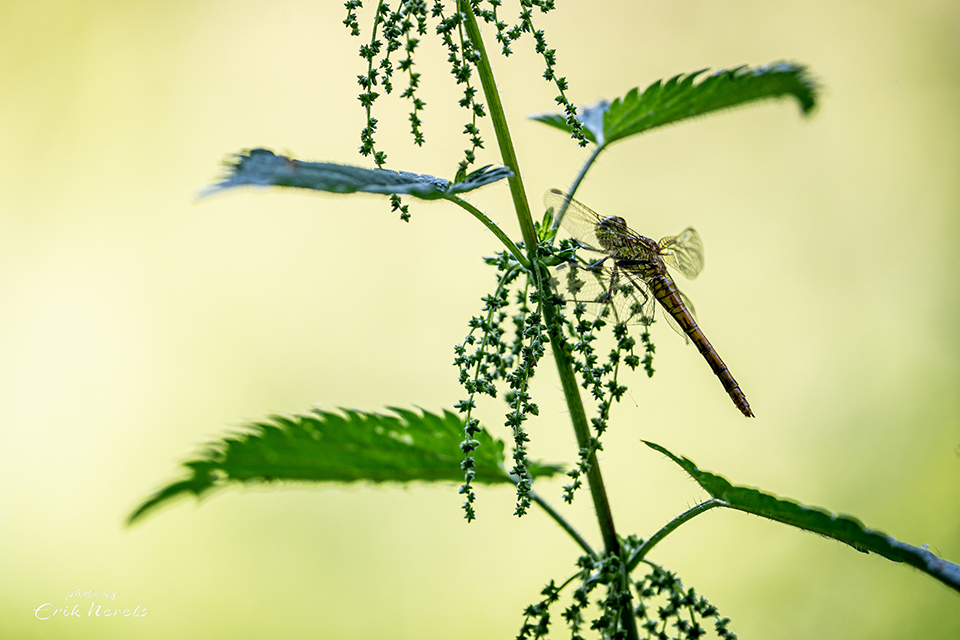
I keep my aperture fully open to make the background as blurry as possible. From experience, I know that the depth of field needed to get the entire dragonfly sharp is just sufficient at that distance.
I focus manually, enlarging the subject in my viewfinder.
At ISO 200, I arrive at a shutter speed of 1/25 second, normally far too slow for a 600mm telephoto lens, but fortunately there is no wind.
The shutter speed is also slower because I base the exposure on the dragonfly and do not let the bright background influence me. My histogram is almost completely filled on the right, indicating a more or less high-key photo.
Finally, I switch image stabilisation 'off' and use the cable release to prevent any movement caused by pressing the shutter button by hand. To be on the safe side, I take several photos in case the wind does cause some movement.
With a 90mm macro handheld
It is still early in the morning when I discover a dragonfly emerging. This emergence can take a few hours, giving me time to take photos calmly.
I choose the macro lens so I can capture the beautiful spectacle from close up. Unfortunately, I cannot place the tripod here without disturbing the dragonfly, so I have to photograph handheld.
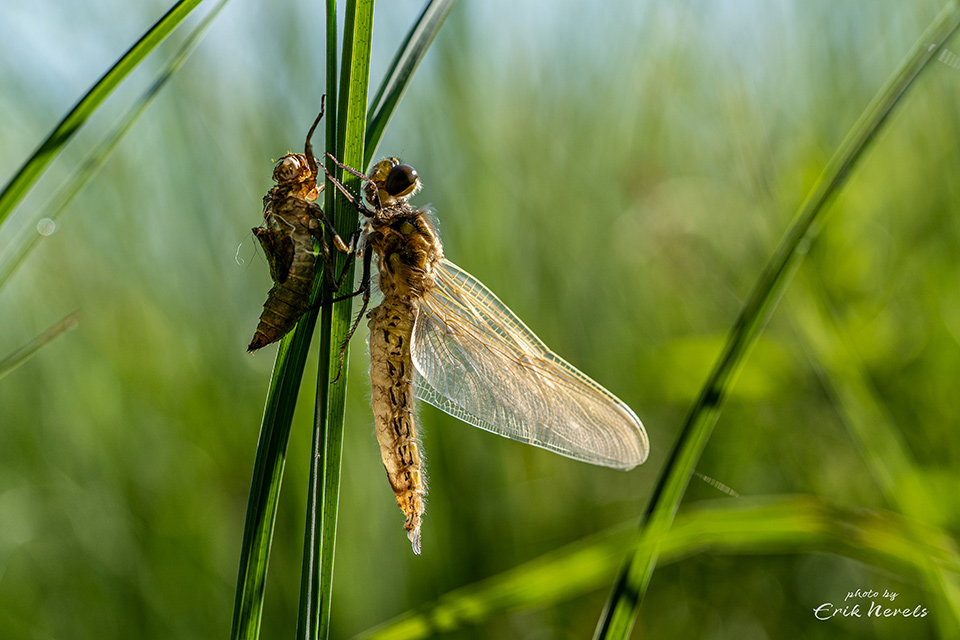
To avoid having to crop too much from the photo at home, I hold the camera as far in front of me as possible from the bank and use the screen to check the composition and focus.
To get a little more depth of field, I choose f/5. Image stabilisation is also switched 'on' and I choose a shutter speed of 1/400 second. That in turn requires an ISO of 200. Then there is the focusing.
To get the entire dragonfly and the exoskeleton it has just crawled out of sharp, I have to hold my camera perpendicular to the imaginary plane of both, both horizontally and vertically. It is a precision job, so to be on the safe side I take several photos again.
With a 600mm handheld
The sun is already some way above the horizon when I see several four-spotted chasers flying above the mere. The stems sticking out of the water are still covered in dewdrops, and I need those together with the sun's backlight for bokeh.
The four-spotted chasers land from time to time, but soon fly off again. I therefore decide to photograph handheld and get as close to them as possible at 600mm.
I also choose the widest aperture of 6.3 and a shutter speed of 1/400, trusting in the image stabilisation and my steady hand, with an ISO of 200.
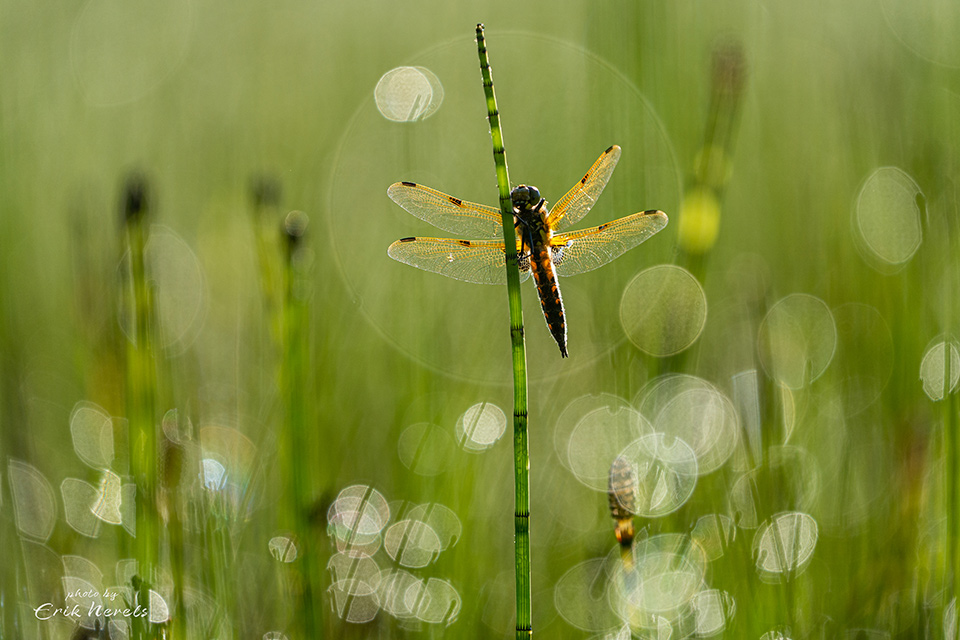
After several attempts where focusing fails or the dragonfly has already flown away, I try again. The four-spotted chaser is sitting beautifully.
Focusing is once again a precision job, because as soon as I miss the focus point slightly, the camera focuses on the background. This time, however, I manage to quickly get the dragonfly sharp in the frame and keep it there using autofocus, flexible spot - S.
I am delighted by the bokeh embellishing the background, especially a large bokeh ball near the dragonfly.
I move the camera a few centimetres to the left and slightly down, causing the ball to move behind the dragonfly. It fits perfectly!
Then I breathe out, hold the camera as still as possible and take a series of photos at high speed. This gives me a better chance of keeping the camera still because I keep the shutter button pressed for longer.
Only when the dragonfly flies off again do I look at the results on my screen and realise: 'It is not going to get much better than this today'.
With a 90 mm macro on a tripod
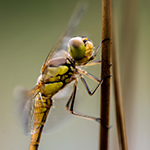
Although it is still early, half past six in the morning, the first dragonflies are already flying above the mere. This one is still patiently evaporating the last dewdrops, so I take the time to set up my tripod and put the camera in the right position.
I pay attention not only to the subject but also to the background. Initially, I focus on the eye and adjust the camera position a little more until the body is also sharp in the photo. I am happy with the result but want more.
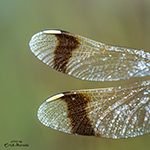
I decide to focus on the two white spots, pterostigmas, on the hind wings. I want both of them sharp while the dragonfly's body is as blurry as possible.
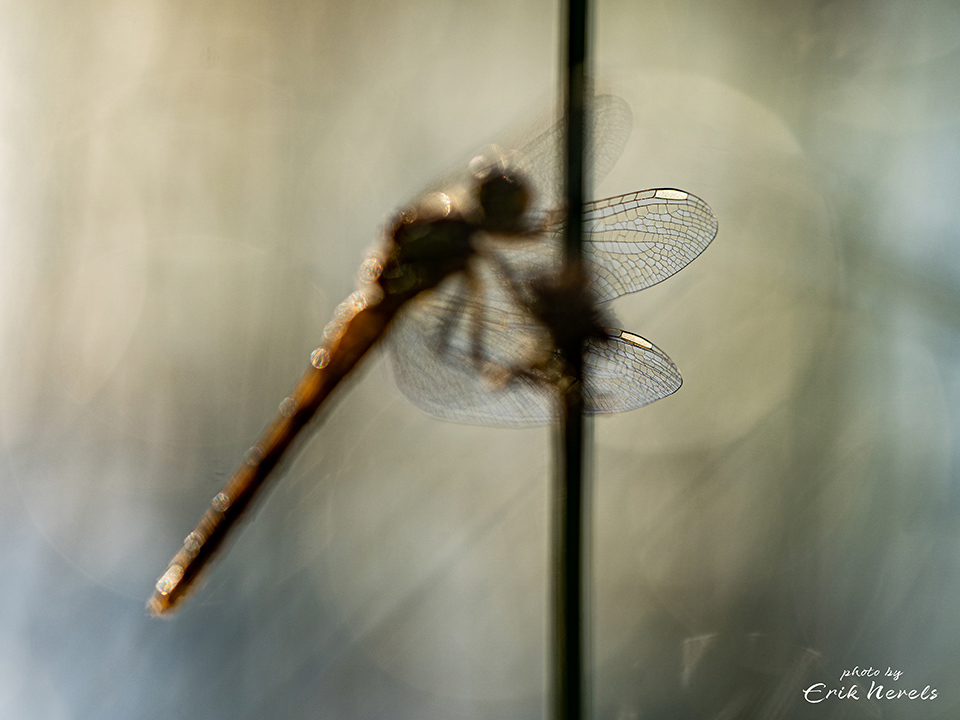
With an aperture of f/3.2, this will work as long as I position the camera exactly perpendicular to both spots. I use focus magnification, which zooms in on the focus point, to focus on one white spot and then check whether the other one is sharp too.
It takes real patience to get everything right. There is hardly any wind, but to be on the safe side I take a whole series of photos and check the focus again. The dragonfly gives me the time I need.
Satisfied, I look at the results in the viewfinder. The white spots are sharp. Once I am home, I find the dragonfly rather dark, and with a reflector I could have given it and the stem some extra light. Something to remember for next time.
Precision and patience
Photographing dragonflies requires precision and a lot of patience. That is exactly why I find it so enjoyable and challenging. From preparation to a successful dragonfly photo, I still cannot get enough of it.
About the author
Steeds weer boeiend en op zoek naar de essentie! Dat is wat fotograferen in de natuur voor mij is. Gefocust op het landschap of het onderwerp in diens omgeving tracht ik meer dan alleen te registreren. Een continue uitdaging waarvan ik elke keer volop geniet. Meer foto's? Volg mij op Instagram en/of kijk op mijn website
You might also like
-
 Bird photography often requires a lot of patience
by Erik Nevels
-
 Photographing with a purpose
by Erik Nevels
-
 A fan of mushrooms and creepy-crawlies
by Erik Nevels
-
 Photographing from a mobility scooter
by Juliette Gribnau
-
 Up early to photograph banded darters
by Erik Nevels
0 comments
Be the first to share what you think!
Have your say
Please note: Articles older than a week can only be commented on by signed-in visitors.Would you still like to comment? sign in or create a free account.
Become a better photographer every week
A practical photography tip in your inbox every week.
39,079 photography enthusiasts already receive the tips! More about the weekly mail. Or keep up to date via  Facebook.

Elja Trum
Photofacts; everything to do with photography!
Would you like to take better photos and keep up with what is happening in photography? Photofacts publishes articles that teach you something about photography — from a product announcement to a practical shooting tip or a look at a website. Photofacts covers photography every day and is a hobby project of Elja Trum's that got out of hand. The articles are written by a team of volunteer authors. If you would enjoy writing one or more articles for Photofacts, do get in touch.More about PhotofactsPhotofacts is made possible in part by
