

Improve your panorama with a nodal slide
Thursday 4 March 2021, 20:40 by Nando Harmsen | 7,805 views | 8 commentsThis article was translated from Dutch with the help of AI. Read the original.
Do you make a panorama now and then? Then you know that, when merging the photos, they do not always line up properly.
The problem occurs with elements in the photo that are close by. These errors when merging are caused by parallax.
There is a very simple solution for this: a nodal slide.
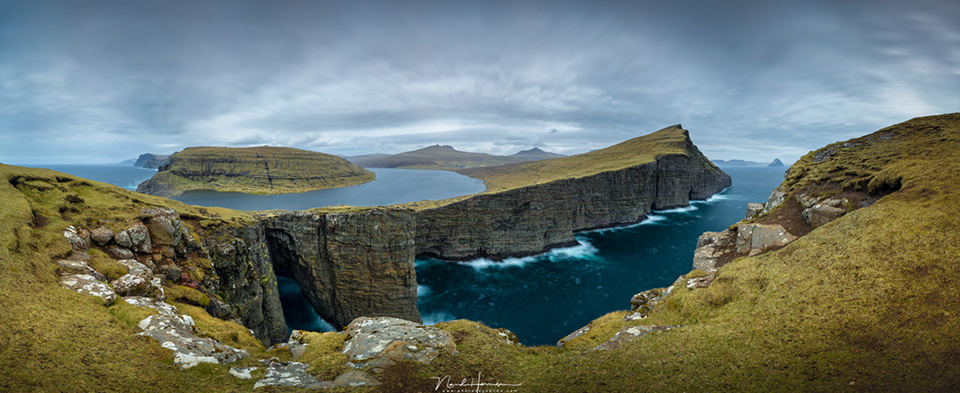
With a panorama, you can create very impressive photos. You can capture even more in the frame than you can with an ultra-wide-angle lens. In principle, there is no limit. If you want, you can capture a complete circle: 360 degrees all the way round.
The best result is achieved with a tripod and a rotating tripod head. Set your camera perfectly level, and take photos with around 30 per cent overlap. That is enough to stitch the photos together seamlessly. Stitching is the English word for this.
When everything in your photo is far enough away from you, this works perfectly. You can capture everything from left to right, or the other way round, and stitch it together.
Software can do this for you very quickly and easily. But when elements in a photo are very close by, the photos do not line up as well.
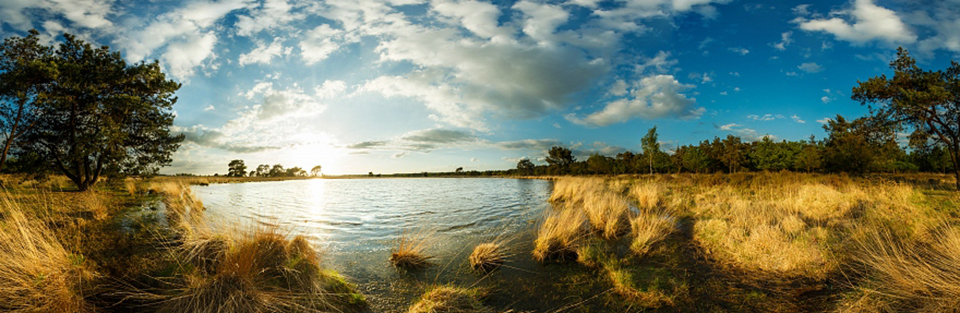
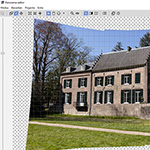
[cenger]When you have lots of elements in the foreground, the parallax problem can occur. The photos do not line up exactly. This photo was taken 360 degrees all the way round.
The parallax problem
It almost sounds like the title of a Dan Brown novel: the parallax problem. Nothing could be further from the truth. Parallax is what occurs when we look at something from slightly different viewpoints.
We do nothing else with our eyes, and it is precisely these parallax differences that allow us to see in three dimensions.
Put your camera on a table and look at it. Close your left eye and pay attention to what you can see behind the camera. Then close your other eye, making sure you open your left eye again, and see what happens. Your camera has a slightly different position relative to the background. That is parallax.
Now put your camera on a tripod, position it perfectly level, and make sure you have a nearby subject in the frame against a background that is a little further away.
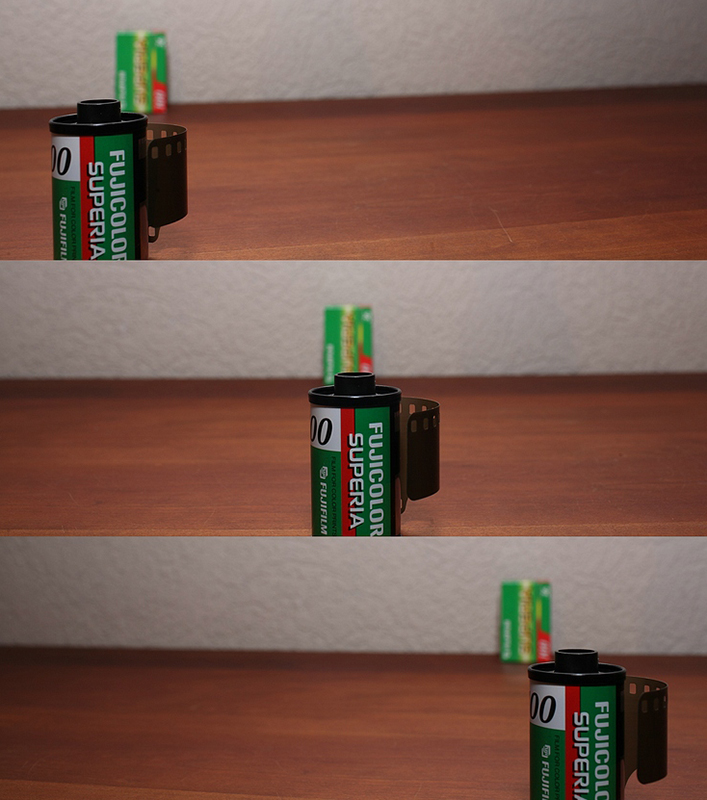
Turn on live view, and watch how the position of the subject changes relative to the background as you rotate the camera. That is parallax.
Parallax errors
The shifting of a foreground element relative to the background becomes a problem when you want to stitch your photos together. Sometimes the software can correct this to some extent, but usually that is difficult or even impossible. Then you have stitching errors. In Dutch, these are called parallax errors.
To do this seamlessly, the foreground must remain in exactly the same place relative to the background. In other words, the background must not shift when you rotate the camera. To achieve this, you need to place the rotation point in exactly the right position. This is called the nodal point.
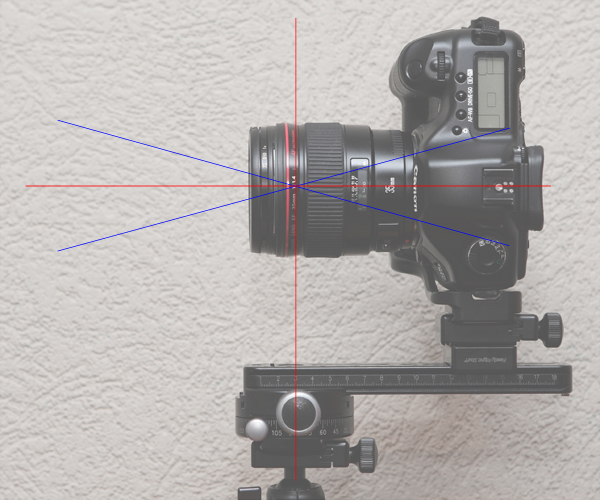
Rotating around the nodal point
When you put the camera on a tripod, the camera rotates around the position of the sensor. Instead, you need to rotate the camera around the nodal point. This is a point somewhere inside your lens. Once you have found this point, parallax errors are avoided.
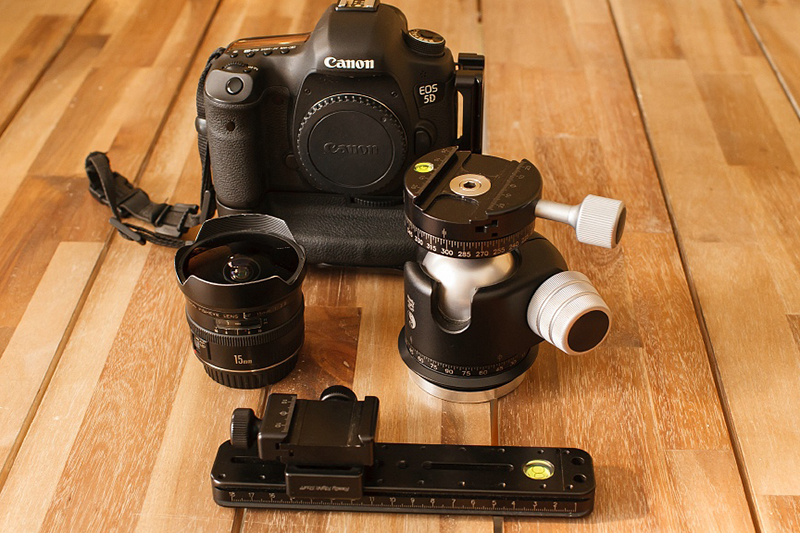
You therefore need a tool to position your rotation point underneath your lens. This tool is called a nodal slide. Do you want to make perfect panoramas? Then a nodal slide is essential.
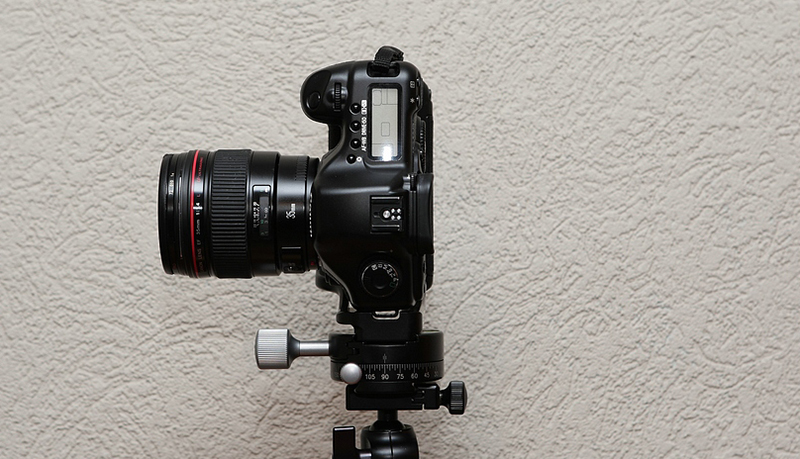
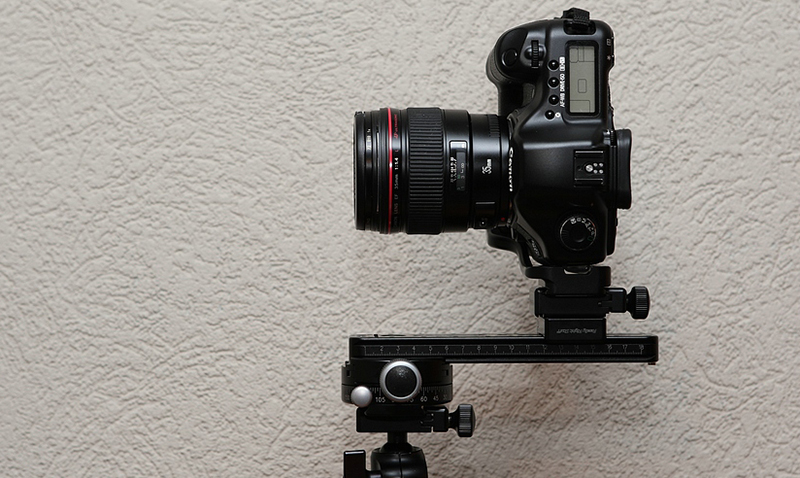
Where can you find the nodal point?
Where the nodal point is located depends on your lens and your focal length. You will have to work this out by trial and error. You do need a nodal slide for this, of course.
For this, place two subjects in line with each other, just as I did in my example photos. Then rotate the camera and move the camera forwards or backwards until the two subjects remain perfectly behind each other regardless of the rotation.
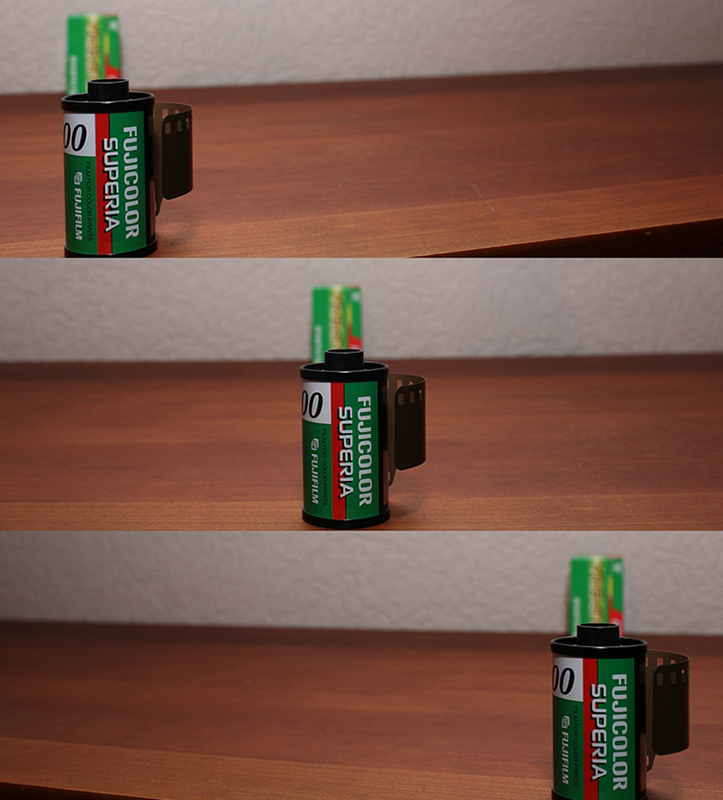
Most nodal slides have a scale. Note down where the nodal point is for your lens and focal length. This allows you to set everything up perfectly straight away on location and prevents the photos from failing to line up exactly because of parallax errors.
About the author
Nando Harmsen has been photographing for more than 40 years. He specialises in wedding photography and landscape photography. Nando also gives talks, workshops, masterclasses and photo trips, and regularly reviews new and interesting equipment.
You might also like
-
 A panorama or a panorama crop?
by Nando Harmsen
-
 A little short on wide angle? Make a panorama
by Nando Harmsen
-
 10 Tips for a Handheld Panorama
by Nando Harmsen
-
 A panorama should add value
by Nando Harmsen
-
 Ten tips for panorama photography
by Nando Harmsen
-
 The difference between a wide-angle photo and a telephoto panorama
by Nando Harmsen
8 comments
-
 Mac wrote on Friday 5 March 2021 at 09:26 | reply
In principle you don't need to buy a nodal slide. Provided you have a macro rail.
Translated from Dutch.
Or have I got it wrong. -

-
 Jan Hulas wrote on Tuesday 9 March 2021 at 10:59 | reply
Which length is best to choose?
Translated from Dutch. -
 Nando
wrote on Tuesday 9 March 2021 at 11:31
| reply
Nando
wrote on Tuesday 9 March 2021 at 11:31
| reply
@Jan,
Translated from Dutch.
a good question. That depends a bit on which lenses you have. If you can look up where the nodal point is for your lenses (the internet makes all information findable - usually) then you know how long it should be.
An estimate: 15cm is definitely recommended, maybe even 20cm -
 Jo VP wrote on Tuesday 22 November 2022 at 17:07
| reply
Jo VP wrote on Tuesday 22 November 2022 at 17:07
| reply
Hey Nando, yes it is reasonably long after the publication of this article but still a quick question. We run into the following problem when using the nodal slide for panoramas. We also use Benro's filter holder system, when using the graduated filters, they collide with the bottom of the nodal slide because of their length. How do you solve this problem ?
Translated from Dutch. -
Nando
wrote on Wednesday 23 November 2022 at 09:43
| reply
Hello Jo,
Translated from Dutch.
I know the problem. The solution is a shorter nodal slide that does not stick out in front of the lens. Or a system like in the photos in the article. There, the camera mount on the nodal slide can be shifted so that you can use GND filters without any problems,
In 2023 I will be creating a course on panoramic photography, I will include this problem in it. -
 Dingeman wrote on Tuesday 17 October 2023 at 18:32
| reply
Dingeman wrote on Tuesday 17 October 2023 at 18:32
| reply
Hey Nando,
Translated from Dutch.
I'm reading your article now and am working on making panaroma photos with a Tilt/Shift lens. Now I was thinking, I could also do that with a rather slide, only in width instead of in depth. That way I'm imitating the "behavior" of a tilt/shift lens, right? Curious about your opinion. Thanks in advance and regards, Dingeman -
Have your say
Please note: Articles older than a week can only be commented on by signed-in visitors.Would you still like to comment? sign in or create a free account.
Become a better photographer every week
A practical photography tip in your inbox every week.
39,079 photography enthusiasts already receive the tips! More about the weekly mail. Or keep up to date via  Facebook.

Elja Trum
Photofacts; everything to do with photography!
Would you like to take better photos and keep up with what is happening in photography? Photofacts publishes articles that teach you something about photography — from a product announcement to a practical shooting tip or a look at a website. Photofacts covers photography every day and is a hobby project of Elja Trum's that got out of hand. The articles are written by a team of volunteer authors. If you would enjoy writing one or more articles for Photofacts, do get in touch.More about PhotofactsPhotofacts is made possible in part by
