

Total lunar eclipse on Blue Monday
Sunday 20 January 2019, 13:31 by Michelle Peeters | 8,140 views | 6 commentsThis article was translated from Dutch with the help of AI. Read the original.
Blue Monday is the name given to the date supposedly known as the most depressing day of the year. As it happens, on this day, Monday 21 January, you can see a total lunar eclipse from 5.41 am.
The Earth then moves between the sun and the moon, allowing you to see a total lunar eclipse in the Netherlands. Because the moon will be larger and brighter in January, this moon is also called a supermoon.
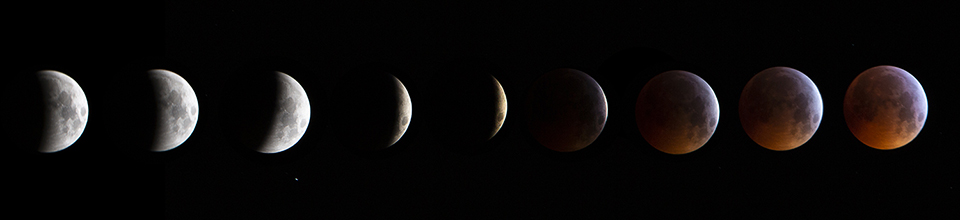
To see or photograph it, you do have to get out of bed early. The eclipse starts at 3:36 am, after which the total eclipse lasts from 5:41 to 6:44 am. It is over by 8:50 am.
During the lunar eclipse, the moon gradually becomes a little darker. This means you need to adjust the shutter speed and ISO to the amount of light coming from the moon.
But how do you actually photograph the moon? We have put it all together for you below!

Nando Harmsen previously wrote the article 10 tips for photographing a lunar eclipse.
And in her article The blood moon on automatic, Tanja Thomas was amazed by how easily her friends achieved incredible results when photographing the blood moon with a compact or bridge camera.
Here are some brief tips for photographing a lunar eclipse. What do you need for photos of the moon?
- A tripod to prevent motion blur
- A telephoto lens with a focal length of 300mm or more
- An extender for even more zoom capability, if required
- A remote control for your camera
Photographing the moon in 6 steps
- Put your camera on the tripod and decide on your composition;
- Start with a not-too-high ISO setting, such as ISO400;
- Set the aperture to around f/11 for optimum sharpness from your lens;
- Use a relatively short shutter speed, such as 1/120th of a second. Because the moon gives off a lot of light, you do not need long shutter speeds;
- Focus manually on the moon in your camera's live view mode. Because of the high contrast between the moon and the sky, the camera has trouble focusing. Focus on the edge or on one of the craters;
- Take the photo using a remote control or timer.
About the author
Michelle Peeters is fotografe en oprichter van DeuxBleus Fotografie. Michelle herkent het bijzondere in het gewone en het gewone in het bijzondere. Ze heeft zich nooit willen specialiseren en is daardoor van alle markten thuis.
You might also like
-
 10 January partial lunar eclipse
by Michelle Peeters
-
 How to photograph the moon
by Michelle Peeters
-
 Photographing the Full Moon creatively
by Nando Harmsen
-
 Lunar eclipse on its way
by Nando Harmsen
-
 Night photography tip: photograph all the Moon phases
by Nando Harmsen
-
 Are you ready for the solar eclipse?
by Nando Harmsen
6 comments
-
 Leen wrote on Monday 21 January 2019 at 14:29 | reply
This morning it was pretty chilly. So you could also add practical tips like gloves, etc. Or practice behind the glass before going outside.
Translated from Dutch. -

 Michelle Peeters wrote on Monday 21 January 2019 at 22:10
| reply
I managed it and it was actually quite difficult to get it right. Especially focusing and preventing the moon from being overexposed before or during the eclipse (I had to underexpose quite a bit). During the total eclipse it was a lot easier. I photographed from a tripod through the bathroom window, from 5 to 6 in the morning. With a 200mm lens with a 2.0 extender (so 400mm on a full-frame DSLR).
Translated from Dutch.
-
 Paul Oosterlaak wrote on Monday 21 January 2019 at 23:34
| reply
The tips also mainly apply to a normal moon photo, not to a blood moon photo. You really need high ISOs, fast shutter speeds and large apertures then. I was using 800mm f/8 (200-400 f/4 with a 2.0x teleconverter) at 1/4 sec (longer causes motion blur due to the rotation of the Earth) and ISO 12800.
Translated from Dutch. -
Michelle Peeters wrote on Tuesday 22 January 2019 at 10:25
| reply
@Paul: yes, that's indeed correct! And the fact that you also have to take into account the motion blur caused by the rotation of the Earth is a really good one! I think that's mentioned in Nando Harmsen's article. I'm curious about your photos, by the way! 800mm is really fun for this kind of photography!
Translated from Dutch. -
Paul Oosterlaak wrote on Tuesday 22 January 2019 at 19:09
| reply
It was fun, but in hindsight I would have been better off bringing a Pentax K-1 with a substantial telephoto lens. This one has a sensor that, in combination with GPS (for the correct position on Earth), can correct for the rotation of the Earth. As a result, much longer shutter speeds and therefore lower ISOs are possible. But anyway, better luck next time
Translated from Dutch.
-
Michelle Peeters wrote on Tuesday 22 January 2019 at 23:02
| reply
@Paul: interesting developments at Pentax!
Translated from Dutch.
Have your say
Please note: Articles older than a week can only be commented on by signed-in visitors.Would you still like to comment? sign in or create a free account.
Become a better photographer every week
A practical photography tip in your inbox every week.
38,938 photography enthusiasts already receive the tips! More about the weekly mail. Or keep up to date via  Facebook.

Elja Trum
Photofacts; everything to do with photography!
Would you like to take better photos and keep up with what is happening in photography? Photofacts publishes articles that teach you something about photography — from a product announcement to a practical shooting tip or a look at a website. Photofacts covers photography every day and is a hobby project of Elja Trum's that got out of hand. The articles are written by a team of volunteer authors. If you would enjoy writing one or more articles for Photofacts, do get in touch.More about PhotofactsPhotofacts is made possible in part by
