

How do you choose the right tripod?
Monday 1 February 2021, 20:02 by Liesbeth van Asselt | 8,741 views | 15 commentsThis article was translated from Dutch with the help of AI. Read the original.
I once bought a second-hand camera and a Gitzo tripod with the first money I earned. That expensive tripod really cost me an arm and a leg, but it was so solid!
Eventually, after about 35 years (!), I had to admit last year that the tripod was worn out. One of the legs was 'slack' and kept sinking down. Unfortunately, the repair service could no longer fix this either.
And then it begins. The search for a new tripod. I know Gitzo, of course, but I am especially curious about what is currently available outside Gitzo.
The requirements I have for a new tripod are: reasonably light but still robust and free from vibration, so carbon, sufficient height to comfortably look through the camera's viewfinder while standing, and legs that can be folded upwards for macro photography.
Light and robust because I want to take my tripod on treks in conditions that are not always easy. You do not want to carry a heavy tripod, but you do want to have a sturdy tripod with you.
Snowshoeing in Lapland at -40, standing in the middle of a river to photograph waterfalls, bivouacking at night in wind and blowing sand to capture star trails, light painting at urban locations, whatever the conditions, the tripod always comes along.
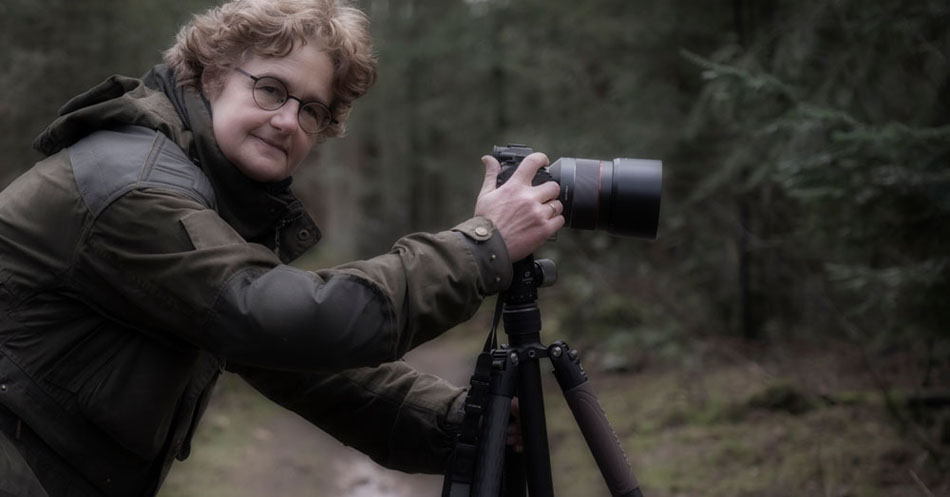
Light and robust do not really go together, of course, but despite its relatively low weight I have not had any problems with my Gitzo, including no vibration blur. This Gitzo weighs around 2.5 kilograms including either the Novoflex Magic Ball tripod head or the Really Right Stuff ball head.
I find that perfectly manageable, so the new tripod may also weigh up to around 2.5 kilograms including the ball head. Less would of course be nice, but the whole thing does need to remain sturdy. That may mean making concessions, finding a middle ground between stability and weight.
I would also like the tripod legs to extend using rubber rings. Rings lock better than clamps. Clamps also have screws, springs and hinges that can break, and knowing me, I would keep getting my fingers caught in them.
Another disadvantage of clamps is that they catch on everything, and although you can take the legs apart for cleaning, it is difficult to put them back together afterwards. With rings, that is no problem at all, slide them together, tighten them and you are done.
Eventually, positive experiences from my students lead me to Leofoto. A brand with a very wide range of tripods. I choose the Urban LX-324CT with the XB-38 ball head. This carbon tripod feels solid and weighs 2 kilograms including the ball head.
The tripod legs are 32 millimetres thick, so they are nice and stable when you are standing in the wind. The load capacity is 15 kilograms, which I will not come close to with my mirrorless camera system.
Not even if I divide this by two, which is the rule of thumb for optimal stability: the maximum weight of the camera and lens should be half the load capacity of the tripod.
Of course, I already had a ball head, but because you fold the legs of this tripod upwards when storing it or attaching it to your backpack to make a compact whole, 48 centimetres, it needs a slimmer ball head that fits between the folded tripod legs.
The Leofoto tripod comes with a suitable ball head as standard, so that is not a problem. As long as the ball head is good and user-friendly, of course.
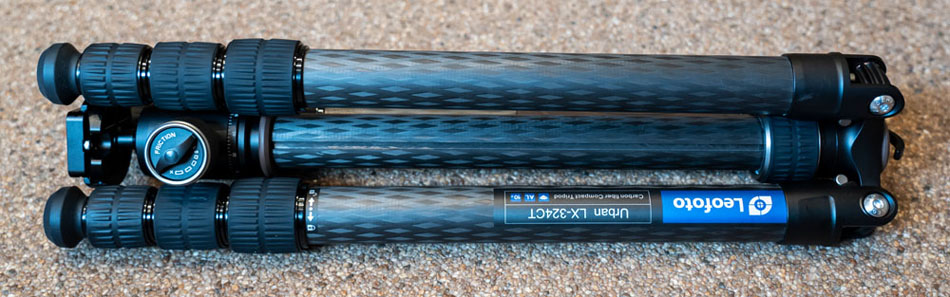
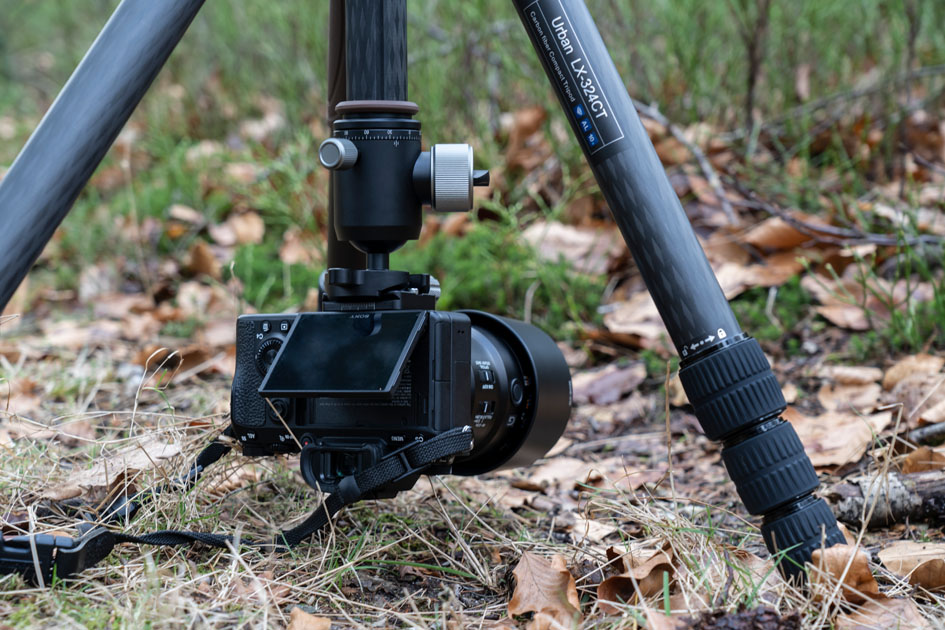
The fact that the legs can fold upwards was one of my requirements for a new tripod anyway. Since I swapped my heavy Nikon D4s with equally heavy lenses for the much lighter Sony equipment, I also have a flip-up screen on the back of the camera.
How did I ever manage without one? I can now hang the camera upside down from the centre column of a tripod while seeing what I have in the frame on the screen. Brilliant! This is also how the photo below was taken.

The tripod is also tall enough: 1.71 metres including the ball head when you raise the centre column.
I would not quickly raise the centre column outdoors because of the loss of stability, but without raising it, the tripod measures 1.44 metres including the ball head, with another approximately 10 centimetres added by the camera.
My eyes will be at around 1.55 metres, which means the tripod is tall enough for me.
The centre column can be removed and optionally replaced with a macro adapter, a short centre column, so you can work very close to the ground. The tripod legs can then be laid almost flat.
You will understand from the above that I am unlikely to use this very quickly because my current camera can be hung upside down from the centre column.
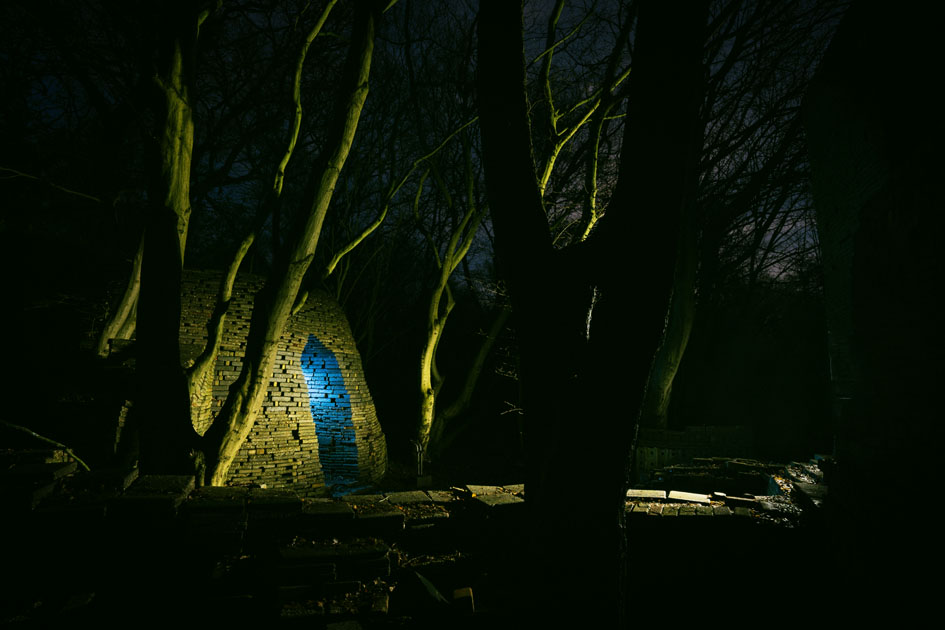
So much for the theory. How does the tripod work in practice? I decide to take it with me on two location-scouting trips through Friesland for my workshop 'Lightpainting in nature'. Into rugged areas full of mud and rocks.
What immediately stands out during the practical test is how easily and smoothly the four leg sections extend.
The rubber rings are nice and wide and provide a good grip. One turn and the lower leg slides easily out of the upper one, without falling out all at once. And tight is tight, one turn is enough to lock the legs again, very user-friendly!
I notice that I unconsciously keep quickly shortening the legs of this tripod whenever we move. Whereas I previously soon found that too much effort, the legs of this tripod move so smoothly that the barrier to doing this has disappeared. That is useful!
I find the operation of the small release buttons at the top, which allow you to spread the tripod legs further apart, less pleasant. You first have to fold the legs in slightly, then push the button down and keep it pressed (!) while unfolding the leg.
If you release the button, the leg stops unfolding at the next fixed angle at which the tripod legs lock into place, 85, 55 and 23 degrees. I feel like a real acrobat trying to do all this at once, especially when the camera is on the tripod. Perhaps it is just a matter of getting used to it?
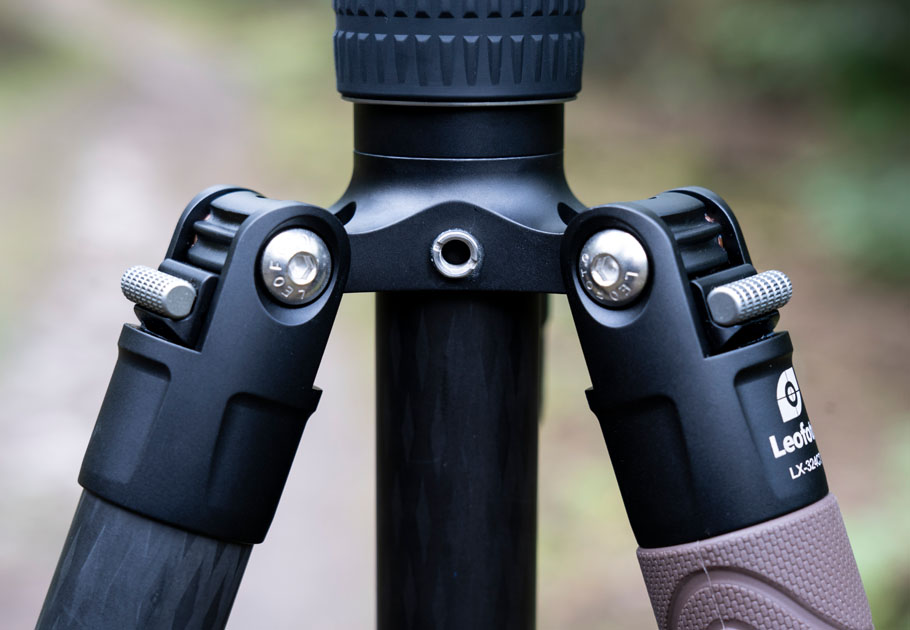
The legs have nice wide rubber feet that keep them stable on the ground. If you need them, metal spikes are also included to provide even more grip on certain surfaces. That is useful on a frozen lake or on a sloping hillside, for example.
The spikes are accompanied by a carrying case, a set of Allen keys, a multitool and the macro adapter mentioned earlier.
So far, I have no regrets about choosing this Leofoto tripod. But it is of course equally important to test whether the tripod head works well.
The question of whether I want a ball head or a three-way tripod head is quickly answered. A ball head! I spent far too much time fiddling with those levers on the three-way head in the past.
At first glance, Leofoto's ball head looks like a slim version of my Really Right Stuff ball head. A brand I once chose because it was the only brand that neatly held its position after being adjusted. Very useful when you have just framed something precisely!
With all the other brands, the ball would sink a few millimetres downwards with my heavy Nikon on it, which we call 'creep'. You therefore had to take this into account when framing.
And it was completely unworkable if the 'creeping' did not stop after a few millimetres. So I am very curious to see how this works with the Leofoto ball head.
First I put my Sony A9 on it with a 70-200mm lens. The ball head does not budge and remains neatly in position. Then the real test: an old heavy Nikon D3 with a 70-200.
I am genuinely amazed, the ball head really does not drop a single millimetre! I think that is a superb performance for this ball head, and even more so for a ball head in this price range.
The Really Right Stuff ball head currently costs 879 euros, while the Leofoto tripod WITH this Leofoto ball head costs 479 euros. For just over half the price of the RRS ball head alone, you get a solid tripod AND a good ball head!
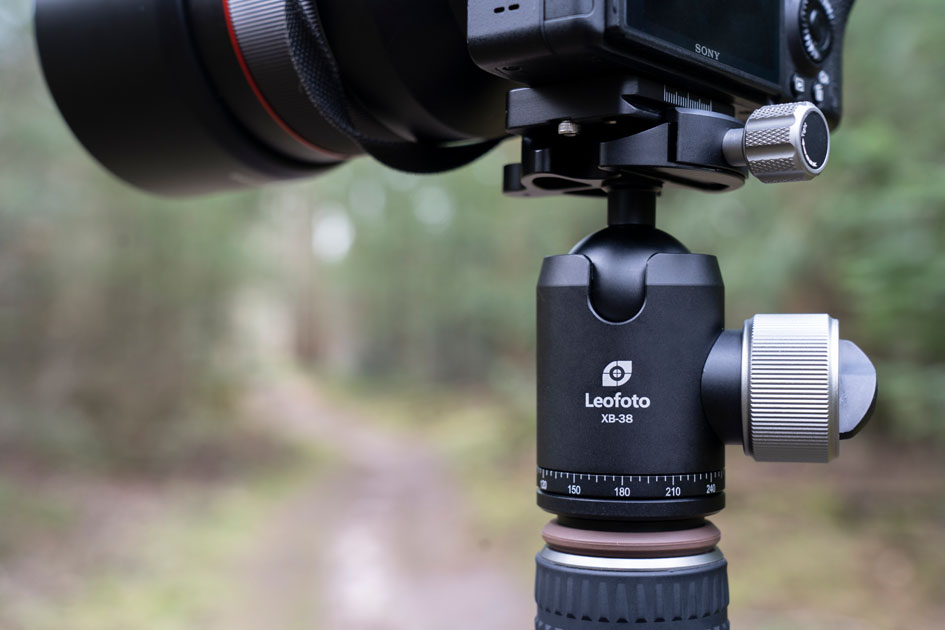
Why do I like this ball head? Firstly because it keeps your camera in the position you set, and secondly because the ball head is so easy to operate.
You set the position of the ball with the large knob. This also allows you to position your camera vertically using one of the notches. There is another smaller knob inside the large knob for adjusting the resistance of the ball.
You then rotate the camera on the plate using the lower knob, so you can position the camera in any direction while it is vertical without having to move the tripod.
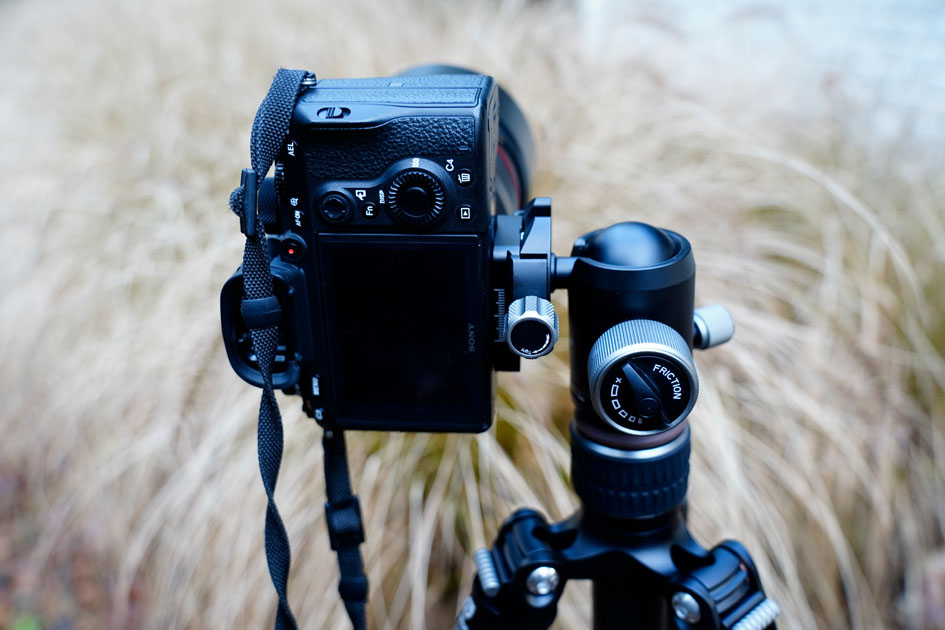
You attach the camera to the ball head using a quick-release plate that slides into a wedge and is tightened with a knob, just as with my Really Right Stuff, the Arca-Swiss system.
This works less easily and quickly than the Magic Ball's quick release, which locks the camera solidly in place with one click. But there is a reason why the Arca-Swiss system is used universally, it has certainly earned its reputation.
The only drawback I have encountered is that when I screw the quick-release plate under a student's heavy Nikon D5 and position the camera vertically, in portrait orientation, on the ball head, the camera and quick-release plate rotate relative to each other.
The camera therefore sinks downwards. Even when you tighten the quick-release plate as tightly as you can. So you run into the same problem as the one described above, with a ball head that cannot hold its position.
This can of course be solved by using an L-bracket. Note: when you buy an L-bracket, make sure that you can replace the battery and memory card without first having to remove the L-bracket!
When I disconnect the Nikon D5 and put my much lighter Sony A9 on the ball head with the same quick-release plate, everything works fine. The camera stays neatly in the set position.
Conclusion
The tripod meets the requirements I set beforehand. It is light yet sturdy. It offers sufficient height. The ball head does not drop and is easy to operate.
For my macro photography, I can hang the camera underneath the centre column. I do not first have to remove the centre column to turn it around, which was often a barrier for me when starting macro photography during a trip in nature.
Now comes the long-term durability test. I am very curious whether this tripod will last another 35 years too!
About the author
Liesbeth fotografeert met haar bedrijf stapfoto.nl voor websites van bedrijven. Daarnaast verzorgt ze al sinds 2004 (vooral creatieve) workshops zoals lightpainting, flitsen in de natuur, fine art, frozen flowers, paintsplash, infrarood, icm en multi exposure. Daarnaast is er een Stapfoto vakgroep voor de meer gevorderde fotografen.
You might also like
-
 Which is best: a ball head or a 3-way head
by Nando Harmsen
-
 Review: Benro geared head
by Martin van Rooij
-
 Setting up a ball head
by Nando Harmsen
-
 The World Through a Glass Ball
by Laura van der Burgt
-
 10 tips for light painting
by Liesbeth van Asselt
-
A tip for using telephoto lenses on a ball head
by Nando Harmsen
15 comments
-
 Hans wrote on Tuesday 2 February 2021 at 11:17 | reply
Dear Liesbeth, It is true, Leofoto makes fantastic tripods.
Translated from Dutch.
I myself have an aluminium tripod from Manfrotto that is 40 years old, impossible to break, a large carbon one from Manfrotto as well, also one for life.
A few years ago I got an intermediate solution from Leofoto for travelling: light, compact and very stable and affordable, although separate heads are quite pricey. Leofoto also has a nice compact table tripod, half a metre high, ideal for macro in forests and such.
Leofoto is the missing link among tripods, I am very satisfied with it. -
 Arend Jan Bolhuis wrote on Tuesday 2 February 2021 at 11:47 | reply
Dear Liesbeth,
Translated from Dutch.
Thank you very much for your article. It is very informative. I am looking for a new tripod and the Urban LX-324CT with XB-38 ball head from Lefoto would also be a good choice for me, if it weren't for the fact that it lacks something that is very important to me: a lever with which you can move the center column up and down. I now have to do that by loosening the clamp that secures the center column, but that is quite an annoying and laborious task. The strange thing is that I can't find such a tripod with a lever for the center column anywhere. Have you happened to come across one?
Kind regards,
Arend Jan Bolhuis -

 Donald Willemsen
wrote on Tuesday 2 February 2021 at 14:59
| reply
Donald Willemsen
wrote on Tuesday 2 February 2021 at 14:59
| reply
I only have a small budget and about 15 years ago I bought a tripod made in the Netherlands, including a tripod head (ball head) from the Redged brand. However, I am not happy with the ball head. When the camera is mounted and I put the camera in the right position for the photo, the camera always droops a little after tightening the ball head. So much for your composition.
Translated from Dutch.
It is an aluminium tripod where the centre column can be shortened and also placed upside down in the tripod. So you can get very low to the ground, which is quite convenient. It is also compact and not too heavy. It does lose a huge amount of stability when the centre column is in its highest position.
So the problem is mainly the tripod head. I am looking for another one, but how much is that going to cost me. Advice is welcome. -

-
 Liesbeth van Asselt
wrote on Tuesday 2 February 2021 at 15:36
| reply
Liesbeth van Asselt
wrote on Tuesday 2 February 2021 at 15:36
| reply
@Arend Jan, I know that Velbon has this kind of video tripod. Unfortunately, Velbon doesn't excel in stability....
Translated from Dutch. -
Liesbeth van Asselt
wrote on Tuesday 2 February 2021 at 15:40
| reply
@Donald, that is a problem for many tripod heads. Maybe a three-way head is an option for you? Try one out in a store when they open again!
Translated from Dutch. -
Liesbeth van Asselt
wrote on Tuesday 2 February 2021 at 15:46
| reply
Hi Jeannette, thx! It’s indeed incredibly handy to be able to hang your camera underneath the tripod! Before, I was always fumbling around removing the center column to get the tripod close to the ground, fortunately I don’t have to do that anymore!
Translated from Dutch. -
Donald Willemsen
wrote on Tuesday 2 February 2021 at 16:17
| reply
@Liesbeth, thanks for the advice. Here in Belgium the shops are open
Translated from Dutch.
-
Liesbeth van Asselt
wrote on Tuesday 2 February 2021 at 16:31
| reply
@Hans, for getting really close to the ground, for example on the beach when lightpainting, I now use the Leofoto Summit LM-362C. Super stable and robust little thing. See https://www.degreef-partner.nl/nl/leofoto-summit-lm-362c-carbon-statief.html.
Translated from Dutch. -
Liesbeth van Asselt
wrote on Tuesday 2 February 2021 at 16:35
| reply
Oh really? I keep hearing from course participants how strict Belgium is regarding the measures, but not in this respect... Good luck!
Translated from Dutch. -
 M.R. van Rijthoven wrote on Tuesday 2 February 2021 at 16:45 | reply
Great article! There's no arguing with the quality of this tripod, nor with the price of almost 500eu. Still, I'd like to mention a very affordable alternative: Rollei C5i Carbon Tripod for 129eu, which I've had pretty good experience with by now: amazingly nice little thing! (Before this I had Redget and Benro, considerably heavier and larger) Now I photograph with a panasonic lumix G9, whose lenses are on average quite a bit lighter, but the Rollei does a very good job for me in this combination (Especially considering the price).
Translated from Dutch. -
Donald Willemsen
wrote on Tuesday 2 February 2021 at 22:57
| reply
@Liesbeth Belgium not strict? Then you're mistaken. We are currently not allowed to leave the country under penalty of a €250 fine. So I can't go visit my family. We've already had a strict lockdown with closed shops twice. If you come from abroad, you have to get tested and undergo a mandatory 7-day quarantine. The number of new infections in the Netherlands is twice as high as in Belgium. In the Netherlands, action was taken too late, so the measures hit twice as hard. There's been a curfew here for months.
Translated from Dutch. -
 Mac wrote on Wednesday 3 February 2021 at 08:37 | reply
@Donald,
Translated from Dutch.
If you don't want your tripod head to drop a little further, you should get a geared head. It is a bit more expensive, but definitely worth it.
https://www.kamera-express.nl/#twn|?tn_q=geared
I have the Benro, and am very satisfied with it. it does work slowly of course, but you are working very accurately.
I myself have multiple tripods, such as with bags lenses etc, there simply isn't 1 that is suitable for everything.
have 2 heavy aluminium ones 1 small aluminium one, 1 carbon one and 2 table top tripods (and 2 monopods). -
Liesbeth van Asselt
wrote on Wednesday 3 February 2021 at 11:32
| reply
@Donald, I know that the measures are strict where you are, that's precisely why I was surprised that the shops are open. At least it gives you the chance to try out what works for you!
Translated from Dutch. -
Liesbeth van Asselt
wrote on Wednesday 3 February 2021 at 11:41
| reply
Dear M.R., which tripod suits you really depends on what you are going to use it for. For example, I give private lessons to someone who photographs handmade products for her website, and that can easily be done with the lightest and cheapest tripod available (provided you use a remote control/self-timer to prevent the tripod from moving when pressing the shutter button). If you work in rough conditions, you need a very stable (and therefore more expensive) tripod. And everything in between.... Fortunately, there is something for everyone!
Translated from Dutch.
Have your say
Please note: Articles older than a week can only be commented on by signed-in visitors.Would you still like to comment? sign in or create a free account.
Become a better photographer every week
A practical photography tip in your inbox every week.
39,079 photography enthusiasts already receive the tips! More about the weekly mail. Or keep up to date via  Facebook.

Elja Trum
Photofacts; everything to do with photography!
Would you like to take better photos and keep up with what is happening in photography? Photofacts publishes articles that teach you something about photography — from a product announcement to a practical shooting tip or a look at a website. Photofacts covers photography every day and is a hobby project of Elja Trum's that got out of hand. The articles are written by a team of volunteer authors. If you would enjoy writing one or more articles for Photofacts, do get in touch.More about PhotofactsPhotofacts is made possible in part by
