

Review: Benro geared head
Friday 4 February 2022, 15:51 by Martin van Rooij | 5,876 views | 5 commentsThis article was translated from Dutch with the help of AI. Read the original.
Taking photos handheld is fast and intuitive. If you want to work precisely, a tripod is the answer. Is that still not precise enough? Then the Benro geared head might be for you. Find out why in this review.
I watched Bas Meelker's Landscape Photography Masterclass with great interest. Whenever I take a course like that, I also want to know what equipment the photographer uses.
In the 14th video, Bas explains which tripod and ball head he prefers. That made me curious...
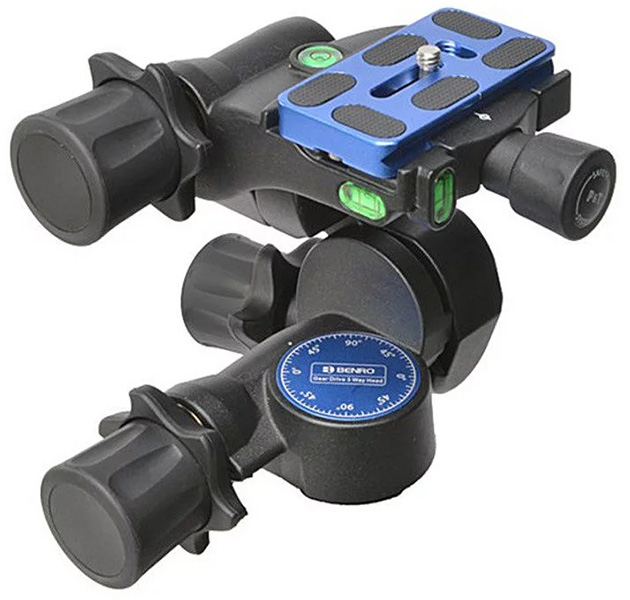
Geared head
Bas invariably mounts a striking tripod head with an unusual shape on his tripod: a so-called 'geared head', or a 'directed head' according to Google Translate, made by Benro. I wanted to try it out, and importer FotoVideoRetail made one available.
It is not that easy to attach your camera to a head like this and remove it again. Maybe that is because of my own inexperience, or because the head is still new. I would not be surprised if it becomes smoother over time.
As I went along, I worked out what works best for me (when photographing architecture). First, I hold my camera in my hand. Looking through the viewfinder, I determine roughly what a good composition would be. Once I have decided on the perspective, I set up my tripod.
It has a spirit level on it, so I first level the tripod as well as possible. I then mount my camera on the head and set the axes (horizontal, or level, tilt (tilting forwards or backwards) and finally the panoramic position (along the horizontal axis to the left or right).
Preventing distortion
From Jan Paul Mioulet's Architecture Photography course, I learned that it is important for buildings to be straight in architectural photography. This is particularly difficult with tall buildings.
You often need a wide-angle lens to fit them in the frame. If you tilt your camera upwards slightly, you get perspective distortion. Some people like that, but I do not. The vertical lines converge, making the building appear to fall backwards.
To prevent this, I use a tilt-shift lens. A tilt-shift lens is a specialist lens that allows you to prevent perspective distortion.
You first set up the image so that everything is straight. The camera is level and the vertical lines line up nicely with the grid in my viewfinder. The only problem is that just the lower part of the building is in the photo.
Then the magic starts. The lens has a wheel that allows you to move the lens upwards relative to the sensor, without changing the angle of view. Brilliant!

First, I level my tripod as well as possible using the built-in spirit level. I then mount the camera on the geared head.
Benro's geared head has three spirit levels, one for each of the three axes mentioned. Each axis can be adjusted with two knobs: one for quick, rough adjustments and one for fine-tuning.
Right. Everything is set up neatly. I then put my Nikon D750 into live view mode and check whether the camera really is level, as indicated by the spirit levels. To my surprise, it is not.
What should I trust now: the spirit level on the tripod or the spirit level in my camera?
Spirit levels: not very useful
I decide to contact Rick Roeven from FotoVideoRetail.
He emails:
'You are absolutely right, the spirit levels built into the head are only for guidance and are too small for genuinely critical camera adjustments. We always recommend using the camera's spirit level function (which almost every modern camera has), because it is much more precise and measures the angle of the camera/sensor itself rather than the angle of the head. This also prevents, for example, deviations in the mounting of the QR plate or anything similar.'
In short: those (small) spirit levels, which are also difficult to read, especially when your camera is mounted on your tripod, are not much use.

Christmas is approaching, so I decide to photograph kerstkransjes. Do not pay attention to sharpness, depth of field and so on, the point is to give you an idea of how the three axes work. In the first three photos, the kerstkransjes shift to the right, as it were.
The camera rotates around a central point along the horizontal axis. That horizontal axis remains unchanged, all the photos are level, and the camera does not tilt forwards or backwards. In fact, this is how you make a panoramic photo.

In the second set of three, the horizontal axis remains fixed again, so all the photos are level once more. The only difference is that I tilt the camera slightly downwards each time, which makes the kerstkransjes appear a little higher in the frame each time.

In the third set, I play with the horizon. The middle photo is level, but because I am not standing directly in front of the kerstkransjes, the grain in the tabletop slopes slightly down to the right.
It is even more pronounced in the first photo and less so in the third, where the grain is almost horizontal. And you have probably worked it out by now: I did not change either of the other two axes.
Advantages and disadvantages
Benro's geared head allows you to set your composition very precisely. You can adjust one of the three axes without affecting the other two. That is quite different with a 'normal' ball head. If you decide to change your position and unlock the head, you have to set everything up again.
With Benro's geared head, you can, for example, pan a little further to the left or right, or include a little more or less foreground in your photo, without affecting the other two axes. This may not be a spectacular advantage in macro photography, but it is very useful in landscape and architectural photography.
One thing also became clear to me: practice makes perfect. You gradually become more skilful at using the geared head. You make larger changes with the large knobs at the back. You then fine-tune the composition with the front rotary controls.
So much for the advantages. The geared head also has a few disadvantages. For example, the head and the quick-release plate for underneath your camera weigh around 750 grams. And my camera bag is already so heavy when I want to take all my lenses with me...
The Benro geared head also has an unusual shape. If you leave it on your tripod, the tripod no longer fits in its original tripod bag. And in your camera bag, it is an awkward thing to carry next to your expensive body and equally expensive lenses.
No documentation
Finally, the geared head really is for perfectionists who want to get the most out of their equipment, and themselves. But how are you supposed to do that with so little documentation?
The only thing I find is a tiny booklet in English and Chinese, with tiny lettering. There is also no decent Benro tutorial on, for example, YouTube. You can find useful tutorials by photographers there, though...
Rick from FotoVideoRetail responds: 'Benro does indeed provide very little information. This is something we are working on.'
Hopefully we will see the result of that soon, because if you can comfortably look back at how to operate the geared head and what advantages it offers, you can make a better assessment of whether it is right for you.
Conclusion
Do you want to take your photography, particularly your landscape and architectural photography, to a higher level? And do you have, or make, the time when you take photos? Then Benro's geared head is a useful addition to your photography equipment.
Do you prefer to work quickly, flexibly and handheld? Do you hate carrying heavy equipment? And would you rather correct any (perspective) errors later in Photoshop or Lightroom? Then another tripod head, such as a 'normal' ball head, might be a better choice.
The Benro GDW3WH costs 219.95 euros and is available from Camera.nu, among others.
About the author
Martin is een freelance tekstschrijver die ooit door een uitgever werd gevraagd interviews te combineren met portretfotografie. Die uitgever was tevreden over zijn foto's, hij niet. Martin ging cursussen volgen en investeerde in apparatuur en software.
You might also like
-
 Review: Sirui L324F with KS-G3 geared tripod head
by Nando Harmsen
-
 Which is best: a ball head or a 3-way head
by Nando Harmsen
-
 Setting up a ball head
by Nando Harmsen
-
 Review: Canon EOS R6
by Nando Harmsen
-
A tip for using telephoto lenses on a ball head
by Nando Harmsen
-
 Review: RRS PG-01 panoramic head for landscape photography
by Nando Harmsen
5 comments
-
 Mac wrote on Monday 7 February 2022 at 08:27 | reply
I find the story a bit confusing to read.
Translated from Dutch.
Don't know exactly where you're testing the Benro now when the shift lens.
I have one myself too, and use it a lot with macro photography. works very well, your camera no longer droops after adjusting it.
ps It's not a ball head, it's a geared head (3-way tripod head). It's better to refer to it as a tripod head. a ball head is a type of tripod head. -

-
 Peter van Dinther wrote on Tuesday 8 February 2022 at 12:07 | reply
I've been using this tripod head for landscapes and portraits for quite some time now. Very handy and you can work with it very precisely. Recommended.
Translated from Dutch. -
guest wrote on Tuesday 8 February 2022 at 12:47 | reply
I don't use the Benro but another alternative (Manfrotto), as this is almost always on my tripod, for landscape, architecture and studio table top photography. I can only recommend such a tripod head, maybe a ball head works faster but this type works much more accurately.
Translated from Dutch. -
 Martin
wrote on Tuesday 8 February 2022 at 14:59
| reply
Martin
wrote on Tuesday 8 February 2022 at 14:59
| reply
This morning I photographed with a ball head again for once. Architecture, where you want the vertical lines to be perfectly straight. A geared head like that is pretty heavy, but this morning I did miss it. It really works more accurately.
Translated from Dutch.
Have your say
Please note: Articles older than a week can only be commented on by signed-in visitors.Would you still like to comment? sign in or create a free account.
Become a better photographer every week
A practical photography tip in your inbox every week.
39,024 photography enthusiasts already receive the tips! More about the weekly mail. Or keep up to date via  Facebook.

Elja Trum
Photofacts; everything to do with photography!
Would you like to take better photos and keep up with what is happening in photography? Photofacts publishes articles that teach you something about photography — from a product announcement to a practical shooting tip or a look at a website. Photofacts covers photography every day and is a hobby project of Elja Trum's that got out of hand. The articles are written by a team of volunteer authors. If you would enjoy writing one or more articles for Photofacts, do get in touch.More about PhotofactsPhotofacts is made possible in part by
