

Photographing a volleyball match with a Nikon D500
Friday 21 October 2016, 15:15 by Rob Jansen | 10,434 views | 5 commentsThis article was translated from Dutch with the help of AI. Read the original.
For years, I have been the house photographer for volleyball club Trivos, taking photos of matches involving, among others, the first women's team. The photos are used on the club's website and various regional news sites, and occasionally in the local weekly newspaper.
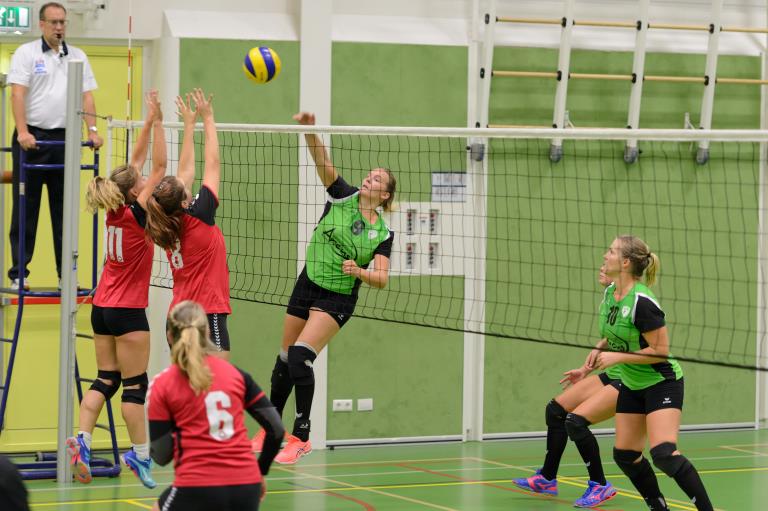
I use a Nikon D4 for this, combined with a Nikkor 70-200mm f/2.8 and 24-70mm f/2.8. Photofacts gave me the opportunity to try out the new Nikon D500. I was able to use the D500 for two matches.
Handling
As well as a Nikon D4, I also own a Nikon D750, so the D500 felt familiar when it came to handling. The only thing I had to get used to was the ISO button being in a different place. The new option to quickly review photos using the touchscreen is also useful, although it does take a little getting used to.
Difficult conditions
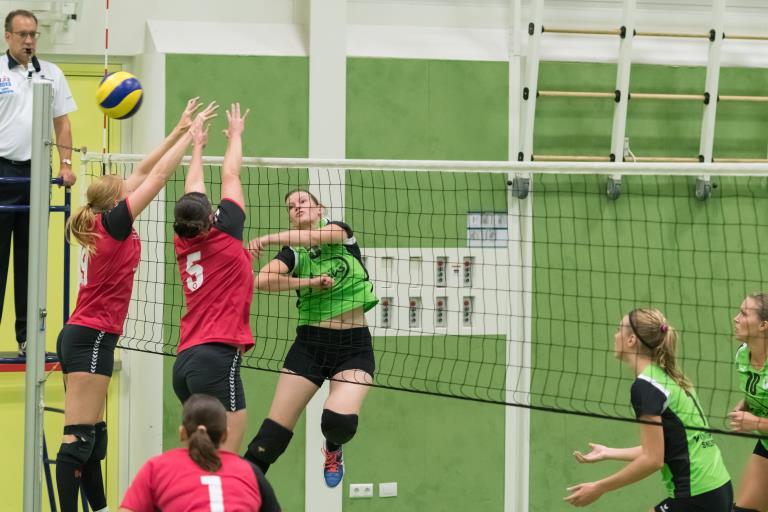
Volleyball usually takes place in sports halls where there is relatively little light. To freeze the fast movements properly, you need a reasonably fast shutter speed, preferably 1/400 or faster. This automatically means using a high ISO value, and you soon reach 1600 or higher.
Personally, I don't need the action to be completely 'frozen', and I actually like it when some movement is visible as well. With my Nikon D4 combined with fast lenses, this works fine, so I am curious to see how the Nikon D500 performs.
I am also curious about the new autofocus system and the speed of the Nikon D500, as well as the noise that occurs at high ISO values.
Focusing and speed
The autofocus is genuinely comparable to that of the Nikon D4, perhaps even a little better. The difficult thing about photographing volleyball is that the net is in the way and the action takes place just behind it.
Because you usually shoot with a small aperture, you only have a small area that is in focus. As a result, the action is often just out of focus while the net is sharp.
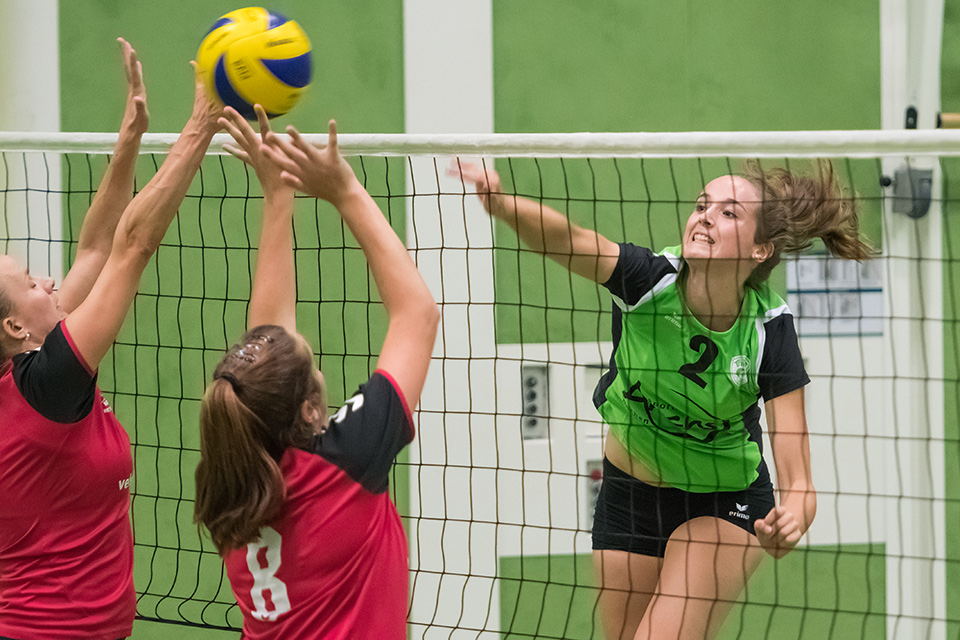
This takes quite a bit of practice. I use the AF-ON method, focusing with the AF-ON button and taking the photo with the shutter button. I tried out various Focus Tracking modes, but for volleyball I find it works best to use one fixed focus point together with the AF-ON method.
I think the other autofocus tracking modes work perfectly well for other sports such as football, athletics, motocross, and so on, but I have not photographed those yet. I also always use one fixed focus point for volleyball with the D4.
Burst mode
The burst mode of the Nikon D500 works perfectly and, at 10 frames, is ideal for sports photography. The focus also keeps up perfectly well, and as far as I am concerned it is comparable to the D4.
Noise at high ISO values
Because of the combination of a fast shutter speed and little light, you soon end up using a high ISO value. In this case, I am comparing it with a photo taken with the D4 under the same conditions, using an aperture of f/2.8, a shutter speed of 1/500 s, and ISO 3200.

When you look at the unedited files at 100%, you can see the actual noise. Sharpening and noise reduction are set to zero. Here we can see that the D4 clearly shows less noise. However, using noise reduction in Camera Raw or Lightroom still produces perfectly usable images.
For the D500 photo, luminance noise reduction was set to 39 and colour to 49. For the photo taken with the D4, luminance was set to 20 and colour to 35. Both photos were sharpened afterwards.
Conclusion
The D500 is extremely suitable for this sport and is Nikon's top camera in the DX range. It is fast, the autofocus is fantastic, and the noise is very acceptable at ISO 3200. If you want to shoot sports and action, this is the camera to go for, and it will also perform extremely well for the wildlife photographers among us.
About the author
Naast een full-time baan ben ik fotograaf met een passie voor concert, sport en portretfotografie zowel op locatie als in de studio. Op mijn website robjansenfotografie.nl kun je mijn werk zien.
You might also like
-
 Review: Nikon D850
by Rob Jansen
-
 Sports photography tip: The best position at a football match
by Nico Delmeire
-
 20 tips from sports photographer Nico Delmeire
by Michelle Peeters
-
 5 power tips for more exciting sports photos
by Huub Keulers
-
 Review: Book Sport Photography
by Michelle Peeters
-
 Nikon DSLR cameras, an overview
by Paul Oosterlaak
5 comments
-
 Hans Keijzer wrote on Tuesday 25 October 2016 at 12:49 | reply
Fixed focus point: isn't that actually just disabling AF and setting it manually; as we were used to via the distance ring/-meter/-feet indication on your lens?
Translated from Dutch. -
 guest wrote on Tuesday 25 October 2016 at 13:38 | reply
Well to be really honest I don't think this photo is sharp at all.
Translated from Dutch. -
 Wim Hendriks wrote on Tuesday 25 October 2016 at 14:42 | reply
what you're missing is "The" moment, you'll still need a fast camera of at least 14 frames per second.Nowadays that's not a problem with the new cameras.
Translated from Dutch. -
Hans Keijzer wrote on Tuesday 25 October 2016 at 16:51 | reply
Well, just a little longer...and then 16 fps.; then you can call yourself a filmmaker, right?...
Translated from Dutch. -

 Rob Jansen
wrote on Wednesday 9 November 2016 at 18:53
| reply
@ Hans, by Fix Focus point I mean that I only use 1 focus point which I lock.
Translated from Dutch.
This is my focus point that the camera automatically focuses on, In my case this happens when I press the AF-On button, as long as I keep the AF-On button pressed it keeps focusing, when I release the AF-On button, the focus is locked. The photo is only taken when I press the shutter release button. Focusing is thus disconnected from the release button and is called the AF-On method.
@ guest, you're right it comes across a little soft.
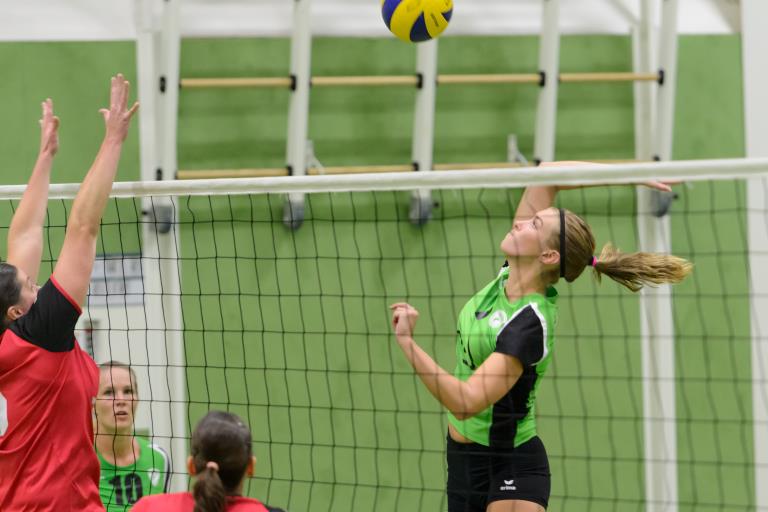
@ Wim, “The” moment is usually in the first photo for me, unfortunately that photo was not placed in the article, I had made a burst of 4 photos to show how fast the “burst” of the D500 is.
For volleyball it is in “Burst” mode for me, but the actions follow each other so quickly that you usually take 2 to 3 photos, of which the first is usually the best.
The editorial team will still place the photos.
Have your say
Please note: Articles older than a week can only be commented on by signed-in visitors.Would you still like to comment? sign in or create a free account.
Become a better photographer every week
A practical photography tip in your inbox every week.
38,733 photography enthusiasts already receive the tips! More about the weekly mail. Or keep up to date via  Facebook.

Elja Trum
Photofacts; everything to do with photography!
Would you like to take better photos and keep up with what is happening in photography? Photofacts publishes articles that teach you something about photography — from a product announcement to a practical shooting tip or a look at a website. Photofacts covers photography every day and is a hobby project of Elja Trum's that got out of hand. The articles are written by a team of volunteer authors. If you would enjoy writing one or more articles for Photofacts, do get in touch.More about Photofacts Photos





Photofacts is made possible in part by
