

Nikon DSLR cameras, an overview
Thursday 28 September 2017, 22:44 by Paul Oosterlaak | 13,931 views | 11 commentsThis article was translated from Dutch with the help of AI. Read the original.
Nikon is exactly one hundred years old this year. In that century, they have not only built a name, but also an enormous collection of cameras, lenses and accessories. In this article, I focus on their current digital SLR cameras.
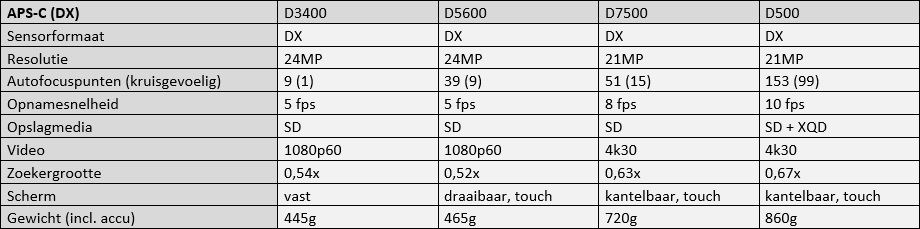
Let's start by putting the different lines and series into an overview.

The table is a guide, not an absolute truth that you have to use to pigeonhole cameras and users. Nothing is stopping you from using a Nikon D3300 professionally, although that is tricky, or from buying a D5 as your first camera. Just put it in P and get going!
These series share certain features, but also differ quite considerably in some respects.
D3000 series
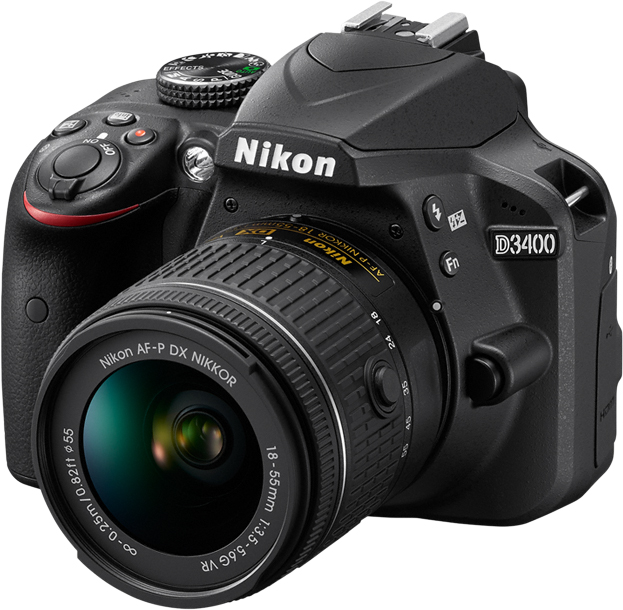
Many people who start taking photographs with a digital SLR choose a Nikon 3000 series. The image quality is excellent, the body is fairly light and the number of buttons is not immediately overwhelming.
This series also has a 'Guide' function. This guide makes it easier for beginner photographers to take the photo they have in mind.
If you want to work more manually with the exposure settings and focusing system, you can simply use the P, A, S and M modes for more control.
The latest new camera in this series is the Nikon D3400. In fact, it is a D3300 with the addition of SnapBridge to make sharing photos easier.
D5000 series
If you have a little more budget for a digital SLR, there is the D5000 series, which has a number of useful additions compared with the D3000 series.
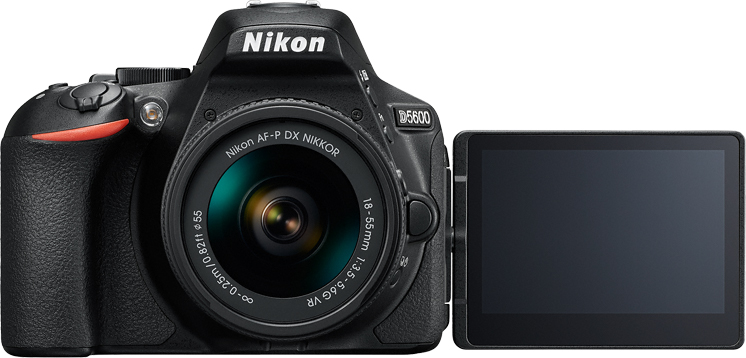
This series has a tilting screen, which is useful for low or high perspectives. It also has a more advanced focusing system, making it easier to 'track' a moving subject.
The D5600 is the latest version and is a D5500 with SnapBridge. The Nikon D5500 is no longer available, but its predecessor, the D5300, is still available and can be a good alternative to a D3400 if you can do without SnapBridge.
D7000 series
If you want more, and especially faster, control over your camera settings, you cannot really avoid the D7000 series.
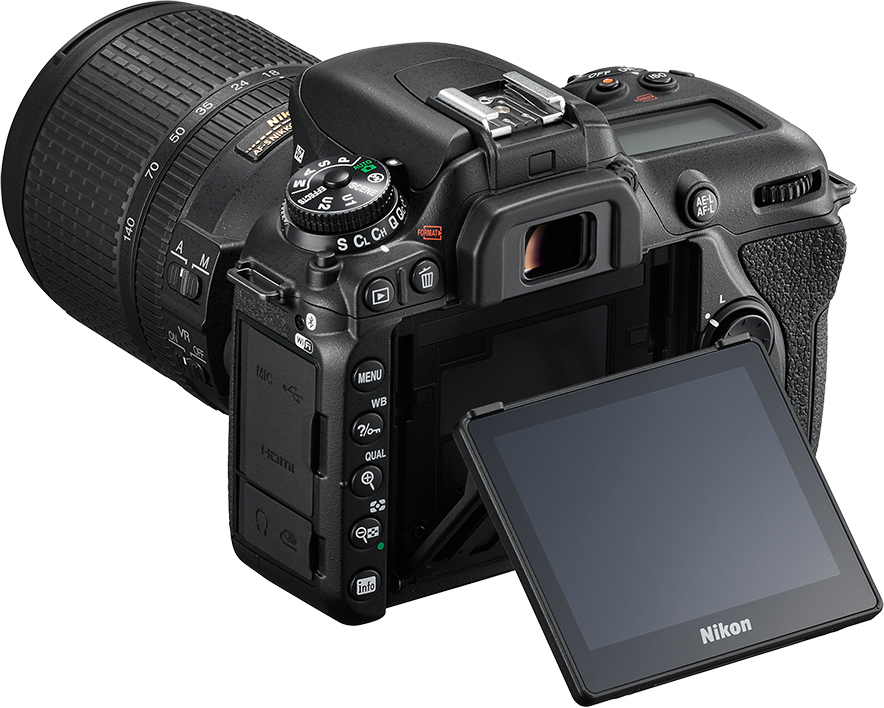
This series is characterised by two control dials, autofocus buttons, a robust body, a large bright viewfinder and a built-in focus motor for older AF-D lenses.
For several generations, the D7000 series has featured the excellent 51-point AF system. And apart from the D7500, these cameras have two SD card slots.
The D7500 is the first in the series to have a tilting screen, and it is also touch-sensitive. This was something many users missed in the D7000 series compared with the D5000 series.
D500
You could call the D500 a camera from the Dxxx series, with the D200 and D300(s) as its predecessors. Nikon enthusiasts had to wait a very long time for a successor to the D300s. Some had already given up hope and moved to a D7000 series, or made the step to FX with the Nikon D750.
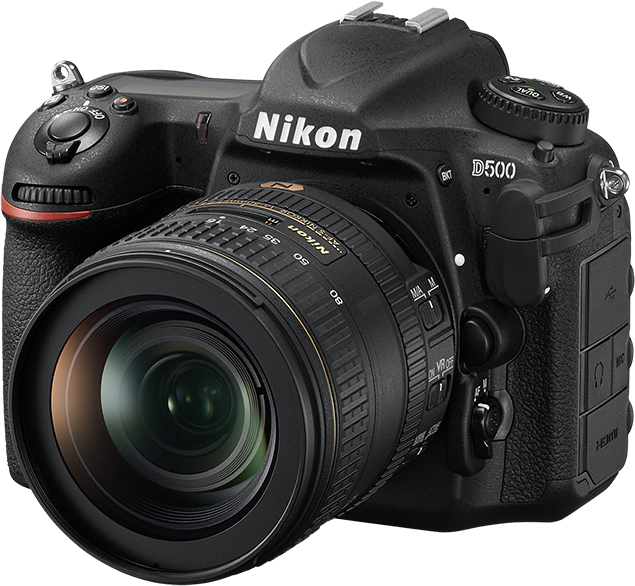
The D500 is the absolute top among APS-C cameras, with a brilliant AF system that contains not only 153 points covering almost the entire frame, but also algorithms for tracking a subject almost perfectly, at ten frames per second.
With the D500, Nikon showed that 'Pro' cameras can also be fitted with a tilting screen. This showed that they had every confidence that these screens would not simply break off or easily become defective in another way.
The D500's controls follow the same approach as those of other Nikon Pro DSLRs, with a mode button instead of a PASM dial. The D500 has an XQD and an SD card slot, and both are capable of clearing the buffer extremely quickly, with the right memory card, so in practice you can shoot 200 raw photos in a burst at 10fps.
D600 series
Many enthusiastic photographers want to move to full frame one day. To make this step less expensive, Nikon created the D600 series. The autofocus system was taken from the D5000 series, which is generally good enough for all-round use.
The body otherwise looks more like a camera from the D7000 series, with two control dials and an AF button. The D600 was plagued by oil spots on the sensor. Although this was solved by replacing the shutter, Nikon soon decided to replace the D600 with the D610, which differs only in its shutter mechanism.
The D610 has excellent image quality, with a wide dynamic range and good noise performance. If you do not need a tilting screen and rarely want to capture moving subjects, the D610 is a very good choice.

D750
The D750 is a true all-round DSLR with the familiar 51-point AF system, very good image quality, a smooth 6.5 fps and a nice, sturdy tilting screen. These are enough reasons why the D750 has been one of the most popular full-frame cameras of the past few years.
The focusing system and the 6.5fps with a deep buffer make it well suited to sports and wildlife photography. But the D750 will not let you down in a studio or at a wedding either.

D800 series
In 2012, Nikon introduced the D800 and D800E and surprised everyone with a very high resolution of 36MP. The sensor not only had a high resolution, but also a very wide dynamic range and excellent noise performance. The D800E version produced a little more detail because the AA filter was disabled.
The D800(E) was later succeeded by the D810, which could be set to ISO 64 for even more dynamic range. A special astro version was also released, the D810A, which was more sensitive to IR light and suffered less from noise at long shutter speeds. The D800(E) and D810 also have the 51-point AF system, but because of the 5fps in full frame, these cameras are somewhat less suitable for sports and wildlife photography.
The arrival of the D850 changed this. The speed increased to 9fps with a battery grip, at an even higher resolution of almost 46MP. To complete the package, the focusing system was upgraded to the 153 AF-point system from the D500/D5. This makes the D850 very probably the most all-round DSLR ever made.

D5
Nikon's flagship is currently the D5. Like its predecessors, the D5 has a built-in grip and the proverbial tank-like build to withstand all conditions.
With the D5 and D500, Nikon introduced its 153-point AF system with 99 cross-type AF sensors, capable of tracking unpredictably moving subjects, even in low light. The D5 can do this at 12fps.
The resolution is not particularly high at 21 megapixels, and the dynamic range does not break any records either, but the noise performance is very good in low light. This makes the D5 ideal for sports photography in poor lighting conditions, in a sports hall, for example.
The controls are similar to those of other Nikon Pro cameras, and the buttons can even light up so they are clearly visible in the dark. The battery seems never to run out, which goes some way towards justifying its high price.
You can choose two XQD slots for optimum performance, or two CF slots for better compatibility with existing equipment and memory cards.

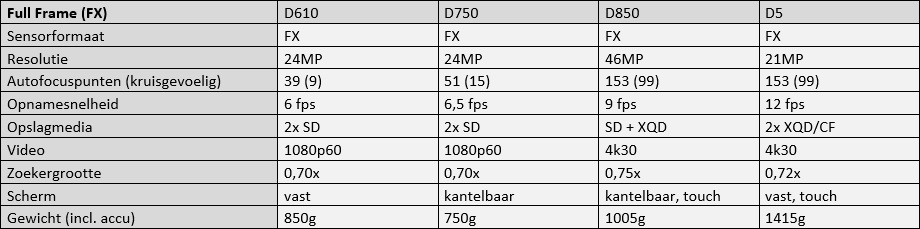
Specifications
I have listed a few specifications for the current models.
About the author
Paul Oosterlaak heeft een voorkeur voor landschappen, portretten en evenementen. Hij fotografeert sinds 2008 en sinds 2016 werkt hij ook in een fotozaak. Met zijn natuurkunde achtergrond houdt hij zich vaak bezig met de technische kant van fotografie, zonder daarbij de creatieve kant uit het oog te verliezen. Paul is te volgen op instagram
You might also like
-
 6 Reasons to Stick with a DSLR and One Reason Not To
by Nando Harmsen
-
 DSLR lenses are still perfect
by Nando Harmsen
-
 Nikon D780 announced
by Elja Trum
-
 Review: Nikon ZR
by Nando Harmsen
-
 The new Nikon Z6 and Z7 mirrorless cameras
by Elja Trum
-
 Nikon unveils its new DSLR: the D6
by Michelle Peeters
11 comments
-

-

 Paul Oosterlaak wrote on Friday 29 September 2017 at 19:36
| reply
When I look at the controls, it's not a pro body. Just another PASM dial with an Auto mode, scene mode and effects mode on it. That's not a pro body in my eyes.
Translated from Dutch. -
hypofocus
wrote on Saturday 30 September 2017 at 11:37
| reply
So the fact that it has a certain type of dial weighs more heavily than what Nikon itself has to say about it?
Translated from Dutch.
Nikon itself lists it in the group for pro bodies for NPS requirements, and on the general site they have also clearly put the label 'PRO' next to it.
As far as operation, weather sealing and other specifications go, it really is obviously a pro body.
For the pro who, for example, doesn't need the high fps of the D5, the D750 was a logical choice for a very long time, and was extremely much cheaper. Weather sealed, direct operation with buttons, programmable buttons/menu, fastest AF apart from the D4s/D5 models (until the D500 came along)... Everything points to a pro body. Along with an extra function/option for scenes. That isn't a shortcoming, but an extra, which no pro will have any problem with.
And I think Nikon is being smart with that; there are a lot of people (hobbyists) who have "a lot" to spend and, thanks to that scene mode, might be happy to spend more on a D750 than on, for example, a D610 or DX model. They don't buy a D5 that easily now, because they may not have the knowledge to set everything manually. With the D750, they have a wonderful toy at home, which they can actually do something with without first having to take all kinds of courses or read books.
If you then want to nitpick about control buttons; with the D500 you have to set the ISO by first pressing an ISO button; it can't be done directly via a dial. Then, according to your reasoning, that one should also immediately be downgraded to a hobby or semi-pro body. THAT is something you really do have "trouble" with in operation as a professional every day.
Nikon did release the D750 officially as a pro body, at any rate. For clarity in an overview like this, it might be useful to stick to Nikon's own recommendations/view. Otherwise people will read here that it is semi-pro, and on more or less all other sites that it is a pro body. That doesn't provide clarification, but rather confusion. -
 Mt. Olympus wrote on Saturday 30 September 2017 at 12:47 | reply
Am I ever glad that, according to the author's definition, I own a pro body! Not a Nikon, of course, but still....
Translated from Dutch. -
Paul Oosterlaak wrote on Saturday 30 September 2017 at 18:31
| reply
@hypofocus: "And I think Nikon is being smart with that; there are plenty of people (hobbyists) who have "a lot" to spend and thanks to that scene mode might be happy to spend more on a D750 than on, for example, a D610 or DX model. They aren't buying a D5 so easily right now, because they may not have the knowledge in-house to set everything manually. With the D750, they have a wonderful toy at home, which they can actually do something with without first having to take all kinds of courses or read books."
Translated from Dutch.
This is exactly what I mean by semi-pro: you appeal to both professionals and enthusiastic consumers.
But anyway, I could discuss this for another hour (among other things, Nikon's controls, because you also have to use multiple buttons to change the AF), but strangely enough Nikon uses the Pro title for this camera.
I will adjust it. Thanks for the clarification. -
 Theotje wrote on Tuesday 3 October 2017 at 17:24
| reply
I'm verrry satisfied with my DF which isn't mentioned
Translated from Dutch.
greetings Theo -
 Mario Kloostra wrote on Tuesday 3 October 2017 at 18:37 | reply
If Nikon has now also made a reliable camera with the new D 850 we're getting somewhere.
Translated from Dutch.
My experience with the D 700 and also the D800 was a catastrophe ,many times the camera,s were sent back and eventually Nikon reimbursed the amount of my last D 800 and I took a D 750 because I have three professional Nikon lenses I had to stay with Nikon! -
Paul Oosterlaak wrote on Tuesday 3 October 2017 at 19:21
| reply
The Df is a real niche camera for enthusiasts, so I left it out.
Translated from Dutch. -
 cor wrote on Wednesday 4 October 2017 at 11:40 | reply
Maybe you can advise me I have a Nikon D3100 and I want another body I photograph holidays and airplanes which body should I get I would like to hear it from
Translated from Dutch. -
 Robert wrote on Wednesday 4 October 2017 at 18:40 | reply
Both my D700s have been doing great for years. What you see is what you get and I still think that's super. Sports, portrait, studio and more of such, it keeps doing great. And enlargements. ....there is even a car covered with a photo. Wow, that's sharp, said the sticker applicator. And I ....had a smile.
Translated from Dutch.
With photo-shooting regards Robert -
Paul Oosterlaak wrote on Thursday 5 October 2017 at 10:15
| reply
@cor: what do you miss in your D3100 and which lenses do you use?
Translated from Dutch.
@Robert: the D700 paired with a good one naturally performs excellently.
Have your say
Please note: Articles older than a week can only be commented on by signed-in visitors.Would you still like to comment? sign in or create a free account.
Become a better photographer every week
A practical photography tip in your inbox every week.
38,839 photography enthusiasts already receive the tips! More about the weekly mail. Or keep up to date via  Facebook.

Elja Trum
Photofacts; everything to do with photography!
Would you like to take better photos and keep up with what is happening in photography? Photofacts publishes articles that teach you something about photography — from a product announcement to a practical shooting tip or a look at a website. Photofacts covers photography every day and is a hobby project of Elja Trum's that got out of hand. The articles are written by a team of volunteer authors. If you would enjoy writing one or more articles for Photofacts, do get in touch.More about PhotofactsPhotofacts is made possible in part by
