

Review: RRS PG-01 panoramic head for landscape photography
Friday 26 March 2021, 20:02 by Nando Harmsen | 5,146 views | 0 commentsThis article was translated from Dutch with the help of AI. Read the original.
Sometimes the widest wide-angle lens is not wide enough to capture your landscape. You can then create a panorama. But what if you actually want to photograph 360 degrees all around you? That is when a proper panoramic setup comes in handy. In this article, I look at the Really Right Stuff PG-01 panoramic head.
For a regular panorama, it is a good idea to use a nodal slide. This puts the rotation point in the right place, allowing you to prevent parallax errors. I wrote an in-depth article about nodal slides, if you would like to know more about them.
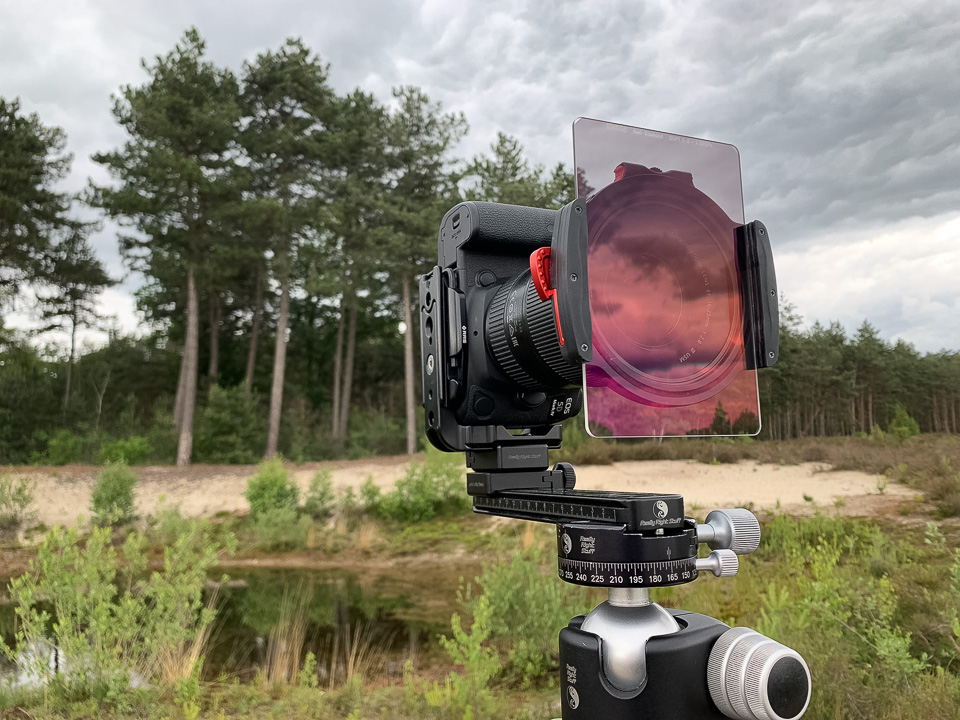
This type of nodal slide helps you create a perfect panoramic photo. However, it is only suitable for a single row of photos. If you want to create a panorama with multiple rows, you will need to tilt your camera up and down.
Tilting up and down does not come without consequences. You cannot avoid parallax then either. As you may have guessed, you will need some kind of nodal slide for this too. Do you have one? Then you can create panoramas not only 360 degrees around, but also 180 degrees in the vertical direction.
Rotating around your nodal point
With a panorama consisting of one row of photos, it is easy. You position the camera so that your nodal point is above the rotation point. That is what you need the nodal slide for. You rotate the camera and take photos with about 30% overlap.
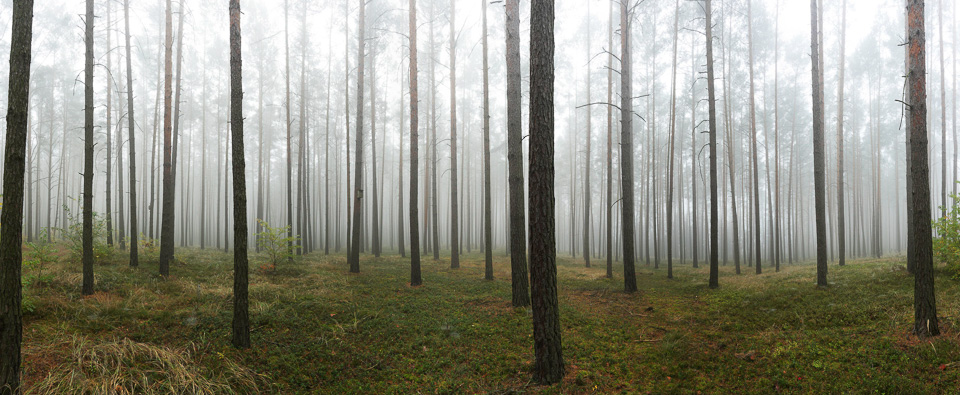
If you want to create multiple rows of photos, a multi-row panorama, you need to tilt the camera, and this must also be done around the nodal point. The camera must be able to rotate freely in all directions around that nodal point.
A good panoramic head ensures that the nodal point stays perfectly above the rotation point, regardless of the direction in which you rotate the camera. This prevents you from having to tilt the tripod head, which would inevitably cause parallax distortion.
The Really Right Stuff PG-01
The American brand Really Right Stuff, abbreviated to RRS, specialises in tripods, tripod heads and everything related to them. RRS has several solutions for creating so-called multi-row panoramas. One of them is the PG-01 panoramic head.
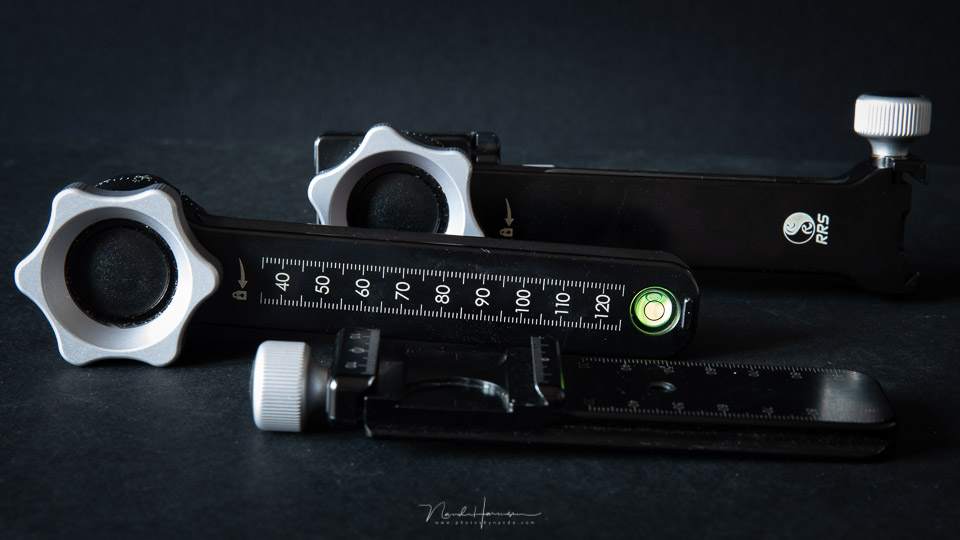
The PG-01 stands out because it is a very compact, small and modular system. You use it on your existing tripod or ball head. There are several basic models available, including one with a leveller, a useful tool for positioning your panoramic head perfectly horizontally.
I chose the version without a leveller, as I use the PG-01 on my existing ball head. In principle, there is no need to have two options for levelling your system, although it does no harm either.
The system consists of a horizontal rail with a rotation knob, a vertical rail with another rotation knob, and a nodal slide. They can be taken apart, making the set easy to take with you. Altogether, it weighs about half a kilogram.
Like everything from RRS, it is a real piece of craftsmanship, perfectly designed and without any compromises. There is a small Allen key in the vertical rail, held in place by a strong magnet. You therefore always have your tool with you.
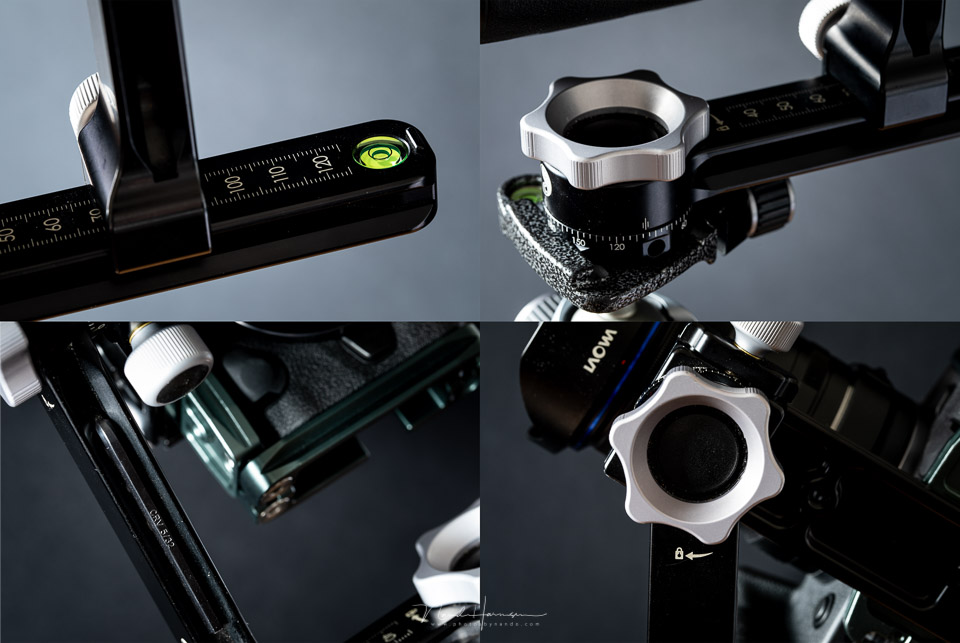
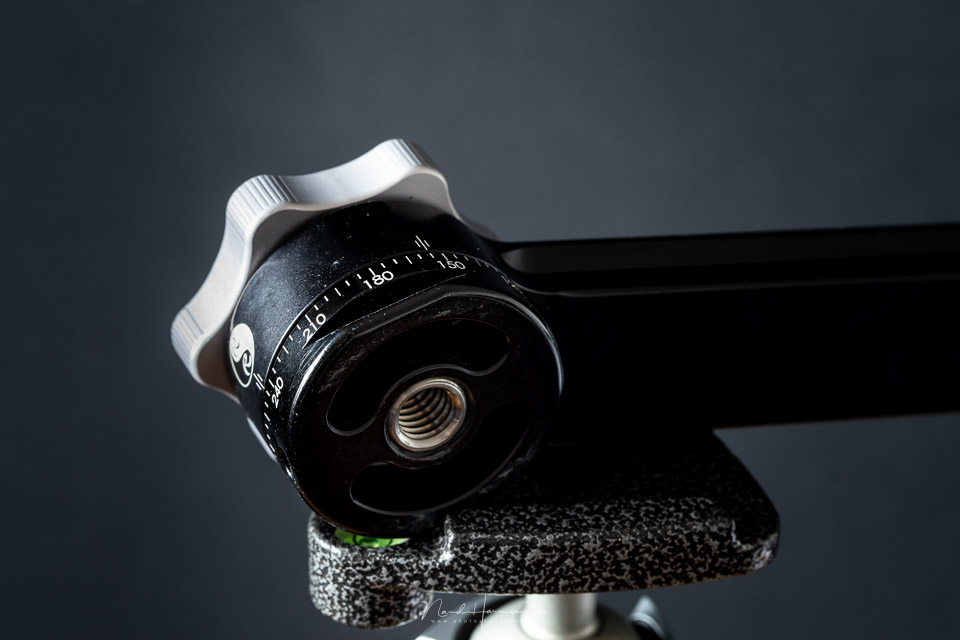
Each rail and the nodal slide have a clear scale. The horizontal rail also has the essential spirit level bubble at the end of the rail. This allows you to level the ball head very accurately.
Setting up the RRS PG-01
Because it is a modular system, you have to assemble everything at the place where you are going to create the panorama. It is a good idea to find out in advance where the nodal point of your lens is. The scale on the PG-01 then makes it easy to set everything up quickly and efficiently.
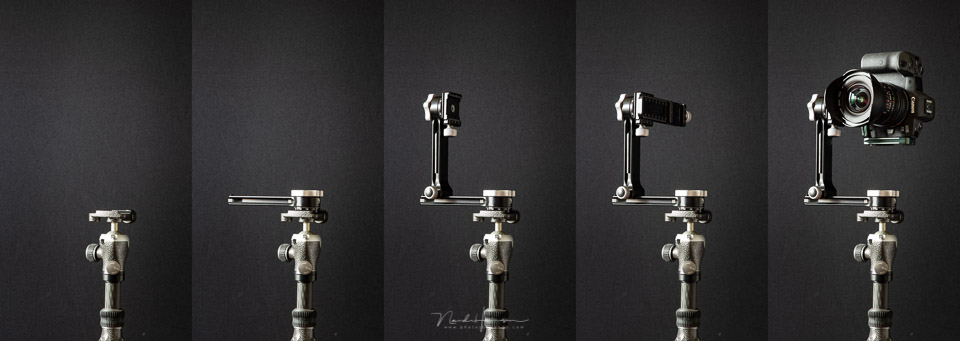
Most of the work is levelling your panoramic head. This is essential for a good and accurate panorama. A ball head is certainly recommended here, but a three-way head is also possible. The spirit level bubble is excellent for getting the horizontal rail truly horizontal.
Levelling your tripod head horizontally takes the most work. It is a good idea to rotate the rail and check the alignment in different positions. Once you have done this, you can set up the rest
The position of the vertical rail depends on your camera, and it is simply a matter of making sure that the centre of the lens is exactly above the rotation point. You can also work this out at home at your leisure, after which it is simply a matter of placing it at the correct distance. The scale is there for a reason.
Finally, you attach the nodal slide, with the camera on it. Position the camera vertically, which is obvious if you have a regular Arca-Swiss tripod plate on your camera. Anyone with an L-bracket could also position the camera horizontally.
In practice
With the RRS PG-01, you can photograph 360 degrees around you without parallax, and with the camera at any desired angle. This means you can create not just one row of photos, but several rows above one another. Or one where the horizon is not exactly in the centre.
If you want a true 360/180-degree photo, you need a number of zenith, straight up, and nadir, straight down, photos. The RRS PG-01 lets you do this without any problems.
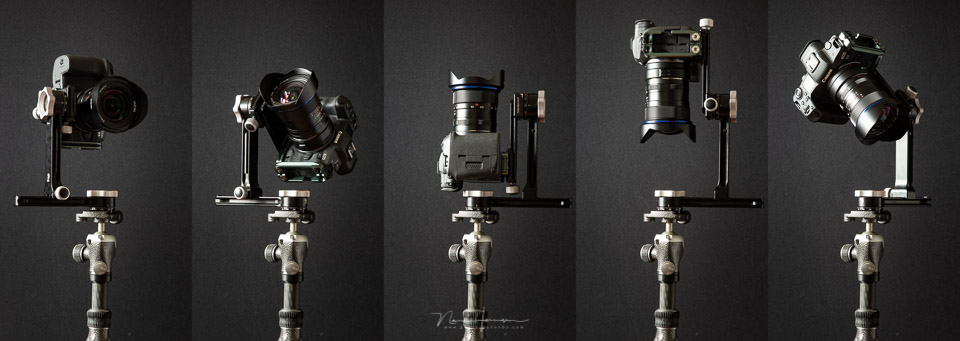
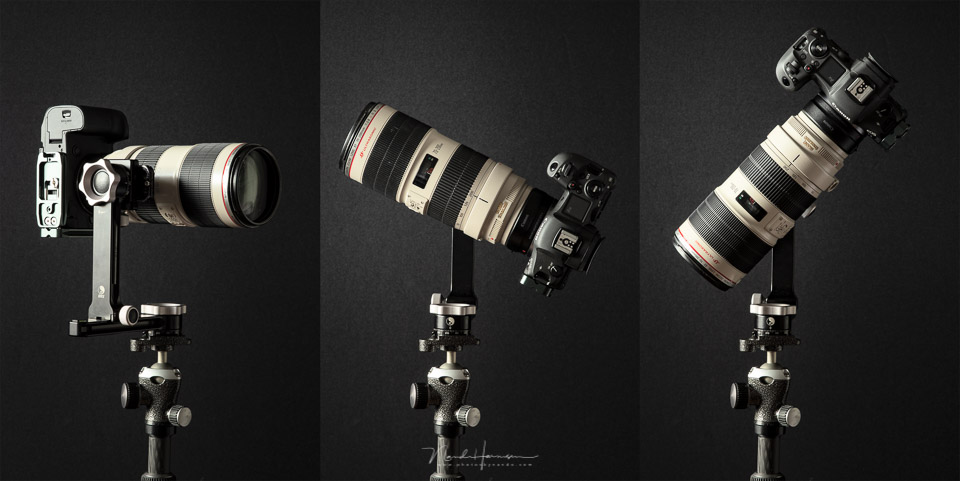
The RRS PG-01 is not suitable for really large cameras, although I have used the PG-01 with a Canon EOS 5D mark IV for years without any problems. I see this compact panoramic head as particularly suitable for mirrorless cameras, which are generally smaller in size.
If you want to create 360/180-degree photos, a long lens can cause problems. The longer your lens becomes, the further the nodal point will be from the camera. If it is too far forward, the camera will hit the base of the RRS PG-01 when rotating vertically.
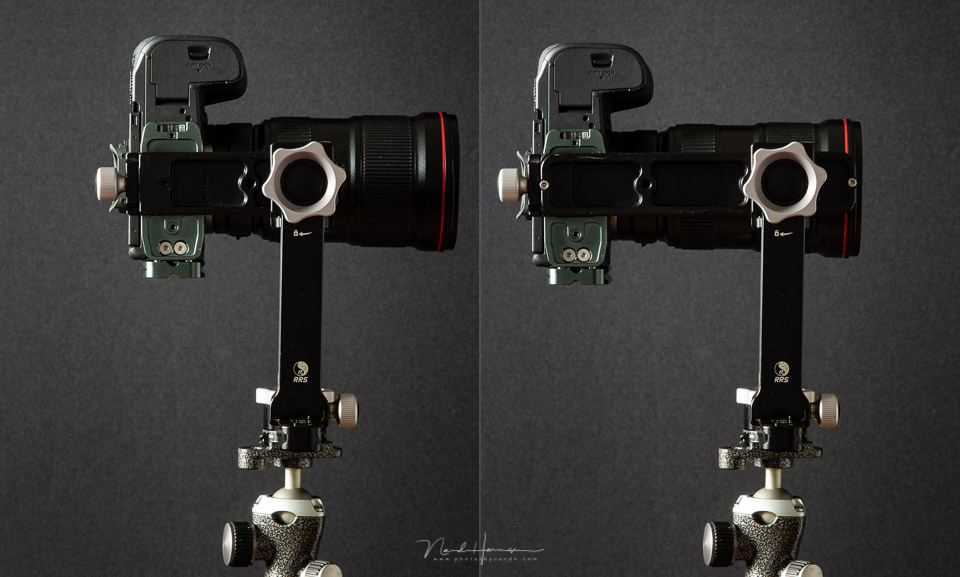
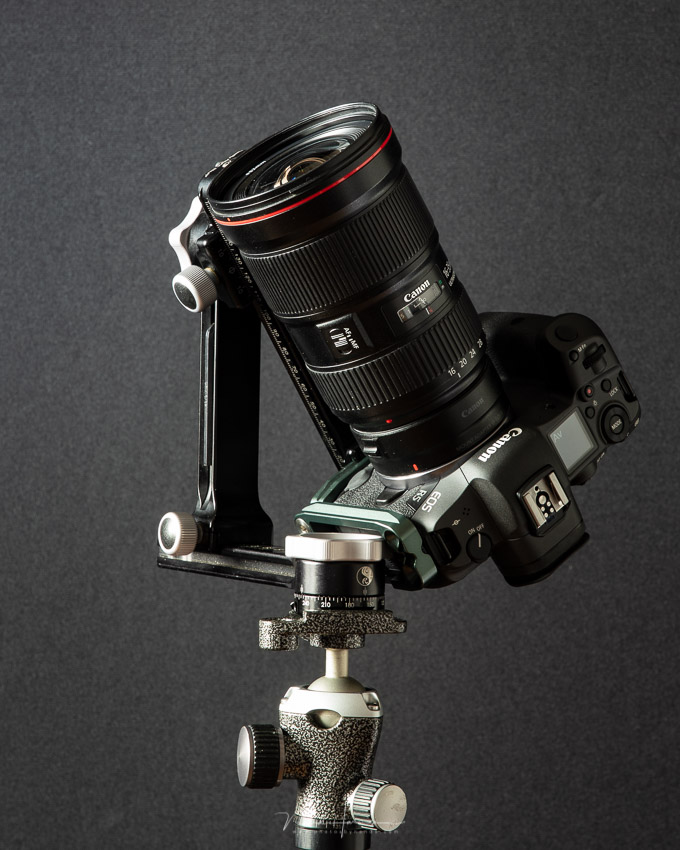
This is naturally a consequence of the compact design, which means that the vertical rail is not high enough. A small, compact ultra-wide-angle lens is particularly recommended for 360/180-degree shots. The photos show a Laowa 12mm ultra-wide-angle lens that meets these requirements.
If, however, you want to create a multi-row panorama with a telephoto lens, the compact design of the RRS PG-01 does not cause any problems. Such panoramas are rarely, if ever, made 360/180 degrees around.
The RRS PG-01 can carry 3.6 kilograms, more than enough for a substantial DSLR with a suitable lens. You can use a 70-200mm f/2.8 lens without any problems for a high-resolution multi-row panorama. You just will not be able to go 180 degrees in the vertical direction.
Conclusion
I have been using the RRS PG-01 for several years now. It is a very compact set that easily fits in your bag. This means you always have the option of creating a perfect panoramic photo. That could be a high-resolution multi-row panorama or a 360/180-degree panorama.
The panoramic head is of perfect quality, made from high-quality materials. Everything fits together seamlessly. There is no play at all, even after years of use. That is reassuring, as you are entrusting an expensive camera and lens to this system.
The PG-01, like all other RRS products, is based on the Arca-Swiss system. If you do not have this, you will need a tripod plate from this system for your camera.
The base of the PG-01 can be attached to any tripod connection. It has a 3/6" thread, which can easily be adapted to 1/4" with an adapter if necessary. This also allows you to attach your tripod's plate to it.
What I really like
- Exceptionally robust and perfectly finished
- Compact and lightweight
- Modular design
- Easy to take with you, always at hand
- Built-in spirit level bubble
- An Allen key is hidden magnetically in the panoramic head
- Easy and flexible to use
- Load capacity up to 3.5 kilograms
- Can be used with a 70-200mm lens without any problems
- Very good value for money
- Can also be used, to a limited extent, as a gimbal head
What I like less
- Less suitable for large DSLR cameras
- The vertical rail is not high enough for large lenses
- Horizontal alignment can be difficult
- No carrying pouch included
- Relatively expensive
- Hard to obtain
Alternatives
There are, of course, alternatives to the RRS PG-01. Brands such as Caruba, Jobu and Falcon Eyes have similar systems. However, the prices of these systems are almost the same as that of the RRS PG-01. They are larger and heavier, though, making them less suitable for simply taking with you,
From that perspective, the value for money of the RRS PG-01 is not bad at all. Based on my experiences with RRS tripod heads, L-brackets and other products, I think it is more than worth the price and the waiting time for delivery.
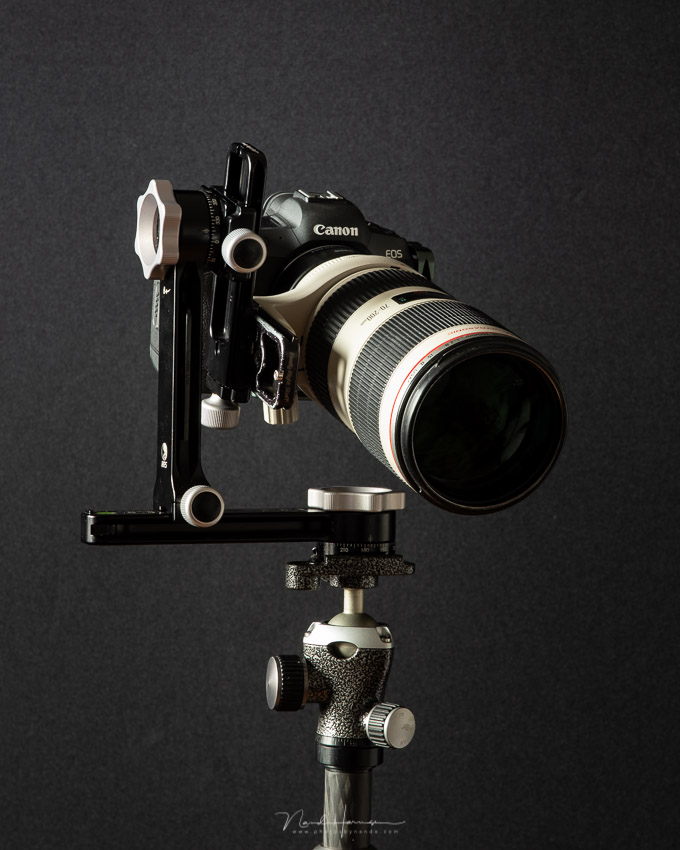
Incidentally, do not make the mistake of confusing this product with a gimbal head. Although the RRS PG-01 can be used as one, provided you stay within the maximum permitted weight, a proper gimbal head cannot be used to create a panorama without parallax.
About the author
Nando Harmsen has been photographing for more than 40 years. He specialises in wedding photography and landscape photography. Nando also gives talks, workshops, masterclasses and photo trips, and regularly reviews new and interesting equipment.
You might also like
-
 Improve your panorama with a nodal slide
by Nando Harmsen
-
 When to use which type of panorama?
by Nando Harmsen
-
The Biggest Disadvantage of a Panorama
by Nando Harmsen
-
A panorama or a panorama crop?
by Nando Harmsen
-
 Review: Benro geared head
by Martin van Rooij
-
 Review of the handy Haida Magic Stick-It Wrapper Cloth
by Nando Harmsen
0 comments
Be the first to share what you think!
Have your say
Please note: Articles older than a week can only be commented on by signed-in visitors.Would you still like to comment? sign in or create a free account.
Become a better photographer every week
A practical photography tip in your inbox every week.
38,982 photography enthusiasts already receive the tips! More about the weekly mail. Or keep up to date via  Facebook.

Elja Trum
Photofacts; everything to do with photography!
Would you like to take better photos and keep up with what is happening in photography? Photofacts publishes articles that teach you something about photography — from a product announcement to a practical shooting tip or a look at a website. Photofacts covers photography every day and is a hobby project of Elja Trum's that got out of hand. The articles are written by a team of volunteer authors. If you would enjoy writing one or more articles for Photofacts, do get in touch.More about PhotofactsPhotofacts is made possible in part by
