

The Sony RX100 VI in practice
Friday 8 June 2018, 14:07 by Elja Trum | 11,799 views | 5 commentsThis article was translated from Dutch with the help of AI. Read the original.
Last Tuesday, Sony announced a new high-end compact camera: the Sony RX100 mark VI. The sixth version in the series has a striking optical range of 24 to 200mm. I got to use this new camera in beautiful Venice.
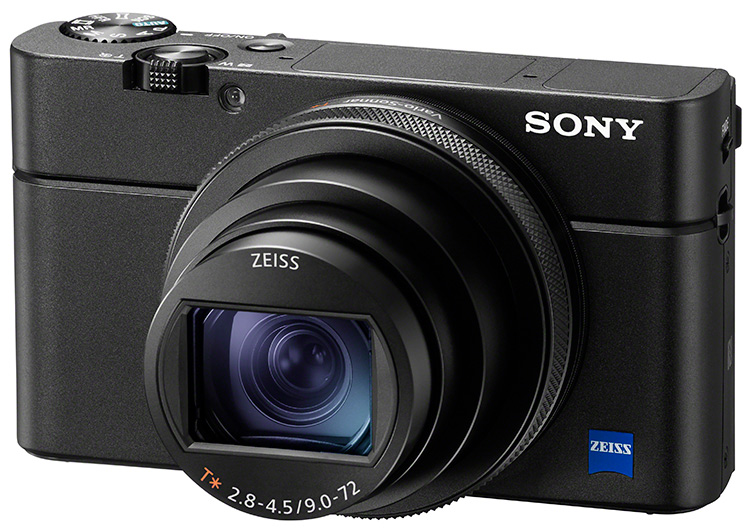
Sony RX100 mark VI specifications
- 20.1-megapixel Exmor RS stacked CMOS sensor (1-inch format)
- 24-200mm lens (15 elements, 12 groups)
- 315-point phase-detection autofocus (0.03-second autofocus time)
- 24 frames per second
- 4K HDR video
- Slow motion up to 1,000 frames per second
- Tilting touchscreen display
- XGA OLED pop-up electronic viewfinder
There are quite a few nice improvements compared with its predecessor. Many of these involve the camera's autofocus speed, for example with eye tracking and tracking moving subjects.
The greater optical range really stands out. Previously, the lens was a 24-70mm (35mm equivalent). The disadvantage of the greater optical range is that the maximum aperture has decreased. On the mark V, this was f/1.8-2.8, while on the mark VI it is f/2.8-4.5.

In the photo above you can see a, otherwise rather uninteresting, photo I took at 24mm. I then zoomed in on the building in the centre of the photo from the same position.
You can see the result below. So 200mm really is a substantial range. That's something you don't immediately expect when you see how compact this camera is.

Travel camera
The new Sony is very suitable for holidaymakers. The camera is incredibly compact. I walked around Venice with the camera strap around my wrist and the camera in my hand.
You can easily walk around with it for hours. The camera is very solid and feels good in your hand. This also means you always have it ready for those moments when you want to take a quick photo. There are more than enough of those moments in this beautiful city.

As you would expect from Sony sensors, this sensor also has a nice wide dynamic range. You can easily take photos containing bright sunlight and dark shadows in the same image.
All the photos in this article are unedited and straight out of the camera. I only resized them for inclusion in this article.
Convenience
The RX100 is perfectly capable of determining a good exposure itself, although some photos look a little dark to me. You can also use shutter priority, aperture priority or fully manual mode. You can turn the ring around the lens, and its function changes depending on the mode, allowing you to set different elements.
The control ring works very nicely in practice. It's a great way to adjust the settings to your liking.
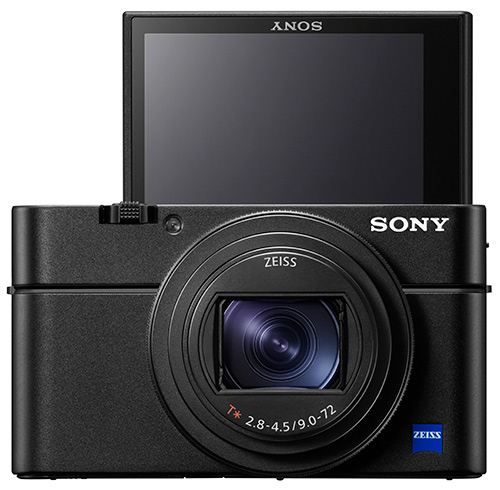
The tilting screen is useful too. You can easily hold your camera above your head or close to the ground while still being able to compose your shot properly. There is also a selfie mode if you tilt the screen far enough to see the image from the front of the camera.

Compared with a smartphone
My biggest doubt about this camera is how it compares with a smartphone. One very nice thing about this Sony is that it's easy to take with you. Your smartphone is even easier to take with you, though. In fact, you already have it with you anyway.
For its purchase price of 1,300 euros, you can also buy the top-of-the-range iPhone X. I still have an iPhone 7 myself, which is now a somewhat outdated model.
I took a roughly comparable photo with both the RX100 and my iPhone 7. You can see both unedited photos below.
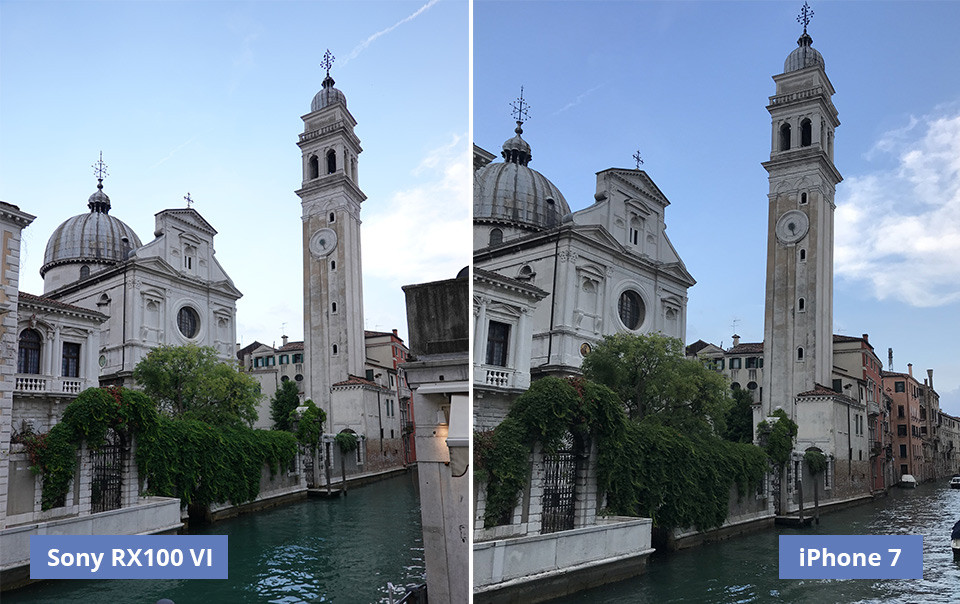
As you will probably notice, especially in the sky, the difference is very large. This is because the iPhone automatically uses an HDR mode, giving the image a very wide dynamic range.
With the Sony, especially if you shoot RAW, you can also recover a lot of detail from the sky, and with some editing the photo will ultimately be even better.
The thing is, I don't think the target audience for this camera wants to edit their photos at all. They want to take a photo and post it on Facebook or Instagram as quickly as possible.
I do think that in the example above, the Sony renders the building, and especially the green bushes, more attractively than the iPhone. It's just that the sky attracts so much more attention that almost everyone will prefer the iPhone image to the RX100's.
Better detail
If you look at the details, you can see that the RX100 VI beats the iPhone 7. This is where the larger sensor and the optical quality of the built-in lens show their advantage.
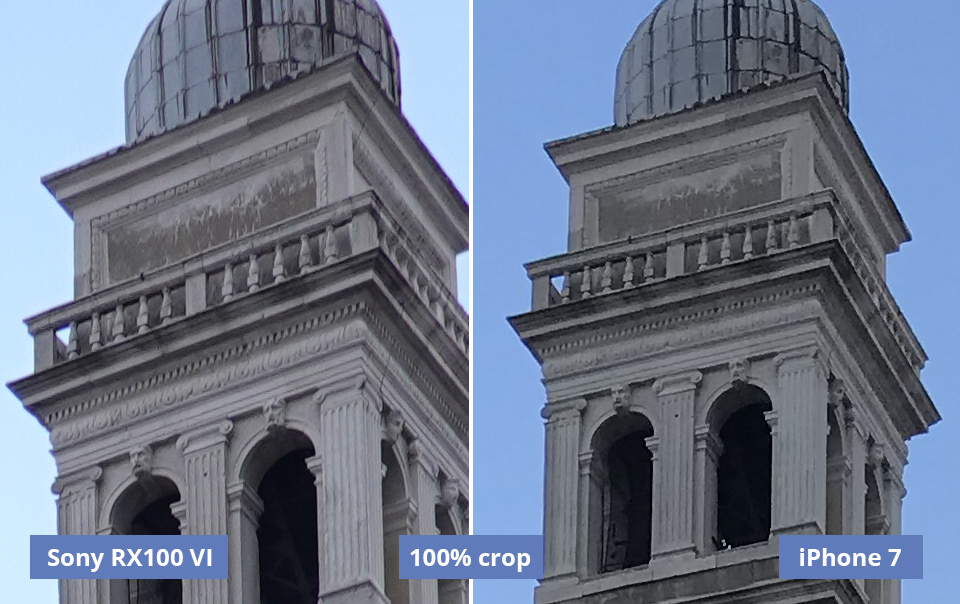
The Sony has more pixels, so at 100 per cent you are also slightly closer in. Although the Sony does suffer a little from purple fringing in this strong contrast, you can see that the colour rendering is better than on the iPhone.
Connectivity
You can also pair this Sony camera with Sony's PlayMemories app. This lets you quickly copy your images from the camera to your smartphone and post them on Facebook or Instagram, for example.
The Sony RX100 VI has NFC, Bluetooth and Wi-Fi for this purpose.
Video
With the Sony RX100 VI, you can record 4K video at 30 frames per second and a maximum bitrate of 100 Mbps.
The full sensor is used for video, so there is no crop factor while filming. The 4K video is downsampled from the 5K worth of image information supplied by the sensor. This produces good video quality.
If you switch to full HD mode, you can also record at up to 120 frames per second.
Slow motion
There are also special slow-motion modes of up to 1,000 frames per second. In this mode, no sound is recorded and the videos are very short in terms of recording time, with a maximum of 4 seconds.
In the video below, you can see a recording made in slow-motion mode at 250 frames per second. I used the 'pre-recording' mode here.
In this mode, the camera starts recording video before you press the button. You wait for the moment you want to capture and press the button when it has happened. The last 4 seconds are then saved. This is useful for choosing the exact moment afterwards.
For videographers, an external microphone input would be useful. Now you have to use the internal microphone, which of course isn't the best option when you want to do more professional video work.
Price and availability
The new Sony Cyber-shot RX100 VI camera will be available from next month for a price of 1,300 euros.

Conclusion
The Sony CyberShot RX100 mark VI is an excellent high-end compact camera. The greater zoom range gives you a reason to choose this camera instead of a high-end smartphone.
The RX100 feels good in your hand and feels very solid. A good sensor provides a wide dynamic range and good performance. The camera is very compact and fits easily in your trouser or jacket pocket. There is really never a reason not to take it with you.
I can certainly imagine wanting to take this camera with you for travel and street photography. It doesn't attract attention when you are taking photos with it and, especially if you shoot RAW and edit the photos afterwards in Lightroom, for example, the RX100 delivers good image quality.
With its hefty price, it's worth considering alternatives, such as a smartphone or a mirrorless camera, before buying it.
About the author
Elja Trum is the founder of Photofacts and online photography course website Photofacts Academy. He has been writing about photography since 2006. Elja is also the author of (Dutch) books on composition, black-and-white photography, flash photography and portrait photography.
You might also like
-
 Sony announces the Sony RX100 VII
by Aäron Nasarany
-
 Sony Alpha 7C compact mirrorless camera announced
by Elja Trum
-
 Sony A9 Mark II announced
by Aäron Nasarany
-
 Review: Sony a7r mark III
by Elja Trum
-
 Fujifilm announces the X100 VI
by Nando Harmsen
-
 Sony A6600 and Sony A6100 announced
by Aäron Nasarany
5 comments
-
 Patrick van Zundert wrote on Tuesday 12 June 2018 at 10:29 | reply
I am a travel photographer and used the Sony RX100 Mark VI alongside my Canon 5D for two years. Since I got the iPhone X, the Sony has been rotting away somewhere in a drawer. When zooming and cropping, the iPhone still scores much lower, but in many cases the iPhone is good enough. The blown-out skies of the Sony are distracting, as is the way Sony captures cloudy skies.
Translated from Dutch. -
 HAJ. Hofland wrote on Tuesday 12 June 2018 at 15:20 | reply
I have two Sony cameras of the RX100 type myself. Technically speaking, they deserve a very big fail on a number of points, and fall very far short. Both cameras have problems focusing, accompanied by irritating noises, like the sound of a stick blender, which led to extremely expensive repairs, and at one point both cameras had to be sent in for repair for the same issue. There you are, without a camera at hand. After returning from repair, both cameras functioned again for a while, but after some time the irritating issue started and reared its head again, and still does. The image sensor of one camera defective, just out of nowhere, switch the camera on and there are only barcode lines on the display, repair costs €245.00 and the display of one camera has now come loose for the fourth time, repairs each time costing approximately €128 to €130.00. And leniency is out of the question, it always happens just outside the warranty period. I've really had enough of it now and decided not to have any more repairs carried out, and am now looking into a replacement new camera, but from a different brand.
Translated from Dutch. -
 Dwars wrote on Tuesday 12 June 2018 at 20:54 | reply
Don't want to be negative, but this time too Sony lets us down again. I think the images posted here are mediocre anyway. It also seems a lot like converted video footage these days. I started with Sony in 2000, but after a malfunction/repair (no leniency policy either) I moved away from Sony. I always loved their sharp images, although I suspected they processed that in the hardware. The combination with compression and image processing hasn't gotten any better since then. Sorry, I'm still dropping out.
Translated from Dutch. -

 Elja Trum
wrote on Wednesday 13 June 2018 at 10:15
| reply
I’m very enthusiastic about Sony’s mirrorless cameras. This high-end compact is also perfectly fine (as far as I’ve been able to assess so far), but is gradually being overtaken by high-end smartphones.
Translated from Dutch.
Yesterday I spoke to a photographer who is considering this camera for concerts. You’re actually allowed to take an RX100 inside with you at all times.
With the zoom range, manual settings and by working with the RAW files, you can probably achieve beautiful results. -
 Marc wrote on Wednesday 13 June 2018 at 22:14 | reply
Currently still happy with my Sony RX100 IV
Translated from Dutch.
Have your say
Please note: Articles older than a week can only be commented on by signed-in visitors.Would you still like to comment? sign in or create a free account.
Become a better photographer every week
A practical photography tip in your inbox every week.
38,886 photography enthusiasts already receive the tips! More about the weekly mail. Or keep up to date via  Facebook.

Elja Trum
Photofacts; everything to do with photography!
Would you like to take better photos and keep up with what is happening in photography? Photofacts publishes articles that teach you something about photography — from a product announcement to a practical shooting tip or a look at a website. Photofacts covers photography every day and is a hobby project of Elja Trum's that got out of hand. The articles are written by a team of volunteer authors. If you would enjoy writing one or more articles for Photofacts, do get in touch.More about PhotofactsPhotofacts is made possible in part by
