

Canon EOS R1 likely before summer, R5 Mark II later
Thursday 11 January 2024, 16:32 by Elja Trum | 5,161 views | 31 commentsThis article was translated from Dutch with the help of AI. Read the original.
Over the coming year, we may see two interesting new cameras from Canon. The Canon EOS R1 is expected, as the top model in the brand's R-series mirrorless cameras. We will probably also see the Canon EOS R5 Mark II.
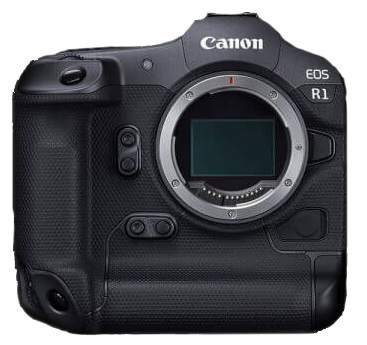
It is expected that the Canon EOS R1 will appear first. The Olympic Games are taking place again this summer, and this is often an important moment for Canon to bring new high-end cameras to market.
According to the rumours, this new R1 will have a lower resolution than previously expected. In itself, it is always the case that high-end Canon cameras have fewer megapixels than other Canon models.
The expectation for the R1 is that it will not have 5K video and will take photos at less than 45 megapixels. The camera will probably also not have a global shutter, like the recent Sony A9 Mark III.
If these rumours are correct, I am curious what its added value over a Canon R3 will be. More photos per second will be something very few photographers actually need.
The Canon EOS R5 Mark II is expected to be announced later, probably somewhere around the end of August.
About the author
Elja Trum is the founder of Photofacts and online photography course website Photofacts Academy. He has been writing about photography since 2006. Elja is also the author of (Dutch) books on composition, black-and-white photography, flash photography and portrait photography.
You might also like
-
 Preview: Canon EOS R1
by Elja Trum
-
 Preview: Canon EOS R5 Mark II
by Elja Trum
-
 Will the Canon EOS R5 Mark II Arrive in Mid-2023?
by Elja Trum
-
 Review: Canon EOS R5
by Nando Harmsen
-
 Review of the fantastic Canon EOS R6 Mark II
by Nando Harmsen
-
 Review of the Canon EOS M50 mark II
by Nando Harmsen
31 comments
-
 Lotte wrote on Sunday 14 January 2024 at 20:04 | reply
I think the people at Canon aren't crazy, and know very well what they are doing. The R1 is a camera for the professional market. So it will have to be possible to shoot handheld with it, something that isn't the case with 45 megapixels, or you have to have a very steady hand. In the manual of the Canon R5 (45 megapixels) it says use a sturdy tripod. I can't yet see a press photographer running across the street with a 45 megapixel camera and tripod😂😂. So I think we've had our fill with 33 megapixels in the R1. More is absolutely not necessary either. My heartfelt wish for the R1 is, leave the eye-controlled AF out, what a disaster that is. And for the pixel fetishists, buy the expected R5 Mark II.
Translated from Dutch. -

-
 Donald Willemsen wrote on Wednesday 17 January 2024 at 09:27 | reply
Where do you get the wisdom from, Lotte, that you can only use the R5 with a tripod? Really nonsense.
Translated from Dutch.
Elja, is there any word yet on the specifications of the R5 Mark II? I'm quite curious about that. -
Lotte wrote on Wednesday 17 January 2024 at 09:42 | reply
Hi Donald
Translated from Dutch.
I many, very many photos taken with the R5. Many photos are totally not sharp/soft. The user manual clearly states, use a sturdy tripod. There are always people who think they know better than the manufacturer.many people are wishful thinkers. Doesn't matter. They should be there too. -

 Nando
wrote on Wednesday 17 January 2024 at 10:04
| reply
Nando
wrote on Wednesday 17 January 2024 at 10:04
| reply
You’re the first person I’ve heard say that it’s impossible to take sharp photos with the R5. If this were such a problem, it would be much more widely reported, and also with the Nikon Z8, Z9, Sony A7RIV and A7RV, and the Fujifilm GFX50 and GFX100, and so on.
Translated from Dutch.
Image stabilization is very important, though, and I wonder whether you did have it switched on. Otherwise, it could be down to your photography technique.
I was curious about that mention in the user manual, but I can’t find the urgent advice about using a tripod anywhere, only as a comment when you have blurry photos. But that could also be due to other things (shutter speed in combination with focal length, focus point incorrect, subject movement, or how you hold the camera) -
 Hans van Kooten wrote on Wednesday 17 January 2024 at 09:49 | reply
This is the first time I'm hearing that eye-controlled AF is considered 'undesirable'. I don't have it myself. I'd like to hear more experiences about it.
Translated from Dutch. -
Nando
wrote on Wednesday 17 January 2024 at 10:01
| reply
I used eye-controlled AF with the EOS R3, and it works. Whether it is desirable depends more on the photographer, and on whether they find it pleasant to use.
Translated from Dutch.
It can be annoying when you look around a lot through the viewfinder for composition purposes.
-
 Wim wrote on Wednesday 17 January 2024 at 09:53 | reply
I use the R5 almost exclusively handheld.
Translated from Dutch.
Whether or not you can photograph handheld depends mainly on the shutter speed used and the pixel density.
The pixel density is much higher on almost all crop cameras than on the R5.
The pixel density of the R7 corresponds to 82 megapixels on full-frame and the R7 is also used handheld.
If you want to use the 400-megapixel function of the R5, then of course you do need a sturdy tripod because the image is built up from 9 frames. -
 guest wrote on Wednesday 17 January 2024 at 10:01 | reply
Can you also show where this is stated in the manual?
Translated from Dutch.
it is indeed mentioned several times but always with functions where multiple images are made. -
Lotte wrote on Wednesday 17 January 2024 at 10:03 | reply
Hi Hans
Translated from Dutch.
I g out the Canon R3. The eye-controlled one is also on it. That possibility is experienced very diversely. There are people who are happy with it,and there are people who go crazy because of it, like the undersigned. Fortunately you can turn that function off, and that is what I did.
Kind regards
Lotte -
Lotte wrote on Wednesday 17 January 2024 at 10:13 | reply
Hi Nando
Translated from Dutch.
It didn't work pleasantly for me, it drove me completely crazy. so I turned that function off. -
 Wim wrote on Wednesday 17 January 2024 at 10:14 | reply
Hi Lotte, eye-controlled focus is something that is experienced quite differently, fortunately you can now also turn it off if you don't use it.
Translated from Dutch.
When this was first applied to the EOS 5 from 1992, opinions were also very strongly divided. -
Lotte wrote on Wednesday 17 January 2024 at 10:16 | reply
Hi Guest
Translated from Dutch.
I no longer have the R5, but I think it was somewhere in the first 5 pages of the user manual. -
Wim wrote on Wednesday 17 January 2024 at 10:35 | reply
Lotte
Translated from Dutch.
I can tell you with certainty that this is Not mentioned in the manual.
It appears that neither the shortened, the extended nor the on-line version of the manual make any mention of this, it is mentioned under the 400 megapixel function and the bracketing function's -
Donald Willemsen wrote on Wednesday 17 January 2024 at 10:40 | reply
@Lotte, I don't have the R5 myself, but a good friend of mine does. I've already seen a great many photos from him and he almost always photographs handheld. His photos are razor-sharp. It is partly thanks to that sharpness that I also switched to a mirrorless camera at the end of 2022. For budgetary reasons, that became the R7.
Translated from Dutch.
Also for me, this is the first time that I've read a complaint about the R5 like the one you describe. I find that unpleasant for you, but you should nevertheless first look for the cause in yourself and in the camera's settings. Also check whether it happens with RF lenses or specifically when using EF lenses. If the EF lenses are from a brand other than Canon, problems can arise. So I say: CAN. That does not mean that this is always the case.
So first try to find out what the possible cause is. Do you know someone who also has an R5? Then compare the sharpness of the photos taken with your R5 and those taken with the other person's. Also compare the settings, such as IBIS, for example.
If you have another person take photos with your R5 and they are sharp, then the cause may nevertheless lie with you. -
 Paul eos wrote on Wednesday 17 January 2024 at 10:48 | reply
I have an R5 and take photos handheld 80% of the time, even with a 500 mm lens. The stabilization of the camera + Canon lens works super well. So Donald and Elja are absolutely right.
Translated from Dutch. -
Lotte wrote on Wednesday 17 January 2024 at 10:55 | reply
Hi dear Donald
Translated from Dutch.
I sold my R5 after 2 years of not using it, brand new in the box. I only use my R3. -
 Stefanie wrote on Wednesday 17 January 2024 at 11:04 | reply
Since when do the number of megapixels and whether or not you can shoot handheld have anything to do with each other then?
Translated from Dutch. -
Nando
wrote on Wednesday 17 January 2024 at 11:26
| reply
The more resolution, the sooner a small movement/vibration becomes visible. Imagine that if you can move half a millimeter with a 25-megapixel camera and this is just not visible, with a 50-megapixel camera it will just be visible because you have 2x as much resolution.
Translated from Dutch. -
Stefanie wrote on Wednesday 17 January 2024 at 11:21 | reply
I'm still curious about the detailed specs of these cameras because what Canon has out now gives me the impression that I have to give up quite a lot for just a few conveniences like eye detection on the Canon DSLR I have now, and then for twice the price and even more ...
Translated from Dutch. -
Lotte wrote on Wednesday 17 January 2024 at 11:27 | reply
Hi Stefanie
Translated from Dutch.
Every camera brand and model has its good and less good sides. That also applies to the man/woman behind the camera. With every camera you can take good and bad
Photos. There are sometimes nice articles on canon Rumors, this time again. -
Lotte wrote on Wednesday 17 January 2024 at 11:31 | reply
Hi Nando
Translated from Dutch.
I think you hit the nail right on the head here. I see really beautiful images from 25 megapixel cameras passing by. And equally bad images from 45 megapixel cameras. More pixels is not by definition better. Sometimes it is rather the opposite. For me, 25 mg pixels is more than good enough. -
-
-
Lotte wrote on Wednesday 17 January 2024 at 11:52 | reply
Hi Nando
Translated from Dutch.
I think that the more resolution, the tighter it gets. In general, I see more bad 45 mg pixel photos passing by than bad 25 mg pixel photos. -
-
Donald Willemsen wrote on Wednesday 17 January 2024 at 12:00 | reply
@Nando, it is also a question of whether you really need more and more pixels. It is as you say, the more pixels, the sooner a minuscule movement becomes visible. After all, more pixels = more details.
Translated from Dutch.
I can imagine that a (super)macro photo benefits from a very high resolution, because that gives more details. There may be other options where that is useful (astrophotography?) as well.
However, there are also some disadvantages. The more pixels you put on a sensor, the smaller they have to be. So the individual pixels can receive less light. We know what the consequence of that is. -
-
Stefanie wrote on Wednesday 17 January 2024 at 12:12 | reply
I haven't had the number of pixels on my list of requirements for a very long time, it was important right at the beginning of digital but now the 26 mp I have are perfectly adequate and I actually see more as a burden, I hardly notice it but need more memory cards and larger hard drives to store it, the whole pixel density story that Nando just explained to me is just another reason for me to (finally) switch to mirrorless
Translated from Dutch. -
 K.J.Schilstra
wrote on Wednesday 17 January 2024 at 16:04
| reply
K.J.Schilstra
wrote on Wednesday 17 January 2024 at 16:04
| reply
GULP.. R5 MII end of August?
Translated from Dutch.
Where did you get that rumor from?
"By Sebastiaan van ’t Hoog
Updated 14 January 2024"
Rumors claim that the R5 Mark II will be released in early 2024, presumably in February just before the 2024 CP+. That is a time of year when the most amount of cameras are released, as it’s one of the biggest camera events of 2024.
Still says End Feb 2024, where does the 6-month shift come from? -
Donald Willemsen wrote on Wednesday 17 January 2024 at 16:54 | reply
@Stefanie, I don't think you have to make significant sacrifices when switching from DSLR to mirrorless. Take, for example, the mirror flipping up and down, which creates extra noise and causes minimal vibrations.
Translated from Dutch.
The prism viewfinder (OVF) of a DSLR gives much less information directly in the viewfinder. The electronic viewfinder (EVF) therefore gives you more information, such as a histogram, before you actually take the photo.
There are quite a few more features that aren't possible with a DSLR and nevertheless turn out to be useful.
I suspect it's a bit of a 'fear of the unknown'. And yes, the wallet also plays a role, of course. I think an R5 body is still cheaper than the latest version 1D body.

Have your say
Please note: Articles older than a week can only be commented on by signed-in visitors.Would you still like to comment? sign in or create a free account.
Become a better photographer every week
A practical photography tip in your inbox every week.
38,982 photography enthusiasts already receive the tips! More about the weekly mail. Or keep up to date via  Facebook.

Elja Trum
Photofacts; everything to do with photography!
Would you like to take better photos and keep up with what is happening in photography? Photofacts publishes articles that teach you something about photography — from a product announcement to a practical shooting tip or a look at a website. Photofacts covers photography every day and is a hobby project of Elja Trum's that got out of hand. The articles are written by a team of volunteer authors. If you would enjoy writing one or more articles for Photofacts, do get in touch.More about PhotofactsPhotofacts is made possible in part by
