

JPG or RAW: an age-old choice
Saturday 7 December 2024, 16:32 by Michiel Heijmans | 3,009 views | 8 commentsThis article was translated from Dutch with the help of AI. Read the original.
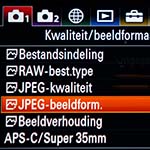
A debate that has been going on since we got digital cameras. Do you shoot RAW, JPG or both? These are the possible file formats for your photos. You can choose which one to use in your camera, usually in the first tab of your camera settings.
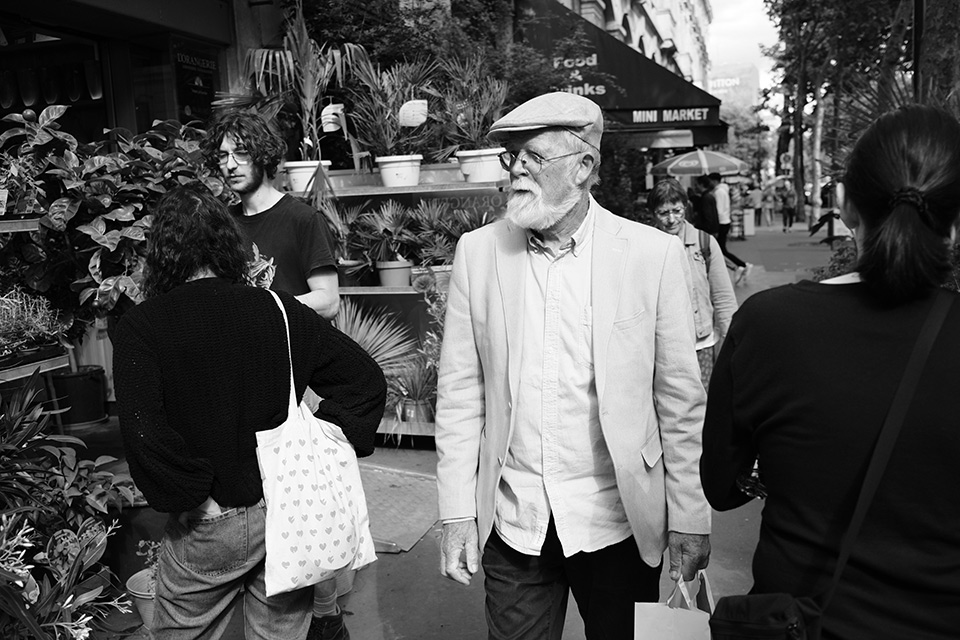
The easy answer: RAW. That lets you bring back more detail during post-processing. And that is absolutely true, there is no arguing with it. But the result is also that your hard drive fills up faster.
RAW and JPG is useful when you have film simulations in your camera. The Fujifilm X100 and the Ricoh GR both have them. You can then take black-and-white photos, for example, while still having all the colours in your RAW file.
Personally? I usually shoot street photography in JPG. The chance of me printing the photo at 2 by 3 metres is small. I don't need that size for books, and 40x60 centimetres is a good exhibition format.
With the megapixels in my cameras, it could certainly be larger if needed. And I love consciously choosing colour or black and white, for example. It adds something to my walk!
About the author
Michiel is professioneel straatfotograaf en geeft workshops en lezingen over straatfotografie. Hij schrijft columns voor Focus Magazine en is erg actief op Instagram. Daar vind je dagelijks inspiratie en tips voor je eigen straatfotografie!
You might also like
-
 Street photography tip: JPG or RAW: An old debate
by Michiel Heijmans
-
 Make a raw file 90% smaller with lossy DNG
by Nando Harmsen
-
 Everyone photographs in raw, there are no exceptions
by Nando Harmsen
-
 Is there a reason to save both raw and jpeg?
by Nando Harmsen
-
 Lightroom Classic and JPG+RAW Files
by Nando Harmsen
-
 Street photography tip: Photograph minimalism in the countryside
by Michiel Heijmans
8 comments
-
 Mac wrote on Monday 9 December 2024 at 08:37 | reply
Actually, you can sum it up like this
Translated from Dutch.
JPEG = slide
RAW = negative -
 Jan Kleinjan wrote on Tuesday 10 December 2024 at 10:21 | reply
As a (possible?) disadvantage of RAW, it is invariably mentioned that your hard drive fills up faster. That is undoubtedly true, but the size of current drives is in most cases so large as standard that I cannot imagine your drive filling up. And if that is nevertheless the case, then a huge hard drive can be purchased for a relatively small amount. So what is stopping you from photographing exclusively in RAW from now on.
Translated from Dutch. -

 Michiel Heijmans
wrote on Wednesday 11 December 2024 at 15:31
| reply
Michiel Heijmans
wrote on Wednesday 11 December 2024 at 15:31
| reply
Of course there are more drawbacks, too. Think of speed: I have RAW files in my 40MP camera for which I deliberately bought fast SD cards, because otherwise I sometimes have to wait too long for them to be written. And there are more. It also very much depends on the application. Most of my STREET photos don't need RAW. I shoot my portraits in RAW.
Translated from Dutch. -
 Nico van Ast wrote on Tuesday 10 December 2024 at 11:14 | reply
With the possibilities that RAW images offer in post-processing, JPEG is no longer an option for me. A RAW photo from my D850 is 90Mb. But as Jan already points out, a large HDD is no longer an expensive investment these days. For archiving, I have a 12 Tb HDD installed. My working drive is a 2 Tb SSD.
Translated from Dutch.
To save space, it is important to delete rejected photos (in Lightroom Classic) from your drive right away. You are never going to use them again anyway. The x key is therefore already quite worn out for me
-
Michiel Heijmans
wrote on Wednesday 11 December 2024 at 15:32
| reply
It also depends very much on the type of photography. But don't be mistaken: today's cameras produce nice JPGs
Translated from Dutch. -
 Rien Linthout wrote on Tuesday 10 December 2024 at 11:39 | reply
The image from Paris shown by the writer clearly demonstrates the incorrectness of his story: I see two pitch-black items of clothing in the image without any detail in them at all! (Not a conscious choice by the photographer because his lights are technically correct) That is the loss you get when you shoot in JPG and therefore cannot properly recover your shadows in RAW conversion. A great shame about this image. There is no problem with finite storage capacity. And I would sooner expect that from the capacity of the cards in the camera, but those are also large and no longer expensive. I do have to say that 23 years ago I did shoot in JPG because back then a 128 Mb memory card (yes, Mb) cost 300 euros and it could just hold 40 RAW images from my camera with no less than 3 million pixels. If I had had more budget for more cards, I would have shot in RAW. So if you want to take yourself seriously as an image maker, shoot in RAW. One more tip: shoot much more selectively, there is no point in clicking thousands of times.
Translated from Dutch. -
Michiel Heijmans
wrote on Wednesday 11 December 2024 at 15:34
| reply
Hey Rien, I only partly agree with you. Those black areas are intentionally black to emphasize the man in the middle. You can technically analyze a photo to see whether you like it, or you can look at the photo itself. A good photo (in my opinion) doesn't have to be a technically perfect photo, especially not in street photography. Thanks for your story from the past. A lot has changed, indeed!
Translated from Dutch. -
Michiel Heijmans
wrote on Wednesday 11 December 2024 at 15:28
| reply
Nice comparison
Translated from Dutch.
Have your say
Please note: Articles older than a week can only be commented on by signed-in visitors.Would you still like to comment? sign in or create a free account.
Become a better photographer every week
A practical photography tip in your inbox every week.
39,079 photography enthusiasts already receive the tips! More about the weekly mail. Or keep up to date via  Facebook.

Elja Trum
Photofacts; everything to do with photography!
Would you like to take better photos and keep up with what is happening in photography? Photofacts publishes articles that teach you something about photography — from a product announcement to a practical shooting tip or a look at a website. Photofacts covers photography every day and is a hobby project of Elja Trum's that got out of hand. The articles are written by a team of volunteer authors. If you would enjoy writing one or more articles for Photofacts, do get in touch.More about PhotofactsPhotofacts is made possible in part by
