

Getting started with nude photography
Monday 3 December 2018, 14:41 by Michelle Peeters | 42,227 views | 38 commentsThis article was translated from Dutch with the help of AI. Read the original.
Nude photography is not something you do every day. I recently did it for the first time. A real challenge, but I learnt a great deal. Find out how you can get started with nude photography too.
We previously wrote about the secrets of nude photography on Photofacts. In practice, it is not as complicated as you might think. With just one light, you can create beautiful, striking lighting. You can quickly achieve a good result this way.
TTL workshop
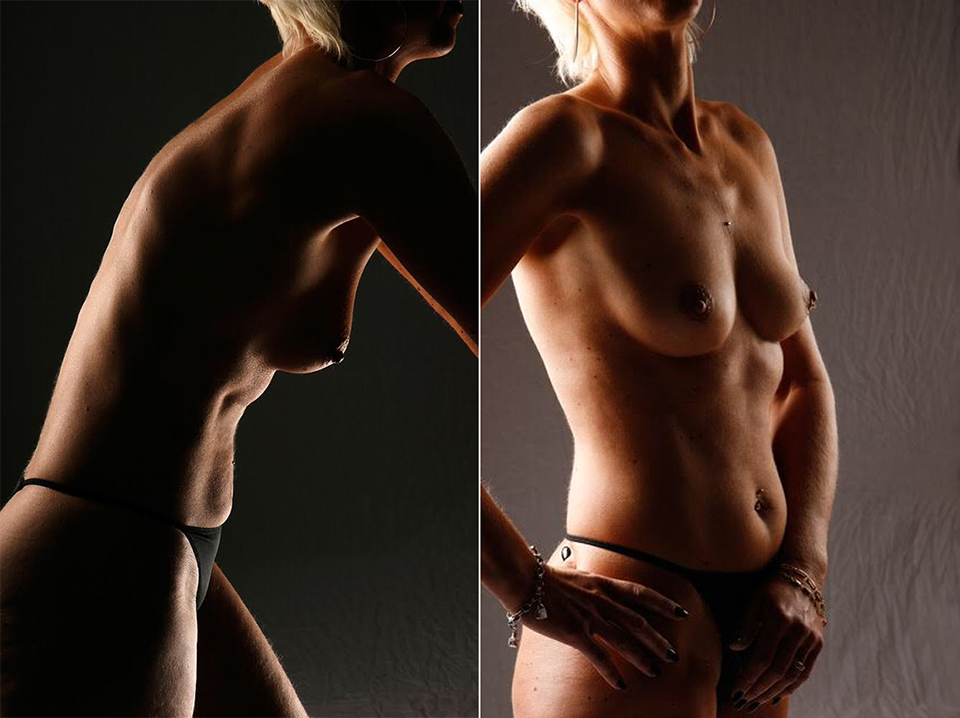
I took the photos below during a short mini-workshop on nude photography at the High Tech Campus about ten years ago. The lighting had already been set up for you, so composition was the only thing you still had to worry about.
It was made clear to me that you should mainly highlight the contours. You do this with what is known as 'tang lighting', where you point two light sources at your model from the left and right, at the same distance.
Female nude
The naked female body has been a source of inspiration and a popular subject for photographers since photography began. Photography used to be quite a technical affair, which is why it attracted quite a lot of male photographers.
Women are therefore photographed nude more often than men, apart from the fact that female forms, which are more beautiful, rounder and softer, are often more suitable for photography than male ones.
What is nude photography?
When men in their local pub hear the term nude photography, they imagine something quite different from cultural professors. What is cheap kitsch or striking eroticism to one person is art to another.
There are three forms of nude photography: classical, erotic and pornography. In fact, only the classical version can be considered high art within photography, and this is therefore the style that is used most often.
Here, the naked or partially covered body, known as partial nude, is shown aesthetically. It is often isolated body parts that are photographed against a neutral background.
Classical nude photography is mainly aesthetic and actually has little to do with seduction. It is about recognisable, beautiful forms shown tastefully, not crudely, in the frame. With beautiful light and often abstract shapes. Less is more is very much applicable here.
How do you find a nude model?
But how do you find a nude model? And how do you photograph one well and, above all, tastefully? In amateur photography, assignments for nude photography often come through an acquaintance. Someone approaches you with the idea because you are known as someone who can take good photographs.
If you are looking for a professional model, Facebook is popular, for example. There are groups for nude photographers and models. You could also work with a modelling agency. And of course, a workshop can also be a good way to gain experience with experienced models.
If you already know the person in front of your lens, that can be both an advantage and a disadvantage. The most important rule here is: be honest!
If you are unsure about an assignment, feel free to talk about it. You do not have to pretend to be a professional. If you are photographing a friend, openness is the only thing that can help you relax and allow you to experiment with techniques and settings.
Having friends in front of the camera can unfortunately also cause some awkwardness. It is not always easy to tell a female friend honestly that she does not look as good in a particular pose as she had hoped.
Another challenge may be that you cannot explain to your friend model the less obvious body position you have in mind. If you cannot explain a pose, or if your model still cannot find the right position after the tenth attempt, it is better to try a different pose.
Be careful about asking your partner to be your model too. Love is blind, after all, and this can often be clearly seen in the photographs. The photographer's personal feelings for the posing partner make it impossible to deal with light and shadow, body position and surroundings, exposure time and focus settings in a rational and critical way.
It naturally helps a lot if you have a model who is used to showing themselves naked. You then need to spend less or no energy creating a relaxed atmosphere and putting your model at ease.
A somewhat more experienced model often has more patience and is less affected by stage fright and insecurity when naked.
Moreover, an experienced model often already knows the most photogenic poses, without you having to ask. I put a number of poses that appealed to me on a moodboard and discussed them with the model before we started the shoot.
Communicating with your model
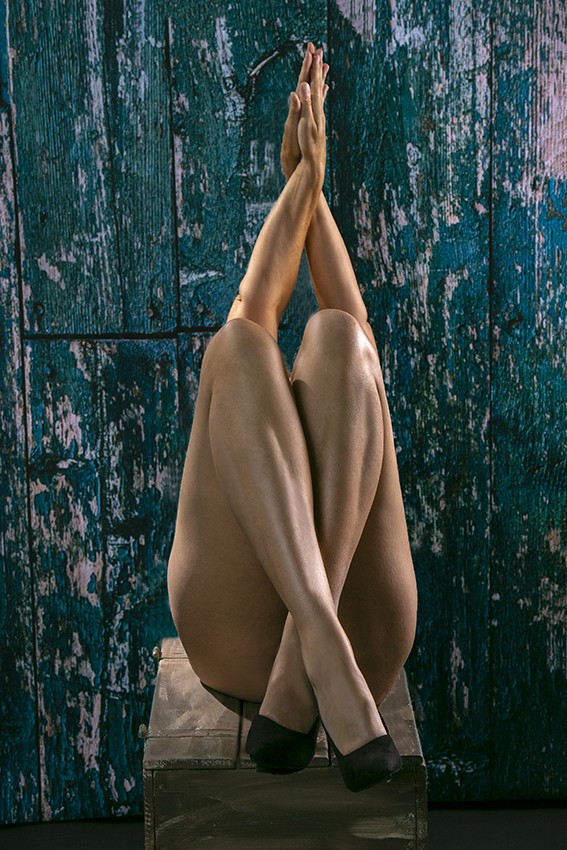
It is also useful to discuss in advance what is going to be photographed. Nude or partially covered? Topless or lingerie? Or a combination of these? I asked my model to bring some outfits and shoes herself. On the spot, we chose what might be useful.
If you do start working with an inexperienced model, you have a longer road ahead and have to learn by discovering the pitfalls yourself. You will automatically find out what does and does not work.
Mistakes such as standing too close to your model, using the wrong lighting setup, using light that is too harsh, less flattering poses and so on, will generally only be made once.
I took lots of photos for each pose and showed the photos to her straight away. Both the successful ones and the photos that I considered failures. This way, you can see and discuss together what does and absolutely does not work.
Delete the failed shots immediately, your model will really appreciate that too! Also let your model decide which photos you ultimately use and which photos may be published. She will obviously not be happy if nude photos continue to circulate on the internet.
Preparation
Whether your model is experienced or inexperienced, always make sure you are well prepared! It is better not to get lost in technical fiddling when your model is already ready to be photographed.
Make sure everything is already set up, the background, lighting setup, camera settings, metering and testing the light, charged batteries and so on, so that you can focus completely on your model.
Make sure you have your moodboard or books with photographs you want to try ready, and discuss them with your model too. Tell them what you want to achieve and together you can achieve the best result.
Make-up and/or post-processing
I let my model do her own hair and make-up and did not hire a make-up artist. Make-up can, however, add significant value. Retouching afterwards is also possible, but this can be quite labour-intensive.
It is tempting to plaster over every imperfection during post-processing. You do need to be careful here, though, to avoid creating plastic-looking Botox bodies. Find a good balance between making things look better and keeping them natural, so that your photo continues to interest and intrigue the viewer.
Lighting
With just one light, you can already create great, striking lighting. The closer you place the studio light to your model, the softer the light becomes. This gives you softer skin texture.
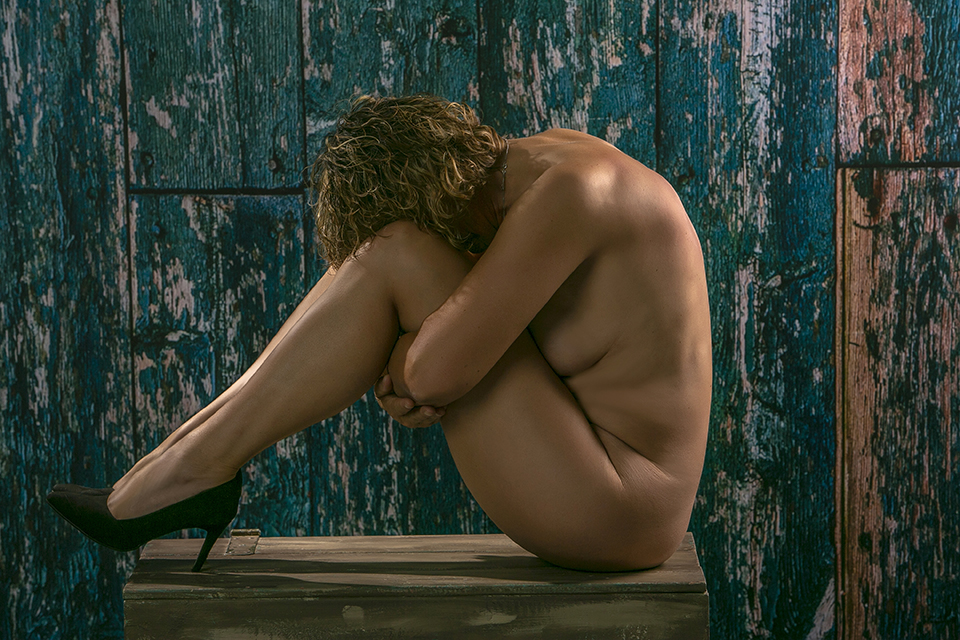
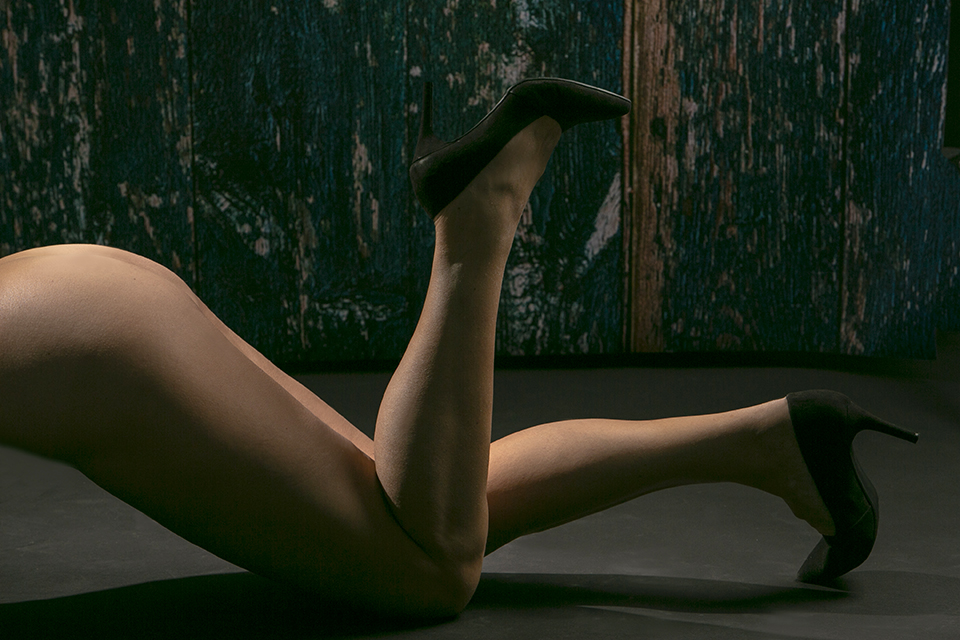
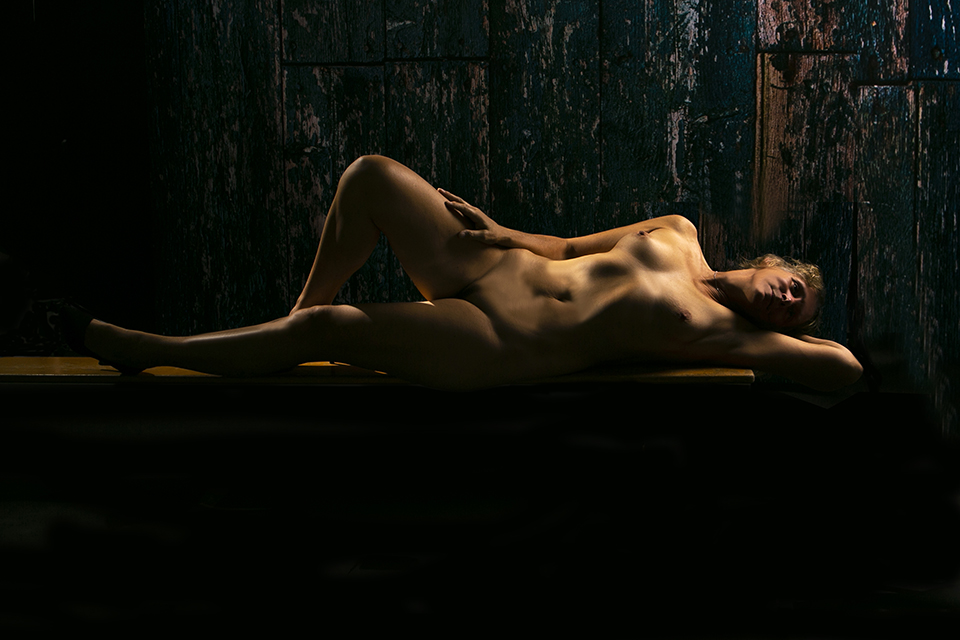
I chose low-key shots, consisting of lots of black and little but purposeful light. I only needed two light sources for all the shots. A softbox was positioned to the right of the model, with the light shining on her slightly from behind.
Her head was turned towards the light. The hard light from above on the left, a lamp with a snoot, emphasises the contours and leaves much in darkness.
Try experimenting with the lighting and walk around your model with your lamp, with the modelling light switched on, of course. Decide on the position of your lamp by looking carefully.
It may seem obvious that a studio light should actually shine onto the model, but this is certainly not the case! You often get the most beautiful lighting by letting the light shine past your model instead.
If you want to keep your background black or simply dark, place the lamp close to your model. I even lit the model slightly from behind, so that the background behind her was not lit itself and therefore became dark or even black.
You can use the histogram on your camera as a starting point to check whether your exposure is correct or not.
Soft light is the most beautiful way to show curves at their best. This also immediately prevents harsh lines in your composition and on the body. In addition, wrinkles and other imperfections become less visible, which is quite flattering.
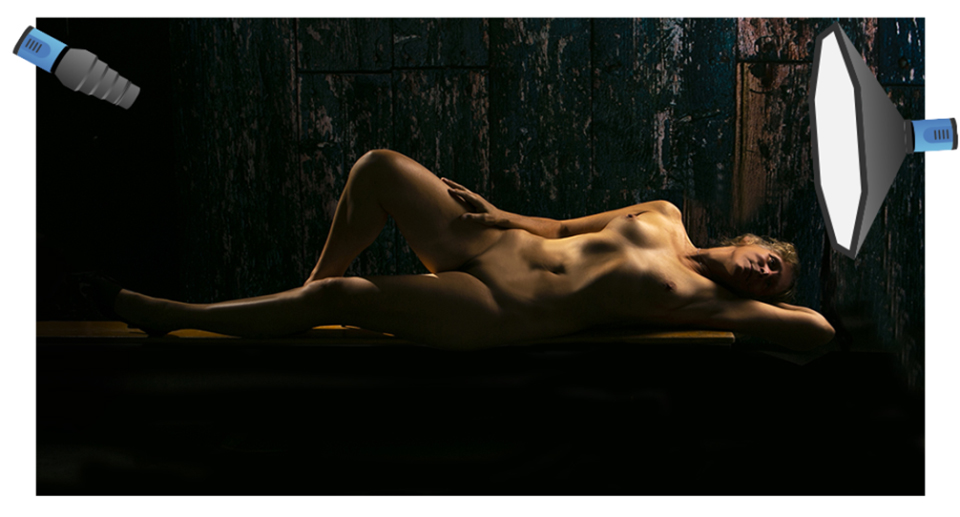
If you let this soft light come from the side, you get beautiful, soft shadows. The contours of the body are lit and depth is created in your photo. The naked body gets beautiful shapes. Soft daylight coming through a window gives you the same beautiful, soft side light.
The disadvantage of a large softbox, for soft light, is of course that light is present from left to right and from top to bottom. And that can become rather boring. You can, however, cut off this soft light and bring dark areas into your composition.
You do this by putting up some black reflectors, or black-painted polystyrene sheets if you have little money to invest.
Camera settings
If possible, also use aperture priority, so that you can deliberately create sharpness and blur. Blur in the foreground or background in particular draws the viewer's eye towards your model.
But body parts that deliberately fall into the blur also make an image more exciting. I used an aperture of f/8 myself, so I cannot demonstrate it with my own photographs.
More lighting tips?
In this article, I have only covered low-key lighting. Of course, many more forms of lighting are possible, including in nude photography. Even high-key is an option! Do you have any interesting or daring tips of your own? Let us know!
By the way, at Photofacts Academy we have the course How to take atmospheric boudoir photographs? ready, in which a number of relevant aspects of nude photography, poses, lighting and working with the model, are covered in detail. A good starting point if you really want to explore this subject!
About the author
Michelle Peeters is fotografe en oprichter van DeuxBleus Fotografie. Michelle herkent het bijzondere in het gewone en het gewone in het bijzondere. Ze heeft zich nooit willen specialiseren en is daardoor van alle markten thuis.
You might also like
-
 How to find a model for nude photography
by Elja Trum
-
 (Nude) portrait photography: get the light right and make contact
by Erik van Rosmalen
-
 Het Perfecte Plaatje; underwater dogs and nudes
by Elja Trum
-
 Het Perfecte Plaatje; Silence and nude models
by Elja Trum
-
 The Perfect Picture; Corona and Wet Nude Shoot
by Elja Trum
-
 Het Perfecte Plaatje: Dutch summer and nude
by Elja Trum
38 comments
-

 martinphili wrote on Monday 3 December 2018 at 20:39
| reply
A mood board is essential. That way, both know what the intention is.
Translated from Dutch.
I often did a clothed series first. That breaks the ice. And the model also has photos to show to those who aren't allowed to see everything.
Also useful: first do the whole setup with swimwear or underwear. You can try out your lighting setup then and the model can practice her poses. And then work towards the final result very calmly. Let the model determine the pace. -
 Huub wrote on Monday 3 December 2018 at 22:14 | reply
@martinphili: this is a very good addition and comment! Thanks.
Translated from Dutch. -
 Donald Willemsen
wrote on Tuesday 4 December 2018 at 10:47
| reply
Michelle, you write the following: 'In the past, photography was rather a technical affair, which is why it attracted quite a lot of male photographers.
Translated from Dutch.
Women are therefore also photographed nude more often than men, apart from the fact that female forms (more beautiful, rounder and softer) are often more suitable for photographing than male ones.'
It is completely made up that female forms are more suitable for photographing. Typically a male thought stemming from history that you allow yourself to be influenced by. A beautifully muscular male body is just as round, beautiful and soft as that of a woman. It is true that there are few male nude models, but that is mainly because the world of photography is still dominated primarily by men. I therefore think that male nudity can be just as beautiful as female nudity. I have extensive experience in nude photography and also know how difficult it is to get a male nude model in front of the camera. Is that (false) shame?
If only we started giving more publicity to male nudity. That would help us look differently at men and women.
Incidentally, I think the article is a good start towards making (aesthetic) nude photography more acceptable -
 Michelle Peeters wrote on Tuesday 4 December 2018 at 11:21
| reply
@Donald: I agree with you! Would you perhaps be interested in writing something about it sometime? It would be great to share your extensive experience!
Translated from Dutch. -
 Rik Brussel wrote on Tuesday 4 December 2018 at 17:14 | reply
In the article I read that you want to photograph in a low-key way and at the same time use the histogram to check whether the exposure is correct.
Translated from Dutch.
With low-key, don't you specifically choose to underexpose certain parts completely, causing your histogram to run off on the left side?
What do you check in the histogram then?
Personally, I mainly look at the photo and whether the exposure reflects what the model and I like to do. But I am always open to learning new things, so I would love to read about it. -
Michelle Peeters wrote on Tuesday 4 December 2018 at 17:22
| reply
@Rik: even when you photograph low-key, you can look at your histogram to see whether your exposure is correct. Or at least, as you intended it. So the fact that the graph is stuck all the way against the left side isn’t a problem in this case! What is a problem is that what you do expose isn’t overexposed or underexposed.
Translated from Dutch. -
 Jan wrote on Tuesday 4 December 2018 at 17:24 | reply
Man or woman, short, fat, tall, white, dark, thin, young old..... The human body is fascinating in all its facets and a wonderful subject for (nude) photography. I have both men and women in front of my lens and also many female photographers at my photo days. So it is certainly not the case that women are "more suitable" for nude poses!
Translated from Dutch. -
Michelle Peeters wrote on Tuesday 4 December 2018 at 17:29
| reply
@Jan: agreed (Donald already said that too). That is a bit of an old-fashioned thought. But it remains difficult to get men (nude) in front of the lens... I do think nude photography is one of the most difficult genres when photographing people. A real challenge, because you have to completely master so many facets (lighting, camera technique, an eye for beautiful lines/beauty, social skills to put the model at ease)!
Translated from Dutch. -
-
 Erik wrote on Tuesday 4 December 2018 at 22:58 | reply
'Women are therefore also photographed nude more often than men, apart from the fact that female forms (more beautiful, rounder and softer) are often more suitable for photographing than male ones.' This is bullshit. You can also photograph men beautifully nude. It's a matter of supply and demand. There are simply many more men interested in photography than women.
Translated from Dutch. -
Michelle Peeters wrote on Tuesday 4 December 2018 at 23:06
| reply
@Erik: that last part isn't true! I think women who take photographs have by now pretty much caught up with men. I do think that male nude photographers are by far in the majority compared to female ones.
Translated from Dutch. -
Erik wrote on Tuesday 4 December 2018 at 23:35 | reply
Caught up with men? The number of female photographers is indeed increasing. But it is still a (large) minority. The number of male nude photographers is indeed still not very large. But that does not mean that women are better suited to photographing nudes. That is very simplistic. Isn't that a challenge for you? To photograph men beautifully nude? There is still a whole market for that. It is still unexplored territory.
Translated from Dutch. -
Michelle Peeters wrote on Tuesday 4 December 2018 at 23:39
| reply
@Erik: the biggest challenge is still (regardless of whether it concerns a male or female nude model) to get someone looking good in the photo. Without concealing clothing, most nude models don't have a perfect body and yet you have to know how to make something beautiful out of it. It is indeed an interesting and challenging subject that I would like to explore further! And preferably with men, provided they are willing to pose nude, and that is rather lacking...
Translated from Dutch. -
 Mabel Amber
wrote on Wednesday 5 December 2018 at 02:02
| reply
Quote:
Translated from Dutch.
"In the past, photography was quite a technical affair, which is why it attracted quite a lot of male photographers."
I would like to ask you, Michelle, what exactly you mean by this. -
 rik wrote on Wednesday 5 December 2018 at 08:59 | reply
What a good article, with all kinds of useful tips.
Translated from Dutch.
The discussion about the lack of male models: that depends on who you ask... I don't have that problem
-
Michelle Peeters wrote on Wednesday 5 December 2018 at 09:24
| reply
@Mabel Amber: maybe a somewhat direct statement, but it is my own experience. Even now, men are often more interested in the technical aspect of photography and women more in the creative part. But I am a woman myself; it doesn't apply to me! And there are plenty of exceptions too. There have been times when you were not accepted at the Fotovakschool if you didn't have chemistry in your subject package! So now, with the advent of digital photography, quite a few things have changed as well!
Translated from Dutch.
Comments must first be approved, which is why it can sometimes take a while before they become visible.
@Rik: I am going to make an effort to find them after all! -
 André wrote on Wednesday 5 December 2018 at 09:59 | reply
I do have quite a bit of experience with nudity; as a bodypainter and as a photographer. A few points from my experience: if I photograph someone nude for the first time and also do "clothed" shots, I prefer to start with the nudes, for 2 reasons: clothing, especially bras and panties, quite often leave lines on the skin. So I always ask someone not to wear tight clothing beforehand, preferably not to wear a bra, give them a bathrobe at the start of the session after they have been able to undress discreetly, and then finalize the lighting settings with e.g. a bare back. (Of course, as much advice as possible should be arranged beforehand, but you often only see the definitive effect when you take actual photos. ) It does make the step to posing unclothed easier, the model is not suddenly standing there naked. That also ties in with the second reason: if you do clothed shots first and then nudes, then for an inexperienced model that is probably something that keeps playing in the back of their mind: soon I still have to take my clothes off. For the rest: communicating well beforehand, sending examples, discussing expectations on both sides, drawing up a script and showing it beforehand, possibly drawing up a contract about what happens to the photos and what right the model has to veto publication etc., helps, in my opinion, to achieve a professional approach and give a model confidence. Someone can always come along as far as I'm concerned, and constantly communicate with the model, and if something doesn't work, make that clear in a professional manner and don't grumble behind your camera; it should all be self-evident, but unfortunately it isn't always.
Translated from Dutch. -
Donald Willemsen
wrote on Wednesday 5 December 2018 at 10:02
| reply
I think it is enriching that more and more women are becoming involved in photography and therefore also in nude photography. What I have noticed in this regard is that women have a different view of nudity as well, and you can see that reflected in the photos taken by women. This is not only the case in nude photography, but also in other forms of photography.
Translated from Dutch.
In the article I am missing a very important aspect that must not be forgotten, and that is: respect for the model. Treat a model respectfully as a human being and not as 'a vase of flowers' that you want to photograph. Touching the model is 'not done'.
If you take part in a workshop where several photographers are present, make sure that when you have placed a model in a certain pose, other photographers do not abuse the pose by taking photos from a different angle that are not acceptable. It will not be the first time that something like this happens.
Always work with a model release, in which it is precisely described what the photos may and may not be used for. Both the model and the photographer then know where they stand. -
Jan wrote on Wednesday 5 December 2018 at 10:26 | reply
@Erik, it is certainly not the case that men are more interested in nude photography than women. I have been teaching nude photography courses for about 10 years and especially now that I regularly have a pregnant lady as a model, there is a balance between male and female participants.
Translated from Dutch.
The female participants do not really have a preference for male models either. At the last workshop with a male nude model, all participating photographers were male.
And @Michelle": I don't know whether my 1,300 students are representative of the entire Dutch photography community, but based on my experiences with them I dispute the assumption that nude photography is a "man's thing". -
-
 Marcel Renard wrote on Wednesday 5 December 2018 at 10:53 | reply
Nice photos and a nice article. I don't see the shoes in the photos as added value, they result in oddly cut-off feet in the horizontal photos and make for a less pure photo in the photo with the crossed lower legs.
Translated from Dutch. -
Mabel Amber
wrote on Wednesday 5 December 2018 at 14:16
| reply
@Michelle:
Translated from Dutch.
Thanks for your answer.
However, your words, as they stand there, come across as quite sexist, a bit on the level of dumb blonde jokes.
You could also ask yourself whether women perhaps were (and still are) excluded from practising a discipline they were indeed interested in, but men wanted to be, and still want to be, in charge of, particularly of course in the times you refer to.
Look into the question of why there are proportionally so few female photographers and directors around today, answer: NOT because they had little interest in the technical side of things but because they simply are not welcome in that world.
Furthermore, you say this, quote: "Let your model also determine which photos you ultimately use and which photos are eventually published."
But that is of course absolutely not the intention! YOU are the photographer, and therefore YOU are also responsible for the end product, NOT the model. I can imagine a situation in which the public gives you bad press because you left the assessment and the choice up to the model, who, for all we know, has no idea about it, or judges the photos far too subjectively, simply because she does not have the necessary distance from her own image.
At most, she can object to an overly intimate pose, but that should have been discussed beforehand anyway, "How far do you want to go".
You should never give up your artistic responsibility (and your integrity too). -
Donald Willemsen
wrote on Wednesday 5 December 2018 at 15:17
| reply
@Mabel Amber, right on the money!!!
Translated from Dutch. -
 Wilma wrote on Wednesday 5 December 2018 at 16:40 | reply
I have been photographing for about 25 years and it is also my experience that historically there have been more male than female photographers. Not that there were no female photographers, but they were nevertheless in the minority. One of the explanations I can think of for this is that technical matters (which I think photography was considered to be) were nevertheless taken up more by men than by women. I think this is what Michelle means. Don't get me wrong: I thought that was incredibly unfortunate and I am glad that these kinds of things are changing. But when I am travelling, I honestly still regularly see somewhat more men with a 'expensive camera' around their necks than women.
Translated from Dutch.
As for nude photography: I like that Michelle makes a clear distinction between classical and erotic nude photography. I cannot quite escape the impression that erotic nude and model photos are nevertheless made much more by men than by women, and then the models are often young girls as well. That gives me a certain feeling of aversion...
But I really appreciate the photos that Michelle shows in this article (and the many tips she gives with them)!
As for the remark about deciding together which ones will be published: I actually think that is the proper thing to do, but then I am also assuming an 'amateur model' (and -photographer). I can imagine that this is very different when you work with professional models, then you make agreements that are laid down in a contract. But then the model also knows what to expect. If you publish (recognizable) photos of an amateur model without her having had any say in this, she could perhaps suffer damage to her profession as a result, so it seems to me that care should come first! -
 Mabel Amber wrote on Wednesday 5 December 2018 at 16:46 | reply
@Donald Willemsen
Translated from Dutch.
Referring back to what you wrote yesterday at 10:47:
I wholeheartedly agree. The glorification of the female nude stems from the patriarchal society, and spoils a lot - I would almost say that the male nude in art and photography is discriminated against
And IF it is exhibited somewhere, people soon associate it with homoeroticism anyway.
But anyway, the male nude is just as beautiful (or ugly) as the female nude, look at the ancient Greek statues, or Michelangelo, to name a few.
I too suggest: let the male nude come out of the closet, without any further homoerotic labels attached to it (a bit of an old-fashioned pun, but I couldn't resist the temptation, sorry). -
Donald Willemsen
wrote on Wednesday 5 December 2018 at 19:00
| reply
@Mabel Amber, I couldn't have put it better.
Translated from Dutch. -
Mabel Amber
wrote on Wednesday 5 December 2018 at 19:18
| reply
@Wilma, quote:
Translated from Dutch.
"As for the comment that you decide together which ones will be published: I actually think that is the proper thing to do, but then I am also assuming an 'amateur model' (and photographer). I can imagine that things are quite different when you work with professional models, then you make agreements that are laid down in a contract. But then the model also knows what she can expect. If you publish (recognizable) photos of an amateur model without her having had any say in this, she might perhaps suffer harm in her profession as a result, so it seems to me that carefulness should come first!"
Why shouldn't an amateur photographer be responsible for his or her work? The fact that he or she does not do it for a living (because THAT is what the word "professional" means) does not also mean that he or she should pawn their artistic integrity through some kind of "say in the matter procedure" with the model. The photographer shoots and the photographer decides which photos to choose and the model poses, that's it, that's what she comes for, not to take the photographer's work out of his hands. That applies just as much to amateur photographers and amateur models.
Speaking of "carefulness" and "proper" and "having a say": BEFOREHAND it is discussed how intimate the poses will be. The model may indeed decide THAT herself. And of course she has, beforehand as well, thought carefully about the consequences of her step. And of course the issue of recognizability has ALSO already been discussed. And even if the photographer is an amateur, he or she would still do well to put what has been agreed in writing in duplicate.
When the photographer works that way, that messy little consultation afterwards in front of a screen with photos, "Oh yes, that one" or "Oh no, not that one, I have to think about my reputation blah blah", is completely unnecessary. Because the photo session was tightly organized.
If an issue nevertheless unexpectedly arises later, both parties can refer to the agreement signed by both of them. -
Donald Willemsen
wrote on Wednesday 5 December 2018 at 20:19
| reply
@Wilma, what Mabel Amber writes may sound really harsh, but it is true. Whether you are an amateur model/photographer or a professional, it makes no difference. You discuss the agreements you make beforehand and put them in a contract to be signed by the photographer and model. There is simply no other way to prevent problems in the future. Both the photographer and model are bound by the contract. In the discussion beforehand, the model can indicate under what conditions the shoot can take place. For example, it can be agreed beforehand that only photos in which the model is not recognizable will be published. But once the contract has been signed, the photographer is fully free, within the agreements of the contract, to do with the photo whatever he/she wishes.
Translated from Dutch. -
Mabel Amber
wrote on Wednesday 5 December 2018 at 22:55
| reply
PS accompanying my most recent answer: I keep referring to the model as a woman, using the personal pronoun "she", but of course I also mean male models.
Translated from Dutch.
Furthermore: apologies for typing and style errors. -
Wilma wrote on Wednesday 5 December 2018 at 22:58 | reply
@Mabel and Donald, goodness, you’re rather taking the businesslike approach (I also think the CAPSLOCK in the argument is a bit over the top...) - well, fine of course if that works for you, it wouldn’t be my way of working. When people show their most vulnerable side, I think that as a photographer you may also allow yourself to be a little vulnerable. And with that, as a photographer, you don’t immediately throw your entire integrity overboard either, that’s rather exaggerated. I think this discussion is somewhat overstated anyway: Michelle is giving a tip on this point, but that is of course not a law of the Medes and Persians, everyone is obviously free to fill that in further themselves. Fortunately, we live in a free country after all
Translated from Dutch.
I think you are completely losing sight of the fact that Michelle’s tips are intended for people who are starting out with this kind of photography. So you can hardly expect the photographer to know exactly beforehand what results will come out of it. The same applies to the model. After all, this article is not directly intended for experienced (or professional) photographers in this field (as you apparently are?)!
I read Michelle’s article as a nice encouragement to take a serious look at this kind of photography, but when I read Mabel and Donald’s comments, I become quite discouraged: if that’s how it has to be, then forget it! :( -
Mabel Amber
wrote on Wednesday 5 December 2018 at 23:11
| reply
@Wilma, quote:
Translated from Dutch.
"I think you are completely losing sight of the fact that Michelle's tips are intended for people who are starting out with this kind of photography, so then you can hardly expect the photographer to know exactly what results will come out of it beforehand"
No, we are precisely NOT losing sight of that. People who are starting out with this kind of photography benefit from good advice that can prevent trouble. Prevention is better than cure. And also: gentle healers make festering wounds.
I don't have any figures on it, but I really do think that quite a lot of unpleasant issues have arisen that could have been prevented by signing a contract, in any case more than with shoots based on clear and documented agreements.
(By the way, I have worked with (scantily clad) models, myself behind the lens, and I have worked with photographers, myself the (nude) model *in front of* the lens.) -
Donald Willemsen
wrote on Thursday 6 December 2018 at 07:21
| reply
@Mabel Amber: Exactly!
Translated from Dutch. -
André wrote on Thursday 6 December 2018 at 10:25 | reply
Not entirely on topic but related: I would like to know of a private website where you can publish nude photos for fellow photographers and nude models to help each other improve their level and to help models find trusted contacts. Where a few agreements apply that should prevent my bad experiences from the past: using screendumps, stealing other people's work, publishing by models without mentioning the photographer's name, in short an environment where each other's work and efforts are treated with respect and where criticism or tips intended to be positive set the tone more than negative criticism or promoting yourself. So Elja or Michelle: do you feel called to do this? (or others with ideas on how this could be realized)?
Translated from Dutch. -
Michelle Peeters wrote on Thursday 6 December 2018 at 10:32
| reply
@André: a very good point! I'll look into that. Especially now with the new privacy law and the fact that everything you post online actually never really disappears. A private Facebook group doesn't seem like an option to me either.
Translated from Dutch. -
Donald Willemsen
wrote on Thursday 6 December 2018 at 10:56
| reply
@André, I really love your idea. I do fear, however, that theft cannot be prevented. You can make stealing less attractive by publishing in low resolution.
Translated from Dutch.
@Michelle, a private group on Facebook is absolutely not a solution. Facebook also refuses nude photos, even if they are aesthetic. Moreover, it is also necessary to have a good administrator. -
-
Michelle Peeters wrote on Thursday 6 December 2018 at 11:22
| reply
@Jan: Facebook doesn't accept nude photos, not even text containing 'naked' or 'nude'. I couldn't even publish this article on Facebook!
Translated from Dutch. -
Donald Willemsen
wrote on Thursday 6 December 2018 at 11:57
| reply
@Michelle, if you want to post a nude model on Facebook that has a full bodypaint, then you can manage to post the photo. They use certain logarithms on a photo to determine whether the photo is rejected. So... too much skin color is simply rejected.
Translated from Dutch.
Have your say
Please note: Articles older than a week can only be commented on by signed-in visitors.Would you still like to comment? sign in or create a free account.
Become a better photographer every week
A practical photography tip in your inbox every week.
38,764 photography enthusiasts already receive the tips! More about the weekly mail. Or keep up to date via  Facebook.

Elja Trum
Photofacts; everything to do with photography!
Would you like to take better photos and keep up with what is happening in photography? Photofacts publishes articles that teach you something about photography — from a product announcement to a practical shooting tip or a look at a website. Photofacts covers photography every day and is a hobby project of Elja Trum's that got out of hand. The articles are written by a team of volunteer authors. If you would enjoy writing one or more articles for Photofacts, do get in touch.More about PhotofactsPhotofacts is made possible in part by
