

In control of the light with filters
Friday 20 October 2017, 16:32 by Sander Poppe | 9,542 views | 15 commentsThis article was translated from Dutch with the help of AI. Read the original.
Beautiful landscape photos do not happen by themselves. A quick drive to the coast, taking a photo and then heading home. No, unfortunately it is not that simple. Many people think otherwise. But you can easily spend a few hours on it.
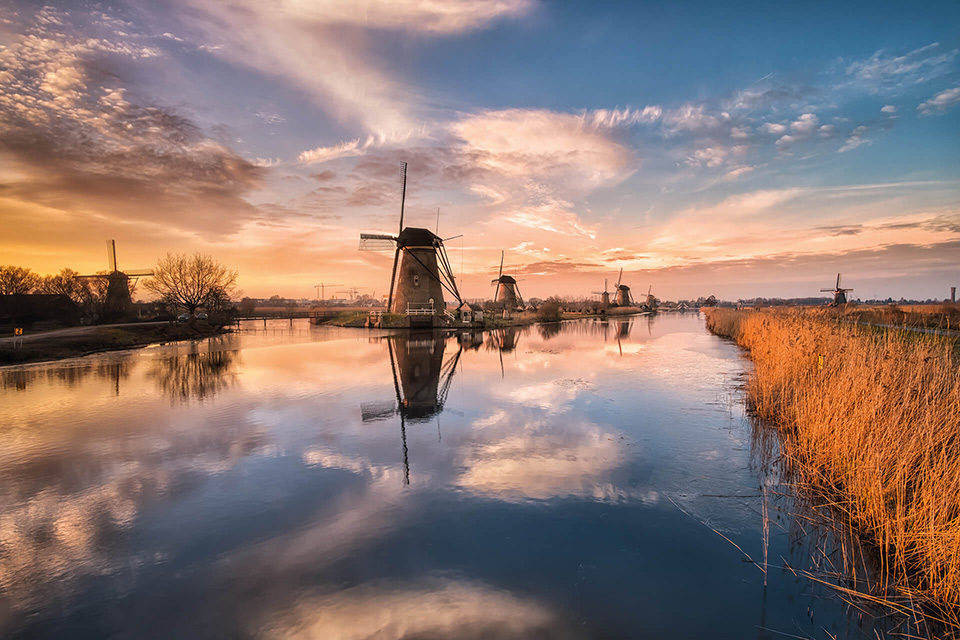
Filters: ND Hard Grad 0.6 & ND Soft Grad 0.6
Take the light, for example. It is completely different every day. This is caused by the cloud cover, position of the sun and time of year. I would bet that if you took a photo with the same composition every day, they would all differ in terms of light.
But how do you get control over the light? When are you in charge? To control the light, I use graduated neutral density filters. Here is a little more about them in this blog.
About filters
There are various brands on the market when it comes to filters. Some are very well known, such as Cokin, Ray Master, Format Hitech, 84.5mm and LEE.
Every brand has its own price. That is not always the case in everyday life, but it is with filters. The more expensive, the better the quality. If you look after them, they will last a lifetime. That makes the price more reasonable.
To take photos with graduated neutral density filters, you need several products. Here is a short list:
- Adapter ring(s); Note: This depends on the lens
- Filter holder(s); Available in various versions
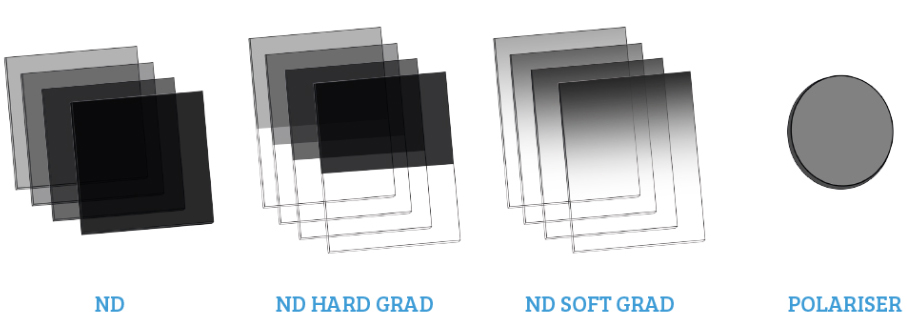
- Graduated neutral density filters; Think of ordinary ND filters, ND Hard Grad filters and ND Soft Grad filters. But also, for example, the LEE Big Stopper (10 stops)
- Polariser
- Cleaning cloths
ND Hard Grad or ND Soft Grad filter?
I regularly get asked when you should use an ND Hard Grad filter and when you should use a Soft Grad filter. I will give you a simple answer... Yes, there is also a difficult answer. But you will have to read that in my book (more information at the bottom of this blog).
When there is a straight horizon line (this straight line may be interrupted by a windmill or another small subject), use an ND Hard Grad filter. If you are in a hilly, rocky or mountainous landscape, use an ND Soft Grad filter.
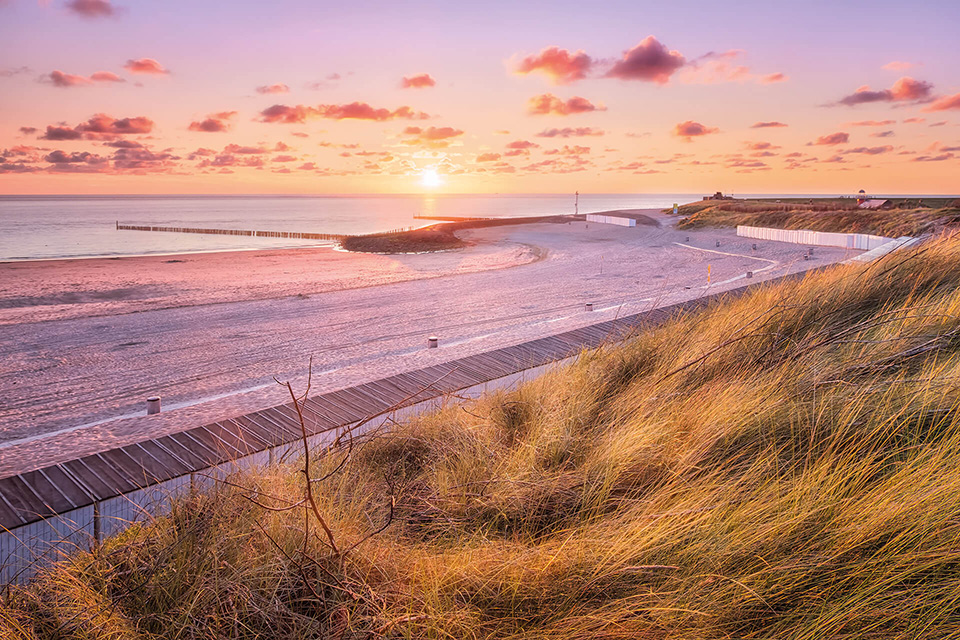
Filters: ND Hard Grad 0.6 & ND Soft Grad 0.6
Which filter do I need?
But how do I know which filter I need at any given moment? For example, when do I use an ND Hard Grad 0.6 and when an ND Hard Grad 0.9?
The answer is actually very simple. The difference in stops between the sky and the land determines which filter you need. Right? Almost... When you point the camera at the sky, you get a particular shutter speed.
Now do the same with the land. Let us say the difference is 3 stops. So the sky is 3 stops brighter than the land. We will now correct this with an ND Hard Grad 0.6 (2 stops) filter.
But why not use an ND Hard Grad 0.9 (3 stops)? Because that step is just a little too big. Give it a try.
Histogram
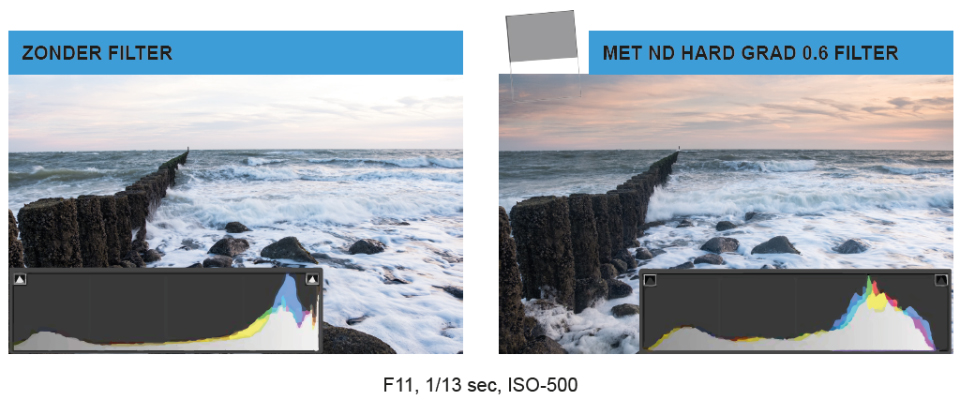
The histogram on your camera may be your filters' best friend. It lets you easily see whether you are using the right filter. If your histogram is too far to the right, the sky is probably still too bright.
If it is too far to the left, you may be using the wrong filter because the whole image is becoming too dark.
Filters versus software
But can I not do this with software as well? In Adobe Lightroom, for example? Or Adobe Photoshop? Yes, definitely. You can get a long way with software. A long way? So not all the way?
In my view, no. A particular sparkle in the water, a beautiful glow on a building or on a stone foreground. You can certainly add this with software too, but in practice it does not quite match.
When you photograph with filters, you can achieve this. You are in charge of the light and make sure the light is balanced in the photo. If you do this properly, you capture that sparkle or glow in the photo as well.
After all, it is still photography. And you take landscape photos outdoors, after all. So the challenge is to make the perfect photo on location too, right? In my view, yes...

The Big Filter Book
I have written an entire book about filters. Would you like to learn more about working with filters? Are you ready to take the next step when it comes to taking landscape photos? Do you want to be in charge of the light?
My book may be useful to you. You can find more information here.
About the author
Sander Poppe (1984) is autodidact en landschapsfotograaf. Als geboren Zeeuw komt hij graag aan de kust. Maar niet alleen de zee fascineert, eigenlijk alles wat met water te maken heeft. Hij levert zijn foto's regelmatig aan diverse bedrijven en stichtingen.
You might also like
-
 Review: Benro geared head
by Martin van Rooij
-
 Which is best: a ball head or a 3-way head
by Nando Harmsen
-
 Setting up a ball head
by Nando Harmsen
-
 Long Exposures on the Opal Coast
by Nando Harmsen
-
 Review: Sirui L324F with KS-G3 geared tripod head
by Nando Harmsen
-
 Photo archive on an M.2 SSD drive
by Elja Trum
15 comments
-
 Karel Hilgers wrote on Saturday 21 October 2017 at 09:09 | reply
The reality is that only the polarizing filter cannot be recreated 100% in Photoshop (only the reflections). So all those graduated neutral density filters can, as long as the scene is within the dynamic range of your sensor. And that is very often the case nowadays.
Translated from Dutch.
The major downside of using physical filters is that you only get one chance to get it right. If you do it in Photoshop, you are much more flexible.
Just leave those filters behind in the analog era! -
 Sander wrote on Saturday 21 October 2017 at 09:39 | reply
Dear Karel, Everyone has their own opinion, of course. If you feel more comfortable doing it via Photoshop, I can only applaud that. I just don't agree with you about the dynamic range of the sensor. You will still have to blend then... But again, to each their own. I prefer doing it outside in the field... Regards, Sander
Translated from Dutch. -

 100
wrote on Saturday 21 October 2017 at 11:06
| reply
@Karel
Translated from Dutch.
Simulating a 6, 10 or 16-stop ND filter in Photoshop is also quite difficult, I would think. Think of blurring movement in water and sky, but also, for example, creating light trails from traffic or making people walking by disappear. So you already have quite a few things where filters can be useful in the digital age (dynamic range, removing reflections, using longer shutter speeds).
You can do a lot with Photoshop, especially if you merge multiple exposures, but that does not change the fact that filters have their specific applications and that, for the same applications, there are specific advantages and disadvantages to the chosen method.
By the way, you can also use Photoshop for photos taken with filters, so correcting/editing afterwards is just as possible as with photos taken without filters. So I don't see the major disadvantage you mention, certainly not with digital photography where you see the result directly on your camera, meaning correction and taking another photo are perfectly possible. In action photography, the moment is gone, but with landscapes you generally have enough time to take multiple photos. -
Karel Hilgers wrote on Saturday 21 October 2017 at 12:21 | reply
@100: in my opinion, the author was not talking about the filters you mention. I am only responding to the things mentioned in the article.
Translated from Dutch. -
100
wrote on Saturday 21 October 2017 at 15:14
| reply
@Karel
Translated from Dutch.
Misschien heb je er overheen gelezen, maar in het artikel staat letterlijk:
“Grijs(verloop)filters; Denk aan gewone ND filters, ND Hard Grad filters, ND Soft Grad filters. Maar ook aan bijvoorbeeld de LEE Big Stopper (10 stops)”
Een LEE Big Stopper is het soort filters waar ik iets over zei. Ik neem aan dat je het inhoudelijk met me eens bent dat degelijke filters niet of slechts beperkt te Photoshoppen zijn. -
Karel Hilgers wrote on Saturday 21 October 2017 at 18:42 | reply
I'm not overlooking anything. Did you see the examples? And the author's explanation of those examples? Have you seen an example anywhere of flowing water? Or day/night? Light trails? I haven't.
Translated from Dutch.
I do know that you can't imitate a 10-stop filter in Photoshop. But that's not what I'm saying either. -
Sander Poppe wrote on Saturday 21 October 2017 at 20:13 | reply
@karel: Thanks for your comments. Sorry for my late response. I was taking storm photos on the Zeeland coast... with filters, it wouldn't have worked without them. Just try blending splashing water above the horizon line
Translated from Dutch.
In any case, you can find examples in my latest book. I go into everything in more depth there. Photofacts allowed me to write a piece about filters and end it with my latest book. If you've read the whole piece, you'll understand that...
Thanks again for your comments and have a nice weekend. -
 geerjanssen
wrote on Tuesday 24 October 2017 at 11:15
| reply
Sometimes I wonder if painters in the 17th century also discussed each other's work like this?
Translated from Dutch. -
 Rob Gipman wrote on Tuesday 24 October 2017 at 13:48 | reply
Maybe a strange comment, but the HDR function in my 5d4 also has a neutral setting that perfectly combines light and dark by taking 3 photos without giving you an HDR look. Here is an example. The heath was totally dark in the backlight of the sunset.
Translated from Dutch. -
Sander Poppe wrote on Tuesday 24 October 2017 at 16:54 | reply
@Rob, I've heard of this before but have no experience with it myself. I also wouldn't dare say whether there is actually a difference between a RAW file photo with the HDR function from a 5D4 and a photo taken with a graduated neutral density filter with another camera... I'm actually quite curious about the difference...
Translated from Dutch. -
 Bas Meelker wrote on Tuesday 24 October 2017 at 19:43 | reply
Nice piece, Sander. Maybe a useful addition to the questions and answers above. In this blog I discuss (briefly and concisely) why filters in the field still have my preference over software solutions. Maybe it provides a bit more clarity.
Translated from Dutch.
@Rob: the HDR function in a 5DIV generates a JPG file as output. Do keep that in mind. Of course, that doesn't have to be a problem, but with a JPG you do lose about 30% of the information compared to a RAW file. Important to know if you still want to edit the photo afterwards.
Kind regards,
Bas Meelker -
Sander Poppe wrote on Tuesday 24 October 2017 at 21:53 | reply
So the HDR function of the 5D IV is still less than working with filters. 30% loss is quite a lot.
Translated from Dutch.
@Bas, thanks for the nice addition! Nice and clear blog, and of course this is also discussed extensively in my book -
Rob Gipman wrote on Tuesday 24 October 2017 at 22:02 | reply
Hi Bas thanks, I get that indeed, I hadn't completely understood that yet. I will definitely test it (if I have the time and location). I was mainly surprised by it, but now also know that I can do this automatically. For this photo I worked on a tripod and pressed the shutter myself each time for the fluorescent light. Obviously noticed movement in the eventual fluorescent light.
Translated from Dutch. -
 PvRFotografie
wrote on Wednesday 25 October 2017 at 07:22
| reply
I think it's an interesting piece, last year I saw a presentation by Ira Tiffen (from Tiffen filters, he's with Schneider now) He showed a number of examples of the difference between filters and effects in post-production.
Translated from Dutch.
I also regularly simulate filters in Photoshop, but since the beginning of this year I've been using real filters much more again. So I bought a few LEE ND and graduated filters. And soon I'll also have your books at home. -
Sander Poppe wrote on Wednesday 25 October 2017 at 08:28 | reply
Thank you Pieter. I hope you enjoy reading a lot
Translated from Dutch.
Have your say
Please note: Articles older than a week can only be commented on by signed-in visitors.Would you still like to comment? sign in or create a free account.
Become a better photographer every week
A practical photography tip in your inbox every week.
38,836 photography enthusiasts already receive the tips! More about the weekly mail. Or keep up to date via  Facebook.

Elja Trum
Photofacts; everything to do with photography!
Would you like to take better photos and keep up with what is happening in photography? Photofacts publishes articles that teach you something about photography — from a product announcement to a practical shooting tip or a look at a website. Photofacts covers photography every day and is a hobby project of Elja Trum's that got out of hand. The articles are written by a team of volunteer authors. If you would enjoy writing one or more articles for Photofacts, do get in touch.More about PhotofactsPhotofacts is made possible in part by
