

Macro with a crop sensor means more magnification
Monday 19 October 2026, 14:14 by Nando Harmsen | 1,043 views | 14 commentsThis article was translated from Dutch with the help of AI. Read the original.
Most macro lenses achieve 1:1 magnification. This means your subject is shown at the same size as it is in reality. Are you using a crop sensor? Then you get more magnification.
Macro lenses make it possible to show a small subject at its actual size. This is 1:1 magnification. If you use a camera with a crop sensor, you get even more magnification.
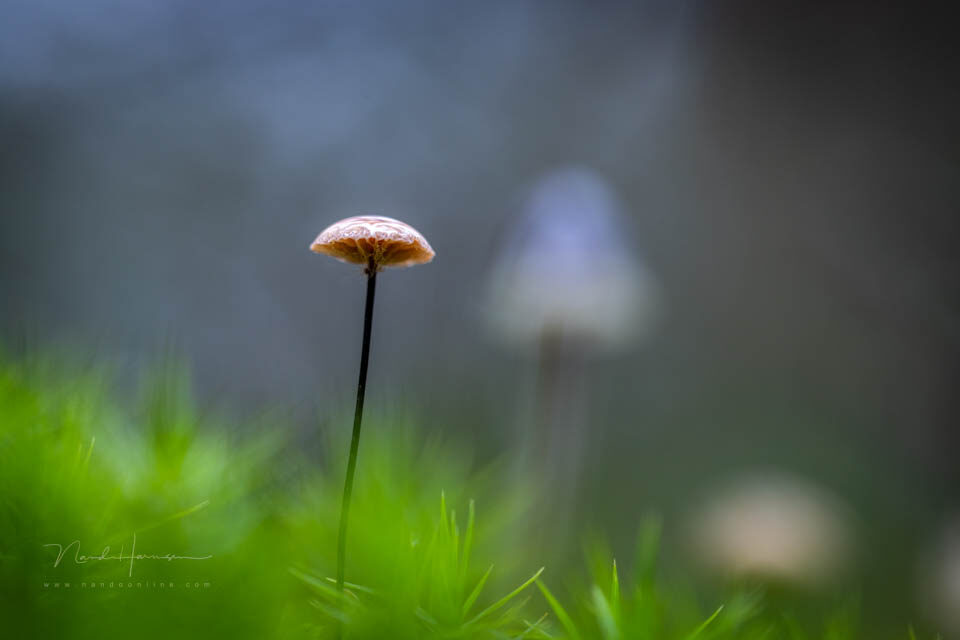
Horsehair parachute with a macro lens at 1:1 magnification - f/4, 1/30s, 400 ISO @ 100mm
We all know that a smaller sensor gives you a narrower angle of view. This makes the focal length appear longer. This is, of course, compared with a full-frame sensor.
With macro photography, you also have to deal with this crop factor. A 100mm lens gives you an image equivalent to a focal length on full-frame multiplied by the crop factor.
But with macro photography, the minimum focusing distance does not change. This means you 'zoom in' closer to your subject. So you get even more magnification. With an APS-C sensor, this is 1.5x or 1.6x.
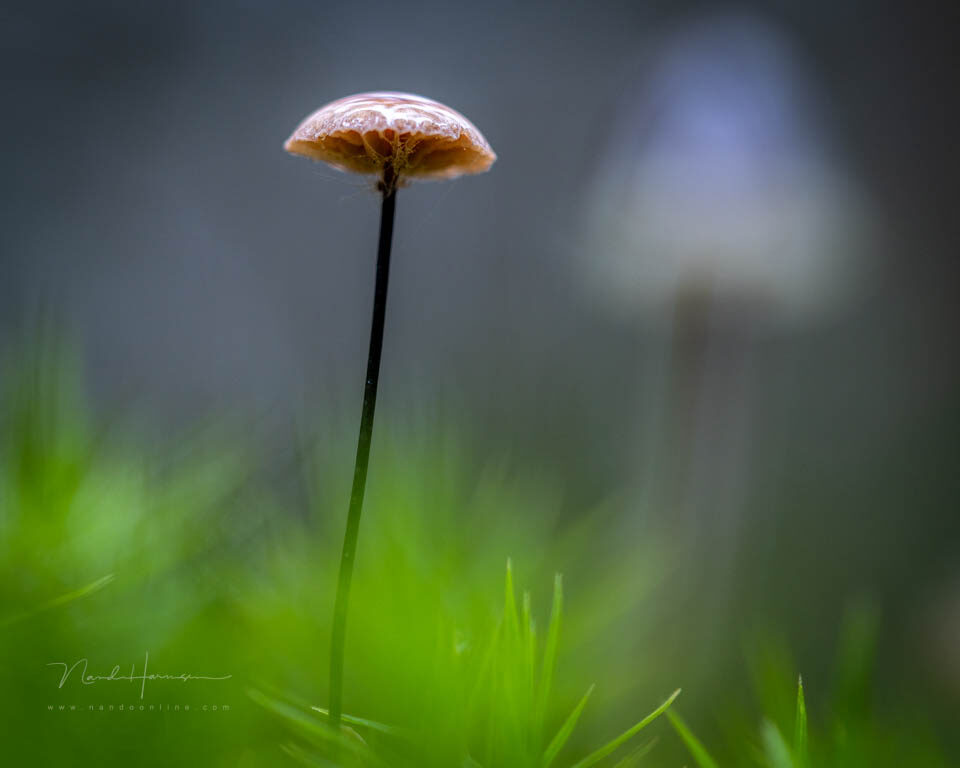
With a crop sensor, you achieve more magnification compared with a full-frame sensor. This is, of course, the same as cropping in post-processing.
If you use an M43 sensor, the crop factor is even 2x. This means that a normal macro lens with 1:1 magnification produces an image that is magnified twice as much.
This effect can be useful in macro photography. Of course, you do not always need that much magnification. But it is available to you, and that can be handy.
On the other hand, a macro lens that already allows 2:1 magnification gives you even more magnification with a crop sensor. Extremely high magnifications become possible this way.
Incidentally, if you crop a photo with 1:1 magnification further in post-processing, you achieve the same effect. The magnification also increases. It is the same as using a crop sensor.
About the author
Nando Harmsen has been photographing for more than 40 years. He specialises in wedding photography and landscape photography. Nando also gives talks, workshops, masterclasses and photo trips, and regularly reviews new and interesting equipment.
You might also like
-
 Converting focal length to full-frame is pointless
by Nando Harmsen
-
 Why the crop factor also affects depth of field
by Nando Harmsen
-
Which is better, cropping a full-frame image or using a crop sensor?
by Nando Harmsen
-
 The opposite of cropping
by Nando Harmsen
-
 What is focal length?
by Michelle Peeters
-
 Review: Canon RF 100mm f/2.8L IS macro lens
by Nando Harmsen
14 comments
-
 Paul wrote on Tuesday 20 October 2026 at 14:10 | reply
This doesn't seem entirely correct to me: the magnification is determined by the lens, independently of the sensor (M=b/v, to a good approximation).
Translated from Dutch.
With a crop sensor, you only see part of the image that you get with a full-frame sensor. It then seems as if you are magnifying more, but that has nothing to do with the image the lens projects onto the sensor plane -

 Nando
wrote on Tuesday 20 October 2026 at 14:36
| reply
You can approach it very theoretically, but ultimately it is the end result that matters.
Translated from Dutch.
Take a 100mm macro lens with 1:1 magnification on a 25-megapixel full-frame camera, and then take the photo with the same lens using a 25-megapixel APS-C camera.
The subject in the photo taken with the APS-C camera will be 1.6 times as large. So a greater magnification. -
 Mac wrote on Wednesday 21 October 2026 at 07:58
| reply
@nando,
Translated from Dutch.
Paul is right. the lens determines the magnification, not the sensor. If you were to photograph with FF, and crop it, you would get the same image as with a crop sensor.
Then the display is larger, but not the magnification.
just like when you print a photo, whether you print A4 or A2, the print is larger, but there is no enlargement of the original photo. -
Nando
wrote on Wednesday 21 October 2026 at 09:27
| reply
Read my response to Paul below again. Assuming that both have a 25-megapixel sensor, a crop from a full-frame, to get the same magnification as with the APS-C, will produce less resolution.
Translated from Dutch.
It's that simple.
Less resolution means that with the APS-C I can have a larger enlargement made than with the cropped full-frame photo.
The story you and Paul are telling does apply if I compare a 25-megapixel APS-C sensor with a cropped 45-megapixel full-frame sensor. In both cases you then have a final result with the same magnification and (and this is important) resolution. -
Mac wrote on Wednesday 21 October 2026 at 09:59
| reply
Yes, you get more in the photo, yes you get magnification through the sensor. but the lens still only provides 1:1 magnification. That is a physical property of the lens, which you cannot change by using a different sensor.
Translated from Dutch. -
-
Paul wrote on Tuesday 20 October 2026 at 16:54 | reply
It wasn't about the theoretical approach for me... only about the clarity regarding how it works.
Translated from Dutch. -
Nando
wrote on Wednesday 21 October 2026 at 09:19
| reply
I suggest that you take the photos yourself that I described in my comment. You will see that the image is more magnified.
Translated from Dutch.
That is the practice.
And indeed, it is caused by a smaller surface area of the sensor. That is the theory behind it, the reason. But ultimately, it is about what and how you have it in the photo, the practice.
Of course, you achieve the same magnification with a crop from a full-frame. But then I no longer have those 25 megapixels. I only have about 18 left. I have a lower resolution. -
Paul wrote on Wednesday 21 October 2026 at 10:23 | reply
Totally agree that with a 25 MP APS-C sensor you have a higher resolution than with a 1.5 x crop from a 25 MP FF sensor.
Translated from Dutch.
My comment was in response to the sentence "On the other hand, a macro lens that already makes a 2:1 magnification possible magnifies even more with a crop sensor": it is not the lens that magnifies more with a crop sensor, the resulting magnification in that case comes from the crop you make. With the same pixel density of the sensor, it makes no difference whether you make that crop from an image from an FF or an APS-C camera -
-
Paul wrote on Wednesday 21 October 2026 at 12:01 | reply
@nando: of course I understand the gist of your story -I've worked with enough bellows- but to clarify how this all works I only wanted to sharpen the wording a little.
Translated from Dutch. -
Nando
wrote on Wednesday 21 October 2026 at 12:56
| reply
Bellows... you don't see those very often anymore.
Translated from Dutch.
In any case, that has little to do with sensor format and the size of the image on that sensor.
In any case... a bellows is still quite an interesting alternative to a set of extension tubes. Also in combination with a macro lens... -
Paul wrote on Wednesday 21 October 2026 at 14:02 | reply
"that, in turn, has little to do with .....the size of the image on that sensor".... here too I don't entirely agree with you: bellows were used in macro photography to obtain a greater image distance and thus (with the same focal length and object distance) a larger image on the image plane).
Translated from Dutch. -
Nando
wrote on Wednesday 21 October 2026 at 14:19
| reply
That's right, I know that. I've used them often enough in the past too. But in this article we're talking about sensor size, right? A bellows is nothing more than a variable extension tube for changing magnification on the film/sensor you're using.
Translated from Dutch.
Have your say
Please note: Articles older than a week can only be commented on by signed-in visitors.Would you still like to comment? sign in or create a free account.
Become a better photographer every week
A practical photography tip in your inbox every week.
38,836 photography enthusiasts already receive the tips! More about the weekly mail. Or keep up to date via  Facebook.

Elja Trum
Photofacts; everything to do with photography!
Would you like to take better photos and keep up with what is happening in photography? Photofacts publishes articles that teach you something about photography — from a product announcement to a practical shooting tip or a look at a website. Photofacts covers photography every day and is a hobby project of Elja Trum's that got out of hand. The articles are written by a team of volunteer authors. If you would enjoy writing one or more articles for Photofacts, do get in touch.More about PhotofactsPhotofacts is made possible in part by
